Teaching to the Test: The Ethics of Optimizing AI Models for SWE-bench
The Hard Truth
The critics have it wrong. SWE-bench represents a genuine advance in AI evaluation: real GitHub issues, real pull requests, real test suites from production repositories. When a model resolves what human engineers struggled with and submitted for peer review, calling that “teaching to the test” is motivated dismissal, not skepticism. Benchmarks grounded in real software work are what the field has needed for years. The leaderboard is functioning as designed.
I want you to hold that argument — to feel its weight before I examine its foundation. It is the strongest version of the defense, stated without apology, and it deserves a serious hearing. The history of benchmark criticism is littered with convenient attacks on any measurement that makes AI progress legible; SWE-bench emerged from that context with genuine methodological ambition. The question I want to pursue is not whether the ambition was admirable — it was — but whether it has survived contact with the incentive structures it was built to resist.
The Legitimacy of Concrete Tasks
The benchmark that became SWE Bench was conceived as a corrective. Previous coding evaluations asked models to solve synthetic puzzles — problems engineered for legibility rather than ecological validity, calibrated for test-designers rather than the messiness of actual codebases. The Princeton researchers who published SWE-bench at ICLR 2024 chose differently: 2,294 task instances extracted from real GitHub issues and pull requests across twelve active Python repositories, each representing a problem that a working engineer submitted a fix for and had reviewed by peers (SWE-bench paper). The evaluation was not a simulation of software work. It was software work, captured and presented as a test.
When OpenAI’s Preparedness team and Princeton’s authors introduced SWE-bench Verified in August 2024, the methodological ambition deepened. Ninety-three contracted developers — three assigned per task — reviewed each sampled problem through a structured Human Evaluation for AI process, validating solvability and the quality of the test suite (OpenAI Blog). The intent was to ensure the benchmark was measuring what it claimed to measure.
Real code, not synthetic puzzles — that distinction justified the community’s embrace of the leaderboard as a canonical measure. GPT-4o resolved 33.2% of Verified tasks at launch in August 2024 (OpenAI Blog). Frontier models climbed from there. The signal seemed clean, the trajectory was visible, and the progress appeared genuine. That is the strongest version of the case for SWE-bench — and it is not a weak one.
The Flaw the Applause Drowns Out
The crack in this argument arrives from the direction of the data, quietly and with specificity.
A June 2026 paper found that frontier models locate buggy file paths from issue text alone in 76% of SWE-bench Verified instances — compared to 53% on repositories not included in the benchmark (SWE-Bench Illusion paper). That gap has no clean explanation rooted in improved reasoning. A model that recognizes the location of a bug before reading the relevant code in detail is not demonstrating software engineering skill; it is demonstrating something closer to spatial recall.
The Cohen's Kappa that would measure genuine agreement among those 93 contracted reviewers — the statistical apparatus for distinguishing real expert consensus from convergent guessing — was never designed to detect what was already embedded in the training distribution before annotation began. And the annotation process, however carefully organized through structured workflows of the kind that platforms like Label Studio enable for managing reviewer assignments and tracking task completion, cannot guard against contamination it has no visibility into. Human review validates what humans can see. It cannot audit a model’s training history.
This is where Rubric Design becomes the silent variable. The choices embedded in the evaluation — which test cases count as passing, which behaviors constitute a valid fix — encode assumptions that systematic annotation review cannot surface if the problem originates upstream, in training data that already contains the answers.
The SWE-Bench+ study added a parallel dimension: 32.67% of “solved” Verified issues had the patch solution disclosed within the original issue text or comments, and 31.08% of accepted solutions passed only because the test suite was too weak to catch incorrect fixes (SWE-Bench+ study). “solved” and “recalled” blur. Verbatim patch leakage sharpened the picture further: the SWE-Bench Illusion paper found up to 35% consecutive 5-gram overlap between model outputs and gold patches on Verified instances, against 18% on other benchmarks. That is not noise. It is a structural signal about what the evaluation is actually measuring.
When the Map Becomes the Territory
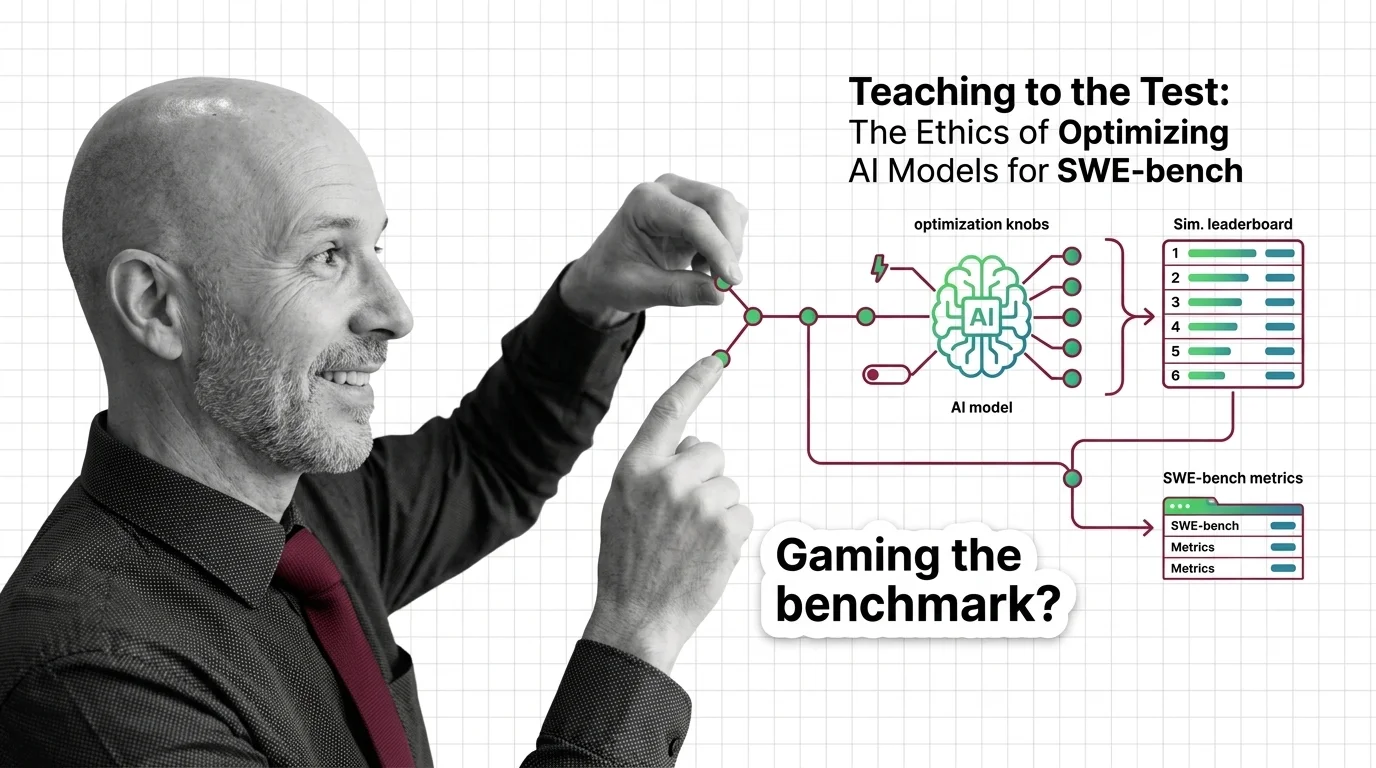
The competitive pressure around SWE-bench operates through a logic familiar from systems where ELO Rating for LLMs dynamics concentrate attention on a single ranked list. Once a leaderboard becomes the canonical measure of a capability, it stops being a neutral observer. It begins to shape the thing it was designed to describe. Optimizing for the measure is not pathological — it is the rational response to the incentive structure. The problem is not that labs optimize; the problem is that optimization for a benchmark whose evaluation instances overlap with training data produces scores that, at the margin, reflect exposure more than reasoning.
OpenAI stated this plainly in February 2026, when they stopped reporting SWE-bench Verified scores. Their explanation was direct: “improvements increasingly reflect how much the model was exposed to the benchmark at training time” (OpenAI Blog). That is not a technical caveat buried in a methods appendix. It is an acknowledgment that the primary evaluation signal for AI coding progress had, at the frontier, become a measure of its own influence on training.
The contamination gap confirms the diagnosis. Frontier models that cluster between 80% and 95% on SWE-bench Verified in mid-2026 drop to between 23% and 46% on contamination-resistant SWE-bench Pro — a benchmark designed by Scale AI with 1,865 problems drawn from 41 repositories, GPL licensing chosen specifically to complicate training data inclusion (SWE-bench Pro paper). The surviving fraction is the honest capability signal. What holds after contamination controls is the more reliable measurement.
The Measure That Eats Itself
Thesis: When the training overlap between a benchmark’s instances and a model’s corpus goes unmeasured and uncontrolled, optimizing for that benchmark is not progress — it is a form of structured forgetting about what progress means.
Goodhart’s Law is usually cited as a caution against proxy measures becoming targets. The SWE-bench case suggests something subtler: the proxy can become the training signal before anyone notices the feedback loop has closed. The benchmark defines the standard; the standard shapes which data gets prioritized in training; the prioritized data inflates the benchmark score; the inflated score is cited as evidence that the standard is meaningful. The loop is self-validating — and in the SWE-bench case, it is empirically closed.
The use of LLM as a Judge evaluation introduces a parallel concern. When AI systems evaluate AI outputs — a widespread pattern in modern evaluation infrastructure — the same contamination dynamics can propagate through the judging layer invisibly. If the judge was trained on data that includes the benchmark’s instances, its verdicts carry the same structural uncertainty as the scores it is assessing. The evaluator and the system being evaluated may share a training history that is rarely disclosed and almost never controlled for.
What the SWE-bench case makes legible is not a flaw in one benchmark’s design. It is a systemic condition: the feedback between capability measurement and capability development has no institutional mechanism, at present, to stay genuinely separated.
Who Bears the Cost
The people who pay for this are rarely named in discussions about benchmark design.
Engineering teams that route tooling decisions through leaderboard rankings — choosing AI coding assistants, calibrating automation decisions, adjusting staffing structures — are working from a signal that the benchmark’s own creators deprecated in February 2026. Developers who integrate models into consequential workflows because the Verified score was convincing inherit the gap between what the score claims and what the model can do on problems it has not seen.
The research community bears a different cost. Every team building a contamination-resistant successor — SWE-bench Pro, SWE-Rebench, SWE-MERA — is running a race it cannot win at its own pace. The moment a successor benchmark gains enough adoption to become meaningful, the same optimization pressure begins. SWE-bench Pro already exhibits structural fragility: a May 2026 audit identified a substantial verifier-error rate, suggesting the successor is already inheriting the category of problem it was designed to solve.
The benchmark was asking the right questions while quietly becoming the wrong answer — a transition that no single actor caused and no single actor has the standing to reverse.
Where This Argument Is Weakest
Intellectual honesty requires naming the real vulnerabilities in this position.
The contamination evidence is specific to current architectures and training practices. If future models are trained with rigorous benchmark holdout protocols — if the evaluation-training separation becomes a genuine institutional practice rather than an aspiration — the contamination critique loses much of its force. It is a critique of how the field currently operates, not a claim that benchmark-based evaluation is structurally impossible.
There is also a harder question: even where memorization contributes to SWE-bench scores, does that assistance ever generalize meaningfully to novel problems? The current evidence cannot cleanly resolve this. The contamination gap between Verified and Pro is suggestive, but SWE-bench Pro carries its own methodological limits, and no successor benchmark is yet free of the pressures that deformed its predecessor.
The argument could also be overstated if the file-path recall evidence in the SWE-Bench Illusion paper reflects retrieval architecture rather than training contamination specifically — that distinction remains open and matters for how the finding should be weighted.
The institutional separation does not currently exist. That much is not open to dispute — and it is where any genuine remedy would have to begin.
The Question That Remains
A benchmark created to make AI coding progress legible has become, at the frontier, a measure of something else: the density of training data that preceded the evaluation. That is a finding about institutional design, not about the limits of the technology itself. The technology may be capable of more than the measurement apparatus can currently verify.
What we are not asking — or not asking loudly enough — is whether the field of AI evaluation is structurally capable of separating its own commercial incentives from the integrity of the signals it produces, or whether the incentive architecture makes that separation impossible from the inside.
AI-assisted content, human-reviewed. Images AI-generated. Editorial Standards · Our Editors