Target, Temporal, and Preprocessing Leakage: Why Data Leakage Evades Detection
ELI5
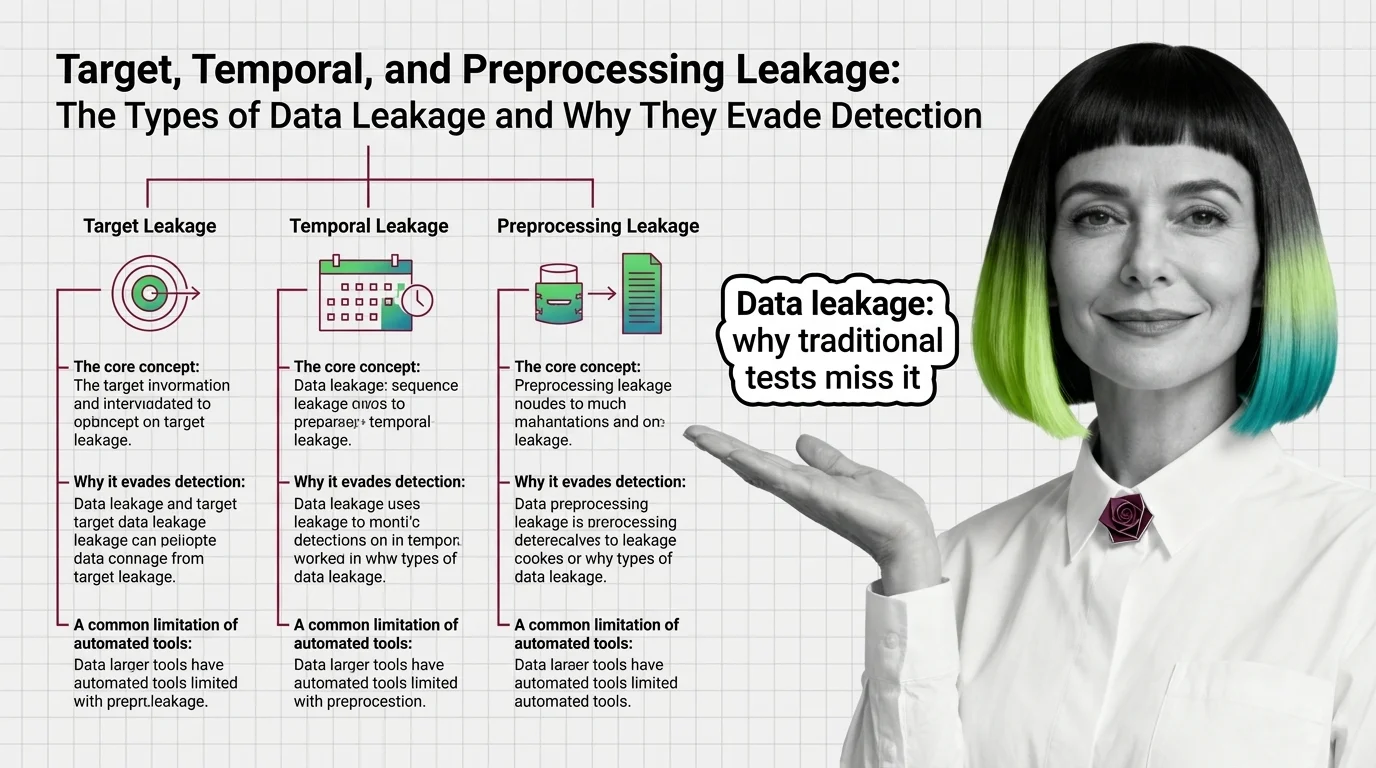
Data leakage happens when a model trains on information it won’t have when making real predictions. The score looks brilliant in testing, then collapses in the real world. The leaked clue was the answer, hiding in plain sight.
A fraud model posts a 0.99 AUC on held-out data. The team celebrates, then watches it fail the moment it meets live transactions. The instinct is to blame Overfitting — the model memorized the training set. But the training and test scores were both excellent, which is exactly what overfitting does not look like. Something leaked.
Three Routes the Answer Takes Into Your Training Set
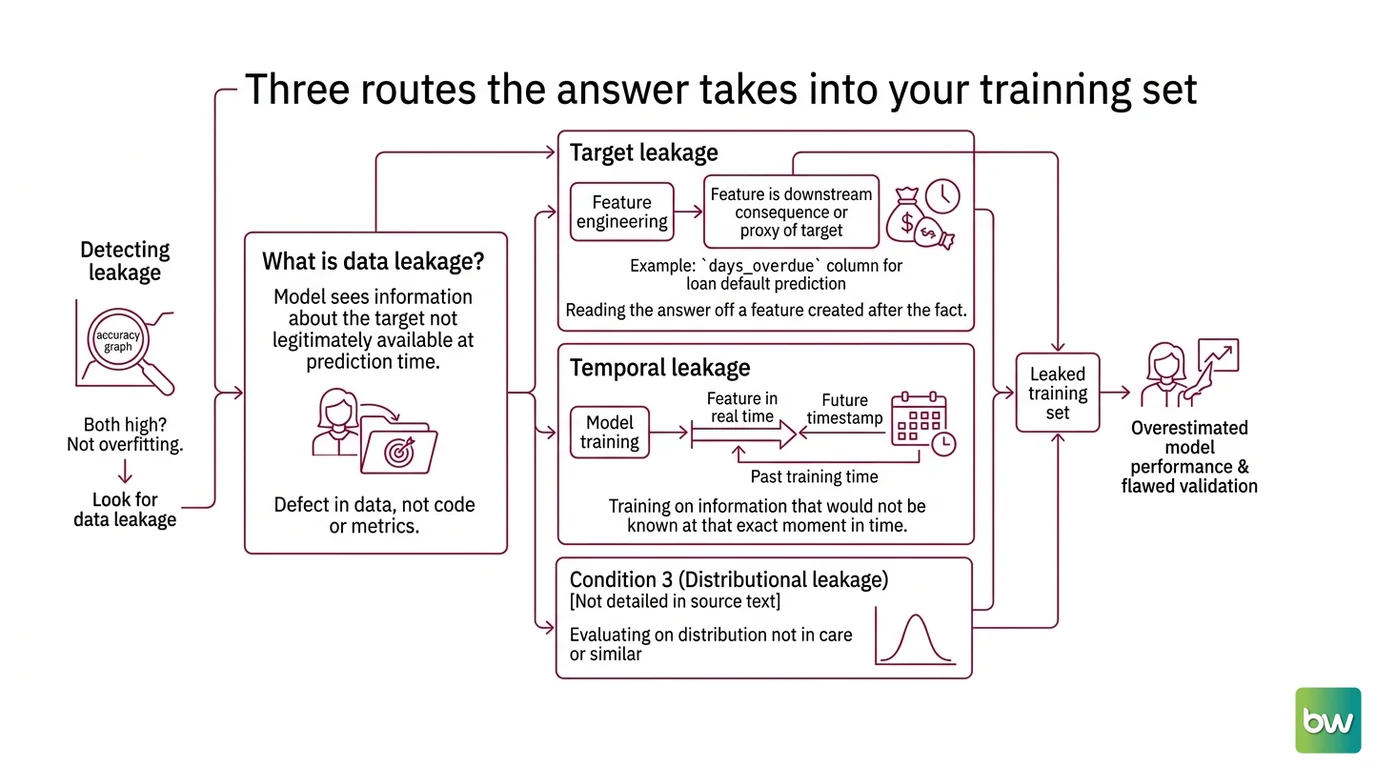
Overfitting leaves a fingerprint: training accuracy climbs while test accuracy stalls. Here both were high, so the obvious suspect has an alibi.
Not overfitting. Leakage.
Data Leakage is not a defect in the usual sense. The code runs, the metrics compute, nothing throws an error. The flaw lives in what the model was allowed to see: information about the Ground Truth target that would not legitimately be available at the instant of prediction. The defect is old enough to carry a canonical name — one of the top ten data mining mistakes, per Kaufman et al., who defined it as the introduction of information about the prediction target that should not be available at mining time.
What are the main types of data leakage in machine learning?
Eight distinct types of leakage have been catalogued and grouped under three conditions a valid evaluation must satisfy: a clean separation between training and test data, features that are all legitimately available, and a test set drawn from the distribution you actually care about. This is the most systematic survey of the problem to date (Kapoor & Narayanan, 2023). Three failure modes map onto those conditions cleanly enough to organize everything that follows. They are an editorial grouping over the published taxonomies, not an official three-way split, but each names a mechanism that behaves differently.
The first is
Target Leakage: a feature that is a proxy for, or a downstream consequence of, the thing you are trying to predict. A days_overdue column predicting loan default is the textbook case; the value only exists because the loan already went bad. The model isn’t learning to predict the future. It’s reading the answer off a feature engineered after the fact, often slipped in quietly during
Feature Engineering.
The second is Temporal Leakage: training on information that, in real time, arrives after the prediction point. A churn model that uses next month’s account activity to predict this month’s churn has folded the future into the past. The split looks fine row by row; the timeline is what’s broken.
The third is preprocessing leakage: statistics computed across the whole dataset before the split, so the test rows quietly shape the transformation applied to training. The features themselves may be perfectly legitimate. The contamination rides in through the Data Preprocessing step.
What is the difference between target leakage and train-test contamination?
These two get conflated constantly, and the confusion matters because the fixes are different.
Target leakage corrupts the feature set. A feature is an illegitimate proxy for the target — present in your table, absent at real prediction time. It would mislead the model even with a flawless Train Test Split, because the problem is the column, not the partition.
Train-test contamination corrupts the boundary. Information from the test set leaks into training through three structural channels: rows that overlap both splits, preprocessing fit on the combined data, or duplicate records that land on opposite sides of the divide. The features can be entirely legitimate; the split is simply porous.
Target leakage poisons the ingredients. Contamination poisons the wall between train and test. One asks “should this feature exist at prediction time?”; the other asks “did my test set stay genuinely unseen?”
Why the Numbers Lie
The unsettling part isn’t that leakage inflates a score. It’s that the instrument you would reach for to catch an inflated score is often the very thing leakage has already compromised.
Why is data leakage so hard to detect in machine learning pipelines?
Cross Validation is the standard guard against optimistic results. Its protection rests on a single assumption: each fold’s held-out portion must stay untouched while the model and its preprocessing are fit. Preprocessing leakage breaks that assumption silently. Fit a scaler, an imputer, a PCA, or a feature selector on the full dataset before cross-validating, and every fold’s “held-out” rows have already shaped the transformation — their means, their variances, the columns that survived selection. The held-out data was never truly held out.
Fit transforms on the training split only, transform the test split, and never fit on the test data — the
Scikit Learn documentation states the rule without hedging. The guard it prescribes is a Pipeline evaluated inside cross-validation, so each fold refits its preprocessing from scratch on training data alone. Skip that, and the contamination is invisible, because the metric meant to expose it is itself contaminated.
The most dangerous leak throws no error and raises no warning. It just hands you a better number, which is the one result nobody thinks to question.
What are the limitations of automated data leakage detection tools?
Tooling exists, and it helps. Deepchecks ships dedicated checks for index train-test leakage, date overlap, date duplicates, and train-test sample mixing. These catch contamination with a structural signature: identifiers that bleed across the split, timestamps that overlap, records duplicated on both sides. As of 2026, its last release was version 0.19.1 in December 2024, per its GitHub repository — stable and usable, but not actively shipping new checks, so treat it as a steady tool rather than a moving target.
What no static check can do is judge whether a feature is legitimate. A tool has no way to know that days_overdue is downstream of defaulted; that requires domain knowledge about when each value becomes available in the real process. Nor can automation verify that the test set matches the distribution you’ll actually face once the model is live. Structural leaks have a fingerprint a machine can match. Feature legitimacy and distribution match are human judgments, and they stay that way.
What This Predicts About Your Next 0.99 AUC
Once you see leakage as corrupted measurement rather than a bad model, the symptoms become diagnosable. Each route predicts a different tell:
- If a cross-validation score sits far above what the problem should physically allow, suspect a feature that encodes the answer before you congratulate the model.
- If accuracy drops sharply the instant the model meets live data, look for temporal leakage — a feature whose value simply wasn’t available yet at the moment of prediction.
- If the score moves when you relocate preprocessing inside the cross-validation loop, you’ve found contamination, not random noise.
The discipline reduces to one question asked of every feature: would I have this value, with this exact content, at the instant I make the prediction? Kaufman et al.’s remedy is learn-predict separation — build the model only from data demonstrably available before the prediction moment, and manage the data flow so that boundary is never crossed.
Rule of thumb: If a feature feels too predictive, it usually is. Trace where its value comes from, and when, before you trust it.
When it breaks: Even disciplined separation fails when the data’s collection process is itself uncontrolled. When you cannot establish when each value was recorded, no split or pipeline can certify a feature’s legitimacy, and detection falls back to manual, error-prone domain auditing — exactly the step that doesn’t scale.
Which Leaks Actually Move the Needle
A textbook treats every leak as an equal threat. One 2026 preprint, analyzing more than 2,000 benchmark datasets, suggests they are not equally dangerous (Roth 2026). Fitting preprocessing on the full dataset — the canonical sin every tutorial warns about — barely moved results at realistic dataset sizes, while leakage from feature selection on the whole dataset dominated, inflating accuracy across the large majority of datasets tested. Leakage tied to temporal boundaries stayed invisible under random cross-validation and surfaced only when the evaluation respected time order.
Hold that result loosely: it is a single-author preprint, not yet peer-reviewed, and it cuts against long-standing advice. But it sharpens the question from “is there leakage?” to “which leak, and how far does it actually bend the result?” — and that is a more useful thing to ask of a suspicious score.
The Data Says
Leakage is the rare failure that makes a model look better, not worse, which is precisely why it survives review. The three routes — a feature that encodes the answer, information borrowed from the future, and statistics shared across the split — all defeat cross-validation because they corrupt the very measurement built to catch them. Kapoor & Narayanan traced the pattern through at least 294 papers across 17 scientific fields; the count is large because the symptom is a good score, and good scores rarely get audited.
AI-assisted content, human-reviewed. Images AI-generated. Editorial Standards · Our Editors