Storage Backends, Data Lineage, and Hashing: The Core Components of a Data Versioning System
ELI5
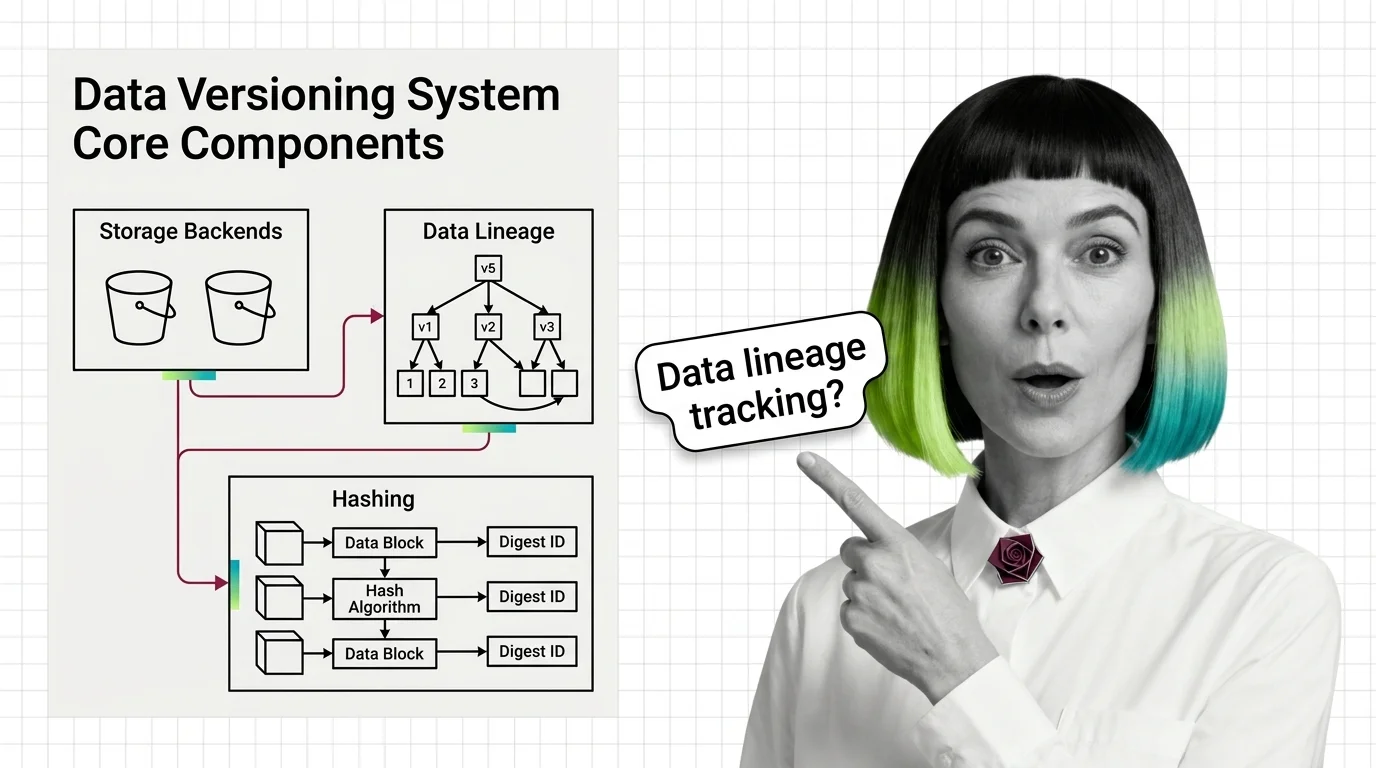
A data versioning system snapshots datasets the way Git snapshots code. Three parts make it work: a hash that fingerprints content, a storage backend that holds the bytes, and lineage that records which data shaped which model.
Change one label in a 200,000-row dataset, retrain, and accuracy drops two points. With code, you would open the diff and see the line that did it. The dataset, though, lives in a folder called data_final_v2_REAL/, and nobody can say what changed or when. Closing that gap is the job of
Data Versioning — and the instinct to reach for “Git, but for big files” is the right one pointed at the wrong mechanism.
Three Parts That Turn a Folder Into a Commit
Git works because text has natural seams. It compares files line by line and stores only the lines that moved. A dataset has no such seams — a Parquet file or a folder of images is an opaque block of bytes, and a one-byte edit can mean a flipped label or nothing at all. So a versioning system cannot copy Git’s line-diff trick. It solves a different problem with a different set of moving parts.
What are the main components of a data versioning system?
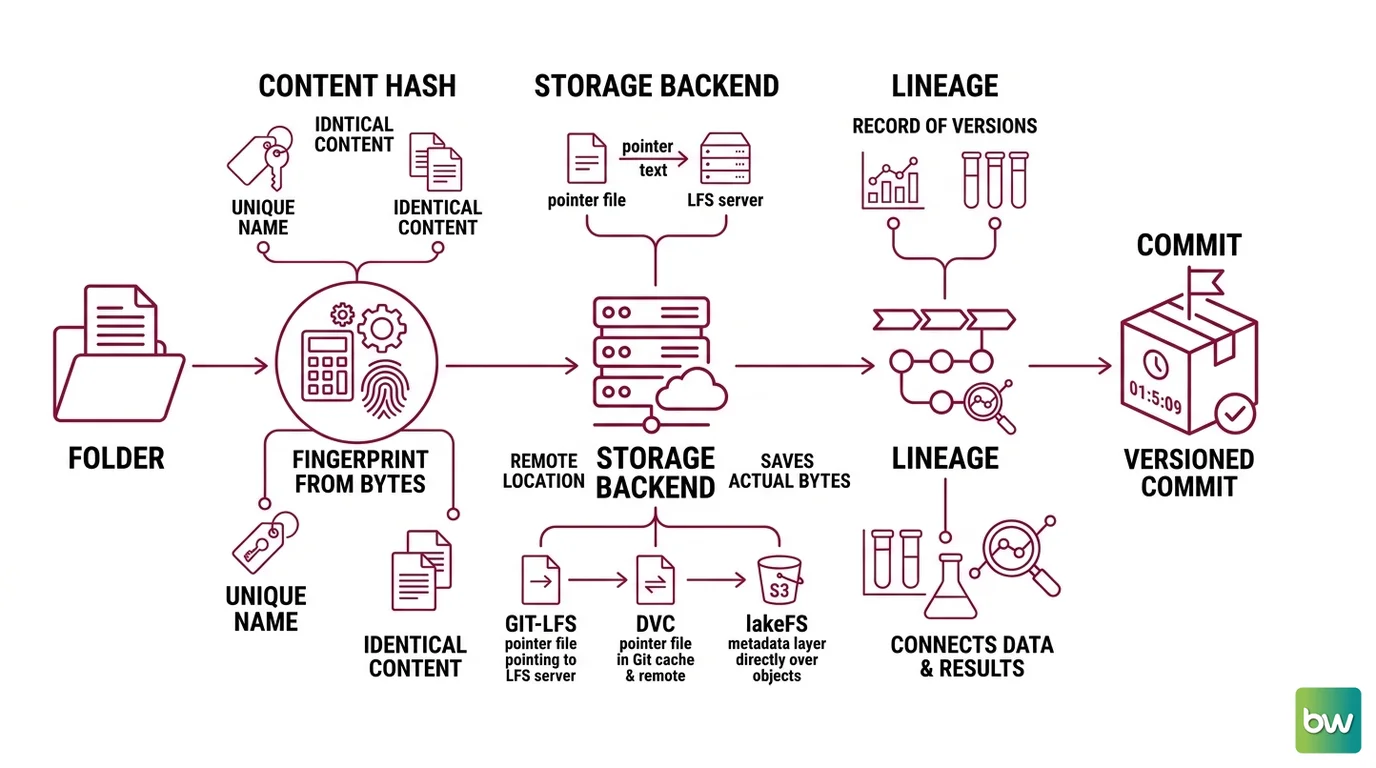
Strip any of these tools down and you find the same three components doing the work.
The first is a content hash — a fixed-length fingerprint computed from the bytes of a file. This is the heart of
Content Addressable Storage: instead of naming an object by where it sits (/data/train.parquet), the system names it by what it contains (a3f9c1…). Identical content produces an identical hash and is stored once; change a single byte and the hash changes completely, which the system reads as a brand-new object. The filename can lie about which version you have. The hash cannot.
The second is a storage backend — the place the actual bytes live. Source control keeps only a tiny pointer file (the hash plus some metadata) in your Git repository; the heavy data sits elsewhere. Git LFS replaces large files with text pointers and pushes their contents to a remote LFS server, a pattern confirmed by Git LFS. DVC commits the same kind of pointer to Git and stores the data in a cache or remote, an approach documented in DVC Docs. lakeFS goes further and layers Git-like semantics directly over object storage such as S3, Azure Blob, or Google Cloud Storage, so a branch or commit is a metadata operation that copies no data at all, per lakeFS Docs.
The third is lineage — the record of which data version connects to which experiment, model, and result. The first two parts let you reproduce a dataset. The third tells you why you would want that specific one.
Lineage: The Receipt That Connects Data to a Model
Hashing and storage solve reproducibility in the narrow sense: given a hash, you can rebuild the exact bytes. Lineage solves it in the sense that actually matters to a working team — given a model, you can walk backward to the data that produced it. This is the component most people skip, and the one that turns a pile of snapshots into an audit trail.
What is data lineage tracking and how does it relate to data versioning?
Data lineage tracking records the path a dataset travels: which raw source it came from, which transformations ran against it, and which model training run consumed which version. Versioning gives every stage along that path a stable identity — the content hash — so lineage is not a vague note in a README but a chain of fingerprints you can verify.
The relationship is directional. Versioning is the noun; lineage is the verb that strings the nouns together. A version answers “what was the data?” Lineage answers “where did it come from and where did it go?” Together they make a model’s result a reproducible claim rather than a story.
This is where versioning stops being bookkeeping and starts protecting you. Lineage is how you trace a Dataset Bias back to the cleaning step that introduced it, instead of discovering it after the model is making decisions. It is the backbone of reproducible MLOps: when an experiment misbehaves, the lineage graph lets you replay it against the precise inputs it ran on, not an approximation of them.
Not a logbook. A causal map.
What You Need to Understand Before the Tools
The tools are downstream of two ideas. Grasp those, and DVC, lakeFS, and Git LFS stop looking like three competing products and start looking like three packagings of the same mechanism. Skip them, and you will fight the tooling without knowing why it resists you.
What should you understand before learning data versioning tools?
Two concepts carry most of the weight. The first is content addressing — the move from “name a file by its location” to “name it by its hash.” Once that clicks, deduplication, immutability, and integrity checking stop being features and become consequences of one design choice. The second is the pointer/payload split: your version-control history holds lightweight pointers, while the bulky data lives in a separate backend. Almost every confusion about these tools traces back to forgetting which half you are looking at.
It also helps to know what a dataset version actually protects against, because the threats are quiet ones. A version is the difference between catching and missing: a botched train/test split that leaks the answer ( Data Leakage); a Cross Validation fold that accidentally shares rows across partitions; a resampling pass that silently rebalances Class Imbalance; or slow Data Drift pushing production inputs away from the distribution you trained on. Each of these changes the data without changing a single line of code. Without versioning, the diff is invisible.
Do you need to know git before using DVC or lakeFS?
You need the Git mental model, not Git mastery. Both tools borrow Git’s vocabulary — commit, branch, merge, revert, tag — because they borrow Git’s underlying idea: an immutable, content-addressed history of states. If you understand that a commit is a snapshot keyed by a hash and that a branch is just a movable pointer to one, you already understand most of how these systems behave.
The practical overlap differs by tool. DVC sits directly on top of Git and commits its pointer files into your existing repository, so day-to-day work runs through real Git commands; comfort with git add, commit, and checkout transfers immediately. lakeFS reproduces the same operations as metadata over object storage and exposes them through its own interface, so the concepts carry over even though you are not literally running Git. Knowing Git is leverage, not a gate.
One historical note matters here, because older write-ups frame these as rival companies. They are no longer competitors: lakeFS (Treeverse) acquired DVC from Iterative.ai on November 18, 2025, and DVC remains fully open source under the same license, according to lakeFS Blog. The current positioning treats DVC as the lighter option for smaller datasets and individual data scientists, with lakeFS aimed at large-scale object storage — two points on one spectrum, not two sides of a fight.
Compatibility and ownership notes:
- DVC + lakeFS: lakeFS (Treeverse) acquired DVC from Iterative.ai on November 18, 2025. DVC stays fully open source; treat the two as complementary (DVC for smaller datasets, lakeFS for large-scale object storage), not rival tools (lakeFS Blog).
- Git LFS: the current 3.7.x line dropped prebuilt packages for older distributions (Debian 10, RHEL/CentOS 7) and now needs Linux kernel 3.2 or newer, so older install guides are stale (Git LFS GitHub).
- Table formats: Delta Lake and Apache Iceberg add time-travel versioning at the table layer rather than the file layer; Delta Lake 4.1.0 (early 2026) requires Java 17+ and Spark 4.x, per Delta Lake Docs.
What the Hash Can and Cannot Tell You
Once you see the three parts, the behavior of these systems becomes predictable. You can reason about what they will do before you run them, which is the real payoff of understanding a mechanism instead of memorizing a CLI.
- If you change one byte in a file, expect a completely new hash and a brand-new stored object — the old version stays intact, untouched, and still retrievable.
- If two teammates commit a byte-identical file, expect it to be stored exactly once. Content addressing deduplicates by construction.
- If your pointer history and your storage backend fall out of sync — someone garbage-collects the cache, or rewrites history — expect dangling references: a hash that points to bytes no longer there.
Rule of thumb: version the data the same moment you version the code that consumed it; if you cannot name the exact dataset hash behind a model’s results, you cannot reproduce them.
When it breaks: content addressing proves that data changed, never whether the change was correct. A corrupted file, a mislabeled batch, and a careful fix all produce equally valid-looking new hashes, so a poisoned dataset versions just as cleanly as a good one. Lineage shows you the path the data took; it does not judge the destination. Integrity of bytes is not integrity of meaning, and only one of those is something the hash can guarantee.
The Quiet Cost of Skipping It
The deeper consequence is cultural, not technical. Teams that version code religiously but leave data in timestamped folders have built a reproducibility system with a hole in the middle: the half that determines model behavior most directly is the half nobody can replay. The model is a function of its data. Treating that data as a nameless input means every result you publish is, strictly speaking, unverifiable — not because the work is wrong, but because there is no fingerprint to check it against.
The Data Says
A data versioning system is three components solving three different problems: a content hash that detects any change, a storage backend that holds the bytes a pointer can only reference, and lineage that links each dataset to the models it produced. The tools differ in packaging — DVC and Git LFS keep pointers in Git, lakeFS works over object storage — but the mechanism is shared. Reproducibility is not a feature you enable; it is what you get when all three parts are present and none is skipped.
AI-assisted content, human-reviewed. Images AI-generated. Editorial Standards · Our Editors