Silent Model Switching and Opaque Fallbacks: Who Is Accountable When Your LLM Quietly Changes?
The Hard Truth
Six months. OpenAI’s committed notice window before a generally available model is retired — the number that appears to settle the accountability question. But the same policy allows preview models to disappear in as little as two weeks, and when a live system quietly reroutes to a different model because the first is rate-limited or overloaded, there is no notice at all — not to developers, and certainly not to the people whose experience just changed.
The deprecation notice lands in an engineering team’s inbox, gets triaged, scheduled, resolved. That accountability chain is legible — there are email addresses, changelogs, migration windows, someone whose job it is to care. What is less legible is the chain running in the opposite direction: from the model that served a response, through the LLM Gateway that routed the request, to the human who asked a question and accepted the answer without knowing the system that produced it had, moments before, quietly swapped itself out.
Six Months, Two Weeks, Zero Notice
The six-month deprecation window for generally available models sits at the center of provider commitments about model continuity — a genuine structural commitment, carried by email notifications, changelog entries, blog posts, and migration guidance (OpenAI Docs). For teams operating production systems, six months is real runway. The commitment is not empty.
But the same policy permits preview model retirement in as little as two weeks. The measured reality is often shorter than the stated policy: the actual window from deprecation announcement to full retirement for GPT-4o was approximately seven weeks, per 2026 tracking data (Presenc AI Tracker). Model lifecycles across providers have shortened to six to twelve months, down from the eighteen to twenty-four months that were common in earlier years — the gap between when teams are warned and when they must act is narrowing continuously.
The shorter the lifecycle, the narrower the window between awareness and exposure. But the window problem is only the visible part of a larger question. The six months measures something very specific: the time a developer has to respond. It does not yet measure the time a user has to notice — because users are not on the distribution list.
Two Ways to Read the Same Guarantee
The optimistic reading is straightforward: providers have constructed a responsible deprecation infrastructure. Notice is given, migration paths are documented, production systems have time to adjust. In this reading, the six-month window is evidence that the industry has internalized accountability as an obligation, not just a reputation concern.
The critical reading starts with a different observation. Developers routinely call model aliases rather than pinned checkpoints — a version label that resolves to an underlying model implementation that can change without a separate notification. The six-month window begins at formal deprecation; it says nothing about quality drift between announcement and retirement, nothing about the silent update to a checkpoint an alias resolves to, and nothing about the experience of users who never knew which model was serving them in the first place.
Both readings take for granted that the developer is the relevant accountability node — the party for whom transparency is designed and delivered. Both are substantially correct. The deprecation infrastructure was built for developers; it works for developers. The assumption embedded in this design is that awareness at the infrastructure layer constitutes accountability for the experience that infrastructure enables. But who decided that awareness at the developer layer is where accountability ends?
A Disclosure That Stops at the API Layer
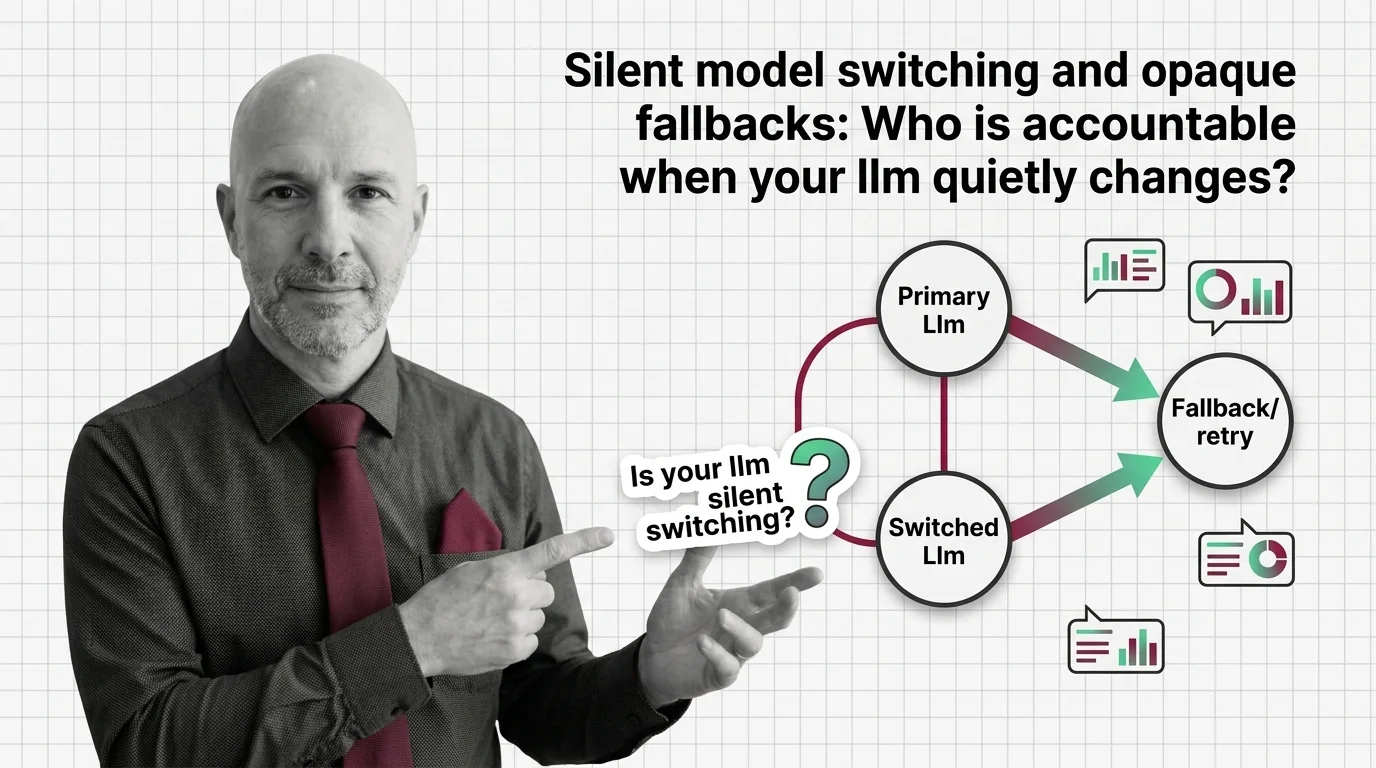
The production LLM Fallback And Retry Patterns stack is built for resilience. When a primary model is unavailable — due to Rate Limiting, an outage, or a Circuit Breaker tripping after repeated failures — a Fallback Strategy routes the request to a secondary model, continuing to serve rather than failing. This is Graceful Degradation in practice, and it is architecturally sound engineering.
The same abstraction that makes
Virtual Keys possible — a single interface routing transparently across multiple underlying model providers — is precisely what makes a model switch invisible to the application layer above it. What happens to transparency at that moment depends on which provider failover setup the team is using. LiteLLM exposes the actual served model via the x-litellm-model-id response header (LiteLLM Docs); OpenRouter reports it in the response object’s model field (OpenRouter Blog). These are genuine transparency mechanisms. They make the routing decision visible to the developer querying the
API Gateway.
Developer-visible transparency is not the same as user-facing accountability.
The end user of the application built on that infrastructure receives no corresponding signal. No indicator that the model changed. No way to correlate an unexpected response quality with an infrastructure decision made milliseconds before their question was answered.
Security & compatibility notes:
- LiteLLM RCE (CVE-2026-42271): Actively exploited command injection vulnerability added to the CISA KEV catalog. Affected versions 1.74.2–1.83.6. Pin to a patched version before any production use.
- LiteLLM Supply Chain (March 2026): Versions 1.82.7 and 1.82.8 on PyPI contained malicious code via compromised CI/CD pipeline (LiteLLM Security Blog).
- LiteLLM Access Control (CVE-2026-35029): Low-privilege users can modify routing configuration via the
/config/updateendpoint.
When the Stack Knows and the User Doesn’t
Research examining routing and cascades finds that static Model Routing — consistently serving the same model — outperforms cascading fallback for user utility; providers can nonetheless throttle model latency to reduce costs in ways that harm the experience of that same user (Routing & Cascades Paper). Most production gateways default to cascading failover architectures regardless. The architecture that most teams inherit is one in which availability takes precedence over consistency, and that decision is invisible to the person on the receiving end of it.
Before the fallback fires, production systems typically exhaust Exponential Backoff retry sequences against the primary model — careful engineering discipline applied to the availability layer. The downstream human is rarely part of the conversation about what happens next.
Regulatory frameworks are beginning to address transparency, but not this specific gap. The EU AI Act’s Article 50 sets an enforcement milestone in August 2026 for transparency obligations including disclosure that a user is interacting with AI. It does not require disclosure of which model served the response, or whether that model changed between sessions (EU AI Act). The gap is acknowledged in compliance discussions without being closed. The governance architecture, like the technical one, was built for the developer layer first — and the question of what users deserve to know was deferred to the application layer, where it became someone else’s responsibility.
Who Bears Responsibility Nobody Claimed?
Thesis: The accountability gap in silent model switching is not a defect in any individual provider’s policy but a structural feature of a production stack assembled layer by layer, with user-facing transparency treated at each layer as the responsibility of whoever builds on top.
The developer who builds an application on an LLM gateway receives the notice, sees the response headers, can inspect the routing decisions. That developer is also building on systems they did not design, subject to model changes they did not initiate, serving users who see none of the infrastructure. Accountability lands somewhere between these layers and diffuses — not through negligence, but through a consistent pattern in which each layer treats the problem as belonging to the next one up.
This is not an accusation. It is a structural diagnosis. Accountability gaps in complex technical systems form the same way every time: through locally reasonable decisions made at layers that cannot see the full picture. No one at any single layer in this chain made a decision to deceive users. Several layers together produced a system in which users cannot know when the ground shifted beneath their feet.
The Quality the Deprecation Window Cannot Measure
The six-month number measures calendar time. It says nothing about differential impact — the question of whether a silent model switch affects all users equally.
Research on prompt fairness finds that certain demographic subgroups experience higher internal response variability and greater divergence from other groups in LLM outputs, a form of structural inequity in how model behavior distributes across the population it serves (Prompt Fairness Paper). A model substitution does not arrive in a neutral system. It arrives in a system where quality is already unevenly distributed. When the model changes, the users at the edges of that distribution receive a new source of variance — invisible, uncontestable, and unacknowledged by the infrastructure that introduced it.
Uptime metrics measure whether a system is running. They say nothing about whether the system running is the one users believed they were using, or whether the change in system constitutes a change in outcome for the people who matter most. The deprecation notice protects the developer’s ability to plan. It does not protect the user’s right to know.
What Would Make This Argument Wrong
Intellectual honesty requires naming where this analysis is most exposed. The argument assumes that user-facing transparency is achievable at reasonable cost — technically, legally, and competitively. If surfacing fallback model identity to end users were genuinely prohibitive, the structural critique becomes a criticism of the possible rather than the actual.
The argument also rests on an assumption about user agency: that users, if informed, could and would act on that information meaningfully. If research were to show that users neither want nor use model identity disclosures in practice, the transparency gap is a gap in principle only. No documented pattern of widespread harm specifically attributed to silent model switching has been established — the risks articulated here are structural and anticipatory, not yet actualized into a recognized caseload.
I hold this position provisionally. The fact that neither providers nor regulators have moved to require user-facing model identity disclosure is consistent with two interpretations: that the risk does not warrant the intervention, or that the mechanism for that intervention has not yet been designed. Which interpretation is correct depends on evidence that does not fully exist yet.
The Question That Remains
The deprecation notice travels from provider to developer and stops. The accountability question it raises does not — it travels further, to an end user who is not on the distribution list, who accepted a response from a system that had, without announcement, quietly become a different system.
We have built remarkable infrastructure for resilience — systems that keep running when components fail, that route around unavailability, that recover without human intervention. We have not built the corresponding infrastructure for transparency at the user layer. The engineering discipline that produced silent, uninterrupted model substitution has not yet turned its attention to what the person on the other side of that substitution deserves to know.
Who is responsible for closing that gap? The answer distributes across the entire chain — the provider who built the model, the gateway team that routed the request, the developer who chose the architecture, the regulatory body that defined transparency as “AI or not AI” and deferred the rest. Distributed accountability, in practice, tends to mean no one in particular. That is what a structural problem looks like — and what makes it harder to resolve than any bug in any individual system.
Ethically, Alan.
AI-assisted content, human-reviewed. Images AI-generated. Editorial Standards · Our Editors