Silent Failure and the Accountability Gap: The Ethical Cost of Undetected Data Drift
The Hard Truth
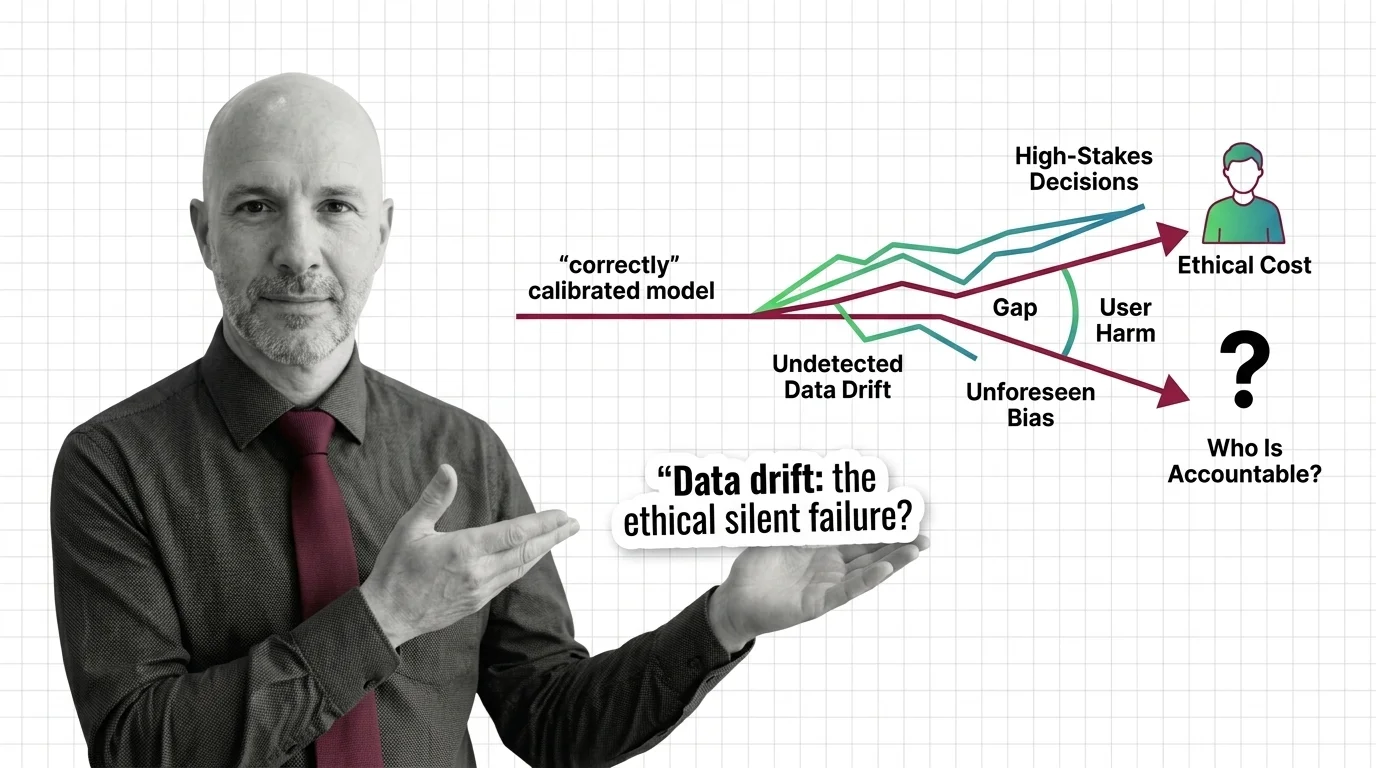
A model that crashes is found within minutes; someone is paged, a fix is made, the incident gets a name. A model that slowly grows wrong keeps answering with the same confidence it had on its best day. If no error is ever logged and no alert ever fires, did the harm still happen — and does anyone still owe an answer for it?
We built our entire moral vocabulary around failures we can see. A bridge that buckles, a product recall, a crash with a black box to recover — each gives us a moment to point to, a before and an after, a person to ask. Statistical decay offers none of that. It is failure without an event, and our institutions have almost no practice holding anyone responsible for harm that never announces itself.
The Failures That Never Trip an Alarm
When people worry about AI causing harm, they usually picture something loud: a system that breaks, a chatbot that says something monstrous, an outage with a headline. The quieter danger is a model that works exactly as engineered and is wrong anyway. Data Drift is the slow divergence between the world a model learned from and the world it now operates in. Sometimes only the inputs move — Covariate Shift, where the kinds of cases arriving change while the underlying logic holds. Sometimes the labels themselves drift, Label Drift. And sometimes the relationship between input and outcome changes underneath the model entirely, which is the kind of drift that actually corrodes accuracy.
What makes this an ethical problem rather than a maintenance chore is the silence. A drifting model can keep emitting confident, wrong predictions long after the ground it stood on has moved, because the true labels that would expose the error arrive late, or never (NannyML Docs). In a loan-scoring system, a clinical triage tool, a fraud filter, that silence is not neutral. It means someone is being quietly misjudged, and the misjudgment carries no signature. Who notices the harm done by a system that never throws an exception?
The Reasonable Case for Sleeping Soundly
It would be unfair to pretend the field has ignored this. The thoughtful engineer has a strong answer: drift is a measurement problem, and we have grown good at measurement. Model Monitoring has matured from an afterthought into a discipline with real instruments. We can track how far an input distribution has moved with the Population Stability Index, test it with the Kolmogorov-Smirnov Test, or quantify the size of the shift with Wasserstein Distance (Evidently AI). Open frameworks like Evidently AI and NannyML now watch live systems and even estimate performance before the labels are in, so a degrading model can be caught and sent for Model Retraining before the damage compounds.
This is a reasonable faith, and I do not want to caricature it. A team that monitors drift, alerts on it, and retrains on a schedule is behaving more responsibly than most of the industry did five years ago. The trouble is not the instruments. It is what the green dashboard quietly persuades everyone to believe once the instruments are installed.
What a Green Dashboard Quietly Assumes
Behind every reassuring monitor sits an assumption that rarely gets stated: that detecting drift is the same as knowing whether anyone was harmed, and that watching a system is the same as being accountable for it. Both halves are shakier than they look.
Drift is not harm. An input distribution can wander without the model getting any worse, and an alert can fire on a change that costs no one anything; conversely, the most damaging drift — where the input-to-outcome relationship itself shifts — can move a model’s real accuracy while the surface statistics still look calm. The label-free performance estimates that make modern monitoring feel safe are themselves estimates, resting on assumptions that can break exactly when conditions get strange (NannyML Docs). A number on a dashboard is a signal to investigate, not proof that all is well, and not proof that someone was wronged.
And here is the deeper gap: a tool can measure drift, but it cannot accept responsibility. Monitoring surfaces a signal. It does not decide what counts as an acceptable level of being wrong, who is owed an explanation, or what is fair to the person on the other end of the prediction. Those are not measurements. They are judgments, and judgments need someone willing to own them.
A Gap the Philosophers Named First
The unsettling part is that this difficulty was described long before the current wave of AI. More than twenty years ago, the philosopher Andreas Matthias argued that when a system learns and adapts in ways its operators cannot reliably predict, our ordinary way of assigning blame begins to fail — he called it a “responsibility gap” (Matthias 2004). It remains a contested claim; other thinkers argue the gap is overstated, that responsibility can be shared deliberately among the people who design, run, and oversee these systems. But drift gives the argument an uncomfortable concreteness.
When harm finally reaches a user, the question of who is accountable scatters across a chain of hands. The data scientist who chose the threshold? The organization that ran the model past the season it was built for? The vendor who supplied it, the executive who approved it, the regulator who had not yet written the rule? Hannah Arendt once described bureaucracy as the rule of Nobody — a structure where everyone follows the procedure and no one is the author of the outcome. A silently drifting model is rule of Nobody rendered in statistics: a decision distributed so thinly that, when it goes wrong, there is no single hand to hold.
The Cost Is Built Into the Silence
Thesis: The ethical danger of undetected data drift is not merely that models fail, but that they fail in precisely the form our systems of accountability are least equipped to see, so the cost lands on the people with the least power to detect it.
Regulators have started to reach toward this. The emerging shape of AI regulation encodes an expectation that a high-risk system should be watched after release, not only certified before it — the principle behind the post-market monitoring duties placed on providers and the independent monitoring duties placed on deployers, including the idea that a deployer’s responsibility to watch its own system is not something a contract can simply hand back to the vendor (EU AI Act, Articles 72 and 26). Read as an ethical statement rather than a legal one, that is a claim about where responsibility should live: with whoever puts the system in front of human beings.
But the principle is running ahead of its enforcement. The high-risk obligations were pushed back — to late 2027 for Annex III systems and to 2028 for AI embedded in regulated products, under the Digital Omnibus agreement reached in 2026 (EU Council). So for now, accountability for drift-driven harm still runs through older channels: data-protection principles, sector rules, ordinary liability. The expectation has been written down. The teeth arrive later. In the meantime, the silence keeps its advantage.
Sitting With the Questions We’d Rather Automate
I am wary of pretending there is a clean fix here, because the honest difficulty is not technical. To put a system into the world whose decay you can only estimate, never directly see, is to accept a strange kind of moral exposure: you are responsible for an outcome you have chosen not to be able to fully observe. If a model’s wrongness is invisible by default, who should carry the burden of doubt — the person affected by the decision, who cannot know they were wronged, or the institution that benefits from the system running unexamined? We have grown comfortable treating monitoring as the end of our obligation. It may be only the beginning: the moment we acquire the ability to know, and with it the duty to keep looking.
Where This Argument Is Weakest
This case rests on the claim that the accountability gap is real and not merely a convenient excuse, and that claim can be wrong. If distributed responsibility works in practice — if designers, operators, and regulators can be made jointly answerable without anyone slipping through the seams — then the gap is a governance problem to be solved, not a moral void. And if label-free monitoring keeps improving until silent failure becomes reliably visible and harm becomes attributable, much of the danger I have described shrinks toward a solved problem. I have argued from the world as it currently behaves, not the one we might yet build.
The Question That Remains
Undetected drift turns a technical fact — that models decay — into a moral one, because it lets harm accumulate in a form no alarm was built to catch. The instruments to see it are finally here. The harder question is whether we will accept the responsibility that seeing creates: when a model quietly fails the people it was meant to serve, will anyone choose to answer for it?
Ethically, Alan.
AI-assisted content, human-reviewed. Images AI-generated. Editorial Standards · Our Editors