Selection, Representation, and Measurement Bias: The Types of Dataset Bias Explained
ELI5
Dataset bias is systematic error baked into training data before any model sees it. It comes in three forms: selection (who got sampled), representation (which groups are too thin), and measurement (whether your labels mean what you think they mean).
A fraud detector clears every held-out fold and goes live. Weeks later it quietly approves a class of transactions it had almost never encountered during training. The post-mortem calls the data “biased” and stops there. That single word is hiding three distinct failures, each entering the pipeline at a different stage, each demanding a different fix.
The Gap Between Your Sample and the World
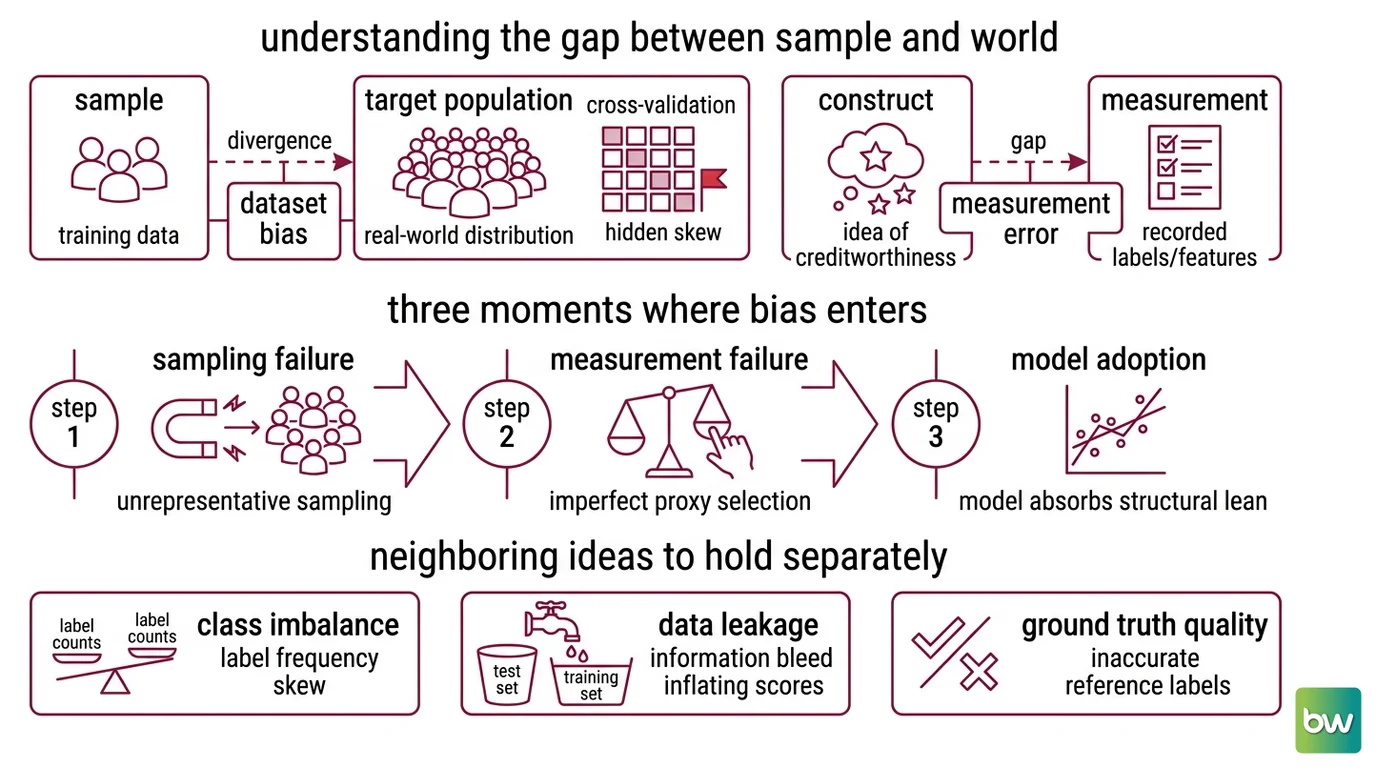
Every dataset is a sample standing in for a population it will never fully contain. Bias appears when the gap between the two is not random noise but structure — a consistent lean the model then absorbs as if it were signal. Calling that lean “bias” feels like naming one problem. It is actually three mechanical failures, not one moral flaw, and they enter the data at different moments.
What do you need to understand before learning about dataset bias?
Two distinctions carry most of the weight.
The first is sample versus population. Your training set is a sample; the distribution you will actually face once the model is serving real users is the target population. Dataset Bias is what you get when the sampling process makes those two diverge in a structured way. This is also why a clean Cross Validation score can lie: if your validation folds are drawn from the same skewed sample, they inherit the same skew, and the error stays hidden until real data arrives.
The second is construct versus measurement. The thing you care about — creditworthiness, health, “crime” — is a construct. What you actually record is a measurement: a label or feature that stands in for it. The two are never identical, and the size of that gap matters more than most teams check.
A few neighboring ideas are worth holding separately so you don’t file them under “bias” by mistake. Class Imbalance is a skew in label frequencies, not in how the sample was drawn; it can ride along with bias or occur entirely on its own. Data Leakage — including Target Leakage and Temporal Leakage — is test information bleeding into training, which inflates scores without making the data unrepresentative. And Ground Truth quality sits underneath all of it: if your reference labels are wrong, every downstream metric is measuring the wrong target.
What are the different types of dataset bias?
There is no single canonical list, and pretending otherwise is its own kind of error. Two surveys anchor most discussions. Suresh & Guttag trace seven sources of harm across the machine learning lifecycle — historical, representation, measurement, aggregation, learning, evaluation, and deployment bias. Mehrabi et al. catalog a wider set of bias and fairness problems in a separate survey. The two framings overlap but are not identical, so the honest move is to name the taxonomy you are using rather than imply one official ledger.
This article follows the slice both frameworks share: the bias that originates in the data itself, before training begins. That slice has three members. Selection Bias concerns who or what enters the sample. Representation Bias concerns which parts of the population end up too thin to learn from. Measurement Bias concerns whether the recorded label faithfully reflects the construct. Same word, three separate mechanisms.
Selection, Representation, and the Proxy Problem
The first two types are frequently merged, and some authors treat one as a subtype of the other. The merge is forgivable because they share a cause — sampling — but they describe different consequences, and the right intervention follows from the difference.
What is the difference between selection bias and representation bias?
Selection bias is about the inclusion mechanism: the rule, explicit or accidental, that decides which records make it into the dataset. When that rule correlates with the outcome you are trying to predict, the sample tilts. The classic case is the “healthy volunteer” effect — people who enroll in a study like the UK Biobank are systematically healthier than the general population, as Mehrabi et al. note, so any model trained on them learns from a group that is not the group it will serve.
Representation bias is about coverage: given whatever sample you collected, which regions of the input space are underpopulated? A subgroup can be present but sparse. The model technically saw examples, just too few to generalize, so it performs worst on exactly the people it has the least data about.
The distinction is who enters the sample versus who is too thin once inside it. Selection bias can produce representation bias, but you can also have representation gaps in a perfectly drawn sample simply because a subgroup is rare. Reach for a Protected Attribute breakdown and the two failures surface in different places: selection bias skews the whole sample relative to the world, while representation bias shows up as a subgroup whose error refuses to fall no matter how long you train.
When the Label Itself Is the Problem
Measurement bias is the odd one out, because it has nothing to do with who got sampled. It arises, in the language of Mehrabi et al., from how we choose, use, and measure particular features — the proxy you record imperfectly reflects the construct you meant to capture. The textbook example is using “arrests” as a proxy for “crime.” Arrests measure policing activity as much as criminal activity, so a model trained on them learns the proxy faithfully and inherits the gap between the two as if it were truth.
This is why measurement bias is the most dangerous of the three to a careless team. Selection and representation problems leave statistical fingerprints in the sample. Measurement bias can leave the sample looking perfectly balanced while the labels quietly encode the wrong thing.
What Each Type Predicts About Your Failures
Understanding the mechanism turns a vague worry into specific predictions. Each bias type implies a different failure signature, which means each one is caught by a different test.
- If your collection method correlated with the outcome, expect selection bias: the model looks well calibrated in testing because the test set shares the sample’s skew, then degrades the moment it meets the broader population.
- If a subgroup is sparse, expect representation bias: aggregate accuracy stays high while per-group error spikes for that subgroup alone.
- If your label is a proxy, expect measurement bias: the model reproduces the proxy precisely and carries its distortion forward, no matter how much data you add.
Auditing tools formalize these checks. Aequitas — version 1.1.0 on PyPI, from Data Science for Social Good at the University of Chicago, MIT-licensed — computes confusion-matrix-based group fairness metrics like true and false positive rates stratified by sensitive attributes, and its Flow rewrite added a set of pre-, in-, and post-processing mitigation methods. Deepchecks ships data-integrity and train-test validation suites that flag distribution shifts and imbalance. Fairlearn and AI Fairness 360 cover overlapping ground with broader metric sets. A Bias And Fairness Metrics dashboard will surface selection and representation gaps quickly.
Tooling note: Deepchecks’ open-source suite has had no release since 0.19.1 (December 2024), and the vendor has shifted toward a separate paid LLM-evaluation product. It still runs, but treat it as a stable-but-static dependency rather than an actively patched one.
Rule of thumb: name the stage before you name the fix — sampling failures get reweighted or recollected, coverage failures get rebalanced, label failures get remeasured.
When it breaks: fairness dashboards can only see what the labels admit. If your only ground truth is the biased proxy itself, measurement bias is invisible to every group-fairness metric, and the audit certifies a model that is faithfully wrong.
Why More Data Doesn’t Fix the One That Matters Most
Here the three types finally separate cleanly, because they respond to completely different interventions.
Representation bias is the tractable one. It responds to rebalancing the sample: undersampling the dominant group, oversampling the sparse one, or synthesizing minority examples with a method like SMOTE to relieve the underlying class imbalance. More signal for the thin region genuinely helps.
Selection bias is harder but still addressable. You can reweight records to match the target population, or — better — fix the collection mechanism so the sample stops tilting in the first place.
Measurement bias resists all of it. Resampling a corrupted label only gives you more corrupted labels; reweighting a proxy only changes how confidently you reproduce its distortion. The fix is not statistical at all. Not more data. Better measurement — a closer operationalization of the construct you actually care about.
The Data Says
Dataset bias is not one defect but three mechanisms: selection at the sampling stage, representation at the coverage stage, measurement at the labeling stage. The first two leave detectable traces in the sample and respond to resampling and reweighting. The third can hide inside a perfectly balanced dataset and yields only to a better measurement of the thing you meant to capture.
AI-assisted content, human-reviewed. Images AI-generated. Editorial Standards · Our Editors