Same Prompt, Five Models: Image Prompt Tooling Resets in 2026
TL;DR
- The shift: Image prompts no longer travel between models — and the optimizer tools that promised they would are dying.
- Why it matters: Output drift broke before the industry agreed it was a problem. Your prompt library is now model-locked.
- What’s next: First-party optimizers replace third-party suites. Image teams that don’t follow the migration get stranded.
Two years ago a great prompt was a transferable asset. Type it into one model, type it into another, and you got the same intent rendered in a different style. That contract just broke. Prompt-optimizer suites are folding, leaderboards reshuffle every two months, and the reference output for the exact same words now varies so dramatically by model that “same prompt” has stopped being a benchmark and started being a category error.
The Portable Prompt Just Died
Thesis: Image prompts are weld-shut to specific model architectures, and the third-party tooling that papered over that gap is collapsing into two camps — first-party optimizers from model providers, and dedicated tools that price Reproducibility as a service.
The signal isn’t a single product launch. It’s three independent moves pointing the same direction.
PromptPerfect, the early flagship of cross-model prompt rewriting, is shutting down. Its parent company, Jina AI, was acquired by Elastic to fold multimodal embeddings into enterprise search — and consumer prompt optimization didn’t fit that roadmap (Prompt Builder, Elastic IR).
OpenAI launched its own Prompt Optimizer inside the Playground. A meta-prompt rewrites your draft against current best practices — but only for text models. Image-prompt optimization isn’t part of the documented scope (OpenAI Docs).
Meanwhile, the Prompt Engineering For Image Generation layer is fragmenting by model family. Each provider publishes its own prompt guides, its own reference vocabulary, its own tuning quirks. Portability is no longer a feature anyone is selling.
Five Models, One Prompt, Five Different Pictures
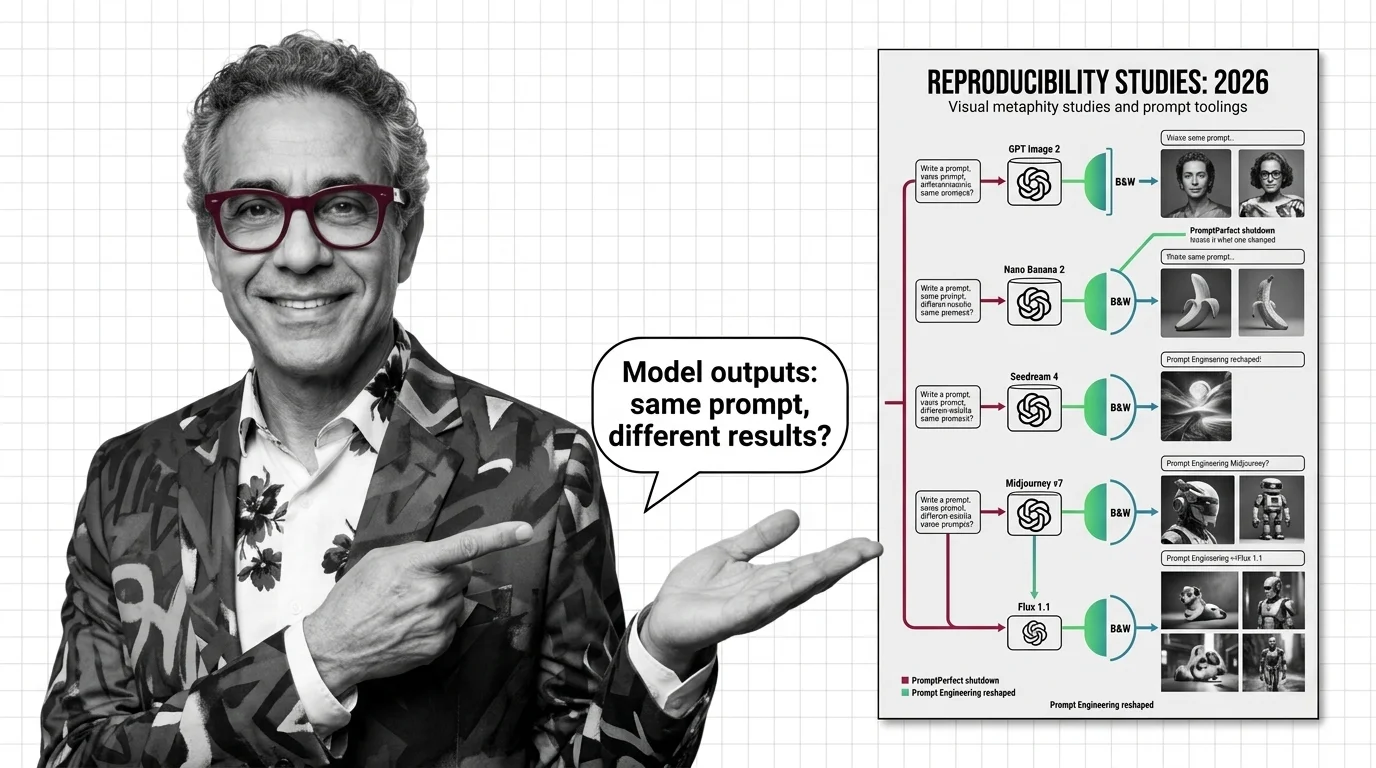
The same prompt fed to GPT Image 2, Nano Banana 2, Seedream 4, Midjourney v7, and Flux 1.1 doesn’t just yield five aesthetic variations. It exposes five different conditioning architectures, five different sampler schedules, and five different failure modes.
As of late April 2026, the Artificial Analysis Text-to-Image Arena ranks GPT Image 2 (high) at the top with 1333 ELO, followed by GPT Image 1.5 at 1272, Nano Banana 2 at 1263, Nano Banana Pro at 1217, and Seedream 4.0 at 1205 (Artificial Analysis). Midjourney v7 — still the production default in early 2026 — and Flux 1.1 Pro round out the comparison set most teams actually run.
The pattern from industry benchmark posts is consistent. GPT Image 2 leads on text rendering and structured layout. Nano Banana Pro leads on portraits and multi-reference compositions. Midjourney still owns stylized concept art. Seedream pairs structural “vibe” with factual layout via real-time web search (Atlas Cloud Blog).
Reproducibility sits underneath all of it. Academic seed-instability research on Diffusion Models measured “golden” seed FID at 21.60 versus “inferior” seed FID at 31.97 — meaningful quality drift on the same prompt, same model, just a different starting point (arXiv). Now expand that variance across five models that don’t even share an architecture.
Nano Banana Pro doesn’t expose a seed parameter at all. Reproducibility there means feeding reference images, not fixing entropy (LaoZhang AI Blog).
That’s not a benchmark problem. That’s a contract problem.
The Tooling Pivot
PromptPerfect stops accepting new signups in June 2026, shuts down completely on September 1, 2026, and deletes user data on October 1 (Prompt Builder).
In the same window, OpenAI rolled out its first-party Prompt Optimizer in the Playground (OpenAI Cookbook). Adjacent tools are filling the image-specific gap: Prompt Builder for cross-model rewriting, ImageToPrompt for reverse-prompting and per-model reference guides.
The market just told you which layer is becoming infrastructure and which is becoming commodity. Cross-model optimizers are commodity. Model-native optimization plus reproducibility tooling is infrastructure.
Migration & deprecation notes:
- PromptPerfect (Jina AI): New signups close June 2026; shutdown September 1, 2026; user data deleted October 1, 2026. Action: export prompt libraries before June.
- DALL·E 2 / DALL·E 3: OpenAI sunset May 12, 2026. Migrate to GPT Image 1.5 / 2.
- Imagen 3.0 (generate-002): Google deprecated; migrate to gemini-2.5-flash-image (Nano Banana family) before June 30, 2026.
- Nano Banana Pro: No
seedAPI parameter — reproducibility requires reference images and fixed prompt structure.
Who Wins
Model providers that ship first-party optimization. OpenAI built it into the Playground. Google publishes Nano Banana prompt guides keyed to the Gemini 3.1 Flash Image API. Each provider that owns the optimization surface owns the lock-in.
Dedicated tools that sell reproducibility, not portability. Prompt Builder is positioned to absorb PromptPerfect’s customer base. ImageToPrompt’s per-model reverse-prompt guides ship value precisely because prompts no longer transfer.
Teams that already invested in AI Image Editing workflows where the prompt is part of a pipeline — reference images, fixed seeds where exposed, post-processing with Image Upscaling and AI Background Removal. They were already model-aware. They just stopped being early.
Who’s Stranded
Anyone whose stack assumed image prompts were portable. PromptPerfect refugees with libraries built against generic best practices have a six-month migration window with no obvious successor offering identical behavior.
Tooling vendors selling “one prompt, every model.” That category lost its premise. Customers will pay for reproducibility against a specific model. They will not pay for translation between models that disagree on what the prompt even means.
Teams running production image generation without LoRA for Image Generation or reference-image discipline. The leaderboard reshuffles every two months. If your output quality depends on a single API endpoint and a single prompt template, you’re a model deprecation away from a content emergency.
What Happens Next
Base case (most likely): Model providers consolidate optimization inside their own platforms. Cross-model third-party optimizers either pivot to evaluation or die. Signal to watch: Anthropic or Google ships a first-party image-prompt optimizer mirroring OpenAI’s text version. Timeline: By Q4 2026.
Bull case: A standards body or major lab publishes a portable prompt-intent format that abstracts model-specific tokenization. Image prompts become composable again. Signal: Open-source release with adoption from at least two frontier labs. Timeline: 12-18 months — possible, not probable.
Bear case: Image generation fragments further. Every model family ships its own DSL. Prompt expertise becomes non-transferable career capital.
Signal: A second model provider deprecates seed parameters or introduces proprietary prompt syntax.
Timeline: Visible within two quarters.
Frequently Asked Questions
Q: What happened when the same prompt was tested across GPT Image 2, Nano Banana 2, Seedream 4, Midjourney v7, and Flux 1.1?
A: Outputs diverged by category, not just style. GPT Image 2 won text and layout, Nano Banana led portraits, Midjourney owned stylized concept art, Seedream paired structure with real-time factual layout, and Flux delivered fast photorealism. The prompt was constant. The contract wasn’t.
Q: How is prompt engineering for images changing after PromptPerfect’s shutdown and OpenAI Prompt Optimizer’s launch in 2026?
A: It’s splitting into two layers. First-party optimizers (OpenAI’s launch is text-only so far) handle model-native rewriting. Dedicated tools like Prompt Builder cover cross-model image work. The era of one universal optimizer is over.
The Bottom Line
The portable image prompt is dead, and the tools that promised portability are dying with it. Lock your prompts to your models, or lock your models to a tooling layer that prices reproducibility as a feature.
The window for retooling is open. It won’t stay open through Q4.
Stay ahead, Dan.
AI-assisted content, human-reviewed. Images AI-generated. Editorial Standards · Our Editors