Role Prompting for Code Review, Customer Support, and When to Skip It Entirely
TL;DR
- Role prompting reliably improves LLM accuracy on generative tasks — reasoning, STEM, open-ended analysis — but consistently damages discriminative tasks like classification and factual QA.
- For code review and customer support, a structured role combined with explicit constraints outperforms a bare persona. The role sets the tone; the spec does the work.
- Skip the persona entirely when precision matters most: classification labels, yes/no factual checks, and misinformation detection all perform worse with an identity injected.
Here’s what happens every week. Developer adds “Act as a senior software engineer” to a code review prompt and gets solid results — then copies the same pattern into a content classifier. Accuracy drops. Nobody runs the comparison, so the persona stays in both prompts.
The task type is the variable. Get it wrong and the persona works against you.
Before You Start
You’ll need:
- A Role Prompting baseline: how persona injection affects model output
- Working knowledge of System Prompts for persistent role injection across turns
- A task to evaluate: code review, customer support, or classification/QA
- A comparison baseline: the same task run without any role
This guide teaches you: a decision framework for matching task type to role strategy — so you stop adding personas by reflex and start adding them by design.
The Act-as Trap
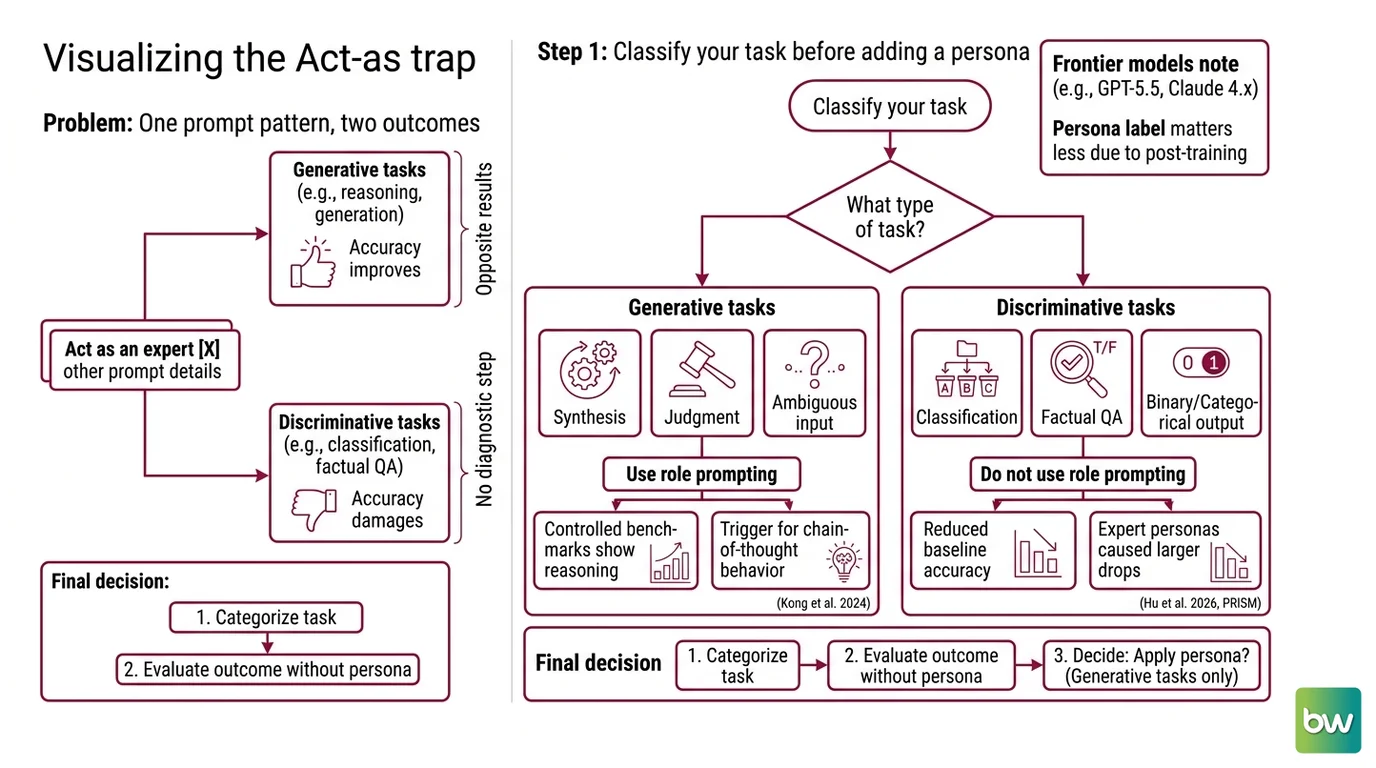
The problem compounds quickly. You add “Act as an expert [X]” before a category of prompts. Same persona, opposite results — some tasks improve, others degrade. You ship both outcomes without measuring either.
Here’s what the research shows. Role prompting improves accuracy on reasoning and generative tasks across controlled benchmarks. But it damages accuracy on discriminative tasks — classification, factual QA, and misinformation detection (Hu et al. 2026, PRISM). Same persona. Different task type. Opposite result.
One prompt pattern. Two outcomes. No diagnostic step.
A note on frontier models (Claude 4.x, GPT-5.5): Post-training increasingly internalizes persona behaviors. The gap between “Act as X” and a well-specified direct instruction is smaller than 2024 benchmark numbers suggest. The architecture still matters — but the persona label matters less on current frontier models than it did two years ago.
Step 1: Classify Your Task Before Adding a Persona
Before touching Prompt Engineering, categorize what the model is actually doing.
Generative tasks — the model produces open-ended output. Code analysis with narrative, advisory responses, STEM explanations, drafting. The task requires synthesis and judgment from ambiguous input. Role prompting helps here. Controlled benchmarks show role-play prompting outperformed standard zero-shot on most of 12 diverse reasoning benchmarks and acted as a stronger trigger for Chain-of-Thought behavior than explicit “think step by step” instructions (Kong et al. 2024).
Discriminative tasks — the model makes a constrained choice. Classify this text. Is this statement factual? Does this request qualify for a refund? Binary or categorical output. Role prompting hurts here. On MMLU factual QA, injecting expert personas reduced baseline accuracy — stronger expert descriptions caused larger drops (Hu et al. 2026, PRISM). The Wharton GAIL lab found no expert persona reliably improved accuracy on knowledge-intensive benchmarks across six tested frontier models, including GPT-4o-mini, o3-mini, and Gemini 2.5 Flash.
Your task type diagnostic:
- Does the task require synthesis and judgment from open input? → Generative. Continue to Step 2.
- Does the task require a label, a yes/no, or factual retrieval? → Discriminative. Skip the persona. Use direct instruction.
One domain-level split worth adding: role prompting helps advisory and medicine/psychology questions but hurts on finance, legal, and technical conceptual explanations (ArXiv 2605.29420, May 2026). If your use case falls in the second group, treat it as discriminative even if the output is technically prose.
Step 2: Define the Role Specification
You’ve confirmed the task is generative. Now specify the role precisely.
A bare persona — “You are an expert software engineer” — is an underspecified role. The model fills in undefined behavior from training defaults. That fill-in is the source of inconsistency.
A role specification has four fields:
- Domain — specific, not generic. “Python security reviewer focused on injection vulnerabilities” not “senior engineer.” The narrower the domain, the more predictable the output.
- Behavior constraint — what the role does. “Identify issues only; do not rewrite code.” Without this, the model writes code when you wanted a list.
- Output format — what the role produces. “Bulleted list: issue | severity (CRITICAL / HIGH / MEDIUM / LOW) | file:line.” Without this, the model picks the format.
- Persona boundary — what the role does NOT do. “Do not suggest architectural changes outside the diff.” Without this, the role expands.
Each missing field is a gap the model fills with its default behavior. If the defaults are acceptable, leave the field out. If they aren’t, specify it.
Step 3: Build Role Prompts for Code Review and Customer Support
Two practical patterns. Both combine role declaration with explicit constraints. Structure wins more than the persona label does.
Code review with ChatGPT or Claude:
The key finding from LLM code review research: structured format — task definition, output constraints, few-shot examples — matters as much as the persona itself, and sometimes more (ScienceDirect 2024). The role anchors evaluation framing. The spec determines what “done” looks like.
Build order:
- Role declaration first — domain and behavior in one sentence. “You are a security-focused Python reviewer. Identify vulnerabilities only.”
- Output spec second — format before content. “Return a bulleted list. Each item: file:line — issue — severity.”
- Scope constraint third — what’s out of scope. “Do not suggest refactors. Do not rewrite functions. Flag only.”
- Few-shot if needed — 2–3 examples of input diff → expected output format. In Context Learning closes the formatting gap that descriptions leave open.
Your review role prompt structure:
You are a [domain] reviewer. Your task: identify [issue type] in the following [artifact].
Output: [format with field labels].
Do not: [out-of-scope actions].
Customer support with ChatGPT or Claude:
Role prompting with structured constraints anchors tone and reduces variance on edge cases. The role shapes register; the constraints prevent the model from making decisions it has no authority to make.
Build order:
- Role declaration — persona and scope. “You are a support specialist for [product]. Your task: resolve billing and account questions.”
- Tone constraint — register and length. “Respond professionally, under 100 words.”
- Policy constraints — hard rules. “Do not approve refunds. Do not make exceptions to the return policy.”
- Escalation rule — when to exit the role. “If the user requests a supervisor, respond: ‘Let me connect you with someone who can help.’”
The escalation rule is the spec gap most customer support prompts miss. Without it, the model keeps trying to resolve issues the role has no authority to handle.
Step 4: Test Whether the Role Is Helping
Instruction Following is what you’re actually measuring. Does the model follow the role specification consistently, and does it outperform no-role on your specific task?
Your validation checklist:
- Run the role prompt on 5–10 test cases — failure looks like: inconsistent output format across cases
- Run the same cases without the persona — failure looks like: worse task accuracy with the role than without it
- Check persona boundary compliance — failure looks like: the model making decisions outside the specified scope
- Check for Prompt Leakage in multi-turn sessions — failure looks like: role constraints eroding after several turns in a long Context Window session
If the role-prompt version performs worse than the no-role version, the task is discriminative. Remove the persona. Reframe as a direct instruction.
If the output format drifts across test cases, the output spec field is underspecified. Add a format requirement and retest.
Common Pitfalls
| What You Did | Why the Model Failed | The Fix |
|---|---|---|
| Added “Act as expert” to a classifier | Persona introduces stylistic variance that disrupts label precision | Remove persona; use a direct categorical instruction |
| Used a generic role (“senior engineer”) | Model fills undefined behavior from training defaults | Add domain + behavior constraint + output spec |
| No output format specified | Model picks format; consistency breaks across runs | Add format as a required field in the role spec |
| Persona used for misinformation detection | Role adds social-identity framing that degrades detection accuracy (JMIR 2024) | Direct instruction only: “Return: misinformation / not misinformation” |
| No escalation rule in support agent | Model continues handling out-of-scope requests | Add explicit out-of-scope condition and escalation response |
| Same persona across a long multi-turn session | Role constraints erode in extended sessions | Re-inject the role spec at key conversation boundaries |
Pro Tip
The role prompt is a specialization of Context Engineering. The persona is one layer. The domain constraint is another. The output spec is another. The boundary is the last. You can apply each layer independently. If a task needs format control but not a persona, add the format spec and skip the role. Build what the task actually needs — not a complete persona by default.
Frequently Asked Questions
Q: How do I use role prompting for code review with ChatGPT or Claude?
A: Start with a domain-specific role declaration (not a generic “senior engineer”), then add your output format and a scope constraint — what the review must NOT do. Research on LLM code review automation found that structured constraints and few-shot examples matter as much as the persona itself (ScienceDirect 2024). On current frontier models like Claude Sonnet 4.6 and GPT-5.5, few-shot examples of the expected output format close the remaining consistency gap better than a more detailed persona description alone.
Q: Role prompting vs chain-of-thought prompting — which actually improves LLM accuracy?
A: Task type decides. Role prompting consistently acts as a stronger chain-of-thought trigger than explicit “think step by step” instructions on reasoning benchmarks (Kong et al. 2024). On current frontier models like Claude Fable 5 and GPT-5.5, chain-of-thought is increasingly internalized through training, so the gap between both techniques and clear direct instructions has narrowed. When you need the ceiling, combine a specific role with an explicit reasoning instruction — neither technique alone gets you there on harder tasks.
Q: When should you avoid role prompting in classification and factual question answering tasks?
A: Whenever the output is a discrete label, a yes/no, or a retrieved fact — skip the persona entirely. Injecting expert personas consistently reduces accuracy on classification and factual QA benchmarks, with stronger persona descriptions causing larger drops. Zero-shot prompting with a direct categorical instruction outperforms role prompting for these task types. If your task is misinformation detection, content classification, or structured Entity Extraction — use direct instruction. The persona adds noise to a channel that needs precision.
Your Spec Artifact
By the end of this guide, you should have:
- A task type classification: generative (role helps) or discriminative (role hurts), applied to your specific use case
- A four-field role specification: domain, behavior constraint, output format, and persona boundary — each field explicitly filled in
- A validation checklist: before-and-after comparison criteria with failure signatures you can check against real test cases
Your Implementation Prompt
Use this as a system prompt in Claude, ChatGPT, or any model that accepts persistent instructions. Fill in the brackets with your specific values. Run on 3–5 test cases before deploying role prompts to production.
TASK TYPE: [GENERATIVE — write/reason/analyze | DISCRIMINATIVE — classify/label/fact-check]

If DISCRIMINATIVE: skip the persona. Use a direct instruction:
  "[Your task instruction]. Return only: [label / yes / no / extracted value]."

If GENERATIVE, complete the role spec below:

ROLE: You are a [specific domain, e.g. "Python security reviewer focused on injection vulnerabilities" — not "senior engineer"].
TASK: [Specific task in one sentence.]
OUTPUT FORMAT: [Format with field labels, e.g. "Bulleted list — issue | severity | file:line"]
CONSTRAINT: [What the role does, e.g. "Identify issues only; do not rewrite code."]
BOUNDARY: [What the role must NOT do, e.g. "No architectural suggestions outside the diff."]

VALIDATION: Run on 3-5 test cases. Compare to a no-role baseline.
- If accuracy drops: remove the role. Rewrite as a direct instruction.
- If format drifts: tighten the OUTPUT FORMAT field.
Ship It
You now have a decision rule for one of the most common Persona Simulation errors in production: adding a persona to a task that doesn’t need one — or hurts when it has one. Generative tasks get a structured role; discriminative tasks get a direct instruction. That split is the whole framework. It’s measurable, and the research is consistent about which direction the error goes.
Deploy safe, Max.
AI-assisted content, human-reviewed. Images AI-generated. Editorial Standards · Our Editors