Recording Every Step: Privacy and Ethics of Agent Traces
The Hard Truth
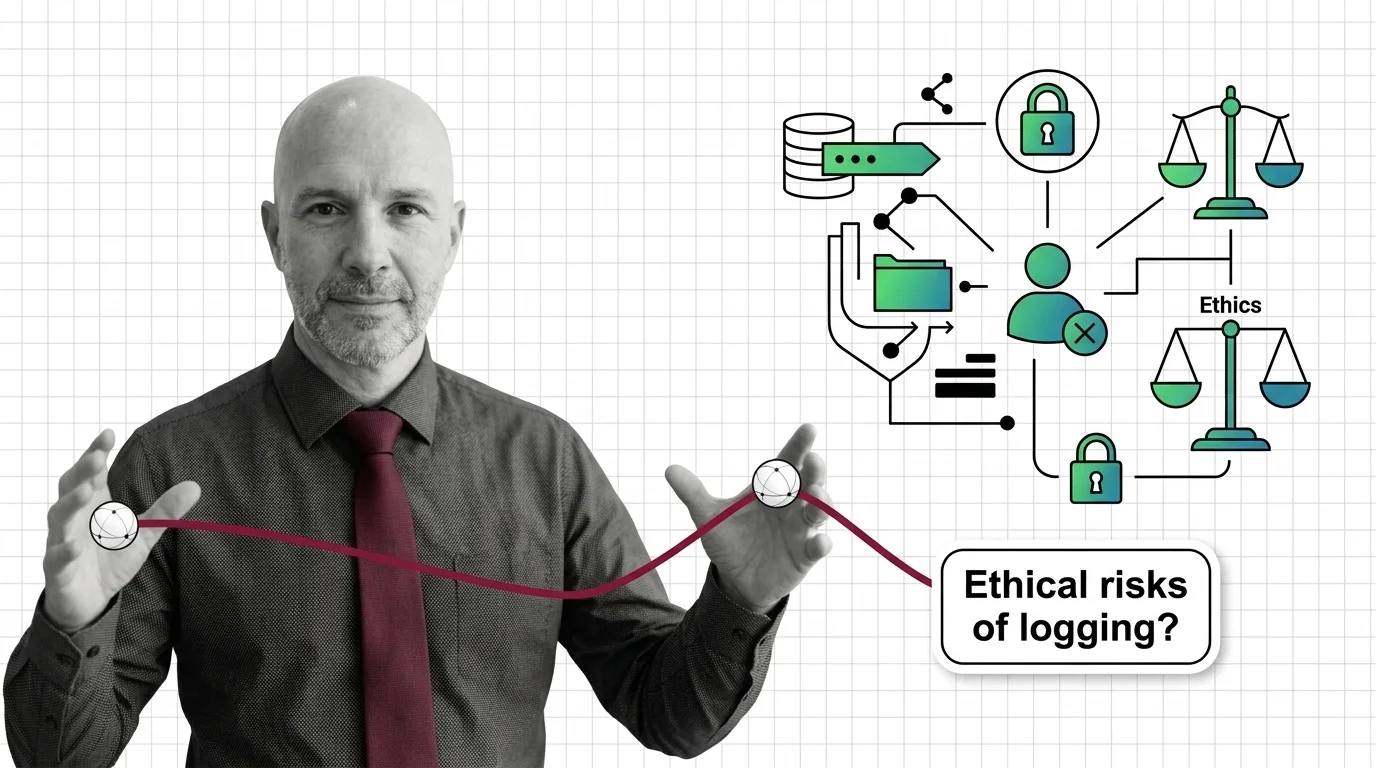
We accepted that an autonomous agent needs full traces to be debuggable. What we have not accepted — or even examined — is that “full traces” means recording every email it read, every customer name it touched, every screenshot it took on your behalf. Did anyone ask whether the user agreed to that bargain, or did the bargain quietly become the default?
The first time I watched an engineering team replay an agent’s full session — every prompt, every tool call, every page the browser agent scrolled through — I felt the same vertigo I once felt reading old surveillance archives. The intent was honorable. The team wanted to understand why the agent failed. But the artifact they were holding was not a debug log. It was a transcript of a person’s afternoon.
The Question Behind the Replay Button
Why does it feel acceptable to record every step an agent takes through a stranger’s data, and so unacceptable to record every step a stranger takes through a building? Both produce a faithful behavioral history. Both promise that the recording will only be used “for safety.” The difference is that one has been culturally negotiated for a century, and the other arrived last year, dressed as an engineering convenience.
Agent Observability is not optional. Without traces, an autonomous system that books flights, files tickets, or reads inboxes is unmaintainable — and undebugable means unsafe. But the default that emerged with the tooling, “capture everything the agent sees,” is not the only design choice available. It is just the one that was easiest to ship.
The Case For Capturing Everything
The argument for full-fidelity capture is genuinely strong, and pretending otherwise would be lazy. Agents fail in ways that look reasonable from the outside. The model produced fluent text; the tool call returned a 200 status code; the user got a wrong answer. The only way to reconstruct what happened is to replay the exact context the model saw, the exact tool outputs that came back, and the exact intermediate reasoning. Anything less and you are debugging by guesswork.
Regulation, ironically, reinforces this instinct. The EU AI Act’s record-keeping obligation requires that high-risk AI systems generate event logs automatically — manual recording does not count, and logs must be retained for at least six months (AI Act Service Desk). Full application for high-risk systems begins on 2 August 2026, which is roughly three months from now. NIST’s AI Risk Management Framework asks for continuous performance monitoring and documented uncertainty across deployment.
The conventional wisdom, then, is not naive. It says: agents are accountable systems, accountability requires evidence, evidence requires fidelity, and fidelity requires capturing what the agent actually saw. Cut corners on the trace, and you cannot defend the agent’s behavior to a regulator, an auditor, or a user who claims harm.
The Fault Line Inside “Capture Everything”
The hidden assumption is that what the agent sees and what the user consented to share are the same thing. They are not, and the gap is widening.
When an Agent Evaluation And Testing pipeline logs a customer support agent’s reasoning, it captures the customer’s complaint verbatim. When a browser agent runs a research task, its session replay captures every email subject line that flickered across the screen. When a coding agent reads a repository, the trace contains whatever proprietary code, embedded secrets, and personal commit messages were in scope. The user authorized the agent to act on their behalf. They did not necessarily authorize a third-party observability vendor to retain the entire experience in queryable form for the next six months.
OWASP’s Top 10 for LLM Applications now ranks Sensitive Information Disclosure as the number two risk, up from sixth place in the previous edition (OWASP Foundation). And the public record of what happens when “full capture” leaks is now long enough to be uncomfortable. The 2023 OpenAI history bug exposed chat titles and partial payment details for around 1.2 percent of ChatGPT Plus subscribers. The July–August 2025 shared-conversation incident allowed more than 4,500 chats — including legal questions, therapy notes, and workplace grievances — to be indexed by search engines because a “discoverable” toggle was paired with a missing noindex tag (Wald AI). A November 2025 analytics-vendor breach added a different lesson: the model’s data store can stay intact while a downstream observability surface bleeds. The pattern is consistent: the captured artifact, not the model, is the attack surface.
A Different History Tells a Different Story
We have lived through this argument before. Microsoft Recall, in its original 2024 design, screenshotted the desktop every few seconds and stored the index in a plaintext SQLite database — including content from disappearing messages and OCR’d images. The backlash forced opt-in defaults and database encryption, and Signal shipped a “Screen security” flag specifically to block Recall from capturing its window (Signal Blog). Recall is not an agent observability product, but it is the closest cultural analog we have, and the lesson is direct: when an engineering team builds a perfectly logical capture pipeline without negotiating with the people on the receiving end, the system gets rebuilt under pressure — usually after harm.
The reframe matters. Observability is not just a debugging interface. It is a recording medium. And recording media in every previous century — court stenography, telephone wiretaps, CCTV, browser session replay — required a public negotiation about who could record what, under which authority, with which retention limits. Browser session replay tooling has already attracted CIPA and GDPR litigation precisely because recording a user’s mouse movements without meaningful consent crosses a legal threshold (Loeb & Loeb). The same surface applies to agent screen captures. We are watching that negotiation happen in real time for AI agents, only most engineering teams have not noticed it is a negotiation yet.
The Uncomfortable Truth
Thesis: The “capture everything an agent sees” default is not an engineering necessity; it is a governance abdication that quietly pushes the privacy cost onto the people the agent acts upon, while leaving the operator with a queryable archive they did not earn the right to hold.
Vendors will protest that masking exists. Langfuse offers client-side custom masking and server-side ingestion masking for self-hosted deployments (Langfuse Docs). LangSmith offers an SDK create_anonymizer built from regex patterns (LangChain Docs). Several monitoring platforms apply default redaction rules before storage. These are real features built by serious engineers. But every one of them is opt-in, regex-bounded, and only as careful as the customer’s configuration. A regex catches the credit card number. It does not catch the customer’s grievance written in free text inside a tool output, the name embedded in an OCR’d screenshot, or the secret pasted into a system prompt the customer forgot they were sending.
A secondary-reported 2024 EU Data Protection Authority audit found that roughly three-quarters of agent implementations at European companies had GDPR compliance vulnerabilities (sethserver). That figure is not from a primary EDPB publication and should be read as directional rather than definitive — but the direction is unmistakable. The infrastructure runs ahead of the consent.
The Questions We Owe Ourselves
There is a more honest architecture available. Industry-emerging patterns suggest storing prompt-pack hashes, tool-schema hashes, retrieval IDs, and content pointers as the default — with raw content fetched on demand, behind an audit trail, into a short-TTL hot store separate from any long-term governance record (Oracle OCI Blog). This trades a small amount of debugging convenience for a structural answer to the minimization principle. It also forces a conversation that “capture everything” lets us postpone: which artifacts must persist for accountability, and which exist only because deleting them was harder than retaining them?
Beyond architecture, the harder questions sit upstream. Who is the data subject when an agent processes someone else’s email on a user’s behalf? Does the user’s consent extend to the people they are corresponding with? How do Agent Guardrails and Human In The Loop For Agents reviews change when the reviewer is reading a transcript that the original participants never expected anyone to read?
Where This Argument Is Weakest
I am not certain that the pointer-first architecture survives contact with a real incident response. If a regulator demands the verbatim record of what the agent saw at 14:32 on a Tuesday, hash pointers alone may not satisfy the obligation. There is a real possibility that the privacy-minimal trace and the legally defensible trace are not the same artifact, and that operators will need to maintain both — at which point the surface area for leakage grows rather than shrinks. If that turns out to be unavoidable, my objection collapses into a narrower one: at least make the maximalist capture a deliberate decision, not a default someone inherited from a starter template.
The Question That Remains
Observability gave us the ability to watch agents act. It did not give us the wisdom to decide what watching means when the people being watched are not in the room. Are we building the audit trail a regulator will thank us for — or the archive a future breach will publish?
AI-assisted content, human-reviewed. Images AI-generated. Editorial Standards · Our Editors