RAG-Augmented Long Context Wins 2026: Why Enterprises Stopped Choosing Sides
TL;DR
- The shift: Frontier labs all shipped 1M-token windows, but enterprises tripled their retrieval spend instead of cutting it.
- Why it matters: Long context and RAG fused into one stack — single-layer architecture bets just got stranded.
- What’s next: Hybrid pipelines with reranking, sparse retrieval, and prompt caching become the 2027 default.
Every CTO who heard “1M tokens” in March bet the same way: kill the vector DB, dump the corpus, and let the model handle it. Six weeks later, those same teams are the loudest customers of hybrid retrieval. The Long Context Vs RAG question stopped being a fork in the road. It became a stack.
The 1M-Token Era Didn’t Kill Retrieval — It Forced a Marriage
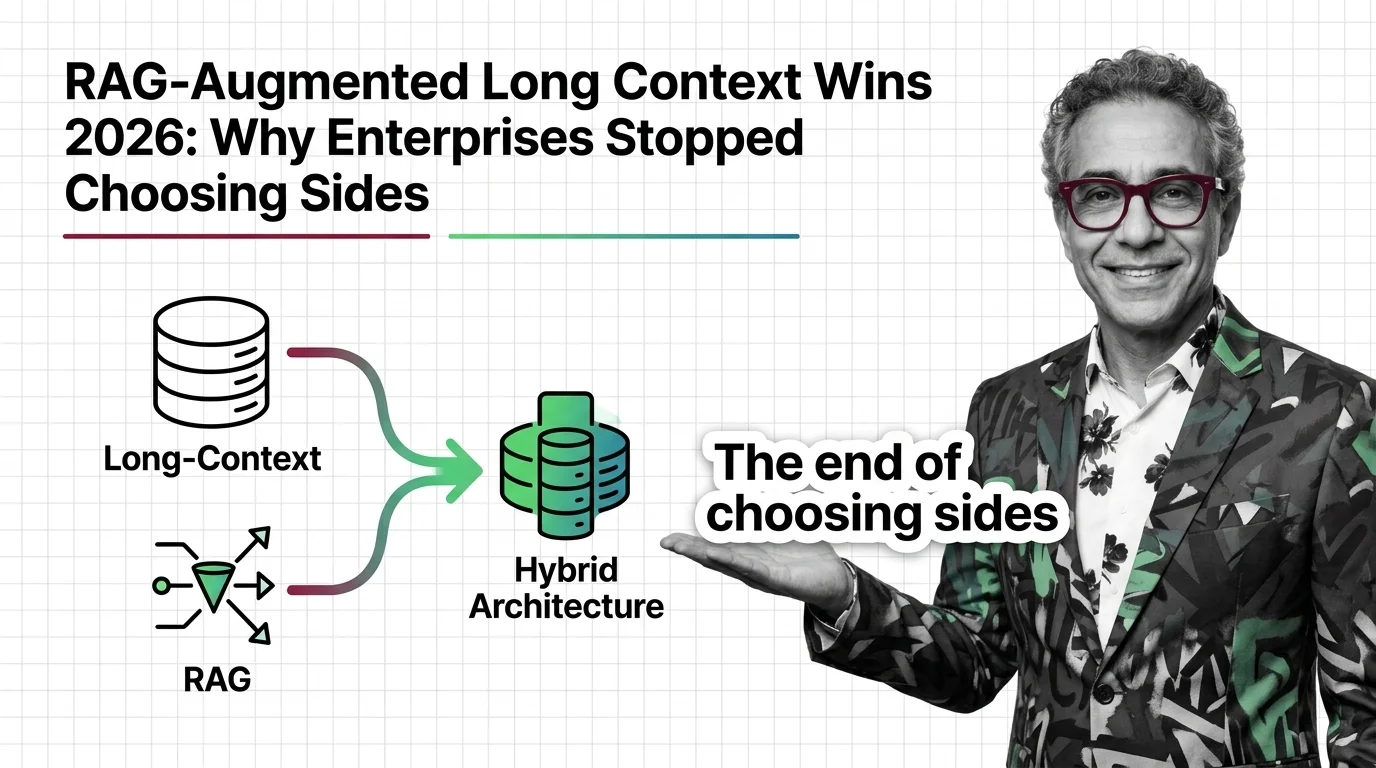
Thesis: The convergence of frontier context windows did not kill RAG. It consolidated retrieval and long context into a single hybrid pattern that enterprises now treat as the default.
For two years, the architecture debate was binary. Either you indexed your corpus and retrieved chunks, or you waited for the context window to swallow your data whole.
Both camps just lost the argument.
What replaced them is uglier and more expensive: a hybrid stack where retrieval narrows the input and long context absorbs the survivors. Even the frontier vendors are pushing this read. Anthropic Docs explicitly acknowledge “context rot” — accuracy and recall degrade as token count grows. Google’s Gemini 3 documentation invites developers to dump everything into context, then concedes that “RAG remains valuable in specific scenarios” (Google AI for Developers). Translation: the labs selling the biggest windows won’t tell you to ditch retrieval.
You’re either running a hybrid stack within twelve months, or you’re paying the cost premium of pure long context while losing on accuracy.
Three Vendors, One Window, A Tripled Retrieval Spend
The architecture race ended in a tie. The economics didn’t.
By April 2026, three frontier labs had shipped 1M-token windows. Claude Opus 4.7, Opus 4.6, and Sonnet 4.6 went GA at standard pricing on March 13, 2026 (Anthropic Docs). Gemini 3 Pro launched in late April with 1M input and 64k output (Google AI for Developers). GPT-5.5 followed days later with a 1M-token API at $5 input / $30 output per million tokens (OpenAI).
Three vendors. One window size. Same quarter.
The pricing tells the story. Gemini 2.5 Pro sits near $1.25 per million input tokens; GPT-5.5 charges $5 per million on input. A retrieval query that pulls just the relevant chunks costs fractions of a cent — roughly three orders of magnitude cheaper per call before prompt caching narrows the gap (MindStudio, illustrative). At enterprise QPS, the math forces hybridization regardless of capability.
Then the demand-side data landed. VentureBeat’s Q1 2026 enterprise read reported intent to adopt hybrid retrieval rose from roughly 10% to 33% in a single quarter — single-source, treat as directional. First-generation single-vector RAG hit a scale wall. The fix wasn’t to delete it. The fix was to surround it with reranking, sparse retrieval, and grounded long-context grading.
That’s a market correcting toward RAG Evaluation as a first-class layer. Sparse Retrieval returned to relevance the moment dense embeddings alone stopped surviving production traffic.
Bigger windows didn’t repeal physics. Liu et al.’s Lost in the Middle finding (Stanford / arXiv) still holds: models prioritize the start and end of context, and middle content recall degrades. Databricks Blog has shown long-context RAG performance often saturates or degrades as more retrieved docs get stuffed in. The failure mode just moved.
Who Cashed In on the Convergence
The winners pre-built for the marriage.
Reranker vendors and hybrid-search platforms are the cleanest beneficiaries. Reranking lifts retrieval accuracy meaningfully over embedding-only setups (Maxim AI) — the standard mitigation for context rot. Every enterprise rebuilding its retrieval layer needs that lift, and it’s a procurement line item now, not a research project.
Anthropic comes out structurally well-positioned. Their docs lead with context-rot honesty and pair the 1M window with explicit guidance on when to retrieve. That’s the framing enterprises buying multi-year contracts want to hear.
Evaluation infrastructure vendors get pulled into every hybrid build, because the failure modes of context rot can only be caught with continuous grading. RAG Guardrails And Grounding is now a procurement line item, not a stretch goal.
The reranker, the evaluator, the grounding harness. Three categories without urgency twelve months ago. They have it now.
The Single-Layer Bets That Just Got Stranded
Anyone who staked their architecture on one layer is recompiling.
Pure-vector RAG vendors without reranking, hybrid search, or evaluation hooks are watching mid-market customers churn. VentureBeat’s framing — first-generation RAG hit the scale wall — names the cohort directly.
The “just stuff it in the context” cohort looks equally exposed. Anthropic-acknowledged context rot, plus the Lost-in-the-Middle baseline, plus the per-query cost, plus secondary benchmarks suggesting effective context can fall well below the advertised window on complex tasks (Markaicode, illustrative). Four converging headwinds against the dump-it-all strategy.
Teams still on Claude Sonnet 4.5’s 1M beta got the cleanest deprecation signal of the cycle. The beta is retired; requests above 200k now error. The capability migrated to Sonnet 4.6, Opus 4.6, and Opus 4.7 (Anthropic Docs). Migrate or break.
You’re either modernizing toward hybrid retrieval-plus-long-context, or you’re explaining context-rot incidents to your security review committee next quarter.
What Happens Next
Base case (most likely): Hybrid RAG-plus-long-context becomes the default reference architecture for enterprise AI, with reranking and continuous evaluation as standard layers. Signal to watch: A second tier-1 enterprise survey confirming hybrid retrieval intent above 30% by year-end. Timeline: 12 months.
Bull case: Frontier labs publish vendor-blessed hybrid reference stacks (retrieval + context patterns), accelerating standardization and compressing custom pipeline work. Signal: Anthropic, Google, or OpenAI ships a “reference RAG-plus-long-context” architecture with first-party reranking. Timeline: 6–9 months.
Bear case: A high-profile context-rot or grounding failure at a regulated enterprise triggers retrieval-only retrenchment in finance and healthcare; long context relegated to draft generation. Signal: A SEC, FCA, or EMA enforcement action citing AI-generated context errors. Timeline: 12–18 months.
Frequently Asked Questions
Q: Is RAG dead now that Gemini and Claude support 1M-token context windows? A: No. Enterprise hybrid retrieval intent roughly tripled in Q1 2026 (VentureBeat) precisely because long context didn’t solve cost asymmetry, context rot, or auditability. RAG isn’t dead. It’s been promoted into a hybrid stack alongside long context.
Q: What is the future of long-context vs RAG architectures heading into 2027? A: The two layers converge. Expect hybrid pipelines — retrieval plus reranking plus long-context grading — to become the default reference architecture, with vendor-published patterns and continuous evaluation as standard. Single-layer bets compress.
The Bottom Line
The 1M-token race ended in a tie, and the prize went to retrieval. Hybrid stacks — retrieval narrowing the input, long context absorbing the survivors, evaluation grading both — are the new enterprise default. Watch for first-party reference architectures from frontier labs.
AI-assisted content, human-reviewed. Images AI-generated. Editorial Standards · Our Editors