Queues, Quality Gates, and Webhooks: The Core Components of a Generative Media Pipeline
ELI5
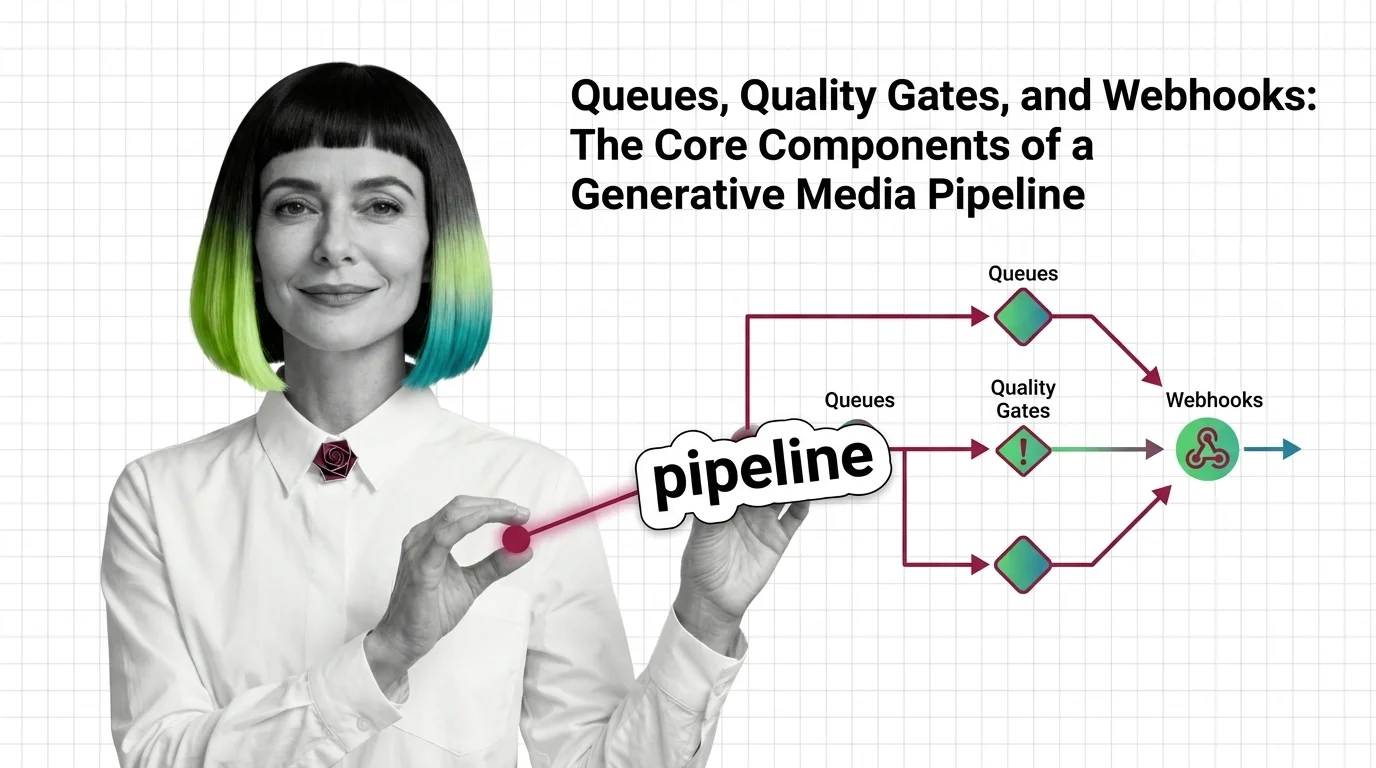
A generative media pipeline is the plumbing between an AI request and a finished image or video: a job queue holds the work, a quality gate checks the result, and a webhook tells your app when it’s actually done.
Call a language model and tokens start streaming back inside a second. Call an image or video model through one of today’s Generative Media APIs and you get back a ticket number instead of a picture — a promise of one, queued somewhere behind GPUs busy rendering someone else’s request. That isn’t a worse API design. It’s the correct response to a different kind of computation.
The Three Parts Hiding Behind Every “Generating…” Screen
Strip away the provider-specific SDKs and most generative media pipelines reduce to the same shape, repeated across fal.ai, Replicate, Stability AI, and anything built on top of them. Each piece solves a problem that simply doesn’t exist for text generation, where output streams token by token in roughly the time it takes to read it. Here’s what’s actually doing the work behind that spinning indicator.
What are the main components of a generative media pipeline?
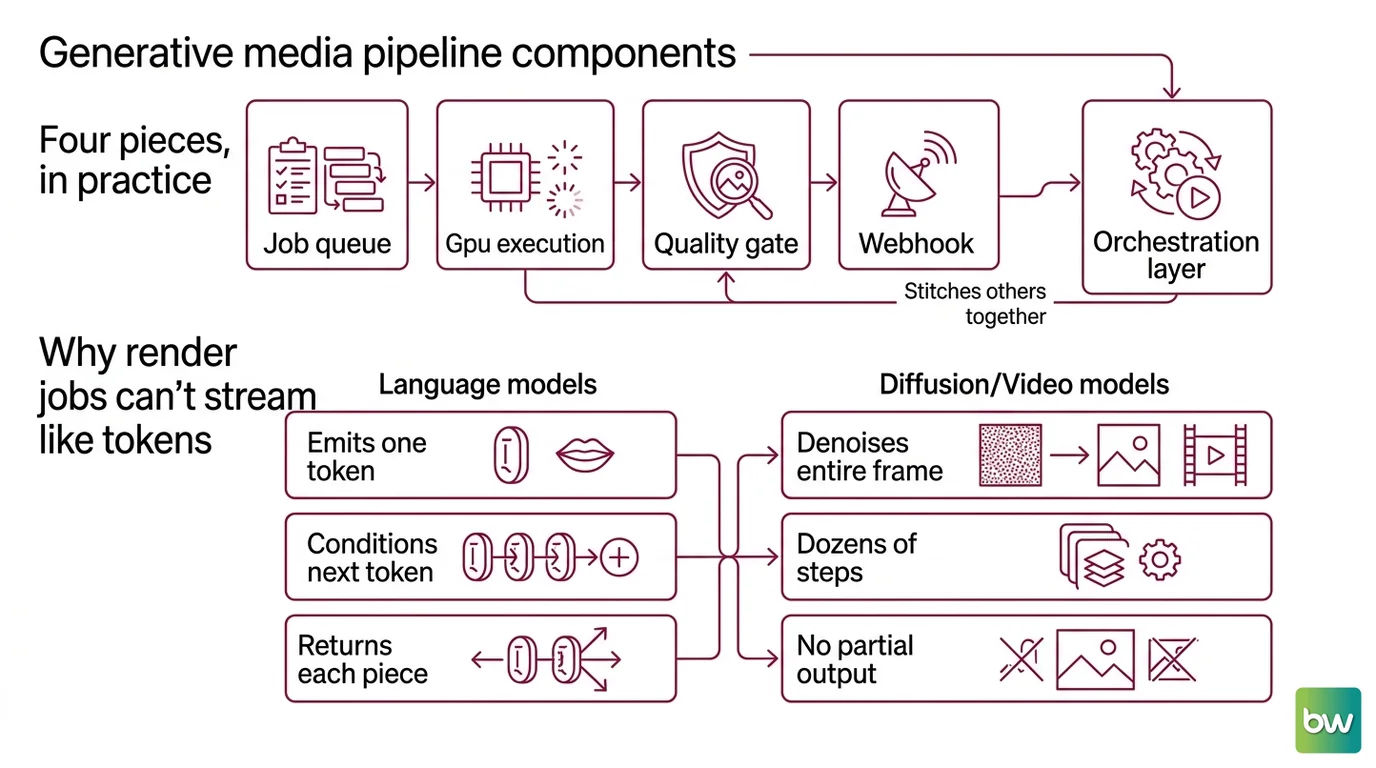
Four pieces, in practice. A Generative Media Pipelines starts with a job queue that accepts the request and holds it until a GPU is free — submission and execution are deliberately decoupled. A Quality Gate inspects what comes back: wrong aspect ratio, a blank frame, a result that trips a safety classifier — anything that shouldn’t reach a user gets caught here before it moves further down the chain. A Webhook closes the loop by calling your application back the moment a job resolves, instead of making your code ask repeatedly. And increasingly, an orchestration layer like n8n stitches the other three together into something a non-specialist can actually read and modify — trigger, generate, gate, deliver, as a visible chain instead of buried application code.
None of these four pieces exist because someone designed an elaborate architecture for its own sake. Each one is a direct answer to a constraint imposed by the kind of model sitting behind the API.
Why a Render Job Can’t Stream Like a Token Can
The anomaly from the opening resolves once you look at what’s actually happening on the GPU. A language model emits one token, conditions the next token on everything before it, and returns each piece as soon as it exists. A diffusion or video model denoises an entire frame across dozens of steps before any pixel is final — there’s no partial output worth sending back early, because the image doesn’t exist yet in any usable form.
What is a job queue and why does it matter in AI content generation?
A job queue is the structure that makes that wait tractable instead of catastrophic. Fal AI’s queue endpoint, queue.fal.run, accepts a submission and returns a request ID immediately; the job sits queued until a worker pulls it, moves into active processing once a GPU picks it up, and resolves to a result the caller can fetch or be told about. Critically, the wait itself costs nothing. Billing starts at inference, not at submission, and a Flux Schnell frame runs $0.025 only once a GPU actually starts rendering it (fal.ai’s pricing page).
Modal Labs offers the same separation one layer down, at the raw compute level rather than the packaged-model level: a function call submitted with spawn() returns instantly as a handle the caller can check or wait on later, scaling to roughly a million offloaded tasks (Modal Docs).
Not a queue because providers enjoy making people wait. A queue because GPU memory is the actual bottleneck, and something has to decide who renders next when demand exceeds supply.
The Parts Most Tutorials Skip: Validation, Notification, and Vendor Risk
Submitting a job and waiting for it covers only the easy part of building something production-ready. What separates a prototype from a pipeline you can trust is what happens after the result comes back, and what happens if the provider behind it changes.
What do you need to know before building an AI content generation pipeline?
Three things, mainly.
First, validate before you trust. A quality gate, to borrow the term SonarQube popularized for CI/CD pipelines, is a set of pass/fail conditions an output must clear before it’s allowed to advance (SonarQube Docs). Applied to media generation, the same logic checks things a diffusion model can’t reliably check about itself: did it render at all, does it match the requested dimensions, does it clear a safety classifier. None of that happens automatically inside the generation API; it’s a layer you build.
Second, notification beats polling. Replicate lets you register a webhook URL that fires once a prediction or training job completes (Replicate Docs), instead of making your code ask repeatedly whether it’s done yet — the job announces itself. That’s the better default for anything beyond a quick prototype, though it does mean trusting that the incoming request actually came from the provider and not from anyone who guessed the URL.
Third, no provider is permanent. Replicate changed ownership in December 2025, when Cloudflare’s acquisition closed; the company maintains, as of mid-2026, that the API itself hasn’t changed (Replicate’s blog). Stability API runs on a credit-based pricing model instead of a flat per-image rate, which is a different cost shape to plan around, not just a different number. A Multi Provider Abstraction layer — the same idea gateway libraries use to normalize many vendors behind one interface — is what keeps a change at any single provider from becoming a rewrite of your application code.
Two of the tools covered here also released notable changes recently (n8n’s release notes) — details below before you build on them.
Security & compatibility notes:
- n8n v2.0: Code nodes lose default environment-variable access, MySQL/MariaDB support is dropped, the
--tunnelCLI flag is removed, and file operations are now sandboxed. v1.x receives only a limited security-patch window — budget time for the upgrade instead of deferring it.- fal.ai queue runner: The queue state model added a new
IDLEstate, so code polling runner status needs updating before it misreads a job’s progress. Separately, revoking an API key can leave in-flight requests stuck reportingIN_PROGRESSindefinitely, still counting against your concurrency limit — avoid revoking keys while jobs may be in flight.
What This Architecture Predicts About Your Failure Modes
Once the shape is visible — queue, gate, webhook, abstraction — failure modes stop looking random and start looking predictable.
If you skip the quality gate, expect a corrupted or blank frame to reach a real user eventually; diffusion sampling collapses occasionally, and nothing upstream of your own check catches that for you.
If you hardcode a single provider’s SDK instead of routing calls through an abstraction layer, expect a forced rewrite the next time pricing changes, a model gets deprecated, or — as Replicate’s customers just learned — the company itself changes hands.
If your webhook endpoint doesn’t verify where a request actually came from, you’re trusting that anyone who discovers the URL is the provider, not someone forging a “job complete” callback.
If you poll instead of registering a webhook, expect to either burn requests checking on a job that isn’t finished yet, or — in rarer failure cases — miss one that’s stuck in a state it should have already left.
Rule of thumb: design every generation call as long-running from the first line of code; treating it as synchronous is the assumption that breaks first, and it breaks in front of a real user, not in testing.
When it breaks: webhook delivery is not guaranteed. A brief outage on your endpoint can silently drop the one callback that mattered, and most providers’ retry policies aren’t generous enough to make up the difference — which is why a pipeline that only listens and never double-checks eventually loses a job.
The Queue Is Also a Price Boundary
There’s a detail easy to miss in all of this: where the queue boundary sits is also where the billing boundary sits. fal.ai prices custom GPU workloads by the second — H100 time from $1.89 an hour — completely separate from its flat per-image rate for packaged models like Flux Schnell, which runs $0.025 a frame regardless of how long the GPU underneath actually took. Two pricing philosophies, one queue underneath: one prices the resource, the other prices the result.
That split matters more than it looks. A provider charging by the GPU-second is exposing you to its own infrastructure efficiency — a slower implementation costs you more. A provider charging per output absorbs that variance itself, and the pricing model is a bet on inherited risk.
The Data Says
The mechanism explains the pattern: diffusion and video models can’t stream partial output the way token-by-token text generation can, so fal.ai, Replicate, and Modal-backed pipelines all converge on the same queue-gate-webhook shape instead of pretending the call is synchronous. What’s left to vary sits one layer up — billing boundaries, breaking changes, who owns the API this year — and that’s exactly where an abstraction layer earns its keep.
AI-assisted content, human-reviewed. Images AI-generated. Editorial Standards · Our Editors