Queue Backlogs, Model Drift, and the Hard Limits of Automated Content Pipelines
ELI5
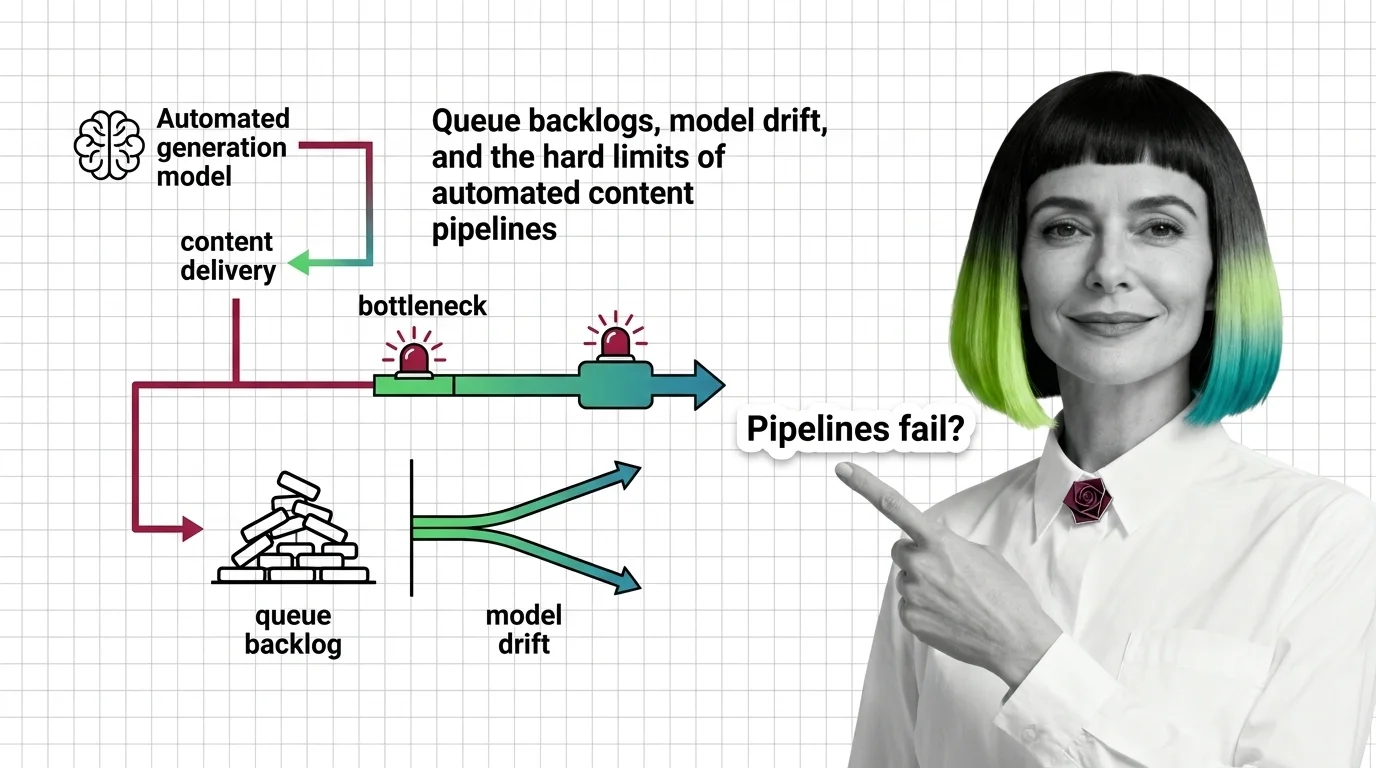
Generative media pipelines rarely break because the model gets worse. They break because the queue fills, the webhook times out, or the API underneath quietly changes shape while nobody was watching.
A pipeline running fine at fifty jobs an hour will, without warning, start throwing “Resource Exhausted” errors the moment someone schedules a five-hundred-image batch overnight — while every GPU underneath sits idle. The instinct is to blame the model: assume the weights drifted, the provider throttled quality, something upstream got worse. It didn’t. The pipeline hit a ceiling that has nothing to do with intelligence and everything to do with arithmetic.
Five Hops, Five Different Ways to Fail
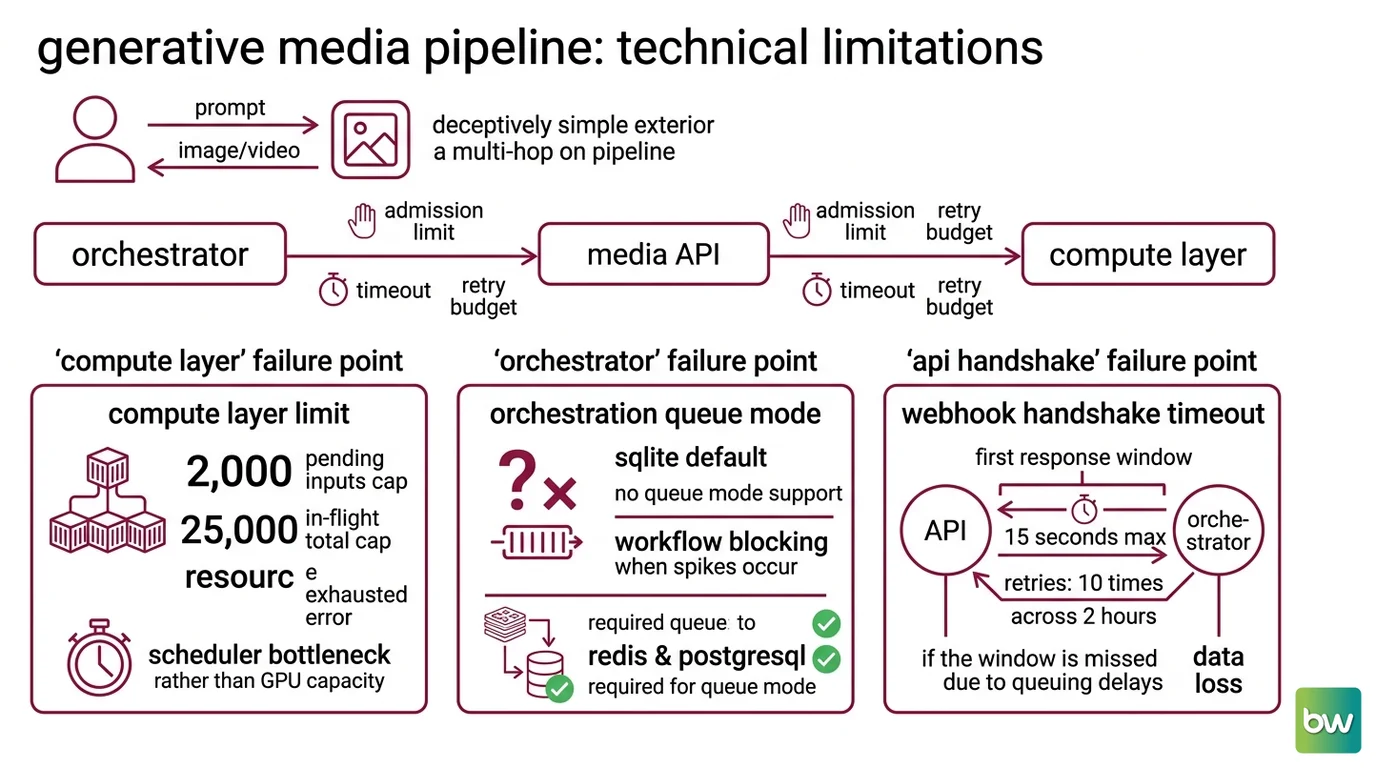
A single generation call looks simple from the outside: send a prompt, get back an image or a video clip. Underneath, a typical Generative Media Pipelines setup chains together an orchestrator, a media API, and a compute layer, with Queue Based Processing meant to absorb bursts at every hop. Each hop carries its own admission limit, its own timeout, and its own retry budget. None of those limits are about model quality. All of them are about traffic.
What are the technical limitations of generative media pipelines?
The first hard limit sits at the compute layer. Modal Labs, the serverless GPU layer many of these pipelines run on, caps each function at 2,000 pending inputs and 25,000 total inputs in flight — cross that line and the call returns a “Resource Exhausted” error, not a queued job (Modal Docs). The ceiling is architectural, not computational. It exists because a function’s containers can only fan out so far before the scheduler itself becomes the bottleneck, not because the GPUs ran out of capacity.
The second limit sits one layer up, in the orchestration tool stitching the calls together. n8n can run in queue mode to survive exactly this kind of spike, but only if it’s wired to Redis and PostgreSQL — its queue mode does not support SQLite, the database most self-hosted instances start with by default (n8n Docs). A pipeline built for a demo on SQLite has no queue mode to fall back on when the overnight batch arrives; it just blocks.
The third limit sits at the handshake between API and orchestrator: the Webhook. Fal AI gives a generation job fifteen seconds to deliver its first webhook response, then retries up to ten times across a two-hour window before giving up entirely (fal.ai Docs). If the receiving n8n workflow is itself queued behind a backlog and doesn’t respond inside that window, the job’s result is gone — not delayed, gone.
Why the Backlog Doesn’t Drain on Its Own
Scale doesn’t just add more requests to the same system — it changes which constraint binds first. Swapping one Generative Media APIs provider for another rarely fixes a scaling problem, because the bottleneck usually isn’t which model generates the media. At low volume, a pipeline never reaches its queue ceiling and never waits long enough for a webhook to expire; at scale, every constraint arrives at once. Constraints compound instead of adding.
Why do automated content pipelines fail at scale?
Cold starts are the clearest example. A Modal container boots in roughly a second, but “booted” is not the same as “warm” — the function isn’t ready to accept work until its initialization logic finishes running (Modal Docs). Under a steady trickle of requests, that distinction barely matters. Under a burst, every new container spun up to absorb the spike pays that initialization cost again, so the effective latency of the whole batch rises with the size of the spike, not just its volume.
Cost Per Generation compounds the same way. fal.ai prices a Wan 2.5 video render at five cents per second and a Veo 3 render at forty cents per second (fal.ai’s pricing page). Neither number looks dangerous in isolation. Multiply by a backlog retried twice because of a webhook timeout, and the pipeline has paid for several renders to deliver one usable result.
The retry behavior itself is where
Replicate draws an unusual line. Its terminal webhooks — succeeded, failed, canceled — retry on exponential backoff for roughly a minute after completion. Its intermediate-state webhooks, the output and logs events that report progress mid-job, are never retried at all (Replicate Docs). A monitoring dashboard built to assume every webhook eventually arrives will quietly drift out of sync with the jobs it’s tracking — not because a request failed, but because the architecture never promised to tell it twice.
What the Queue Math Predicts
Once the constraint is understood as arithmetic rather than model behavior, the failure pattern becomes predictable instead of mysterious.
If a pipeline’s batch size approaches the orchestrator's queue ceiling, expect “Resource Exhausted” errors clustered at the start of the batch, not spread evenly through it — the scheduler rejects admission before it ever reaches the slower jobs further back. If a workflow engine is still running on its default database, expect failures to appear only under load, never in testing, because small batches never touch the queue-mode threshold that exposes the missing backend. If a webhook receiver is itself queued behind other work, expect silent data loss past the provider’s retry window rather than a visible error — the API gave up quietly, on schedule.
Rule of thumb: size queue depth and webhook timeout handling to the slowest component in the chain, not the fastest GPU in it.
When it breaks: Replicate’s intermediate-state webhooks are never retried, so a downstream dashboard that assumes every progress update eventually arrives will desync from the actual job state under any sustained backlog — the practical fix is polling the job status endpoint directly rather than trusting webhook delivery alone.
The Drift Nobody Budgets For
There’s a second failure class that has nothing to do with queues: the pipeline that worked yesterday and doesn’t today, with no code change on either side. The model itself is rarely the moving part — Stability AI’s flagship is still the Stable Diffusion 3.5 family it shipped in October 2024, with no successor announced as of mid-2026 (Stability AI). What moves instead is the surface around the model. Stability API retired its Stable Video and Stable Diffusion 1.6 endpoints in mid-2025; any pipeline still calling those URLs now fails outright, not because the model degraded, but because the endpoint stopped existing. Replicate’s ownership changed hands too — Cloudflare announced its acquisition in late 2025, and while the company states its API contract isn’t changing, a pipeline depending on Replicate as an independent vendor now depends on Cloudflare’s roadmap instead.
Not model drift. Infrastructure drift.
The weights didn’t move. The ground underneath the integration did — and a pipeline with no monitoring on endpoint health and no pinned dependency versions has no way to tell the difference between “the model got worse” and “the API stopped existing” until a generation job fails.
Security & compatibility notes:
- n8n workflow-expression RCE (CVSS 10.0): Critical unauthenticated remote-code-execution vulnerability (CVE-2026-21858, “Ni8mare”) plus a related authenticated bypass (CVE-2026-25049, CVSS 9.4) affecting self-hosted n8n instances. Fixed in n8n 1.123.17 and 2.5.2 — instances below these versions running the orchestration layer are exploitable.
- Stability AI endpoint deprecation: Stable Video API and Stable Diffusion 1.6 API were retired July 24, 2025. Pipelines still calling either endpoint fail outright; migrate to SDXL or SD 3.5.
- Replicate ownership change: Acquired by Cloudflare (announced November 2025). The API contract is unchanged today, but teams treating Replicate as a standalone vendor now carry roadmap risk tied to a different parent company.
The Data Says
The failures that take down generative media pipelines are rarely about model quality — they’re about queue ceilings, webhook retry windows, and orchestration databases that were never built for production load. Modal Labs caps functions at 2,000 pending inputs for architectural reasons, fal.ai gives webhooks a two-hour retry window, and Replicate never retries intermediate-state callbacks at all — three independent limits that compound at scale instead of adding. Diagnose the hop, not the model.
AI-assisted content, human-reviewed. Images AI-generated. Editorial Standards · Our Editors