PyG vs DGL, GNN+LLM Fusion, and Where Graph Neural Networks Are Heading in 2026
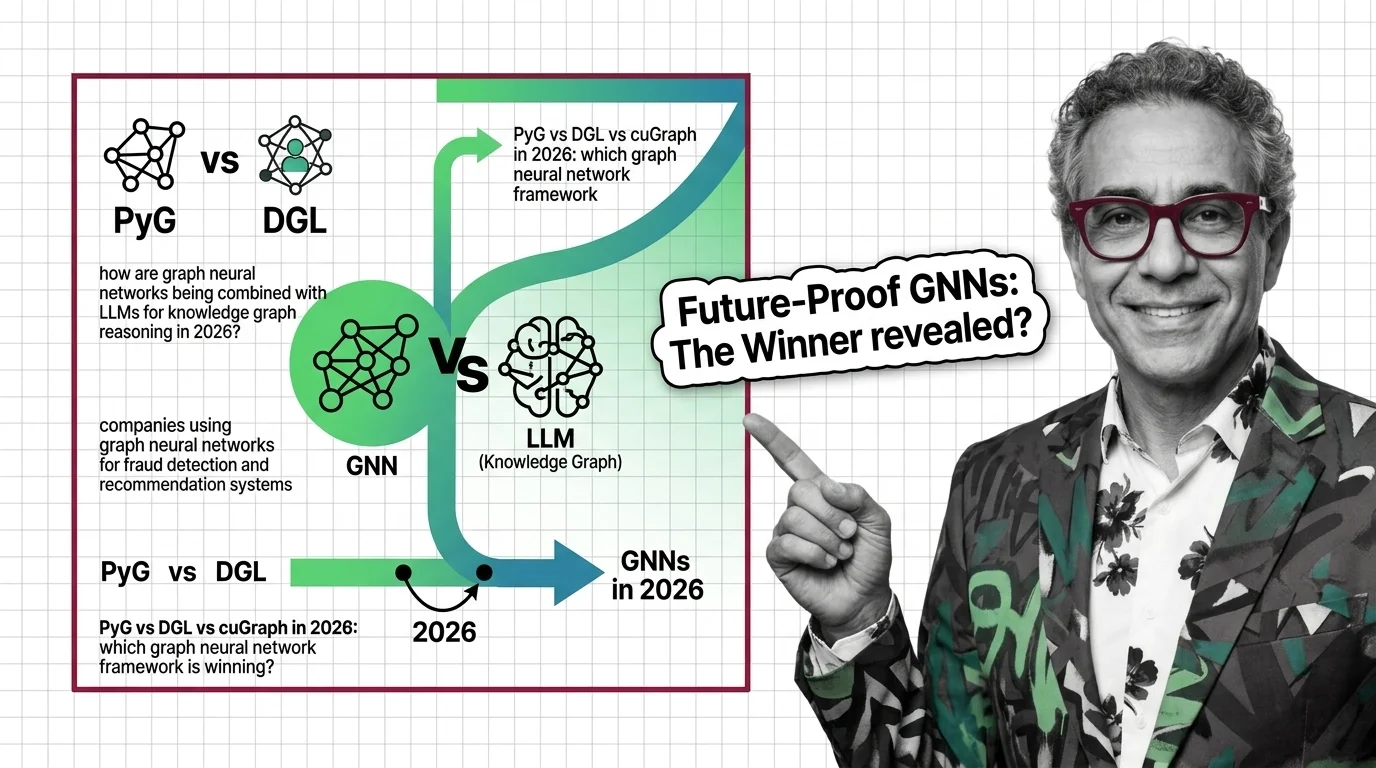
TL;DR
- The shift: NVIDIA is consolidating its entire graph stack around PyG — DGL support is being removed across cuGraph and PhysicsNeMo
- Why it matters: teams still building on DGL face forced migrations and a shrinking ecosystem
- What’s next: GNN+LLM fusion is turning graph networks from standalone models into reasoning engines for knowledge graphs
The Graph Neural Network framework race stopped being a fair fight. One side has NVIDIA’s full backing — the other is watching its integrations get stripped out, one release at a time.
That’s not a competitive market. That’s a consolidation.
The Framework Bet NVIDIA Already Made
Thesis: The GNN framework decision is no longer a technical preference — it’s an ecosystem survival question.
RAPIDS 25.06 removed cuGraph-DGL entirely (RAPIDS Docs). Not deprecated. Removed.
Teams using Deep Graph Library for GPU-accelerated graph analytics now have one option: migrate to cuGraph- Pytorch Geometric.
PhysicsNeMo tells the same story. NVIDIA added PyG support in 25.08, stripped DGL as the default in 25.11, and has full DGL removal on the roadmap (NVIDIA Docs).
The performance gap makes the bet rational. PyG delivers up to 30% GNN performance improvement over DGL in some workloads (NVIDIA Docs).
That’s not marginal. That’s the kind of delta that decides which framework gets the next round of investment.
DGL 2.4.0 shipped in September 2024 with multi-backend support across PyTorch, MXNet, and TensorFlow. The project has open issues and active PRs. But ecosystem activity and ecosystem momentum are different things.
NVIDIA chose a side.
Compatibility notes:
- cuGraph-DGL: Removed in RAPIDS 25.06. Migrate to cuGraph-PyG for GPU-accelerated sampling and heterogeneous graph support.
- PyG 2.7.0: Dropped Python 3.9 and PyTorch 1.11–2.5 support. Pin your environment before upgrading.
- PhysicsNeMo DGL backend: Removed as default in 25.11. Full removal planned. Begin migration now.
Graphs That Learn to Reason
GNN+LLM fusion is the second structural shift — and it’s moving faster than most teams expected.
PyG ships a dedicated torch_geometric.llm module with GLEM, GRetriever, and TXT2KG models built for connecting graph structures to language models (PyG Docs). The module is still evolving — but it’s framework-level infrastructure for
Knowledge Graph reasoning, not a research demo.
The academic side confirms the direction. The EIG framework, published in Neurocomputing in May 2026, combines GNNs with LLMs for knowledge reasoning — reducing complexity from exponential to linear while mitigating hallucinations through structured Message Passing along graph paths (Neurocomputing).
Early results with limited independent replication. But the architecture pattern is unmistakable.
Fraud detection is where convergence hits production. An R-GCN plus XGBoost hybrid delivered a 39x GPU preprocessing speedup in NVIDIA’s 2022 benchmarks (NVIDIA Blog). With authorized push payment fraud projected to reach $7.6 billion by 2028 and false declines costing roughly $264 billion per year (Thoughtworks), the financial case for Graph Convolution at scale is no longer theoretical.
Uber Eats and Pinterest already run GraphSAGE for production recommendations — Node Embedding models handling billions of edges without hitting Oversmoothing limits.
Production deployment is no longer the question. Scale is.
Who Moves Up
Teams already on PyG. Their stack is the one getting NVIDIA’s investment. cuGraph-PyG now offers heterogeneous sampling and unified GraphStore, FeatureStore, and Loader interfaces for Adjacency Matrix operations at GPU scale. The integration points are being built around them.
Fraud and risk teams move up next. Even accounting for vendor-specific testing conditions, the preprocessing speedup signals that GNN-based fraud detection is crossing from experimental to operational.
Who Gets Left Behind
DGL-native teams face forced migrations. NVIDIA’s roadmap is explicit: DGL support is being removed, not deprioritized.
The DGL community isn’t dead. But when the largest GPU vendor removes your framework from its toolchain, talent and third-party investment follow the signal.
Teams running Spectral Graph Theory-based approaches on older PyTorch versions face a double migration — framework and runtime. PyG 2.7.0 dropped support for PyTorch versions through 2.5 (PyG GitHub).
You’re either starting the migration now or starting it under pressure later.
What Happens Next
Base case (most likely): PyG solidifies as the default GNN framework. DGL retains a research community but loses production adoption. GNN+LLM fusion moves from papers to early production in knowledge reasoning and fraud detection. Signal to watch: A major cloud provider deprecating DGL in its managed ML services. Timeline: Within 12 months.
Bull case: PyG’s torch_geometric.llm becomes a standard integration layer between graph data and foundation models. GNN+LLM agents handle multi-hop reasoning natively, cutting hallucination rates.
Signal: Two or more Fortune 500 companies disclosing GNN+LLM reasoning in production.
Timeline: 12-18 months.
Bear case: GNN+LLM fusion stalls — too complex for most teams to operationalize, too niche for platform providers to prioritize. DGL forks or gets absorbed. Signal: Minimal community adoption of PyG’s LLM module through late 2026. Timeline: 6-9 months for early indicators.
Frequently Asked Questions
Q: How are companies using graph neural networks for fraud detection and recommendation systems in 2026? A: Financial institutions deploy R-GCN and XGBoost hybrids on GPU clusters for real-time fraud scoring. Companies like Uber Eats and Pinterest run GraphSAGE at scale for recommendation systems, modeling user-item interactions across billion-edge graphs.
Q: How are graph neural networks being combined with LLMs for knowledge graph reasoning in 2026?
A: PyG’s torch_geometric.llm module provides GRetriever and TXT2KG models connecting graph structures to language models. Research frameworks like EIG use structured graph paths to constrain LLM reasoning and reduce hallucinations.
Q: PyG vs DGL vs cuGraph in 2026: which graph neural network framework is winning? A: PyG. NVIDIA removed cuGraph-DGL, is retiring DGL from PhysicsNeMo, and reports up to 30% performance gains with PyG. DGL remains active but is losing ecosystem support from the dominant GPU vendor.
The Bottom Line
The GNN framework war has a winner. PyG owns NVIDIA’s ecosystem, ships LLM integration out of the box, and is pulling away on dataset coverage and community investment.
If you’re starting a new graph neural network project, the framework decision is already made. If you’re on DGL, your migration timeline just got shorter.
AI-assisted content, human-reviewed. Images AI-generated. Editorial Standards · Our Editors