Provider Failover, Timeout Handling, and Thundering Herd: What Makes LLM Retry Logic Break
ELI5
LLM fallback and retry patterns — retry, fallback, circuit breaker, timeout — form a resilience stack. The system breaks when exponential backoff without jitter synchronizes all clients, recreating the spike it was designed to absorb.
The expected outcome seems obvious: add retry logic and get a more resilient LLM integration. The anomaly is that synchronized retries can sustain the very failure they were meant to escape — not by design, but because a synchronized burst of retries is structurally indistinguishable from the original traffic spike. Understanding that failure mode requires tracing how four mechanisms compose, and where each one makes the others more dangerous.
The Four Primitives of LLM Resilience Architecture
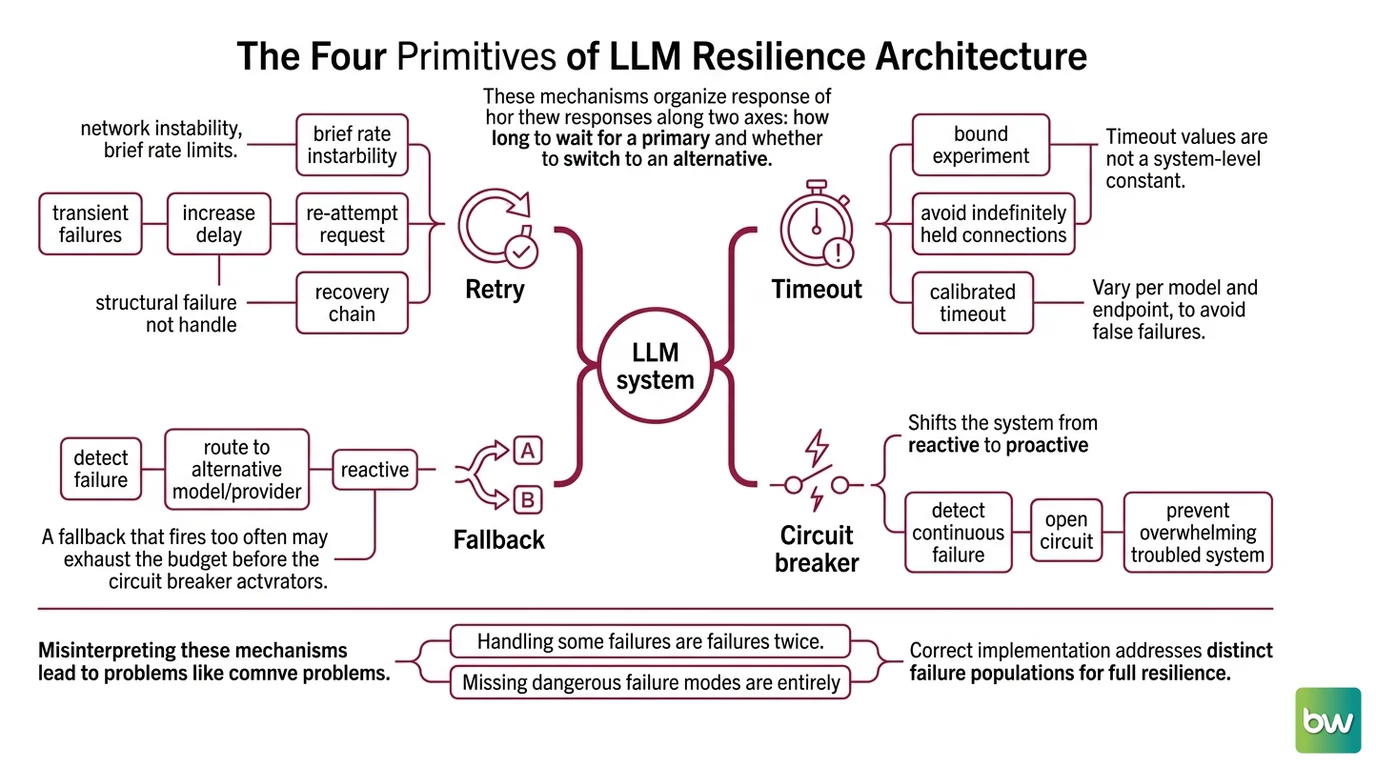
Resilience in LLM production systems isn’t a single dial — it’s a composition of four distinct mechanisms, each addressing a different failure population. Confusing which mechanism handles which failure produces a system that handles some failures twice and others not at all, while the most dangerous failure modes go entirely unaddressed.
What are the core components of an LLM resilience system — retry, timeout, circuit breaker, and fallback?
LLM Fallback And Retry Patterns organize a production system’s response to failure along two axes: how long to wait for a troubled primary (timeout and retry) and whether to switch to an alternative entirely ( Fallback Strategy and Circuit Breaker).
Retry re-attempts the same failed request with increasing delays. It belongs in the recovery chain for transient failures — network instability, brief rate limit events, cold starts. What retry does not handle is structural failure: a provider degraded for hours, a context window that consistently overflows, a guardrail that will block every attempt regardless of how many times the request is submitted.
Timeout bounds the experiment. Without it, a single stalled streaming response can hold a connection indefinitely — the retry loop never fires because the request hasn’t technically failed. LLM inference latency is highly variable (seconds for simple completions, minutes for long-context reasoning chains), so timeout values calibrated for REST APIs will generate false failures for LLM calls. The appropriate timeout is not a system-level constant; it varies per model and endpoint.
Fallback is reactive: the system waits for failure before routing to an alternative model or provider. This distinction matters because a fallback that fires on every retry exhausts the fallback budget before the circuit breaker has time to act.
The circuit breaker shifts the system from reactive to proactive. It monitors failure patterns — failed counts, failure rates, specific status codes (429, 502, 503) — and cuts traffic to unhealthy components before cascading failures propagate. Martin Fowler’s canonical circuit breaker definition describes three states: CLOSED (normal operation, failure counter tracked), OPEN (all calls fail immediately without reaching the provider, giving it breathing room to recover), and HALF-OPEN (limited test requests probe whether recovery has occurred). Five consecutive failures before tripping to OPEN is Fowler’s illustrative threshold (Martin Fowler, CircuitBreaker). The circuit breaker is the only proactive mechanism — the other three respond after a failure occurs; this one cuts traffic before the cascade compounds.
One implementation note:
LiteLLM, the most widely used LLM proxy, implements this using cooldown_time and allowed_fails rather than the classic three-state machine — when a model exceeds allowed_fails failures per minute, it is disabled for cooldown_time seconds (LiteLLM Docs). The behavior approximates a circuit breaker but without an explicit HALF-OPEN state. Understanding this distinction matters when debugging why a model re-enters rotation earlier or later than expected.
Infrastructure Failure vs. Semantic Failure: Why the Distinction Matters
Not every LLM failure calls for the same response. Routing a 429 rate limit error to the same handler as a 502 gateway timeout means applying a semantic solution to an infrastructure problem — and the mismatch compounds the incident.
What is the difference between provider failover and model fallback in LLM systems?
One useful operational distinction separates LLM failures into two categories. Provider failover responds to infrastructure failure — 5xx errors, network timeouts, hard provider outages — by swapping the underlying compute provider while keeping the model family. Model fallback responds to semantic failure — rate limit events, guardrail blocks, context-window overflow — by swapping the model or policy. This separation is not universally standardized across vendors, but it reflects a real difference in recovery strategy: infrastructure failures require rerouting connections; semantic failures require rethinking the request.
The
LLM Gateway layer is where both categories are handled. Tools like Portkey,
Openrouter, and LiteLLM expose this through ordered fallback chains and
Virtual Keys that abstract provider credentials behind a single
Model Routing interface. LiteLLM implements three distinct fallback types: regular fallbacks (fire on any error), content_policy_fallbacks (fire on moderation blocks), and context_window_fallbacks (fire when input exceeds the model’s context limit) (LiteLLM Docs). The separation allows the system to route a large-context request to a model with sufficient capacity without triggering a full provider failover for what is actually a capacity event.
This composability depends on the API Gateway understanding that Rate Limiting events are semantic — they signal a policy constraint, not a provider outage — and routing them accordingly. Most retry storm incidents begin when that distinction is absent and every error type floods the same retry loop.
Compatibility note: Cloudflare AI Gateway’s Universal Endpoint was deprecated in 2026. Documentation referencing it is outdated; the canonical pattern has moved to Dynamic Routing.
What a 429 Is Actually Telling You
Rate limit errors are the most common LLM failure mode in production, and they carry more diagnostic information than most retry implementations use. The decision to retry, wait, or fall back should be informed by what the 429 is measuring — and most LLM 429 errors include that measurement directly in the response headers.
What do you need to understand about HTTP 429 errors and rate limit windows before implementing LLM retries?
HTTP 429 responses from LLM APIs include four standard headers: X-RateLimit-Limit (the limit applied to the request), X-RateLimit-Remaining (remaining quota in the current window), X-RateLimit-Reset (Unix timestamp of when the window resets), and Retry-After (delay in seconds, or an HTTP-date) (IO Tools). When Retry-After is present, use it directly — it is more precise than any calculated delay, and it only appears on 429 responses.
The failure to read these headers is one problem. The second is treating all 429s as equivalent. Async code and large-context multimodal models are especially prone to rate limit events because they accumulate token costs faster per request (Google Cloud Blog). A retry implementation that ignores the rate limit window and retries at a fixed interval is essentially polling — it will keep firing until the window resets, contributing load rather than reducing it.
Google’s recommended approach for LLM 429 handling uses the tenacity library in Python with wait_random_exponential — multiplier of 1, maximum of 60 seconds — rather than pure fixed-increment backoff (Google Cloud Blog). The random element is the critical detail.
Not exponential backoff.
Exponential backoff with jitter.
The Thundering Herd: When Retry Logic Becomes the Spike
The most counterintuitive failure mode in LLM resilience systems isn’t a provider outage. It’s what happens when the resilience layer amplifies the failure it was built to contain.
What technical failure modes occur when LLM retry storms trigger thundering herd effects and latency spikes?
Exponential Backoff without jitter synchronizes all clients to retry at the same moment (Azure Architecture Center). If a fleet of agents each receives a 429 at T+0 and retries at T+1 second, they all fail again — a synchronized burst that recreates the herd on every attempt. The exponential doubling sequence (1s → 2s → 4s → 8s, typically capped at 60s) executes in lockstep across all instances, transforming a recovery pattern into a cascading overload. Azure Architecture Center documented 21,000 failed connection attempts to a single dependency within 30 minutes in a production retry storm with exactly this structure.
Full jitter resolves this by spreading retries across the backoff window: instead of retrying at exactly T+2s, each client retries at a random point within [0, 2s]. At the population level, a synchronized spike becomes a smoothly distributed load (IO Tools). The math is simple; the operational consequence is significant.
Three failure modes emerge from unsynchronized retry storms:
Synchronized retries sustain the overload. All clients retry at the same instant, recreating the original burst. The provider sees the same request volume as during the initial event and continues returning 429s — the storm becomes self-sustaining.
Latency amplification through queuing follows. Even if some retries succeed, the concurrent retry wave floods the provider’s request queue. Latency for successful requests increases as queue depth grows — often exceeding the original timeout threshold, which triggers additional timeouts and further retries.
A timeout-retry cascade on healthy providers is the third mode. If the timeout value is calibrated too aggressively for LLM latency distributions, a provider processing requests normally will appear to be failing. Retries fire, increasing load, which increases latency, which triggers more timeouts. Miscalibrated circuit breakers can trip on healthy providers — cutting traffic to a service that was never actually degraded.
What the Composition Predicts in Practice
These four mechanisms interact, and the interactions are predictable once the underlying dynamics are visible.
If you run multi-instance LLM deployments — multiple service replicas, parallel agents, or batch processing — exponential backoff without jitter is not a configuration choice. It is a correctness issue: the thundering herd is a mathematical certainty when enough instances retry simultaneously. Jitter converts a population-level synchronization problem into an individual-level probability distribution.
If timeout is set shorter than the 95th-percentile LLM latency for your workload, expect false failures on healthy providers — particularly during high-traffic periods when inference latency increases. The appropriate timeout for a streaming LLM response is not the appropriate timeout for a database query; treating them identically is a category error.
If the fallback logic fires on every retry (rather than after the retry budget is exhausted), fallback models will be exhausted before the primary has time to recover from a transient event. The correct sequencing is retry-within-primary before fallback-to-secondary, with circuit breaker monitoring at the provider level across both.
Rule of thumb: parse the Retry-After header before any fixed-delay logic. That header contains information your backoff formula doesn’t have — specifically, when the rate limit window resets.
When it breaks: circuit breaker thresholds are calibrated once and then drift. As traffic patterns shift, a threshold tuned for a given request volume will either trip prematurely under normal load or fail to trip during genuine degradation. Circuit breakers require observability to remain effective — the CLOSED-to-OPEN transition must be visible as a discrete event in monitoring infrastructure, not inferred from downstream latency.
The Data Says
LLM retry logic breaks when the mechanism is treated as a single lever rather than a layered composition. Pure exponential backoff without jitter is the primary mechanical cause of production retry storms — the thundering herd is a predictable outcome of synchronized clients, not a random failure. The fix is specific: full jitter on every backoff interval, Retry-After header parsing before any fixed delay, and a circuit breaker calibrated to distinguish transient failures from structural degradation. Each mechanism addresses a different failure population; the system becomes fragile when they are collapsed into one setting.
AI-assisted content, human-reviewed. Images AI-generated. Editorial Standards · Our Editors