Prompt Management Architecture: Registries, Templating Engines, and Observability Layers Explained
ELI5
Prompt versioning and management is the practice of storing, versioning, and serving prompt templates through a dedicated registry — so the exact prompt reaching an LLM is predictable, auditable, and testable at every call site.
A prompt that passes all local tests will fail in production — and the failure usually has nothing to do with the prompt text. Variable substitution renders as a literal {user_query} because the call site and the template engine use different brace conventions; a model version increments silently between calls; a system prompt injected by the orchestration layer collides with the user-facing one. These failures share a structural origin: the prompt is a parameterized template embedded in a runtime environment where model, variable bindings, and surrounding context drift independently of one another.
This observation is where Prompt Versioning And Management architecture begins — not with version control for its own sake, but with the recognition that every component of the runtime environment can diverge, and without a systematic way to observe that divergence, debugging becomes guesswork.
The Three-Layer Stack That Separates Playground from Production
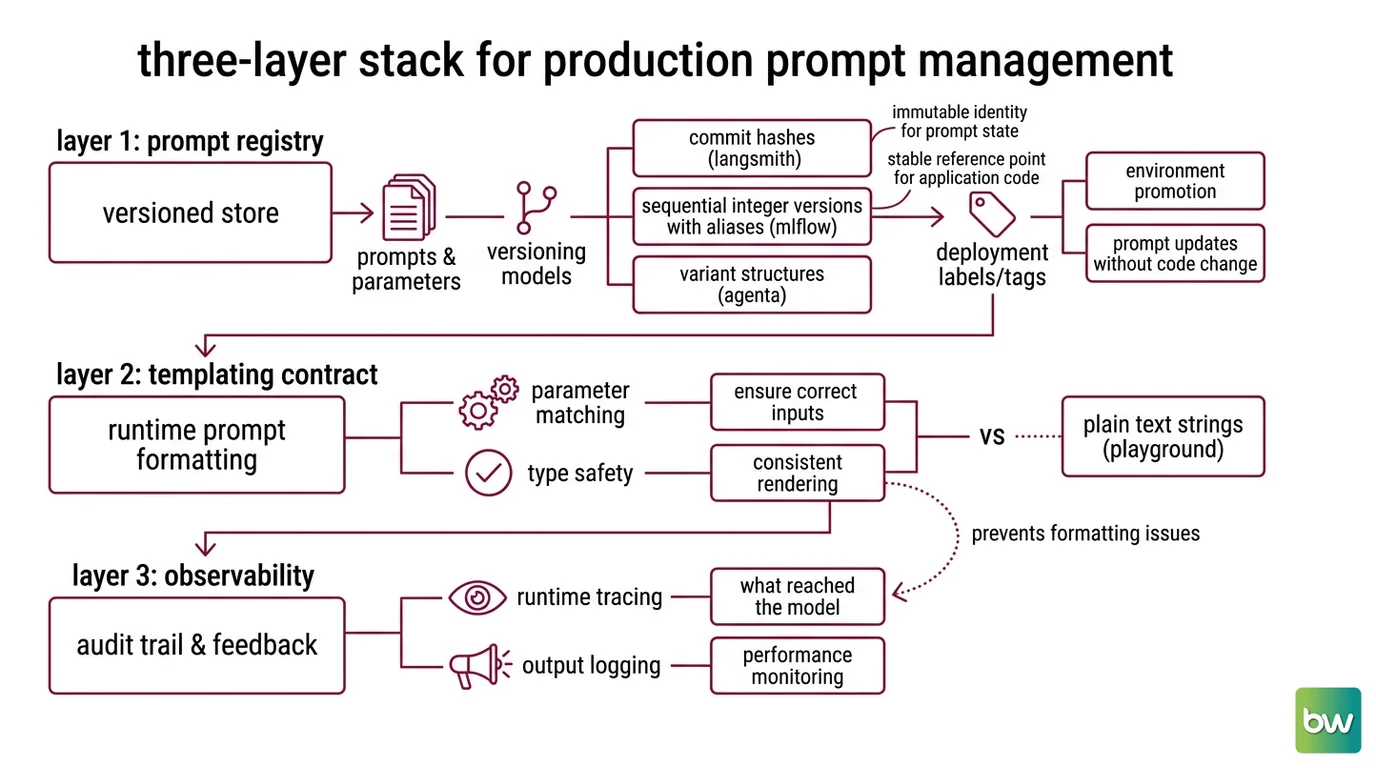
Most teams build the registry first and stop there. The registry gets the most attention because it solves the most visible problem: which prompt version is running right now, and who changed it. But a registry without a templating contract and an observability layer is a filing cabinet with no audit trail and no runtime feedback — it records what you stored, not what actually reached the model.
The three layers are structurally independent. Each one addresses a different failure class in production LLMOps systems, which is precisely why omitting one doesn’t degrade the others — it creates a blind spot in a different dimension entirely.
What are the components of a production prompt management system?
The prompt registry is the versioned store. It holds prompt templates, their parameters, and their deployment labels.
Langfuse — MIT open-source — uses a version number plus a label system; labels map to deployment environments (staging, production, or custom), so teams can promote a prompt without touching application code (Langfuse Docs). LangSmith takes a different approach: each change creates a unique commit hash, with environment tags applied separately for staging and production (LangSmith Docs). MLflow’s Prompt Registry, current as of version 3.14.0 released June 17, 2026, uses sequential integer versions with mutable aliases — the string production is an alias that can be reassigned to any version without changing the code that fetches it (MLflow Docs).
The versioning model matters more than it initially appears. LangSmith’s commit-hash approach gives every prompt state an immutable identity — the same text always produces the same hash, and a different hash is proof that something changed. MLflow’s alias model gives application code a stable reference point that operators can reassign in a single API call. Agenta structures variants differently again: as git branches, each with its own commit history — a design suited to evaluation workflows where several structural rewrites of the same prompt need independent lineage (Agenta Blog).
The templating engine separates prompt structure from the variable data that populates it. MLflow uses double-brace syntax — {{variable}} — for simple substitution, with Jinja2’s {% %} control-flow blocks available for conditionals and loops (MLflow Docs). That matters in practice: the same registry entry can serve both a simple name substitution and a branching prompt that adapts to user role and input length within the same call.
Brace syntax is not a cosmetic choice — a mismatch silently produces malformed prompts with no error, only wrong output. LangChain and LlamaIndex use single-brace syntax by default. MLflow’s answer is prompt.to_single_brace_format(), a conversion method that rewrites template syntax at fetch time so the caller receives the format it expects (MLflow Docs). Until the ecosystem converges on a standard, format conversion is a required engineering step in any heterogeneous stack.
PromptLayer takes a different structural approach: it wraps provider API calls as a proxy, inserting prompt fetching and logging between the application and the model endpoint. The integration surface is minimal, which makes it accessible to non-technical teams editing prompts independently of the application code. The cost is network latency on every inference call and limited visibility into complex agent traces.
The observability layer closes the feedback loop. Without it, prompt management is write-only — you can push changes to the registry, but you cannot measure how those changes affect the model’s actual output distribution. Langfuse uses a client-side SDK cache, so prompt retrieval runs at memory speed with no network round-trip for each inference call (Langfuse Docs). It also exposes prompt templates via Model Context Protocol, making them available to MCP clients as named resources rather than API endpoints (Langfuse Docs).
LangSmith’s observability integrates closely with the LangChain ecosystem but carries one hard operational limit worth understanding before building automation around it: one webhook per workspace (LangSmith Docs). Teams that want separate event handlers — one for staging promotions, one for production rollback alerts — cannot have both in the same workspace.
Compatibility note:
- LangSmith Tracing:
langchain-core1.2.4 or later is required for token counts, cost data, and input content to appear in traces. Earlier versions produce incomplete trace records (LangChain’s GitHub). Verify the installed version before relying on LangSmith observability data in production pipelines.
The Engineering Primitives and Where the Platforms Fall Short
The three layers sit on top of a set of engineering decisions that most teams haven’t made explicitly before adoption. Getting these right at the design phase prevents a class of failures that no amount of tooling can address after the fact — because the failures are architectural, not configurational.
What engineering concepts do you need before building prompt versioning infrastructure?
Content-addressable identity is not uniform across versioning platforms — and the difference determines what “prove it didn’t change” actually means. LangSmith’s commit-hash model borrows from git’s content-addressable storage: identity is derived from content, so the same prompt text always yields the same hash, and two different hashes are definitionally two different prompts. MLflow’s integer sequences don’t carry this guarantee — two adjacent version numbers can differ by one character or by a complete structural rewrite. Teams that need strong audit trails should reason about this distinction before selecting a registry, because it determines what “which prompt version was running at 14:32 on Tuesday” actually means.
Template compilation versus runtime rendering is a distinction that matters more than it appears. Template variables can be resolved when the template is stored or when it’s fetched and called. For Structured Output Prompting and Constrained Decoding: if your prompt includes a JSON Schema block that must match a runtime-determined output structure, static compilation at store time is not an option. You need the templating engine to render it dynamically at call time. Most registries support runtime rendering; few expose explicit control over when resolution occurs, which means the behavior is often implicit rather than designed.
Variable scope creates the injection surface. Separating prompt templates from variable data is architecturally sound — but it introduces the same vulnerability class as unsanitized SQL parameters. User-provided values that flow into a template through variable interpolation can carry Prompt Injection payloads through the variable slot rather than through the prompt text itself. A production registry should treat user-controlled variables as untrusted input and enforce structural validation before interpolation, not after. The registry’s job is to store templates safely; validation at the fetch or render layer is a separate concern that most teams add reactively.
The decision to decouple model parameters from prompt parameters directly affects Prompt Testing And Evaluation fidelity. The registry stores prompt text; model identifier, temperature, and sampling parameters are often stored alongside it or independently, depending on the platform. If model parameters and prompt text share a version record, a model upgrade creates a new prompt version even when the linguistic structure didn’t change. The version history accumulates entries that differ only in a model string or temperature value — useful for rollback, misleading as a change log. Decoupling them allows separate versioning for the linguistic structure and the inference configuration, which drift at different rates and for different reasons.
Tool Use in Prompts is itself a versioned artifact in agentic systems. The tool schema embedded in a prompt reshapes the model’s output distribution in the same way a prompt text change does — it alters what the model treats as valid completions. Most teams don’t version tool schemas with the same rigor as prompt text, which means the observability layer cannot correctly attribute behavioral changes to their actual source when a schema and prompt text change simultaneously.
What are the technical limitations of prompt management tools in 2026?
The limitations follow predictably from architectural choices, which makes them worth understanding before committing to a platform — because the gaps are structural, not missing features that will be added in the next release.
Registry-deep tools optimized for the proxy model — where prompt fetching and logging happen between the application and the model endpoint — solve the version-control problem well and the feedback-loop problem partially. The proxy layer is fast to integrate and accessible to non-technical teams. Every agent step in a multi-step chain, however, generates a proxy round-trip in the critical path. In an agentic workflow with several sequential steps, that latency accumulates entirely outside the model call — before the model is invoked even once. At production inference volumes, that overhead is not cosmetic.
Hard operational limits surface late. LangSmith’s one-webhook-per-workspace constraint (LangSmith Docs) is invisible during initial adoption. Teams that want separate event handlers — one for staging promotion events, one for regression alerts — cannot have both in the same workspace. Limits of this kind don’t appear in feature comparisons; they emerge when the automation architecture is already partially committed.
Template syntax fragmentation is a cross-ecosystem coordination problem, not a gap any single platform can close unilaterally. The MLflow prompt.to_single_brace_format() conversion method exists because LangChain, LlamaIndex, and native Python all use different brace conventions. Until the ecosystem converges, format conversion is a required engineering step in any heterogeneous stack — and conversion bugs produce silent malformed prompts rather than parse errors.
Token counts do not reveal semantic drift. Current observability layers trace costs, latency, and token volumes accurately. What they trace poorly is whether the model’s actual behavior on a given prompt class changed after a model or prompt version update — the question that matters most for Prompt Optimization. You can observe that a new model version costs more tokens per call; you cannot easily observe that it now handles edge cases differently. Closing that gap requires a dedicated Prompt Testing And Evaluation pipeline, separate from the observability layer.
Portkey, fully open-sourced in March 2026 (Portkey’s GitHub repository), addresses the gateway layer specifically — routing across more than 1,600 LLMs via a single endpoint, with versioned prompt templates and canary rollout support. The breadth of LLM routing coverage is genuine. The observability depth for complex agent traces lags behind platforms built observability-first from the start.
What the Architecture Predicts at Scale
The three-layer model implies several testable predictions for systems under production load.
If prompt text and model parameters share a version record, a model upgrade creates a new prompt version even when the linguistic structure is identical. The version history accumulates entries that differ only in a model identifier or a temperature value. The record is technically accurate and practically misleading as a change log.
If the templating engine resolves variables at fetch time rather than at store time, a malformed schema in a user-controlled variable will surface as a runtime error, not a validation error. The registry accepts the template at write time; the inference call fails when the variable is bound. Structural validation belongs at the fetch layer, not the storage layer — placing it at storage time catches a different, smaller class of errors.
If the observability layer runs as a proxy rather than as SDK instrumentation, every step in a multi-step agentic chain adds a proxy round-trip to the critical path. The latency cost is not the round-trip itself in isolation — it compounds across steps and becomes the dominant latency source before any model call occurs.
The transition period is the highest-risk configuration. The three-layer architecture assumes the registry is the authoritative source for what reaches the model. In practice, most teams begin prompt management after some prompts are already constructed inline — built from string concatenation in application code. During the transition, some prompts are registry-managed and others are not: observability is partial, rollback is inconsistent, and the version record misrepresents which prompts are actually in use.
Rule of thumb: Version prompt text, model parameters, and tool schemas as separate artifacts with separate histories. They drift at different rates and for different reasons — coupling them creates noise in all three records simultaneously.
When it breaks: Prompt management infrastructure fails silently when the registry is treated as the canonical record but bypass patterns exist in the application layer. A developer who constructs a prompt inline during a debugging session and forgets to remove it has created a divergence that the registry cannot detect, the observability layer will log under the wrong attribution, and the templating engine will never process.
The Data Says
The structural reason prompt management fails at scale is sequencing, not tooling. Teams add the registry first because it solves the most visible problem, then discover the templating contract is misaligned, then add observability after a production incident makes the blind spot undeniable. The correct design order runs in reverse — observability surface first, then the templating contract, then the registry — because each lower layer constrains what the layers above it can detect.
Not a tooling problem. An architecture problem.
AI-assisted content, human-reviewed. Images AI-generated. Editorial Standards · Our Editors