Prompt Engineering Foundations and the Technical Limits of Automated Prompt Tuning

ELI5
Prompt optimization uses algorithms — like DSPy or OPRO — to search for instructions that outperform human-written prompts. Before those tools can help, you need to understand both what you’re asking them to optimize and why the math resists it.
Engineers who run DSPy’s MIPROv2 for the first time often encounter a specific kind of confusion: the training metric climbs, the optimizer reports success, and the model outputs are somehow worse on new inputs. The tool did not fail. It optimized exactly what it was told to optimize. The failure lives in what “exactly what it was told” actually meant — and that meaning was underspecified by the engineer, not by the tool.
The common assumption is that automated Prompt Optimization removes the need to understand Prompt Engineering deeply. The actual relationship runs the other way.
Not a replacement. An amplifier.
The optimizer searches. You define the space it searches, the metric it maximizes, and the candidate examples it learns from. Every one of those decisions requires prompt engineering knowledge — which no tool can supply.
The Foundation Automated Tools Stand On
Automated optimizers are search algorithms, not reasoning systems. They traverse a space of candidate instructions, score each candidate against a defined metric, and return the highest scorer. The quality of that result depends entirely on what the engineer provides before the optimizer runs a single pass. Every optimizer assumes your problem is already defined — the labeled set, the metric, and the baseline are what make the search meaningful.
What do you need to understand before doing prompt optimization?
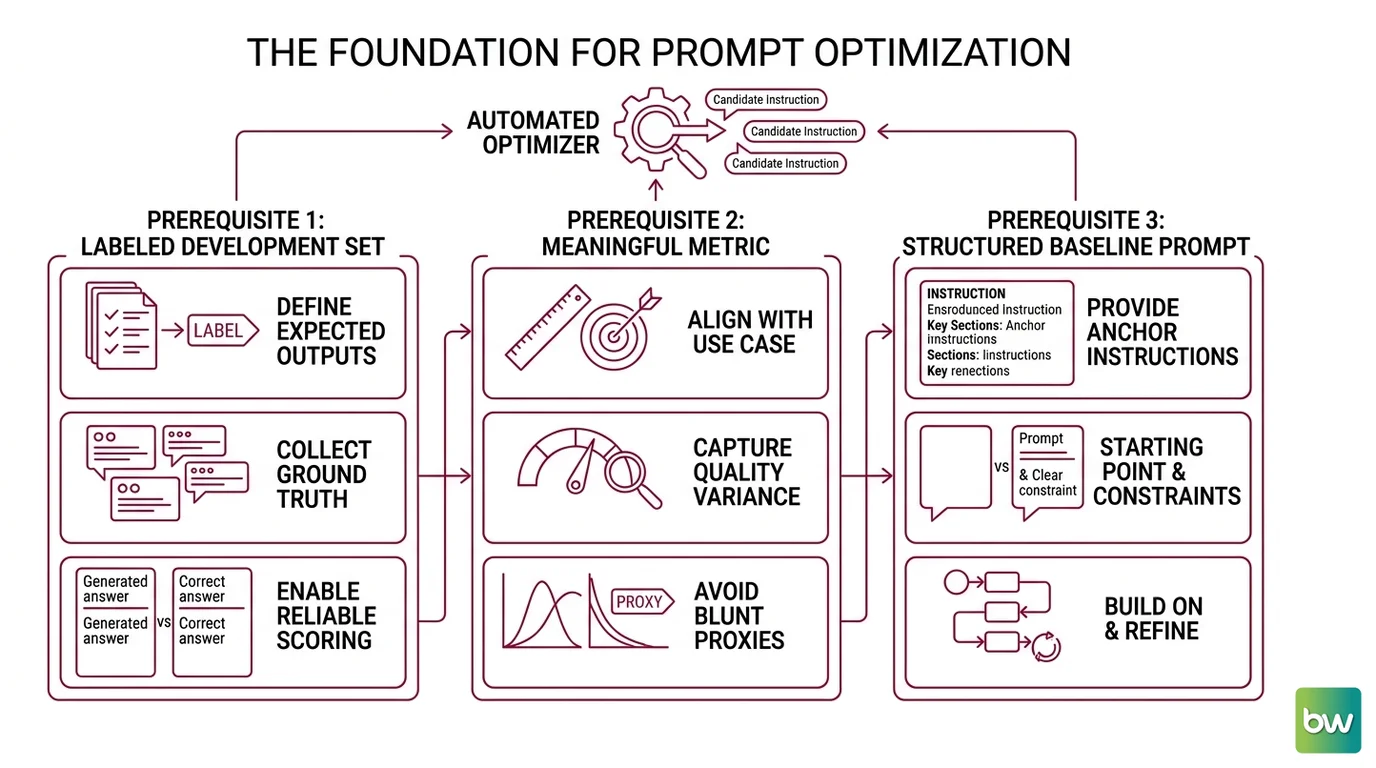
Three prerequisites determine whether an automated optimizer produces anything useful.
The first is a labeled development set with expected outputs. Every major optimizer — MIPROv2 in DSPy 3.2.1, Opro, Textgrad — requires one (DSPy Docs, OPRO Paper). This is not a configuration detail; it is a fundamental constraint. The optimizer has no mechanism for scoring candidate prompts without knowing what a correct output looks like. If your task produces open-ended outputs without ground truth labels, you must first define what “better” means — and that definition is Prompt Testing And Evaluation work, not optimization work.
The second prerequisite is a meaningful metric. Optimizers maximize what you measure. If the metric is a blunt proxy — raw accuracy on a narrow benchmark, for instance — the optimizer finds prompts that score well on that proxy without improving performance on the actual task. This is standard overfitting, extended to the instruction space (DSPy Docs). A useful metric captures the quality variance that actually matters for your use case, which requires understanding your use case well enough to formalize it.
The third is a structured baseline prompt. Optimizers build on and refine candidate instructions; starting from a blank slate produces high-variance search with no reliable anchor. A baseline that applies Structured Output Prompting patterns, specifies the expected format via JSON Schema, and constrains the output range through Constrained Decoding where appropriate gives the optimizer meaningful signal from the first evaluation round. A vague or inconsistent baseline expands the search space without improving search direction — the optimizer samples more candidates and converges on less.
What prompt engineering skills do you need to use DSPy and OPRO effectively?
The skills map directly to each tool’s architecture.
DSPy programs are typed: inputs and outputs have declared signatures, and the optimizer tunes the instructions connecting them. Using DSPy effectively requires the ability to decompose a task into a pipeline of typed steps — a structural design skill within prompt engineering. MIPROv2 jointly tunes instructions and few-shot examples using Bayesian Optimization, so poor seed examples in your baseline produce poor candidate examples in the optimizer’s output. The composition problem is yours to solve before the optimizer runs.
OPRO works differently: it uses an LLM as the optimizer itself, generating candidate prompts based on a meta-prompt that describes the task and prior evaluation scores. The OPRO paper reports genuine performance gains — best prompts outperformed human-designed ones by up to 8% on GSM8K and up to 50% on BIG-Bench Hard (OPRO Paper). Those gains depend on the accuracy of the meta-prompt description that the engineer writes. A vague task description produces a wandering search that converges slowly and inconsistently.
A skill that applies across both tools: the ability to evaluate outputs qualitatively and catch what automated metrics miss. Metric-valid outputs can still be stylistically drifted, subtly hallucinated, or structurally wrong in ways the labeled dev set didn’t anticipate. Neither DSPy nor OPRO surfaces that category of failure — the engineer has to.
One more skill belongs on this list. Prompt Injection vulnerabilities — where adversarial content in retrieved context manipulates the model’s behavior — are not prevented by optimizing the system prompt. An optimizer can produce an instruction set that performs well on every labeled example while remaining systematically open to injected instructions in the input stream. The optimizer and the threat model operate on different layers; understanding that separation is a prerequisite for using automated tools in any system that processes external inputs.
The Ceiling the Frameworks Cannot Raise
The structural limitation of automated prompt optimization is not a product gap that future versions will close. It emerges from the geometry of the search problem itself.
Neural network weights exist in a continuous space where gradient descent can follow the slope of the loss function; prompt instructions occupy a discrete space where small edits produce non-linear, unpredictable shifts in model behavior, with no directional signal equivalent to a gradient (ACL Anthology). This is why every current optimizer — regardless of the sophistication of its sampling strategy — is fundamentally an expensive search procedure rather than a convergence algorithm.
What are the technical limitations of automated prompt optimization tools in 2026?
The non-differentiable search space is the primary constraint. Minor edits to a prompt cause non-monotonic changes in model behavior. There is no gradient to follow; optimizers must either sample broadly or make assumptions about which parts of the prompt matter most, and those assumptions frequently do not transfer across tasks or models. DSPy’s MIPROv2 uses Bayesian Optimization to guide sampling more efficiently than random search, but the fundamental discreteness of the space remains (DSPy Docs).
The “textual gradient” framing that TextGrad introduced deserves scrutiny. TextGrad’s claim — that LLM feedback functions as a gradient signal for automatic differentiation via text — was examined in a December 2024 analysis (arXiv 2512.13598). The finding: textual gradient methods do improve performance, but the gradient analogy does not accurately describe their behavior.
The method works. The mechanism remains disputed.
This matters for practitioners because the gradient analogy implies directional convergence — if it’s not actually a gradient, the optimizer’s behavior under degraded conditions becomes harder to predict and diagnose.
Results do not transfer reliably across tasks or model families. Performance gains from automated optimization are highly specific to the task distribution used for optimization and to the model being optimized against; cross-model and cross-task transfer is unreliable (ACL Anthology). An optimized prompt is, structurally, an overfit artifact of its exact configuration — model, temperature, task distribution, and dev set composition. Treat it accordingly.
API cost is a real operational constraint. OPRO explicitly warns that calling LLM APIs during optimization may incur unexpectedly large costs (OPRO GitHub). Each candidate prompt evaluation requires a full LLM inference pass, multiplied by the number of candidates evaluated per round. Teams that run optimization without budget guardrails on the evaluation loop routinely encounter this.
Compatibility notes:
- OPRO — deprecated backend: OPRO depends on text-bison (PaLM 2 API), decommissioned by Google in October 2024 (Google Vertex AI Docs). The official repository has not been updated for Gemini backends. Community workarounds exist but are not part of the maintained codebase. Use OPRO for conceptual reference; verify any backend before production use.
- DSPy v3.x breaking changes: DSPy 3.2.1 (released May 2026) introduces significant API changes relative to v2.x, including NumPy dependency restructuring and changed GEPA result internals. Code referencing the legacy dspy-ai package or v2.x syntax requires adaptation (DSPy GitHub).
- Humanloop: Shut down September 2025. Teams managing prompt versions have migrated to Langfuse, PromptLayer, or Braintrust (Braintrust).
What the Geometry Predicts
The structure of the problem makes certain failures predictable. If the development set is too small, the optimizer overfits to it and produces prompts that degrade on the first out-of-distribution input. If the metric is a coarse proxy, the optimizer finds a degenerate solution — prompts that produce format-valid outputs while missing the actual quality dimension. If the model changes after optimization, the optimized prompt has no transfer mechanism; re-optimization from the new baseline is the only reliable path.
These are not surprising outcomes once you understand the search geometry. They are expected consequences of searching a discrete space with a finite labeled set.
The if/then predictions for practice:
- If your development set covers too few examples, the risk of overfitting exceeds the potential gain; expand the set before running the optimizer.
- If the training metric improves while production quality degrades, the metric is a poor proxy — redesign it before re-running.
- If you switch models after optimization, treat the optimized prompt as a starting point, not a finished artifact; cross-model transfer is unreliable.
- If your task produces open-ended outputs without clear ground truth, automated optimization is not the right tool; few-shot refinement with structured evaluation is.
Rule of thumb: An optimizer finds good instructions within the space you define — it cannot expand or improve that space itself.
When it breaks: Automated prompt optimization fails systematically when the evaluation metric does not capture the quality dimension that actually matters, because the optimizer has no mechanism for discovering what its objective is missing — it maximizes what it was given to maximize, regardless of whether that objective reflects the real problem.
The Data Says
Automated prompt optimization tools — DSPy, OPRO, TextGrad — are genuinely useful search procedures, but their utility is bounded by what the engineer provides before optimization begins: labeled data, a meaningful metric, a structured baseline. The structural ceiling imposed by the discrete, non-differentiable nature of text means these tools search more efficiently than manual iteration, but they cannot define the problem, evaluate results qualitatively, or catch the class of failure their metric does not measure. That work belongs to the engineer who runs them.
AI-assisted content, human-reviewed. Images AI-generated. Editorial Standards · Our Editors