Prompt Control as Organizational Power: Accountability Gaps in Enterprise Prompt Management
The Hard Truth
In August 2025, Anthropic acqui-hired the team behind Humanloop — one of enterprise AI’s most-cited prompt governance platforms. By September 8, 2025, the platform was shut down (TechCrunch). The behavioral governance infrastructure that enterprise organizations had built their AI controls around simply ceased to exist. This is not primarily a story about startup risk. It is a story about where control over AI behavior actually lives — and what it means when nobody governs the governors.
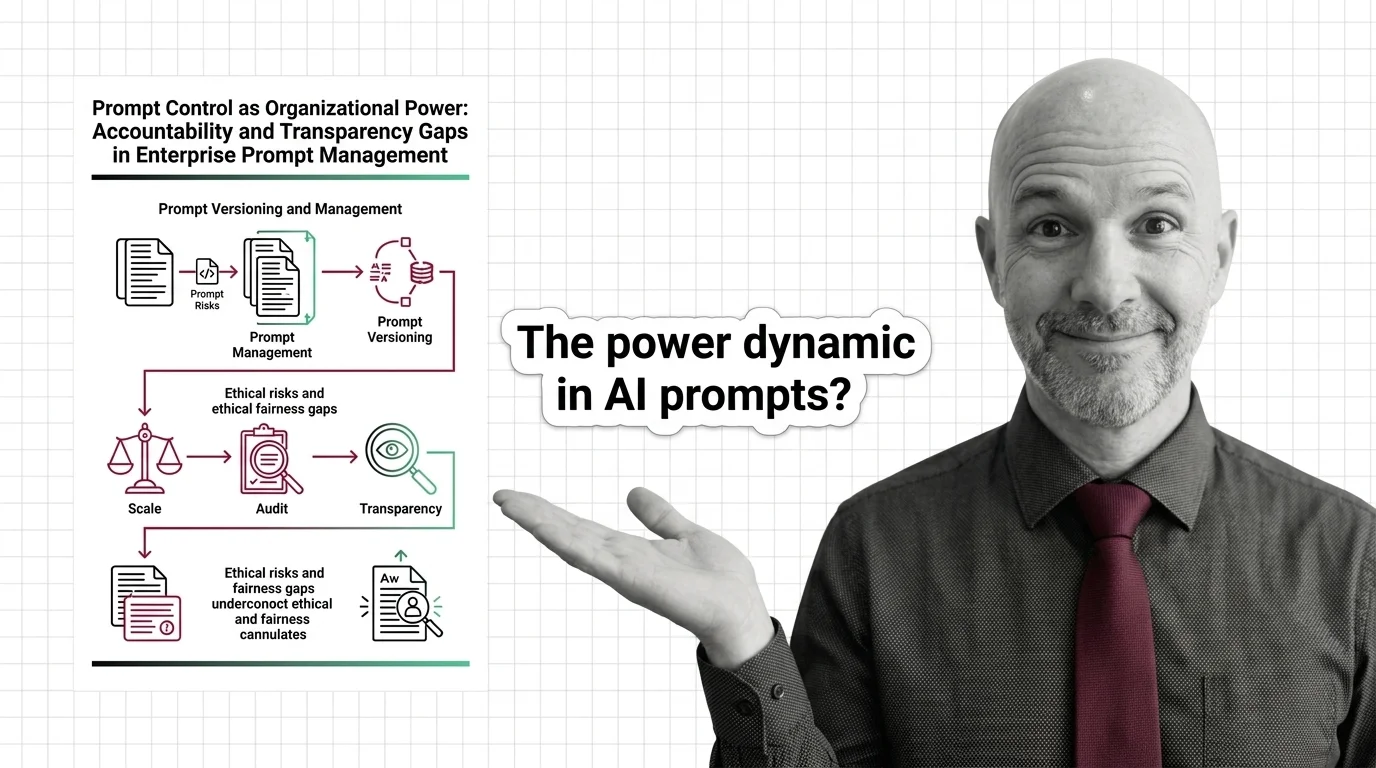
The phrase “ Prompt Versioning And Management” sounds administrative — version numbers, staging environments, access controls, the vocabulary of responsible engineering. But what these systems actually manage is the behavioral layer of AI: the instructions that determine which questions a system treats as valid, which answers it generates with confidence, and which perspectives it has been shaped not to surface. When we centralize that layer inside a platform, we are not merely organizing text. We are concentrating a form of power — quietly, efficiently, and almost entirely without external oversight.
The Platform That Governed the Governor
In August 2025, Anthropic acqui-hired the Humanloop team — an enterprise prompt management company that organizations had adopted specifically to bring discipline to their AI behavioral controls (TechCrunch). The platform shut down September 8, 2025. What Humanloop’s customers discovered in that moment was not simply that they had lost a vendor. They discovered how thin the governance layer had been to begin with.
The tool they had used to track prompt versions, to audit who changed what, to maintain some institutional memory of why a prompt was worded a particular way — that tool was gone. The actual governance documentation existed inside the platform’s database. And the platform was no longer running.
The governance record — the artifact that might explain why an AI system behaves the way it does — had never truly belonged to the organization deploying it. It had belonged to the infrastructure managing it. The moment the infrastructure changed hands, the record moved with it. This is not an edge case. It is the logical consequence of treating governance as a product feature rather than an organizational asset.
The Architecture of Non-Accountability
This outcome was not surprising, because it reflects how LLMOps infrastructure is currently designed. The leading enterprise prompt management tools — Braintrust and Langfuse — are built for agility. Braintrust’s documented behavior is unambiguous: “Changes made in the UI immediately affect production behavior” (Braintrust Docs). Langfuse’s approach to its Prompt Registry is equally explicit: non-technical team members can update prompts “directly in UI without engineering involvement” (Langfuse Docs).
These are features, not failures of design. Speed and accessibility are precisely what made these tools attractive to enterprise teams that could not afford the bottleneck of a formal engineering review every time they wanted to adjust AI behavior. But the same architecture that enables rapid iteration also removes the friction that accountability requires. When changes to behavioral governance take effect immediately — without a mandatory approval workflow in the public tier, without a structural requirement to record why — the governance layer becomes whatever access controls the platform team happens to have configured.
At the scale these tools now operate — Langfuse alone reports processing billions of observations per month across more than 2,300 companies (Langfuse Docs) — that gap, running at scale, is organizational policy.
Speed for the Team, Opacity for Everyone Else
The asymmetry deserves to be examined directly. The platform team — typically a small group of developers, product managers, and data scientists — gains considerable capacity through centralized prompt control. They can test behavioral configurations, roll back poor decisions, and iterate without the overhead of formal change management. The capability gain is real.
The people who carry the cost are those whose lives are touched by the AI system’s outputs without any visibility into what governs them. Research on system prompt dynamics found that prompts “take precedence over user inputs” while being “generally not made public,” leaving users “disconnected from and unaware of a key mechanism guiding and governing their AI interactions” (Neumann et al., arxiv). This is not a marginal finding about edge cases. It describes the default architecture of enterprise AI deployment.
The person whose credit application is processed by an AI, the employee whose performance flags are generated by an HR tool, the customer whose service interaction is shaped by a behavioral specification they cannot see — none of them has visibility into the prompt that governed those decisions. None of them has a mechanism to contest it. The governance that touches their lives is invisible to them by design, and the audit log that exists is legible only to the people who built the system.
The Case for Centralized Control
The engineering argument for platforms like Braintrust deserves to be stated at full strength. Organizations that managed prompt configuration informally — in spreadsheets, in code comments, in undocumented system messages — did not produce better governance. They produced invisible governance, where no one could reconstruct what the system had been instructed to do six months ago, or why that wording was chosen, or who authorized the change.
Centralized tools bring genuine discipline: every prompt save creates a versioned artifact with a unique identifier, environments separate development testing from production, and access controls restrict who can make changes. NIST’s AI Risk Management Framework — a voluntary guidance document, not a binding regulation — treats “accountability and transparency” as defining characteristics of trustworthy AI systems (NIST AI RMF). The engineering case would say that prompt versioning platforms are the practical implementation of exactly that principle. And compared to no governance at all, the case is right.
The argument for centralization is not cynical. It is the reasonable position of people trying to bring order to something that had been genuinely chaotic. That is worth acknowledging before examining where it stops being enough.
What an Audit Log Cannot Prove
The engineering defense is correct about what it claims. But it conflates two things that are not the same — technical control and legitimate governance. An audit log proves that a change was made. It does not prove the change was appropriate, that affected parties were consulted, or that anyone with independent authority reviewed it before the behavioral consequences propagated across thousands of interactions. Consider Prompt Injection — the attack category in which adversarial instructions override legitimate governance: when the governance layer is opaque and centralized, even its corruption is difficult for anyone outside the platform team to detect.
This is the precise point at which the defense breaks down. Technical accountability — knowing who changed what and when — is a necessary condition for governance. It is not sufficient.
The NIST AI 600-1 Generative AI Profile, released in July 2024, classifies “human-AI configuration” as a risk category requiring transparency and documentation (NIST AI 600-1). The EU AI Act’s Article 13 — which for high-risk AI systems as defined in Annex III requires transparency sufficient for deployers to interpret outputs appropriately — enters into force August 2, 2026. Neither framework treats an access log as the end of the transparency obligation. Both point toward intelligibility for the people affected, not merely a record accessible to the team that made the change.
The question that enterprise Prompt Testing And Evaluation and Prompt Optimization infrastructure has not yet answered is the one that matters most: transparent to whom? The audit log is transparent to the platform team. The versioning history is available to engineers with credentials. No publicly documented mechanism exists, in any major prompt management platform, for the people whose interactions are shaped by these behavioral decisions to know what those decisions are — let alone to contest them.
Power That Doesn’t Look Like Power
Thesis: Enterprise prompt management has solved the engineering problem of governing AI behavior at organizational scale while leaving untouched the political problem — who holds the authority to govern it, for whose benefit, and with what accountability to those who are governed.
The mechanism runs deeper than access logs. Constrained Decoding, Structured Output Prompting, Tool Use in Prompts — each represents a layer through which prompts shape not just tone but the logical structure of what an AI system can surface, say, or refuse to consider. Every configuration decision in these layers is a policy decision embedded in infrastructure. When those decisions are made by a platform team operating without external transparency obligations, what we call “prompt management” is, in practice, invisible policy-making at organizational scale — with no constituency for the affected parties to petition.
Humanloop’s acquisition by Anthropic was instructive precisely because of the irony it revealed. The company providing governance infrastructure for Anthropic’s models was absorbed by Anthropic itself. The independence of the governance layer — the premise on which customers had chosen a third-party platform — evaporated the moment the vendor decision changed. The concentration was not malicious. It was the structural consequence of treating behavioral governance as a commercial product rather than a public accountability function.
Where This Argument Is Weakest
This analysis has a real vulnerability. It assumes that the accountability gap — between technical access control and legitimate governance — is not already being addressed in practice by sophisticated enterprise deployers. If large-scale AI deployments are already publishing behavioral summaries, providing disclosure mechanisms to affected parties, or commissioning independent behavioral audits, then this essay identifies a design risk that practice has already mitigated. I have no reliable aggregate data on how many enterprise AI systems currently provide meaningful transparency to affected users, because no institution is systematically collecting it. The gap may be smaller in practice than the design of the tools suggests.
The concern scales with the stakes: a behavioral specification shaping credit decisions or medical triage carries a different accountability obligation than one governing a product search recommendation. The governance design gap I describe is most serious — and the absence of accountability most costly — in the domains where affected parties have the least existing power to demand it.
The Question That Remains
Enterprise prompt management has built the infrastructure to change AI behavior at scale, with speed and traceability. What it has not built — and what no existing standard currently requires — is any mechanism for the people that behavior governs to know it governs them.
The deeper question is whether the decision to concentrate AI behavioral governance in proprietary, non-transparent infrastructure is itself a governance decision. One made without the people it affects being consulted, without a vote, and largely without anyone framing it as a choice at all.
Ethically, Alan.
AI-assisted content, human-reviewed. Images AI-generated. Editorial Standards · Our Editors