Prompt Chaining in Production 2026: Real Deployments, LangGraph Adoption, and the Long-Context Window Threat
TL;DR
- The shift: Stateful orchestration frameworks hit production-stable at the same moment 1M-token context windows went mainstream — and they are competing for the same architecture budget.
- Why it matters: Teams betting on “just dump everything in context” are staking their stack on a ceiling that has not proven itself at scale.
- What’s next: Prompt Chaining is not disappearing — but the form it takes is diverging fast, and the window to pick the right path is already closing.
Within days of each other, LangGraph shipped 1.2.6 and Pydantic AI hit v2.0.0 stable. The same month, the context window arms race crossed 1M tokens across all four major frontier labs.
Two competing bets on the same infrastructure problem. Your team is already committed to one of them — whether you know it or not.
The Architecture Race That Landed in Your Stack
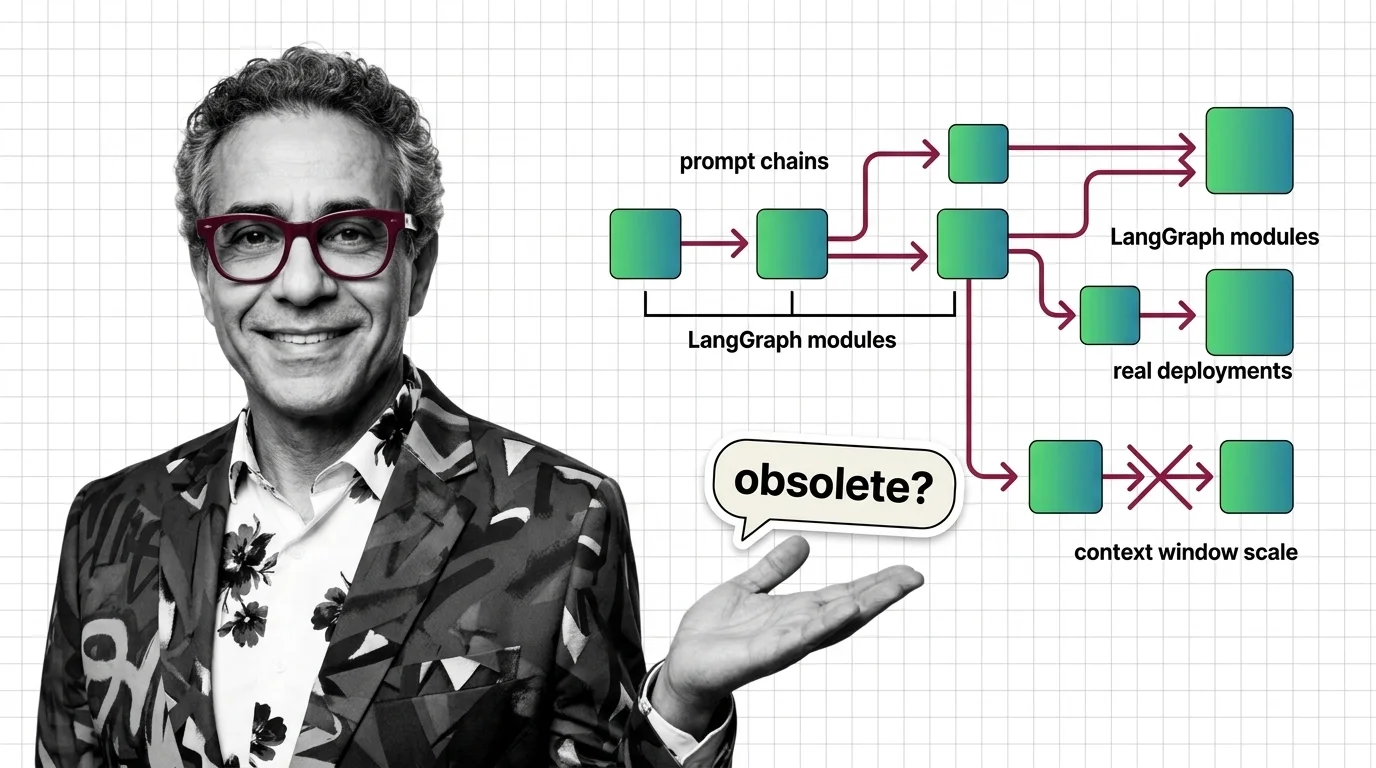
Thesis: The debate over whether prompt chaining is obsolete is the wrong question — the real shift is that sequential decomposition is fracturing into two incompatible schools, and they are headed in opposite directions.
One school says: build stateful chains. Break complex tasks into structured steps, manage state explicitly, use orchestration frameworks to coordinate the flow. That path has production proof — confirmed by enterprises running real workloads.
The other school says: context windows are big enough now. Stop decomposing. Feed everything to the model in one shot.
Both schools have serious backers. Neither is obviously wrong.
But they are architecturally incompatible. And the teams that have not picked a direction are already falling behind both.
The Deployments That Prove the Pattern
Stateful orchestration moved from demo to production faster than most teams expected.
LangGraph reached General Availability in October 2025 (LangChain Blog). Current version: 1.2.6, released June 18, 2026. The GA announcement named confirmed production deployments at Uber, LinkedIn, AppFolio, Replit, and Elastic.
AppFolio’s result is the number worth framing: more than 10 hours per week saved and a 2× improvement in decision accuracy (LangChain Blog). That is a board-level ROI signal, not a prototype benchmark.
The broader data confirms the direction.
As of late 2025, a survey of 1,340 engineering teams found 57.3% had agents running in production — with another 30.4% actively building (LangChain Report). Agent observability was implemented by 89% of those production teams.
These are not teams experimenting. These are teams operating.
Pydantic AI followed the same arc. Version 2.0.0 shipped June 23, 2026 with Production/Stable status. The v2 architecture introduces the Capability primitive — a unified bundle of tools, hooks, instructions, and model settings that makes chains more composable and easier to test (Pydantic Blog).
If you are evaluating either framework, run a version audit before you build. Multiple critical LangGraph vulnerabilities were disclosed in 2026, including a serialization injection flaw and an SQL injection path in the SQLite checkpoint layer (The Hacker News). All are patched in 1.2.6. PydanticAI v2 is not a drop-in upgrade — several integrations were removed and API defaults changed.
Security & compatibility notes:
- LangGraph serialization injection (CVSS 9.3): Critical vulnerability (CVE-2025-68664) — patch to 1.2.6+.
- LangGraph SQL injection (CVSS 7.3): CVE-2025-67644 in SQLite checkpoint layer — patch to 1.2.6+.
- LangGraph path traversal (CVSS 7.5): CVE-2026-34070 — patch to 1.2.6+.
- LangGraph RCE via pickle deserialization (CVE-2026-27794): Affects the Checkpoint sub-package — verify the affected version range for your specific install before deploying.
- PydanticAI v2.0.0 breaking changes: OpenAI defaults to Responses API;
end_strategychanged tograceful;outlines,fastmcp, andvertexaiextras removed. Review the upgrade guide before migrating.
Now for the other bet.
Claude Sonnet 4.6 and Opus 4.6 both support a 1M-token Context Window at standard pricing with no long-context surcharge (Morph LLM). GPT-5.5 matches the limit. Gemini 3.1 Pro sits at 1,048,576 tokens with tiered pricing above 200K.
The advertised ceiling is real. The practical ceiling is not what the marketing says.
Practitioners building on frontier models in 2026 report that reliable recall degrades well before the 1M-token ceiling — a pattern not formally benchmarked but consistent across team reports. And “lost in the middle” degradation, where information buried in the center of a long context gets overlooked, starts showing up at production scale well before the theoretical limit.
Advertised ceiling ≠ production reality.
Most enterprise workloads do not.
Who Owns the Orchestration Layer
Teams with production LangGraph deployments own the orchestration layer.
Uber, LinkedIn, AppFolio, Replit, Elastic — these are not early adopters hedging bets. They are production systems running business-critical workloads with stateful agent architectures. The companies that built those pipelines ahead of GA are now two to three iteration cycles ahead of teams evaluating the same frameworks today.
The LangGraph and PydanticAI ecosystems are maturing fast.
More patterns are documented. More failure modes are known. More engineers understand the primitives.
If your team has already built on these foundations, the advantage compounds. The knowledge does not transfer to the long-context camp — the mental models, the debugging skills, and the architecture patterns are different.
Who’s Betting on the Wrong Floor
Teams treating 1M-token context windows as an excuse to skip orchestration architecture are making an expensive bet.
The practical recall ceiling means you cannot reliably fit most enterprise workloads into a single context and expect consistent output quality. The ceiling shifts by model, by task type, and by how information is distributed in the context.
Betting on “context windows will get better” is reasonable. Betting that they are already good enough to replace structured orchestration is not.
Any team that deferred chain architecture because they expected context windows to make it irrelevant — and has not revisited that decision — is sitting on an architectural gap that compounds with every deployment they delay.
You are either building the orchestration layer now, or you are rebuilding it later under pressure.
What Happens Next
Base case (most likely): Stateful orchestration and long-context approaches coexist, targeting different workload profiles. Orchestration wins for multi-step workflows requiring state and error recovery. Long-context wins for summarization and single-pass reasoning tasks. Teams that build both capabilities maintain optionality. Signal to watch: Which enterprises publish case studies showing long-context-only pipelines replacing stateful orchestration in production — not just in demos. Timeline: 12–18 months for differentiation to solidify.
Bull case: Context window recall improves substantially at the model level, making single-pass approaches competitive with stateful chains for a wider range of enterprise workloads. Signal: Systematic benchmarks showing sustained high-quality recall across the full 1M-token range on complex multi-fact retrieval tasks. Timeline: 18–24 months minimum.
Bear case: The practical recall ceiling stays flat. Teams that skipped orchestration frameworks face costly rewrites after production failures surface at scale. Signal: Multiple high-profile production failures attributed to context window degradation in enterprise deployments. Timeline: First wave visible within 6–9 months.
Frequently Asked Questions
Q: What are real-world examples of prompt chaining used in production AI systems?
A: LangGraph deployments at Uber, LinkedIn, AppFolio, Replit, and Elastic are the clearest confirmed examples. AppFolio’s implementation delivered over 10 hours per week in time savings and doubled decision accuracy, documented in the LangChain production case study. As of late 2025, over half of surveyed engineering teams had agents in production.
Q: How do AI-native companies use prompt chaining in their core product features?
A: AI-native companies embed chaining through framework-level orchestration, not manual prompt stitching. LangGraph provides stateful graph execution with explicit state management between steps. PydanticAI v2 organizes chains through the Capability primitive — bundling tools, hooks, and model settings into reusable units. The architecture shift is from prompt-as-string to chain-as-infrastructure.
Q: Is prompt chaining becoming obsolete as LLM context windows expand to 1M tokens in 2026?
A: No. Context windows expanded, but practical recall degrades before the advertised ceiling. “Lost in the middle” degradation is documented at production scale. Stateful orchestration handles error recovery, state persistence, and multi-step coordination that long-context single-pass approaches cannot reliably replicate today. The tools coexist — they do not compete for the same workloads.
The Bottom Line
Prompt chaining is not dying. It is hardening into production infrastructure — with two incompatible paths forward.
The stateful orchestration camp has GA frameworks, enterprise deployments, and compounding institutional knowledge. The long-context camp has bigger windows and a promise that recall will catch up.
Pick a side. The middle is expensive.
Stay ahead, Dan.
AI-assisted content, human-reviewed. Images AI-generated. Editorial Standards · Our Editors