Data Leakage Prerequisites: Train-Test Splits, Cross-Validation, and Feature Pipelines
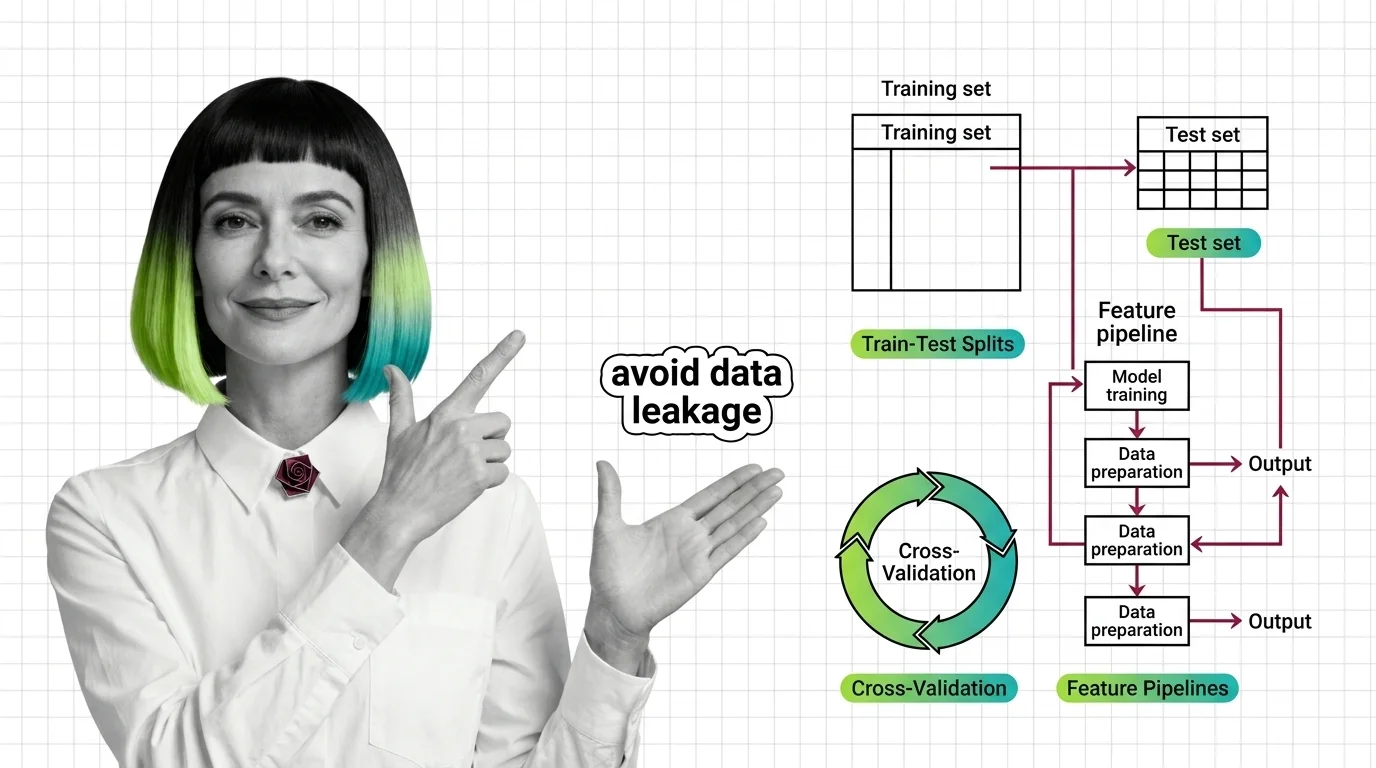
ELI5
Data leakage is when your model peeks at information it won’t have in the real world, so test scores look great and live results disappoint. Three foundations stop it: train-test splits, cross-validation, and leak-proof feature pipelines.
A churn model lands at near-perfect validation accuracy. The team celebrates, pushes it live, and within a week it is barely beating a coin flip. The code is clean. The algorithm is ordinary. The cross-validation looked textbook. The defect sits upstream of all of it, in the order the data was touched before the model ever saw it.
It is tempting to file this under exotic bugs, the kind that hit other people’s pipelines. It isn’t.
Not an exotic bug. An ordering mistake.
Data Leakage is the most common reason a model that dazzles in testing dies in the real world, and almost every instance comes down to information crossing a boundary it should never have crossed. To see that boundary clearly, you need three ideas solid in your head first.
Three Foundations That Decide Whether Leakage Can Even Happen
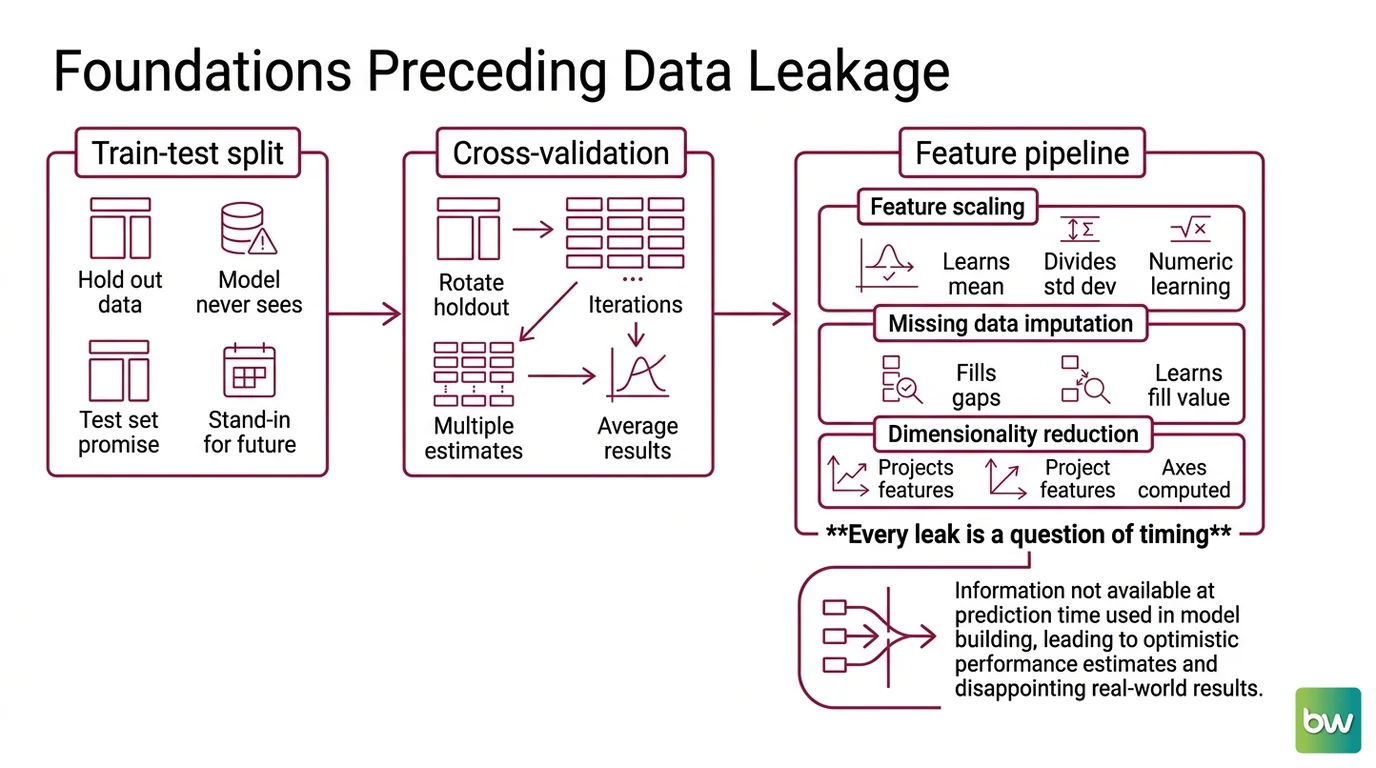
Before leakage makes sense as a concept, three pieces of machinery have to be familiar. Each is simple on its own. The interesting part is the seams between them, because every leak is a question of timing — what the model learned, and when, relative to the data it was supposed to be tested against.
What do you need to understand before learning about data leakage?
Three prerequisites, in the order they appear in a typical workflow.
First, the Train Test Split. You hold out a slice of data the model never sees during training and use it as a stand-in for the future — the inputs the model will face once it is live. The test set is a promise: this is the unknown, and I will not let the model study it.
Second, Cross Validation. A single split can be lucky or unlucky, so you rotate which slice is held out and average the results. Instead of one estimate of how the model generalizes, you get several, which makes the estimate harder to fool yourself with.
Third, the feature pipeline — the chain of preprocessing steps that turn raw columns into model inputs. Feature Scaling subtracts a mean and divides by a standard deviation. Missing Data Imputation fills gaps with a learned value. Dimensionality Reduction projects features onto axes computed from the data. Each step learns something numeric from the rows it sees.
That last word is the whole story. A scaler learns a mean. An imputer learns a fill value. A feature selector learns which columns survive. The model learns weights. Leakage is what happens when any of these learns from data it was never supposed to look at.
Formally, leakage occurs when information that would not be available at prediction time is used while building the model, producing performance estimates that are optimistic and real-world results that disappoint (scikit-learn Docs). It is consequential enough that Kaufman and colleagues catalogued it among the top-ten mistakes in data mining, defining it as “the introduction of information about the target that should not be legitimately available to mine from” (Kaufman et al.).
Why the Split Has to Come First
The fix sounds almost too small to matter, and that is exactly why it gets skipped. Split the data before you do anything else, then treat the test set as if it does not exist until the very end. Everything the pipeline learns, it must learn from the training data alone.
Why does proper train-test splitting prevent data leakage?
Consider the most innocent step imaginable: standardizing your features so they sit on a common scale. To do it, you compute the mean and standard deviation of each column, subtract, and divide.
Now watch the timing. If you compute that mean and standard deviation across the entire dataset and only afterward carve out a test set, the statistics you used were shaped by the test rows. The test set’s values nudged the mean. They influenced the spread. The model, through the scaler, has now seen a faint shadow of the data it was supposed to be graded against. Its test score will come in a little high, and that little will evaporate in production.
Split first, and the shadow disappears. You compute the mean and standard deviation on the training portion only (fit_transform on train), then apply those frozen numbers to the test set without recomputing (transform on test). The test set passes through machinery that has never learned anything from it. That is what makes the held-out score an honest estimate of the unknown (scikit-learn Docs).
Not the model weights. The preprocessing.
The risk applies to almost every transform that has internal state, not just scaling — StandardScaler, SimpleImputer, PCA, and feature selection all learn parameters from their input, so all of them can leak if they see the test set first (scikit-learn Docs). The pattern is identical every time: a step learned a number from rows it should not have touched.
Cross-Validation Multiplies the Same Mistake
Cross-validation is supposed to make your estimate more trustworthy. Done carelessly, it does the opposite — it bakes the leak into every fold and averages the inflated results into something that looks even more reassuring.
The trap is preprocessing once, up front, and then running the cross-validation loop on the already-transformed data. If you scaled or imputed before the loop, then in every fold the “training” portion was standardized using statistics that included the rows currently serving as that fold’s validation set. The leak is not in one split now; it is in all of them.
The structural fix is to preprocess inside the loop, never before it. A scikit-learn Pipeline does this for you: when wrapped in cross-validation, it runs fit_transform only on each fold’s training data, so a transformer’s state — a scaler’s mean, an imputer’s fill value — never leaks from the fold being used to evaluate it (scikit-learn Docs). The pipeline turns “remember to split before preprocessing” into a property of the object instead of a thing you hope you did.
Two flavors of leakage hide deeper than ordering, and they are worth naming because no amount of careful splitting catches them on its own. Target Leakage is when a feature secretly encodes the answer — a column populated only after the outcome is known, or a near-duplicate of the label. Temporal Leakage is its time-series cousin: shuffle dates into random folds, and your model gets to study the future while being tested on the past. A clean split with shuffled time is still a model grading its own homework.
This is where validation tooling earns its place. The open-source Deepchecks library tests and validates ML data and models across tabular, NLP, and vision tasks, with built-in checks that flag data integrity issues, drift, Overfitting, and train/test leakage before they reach a report (Deepchecks Docs). Treat it as a mature, slow-moving option rather than a fast-evolving one: its last open-source release targets older Python versions, and active development has shifted toward separate LLM-evaluation tooling.
Compatibility note (as of 2026): the open-source deepchecks library’s most recent release is 0.19.1 (December 2024), which supports Python 3.6–3.10. It still works for leakage and drift checks; just don’t expect newer-Python support or a rapid release cadence.
What This Predicts About Your Own Models
Once you see leakage as a timing problem, it stops being mysterious and starts being predictable. The mechanism makes specific forecasts about what you will observe in your own work.
- If your validation accuracy lands far above any published baseline for the task, suspect leakage before you celebrate. Honest models rarely leap past the field by a wide margin.
- If you scale or impute before splitting, expect a few points of inflated test performance that quietly vanish once the model meets data it genuinely has not seen.
- If a time-series model is evaluated on randomly shuffled folds, expect it to “predict” the past using knowledge of the future, then fail the moment it has to face an actual tomorrow.
These are not edge cases you might hit. They are the default outcome of touching the data in the wrong order, and they reproduce every time.
Rule of thumb: anything learned from data — a mean, a standard deviation, a fill value, a vocabulary, a set of selected features — must be learned from the training set alone, and the split must happen before any of it.
When it breaks: a perfect split and a leak-proof pipeline still cannot save you from target leakage baked into a feature’s definition. If a column is a proxy for the label or was computed using information from after the prediction moment, no amount of correct ordering will catch it. That failure mode lives in domain knowledge, not in mechanics — you have to understand what each feature actually means and when it becomes available.
The Data Says
Data leakage is not a rare or exotic failure; it is the predictable result of letting a model, or its preprocessing, learn from data it will not have at prediction time. Split first, fit every transform on the training portion only, and run preprocessing inside each cross-validation fold rather than once before the loop. The math underneath is simple. The discipline of respecting the boundary is what separates a test score you can trust from one that is quietly grading its own homework.
AI-assisted content, human-reviewed. Images AI-generated. Editorial Standards · Our Editors