Prerequisites for Role Prompting and When It Technically Fails
ELI5
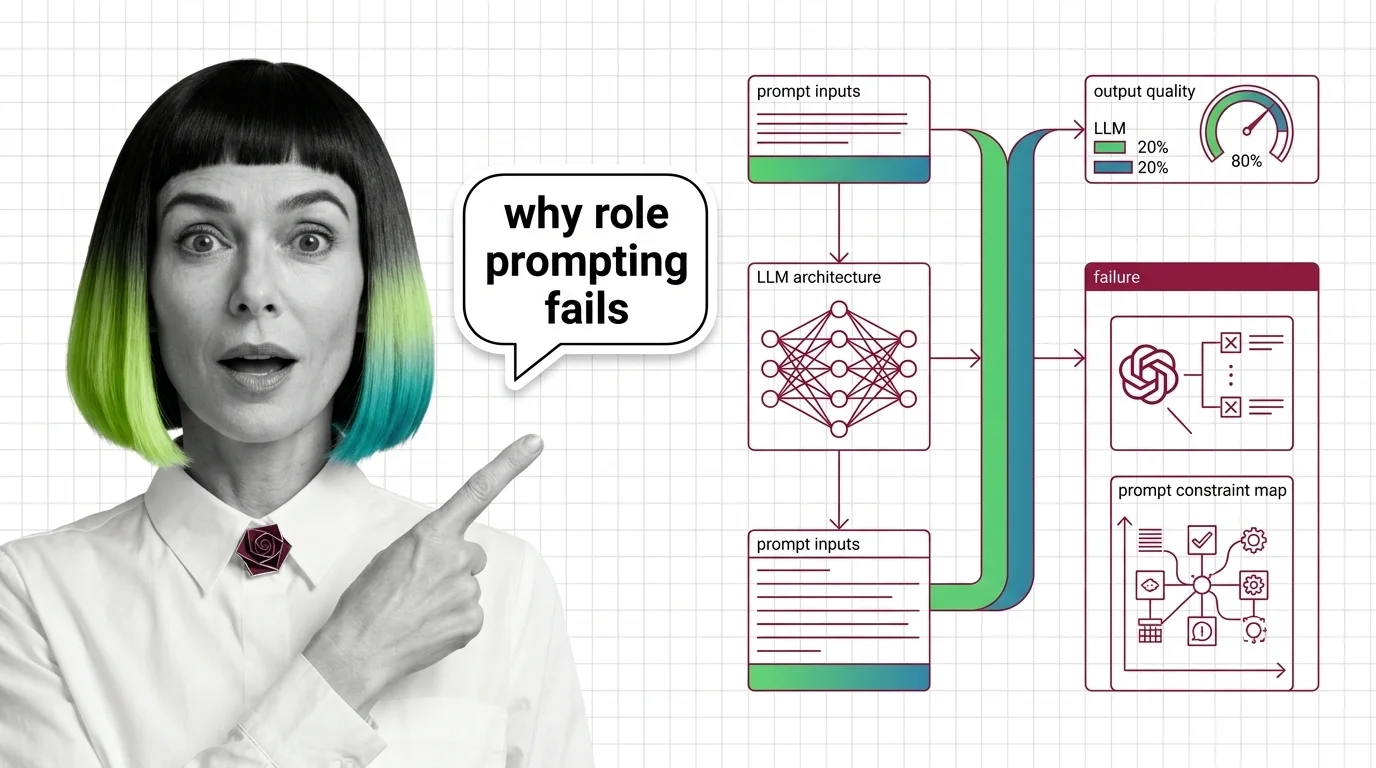
Role prompting assigns a persona to an LLM before a task. It shifts tone reliably. On factual and math tasks, the persona adds almost nothing — the model’s pretraining data determines the outcome, not the role you assign.
Here is the anomaly: ask an LLM to “act as a PhD mathematician” and the calculus accuracy barely changes. Ask it to “act as a creative writing mentor” and the prose critique improves noticeably. Same technique, same model architecture, opposite results. The mechanism that explains this contradiction is also the reason Role Prompting fails in ways that aren’t obvious until you understand what the model is doing when it accepts a persona.
The Statistical Substrate Role Prompting Runs On
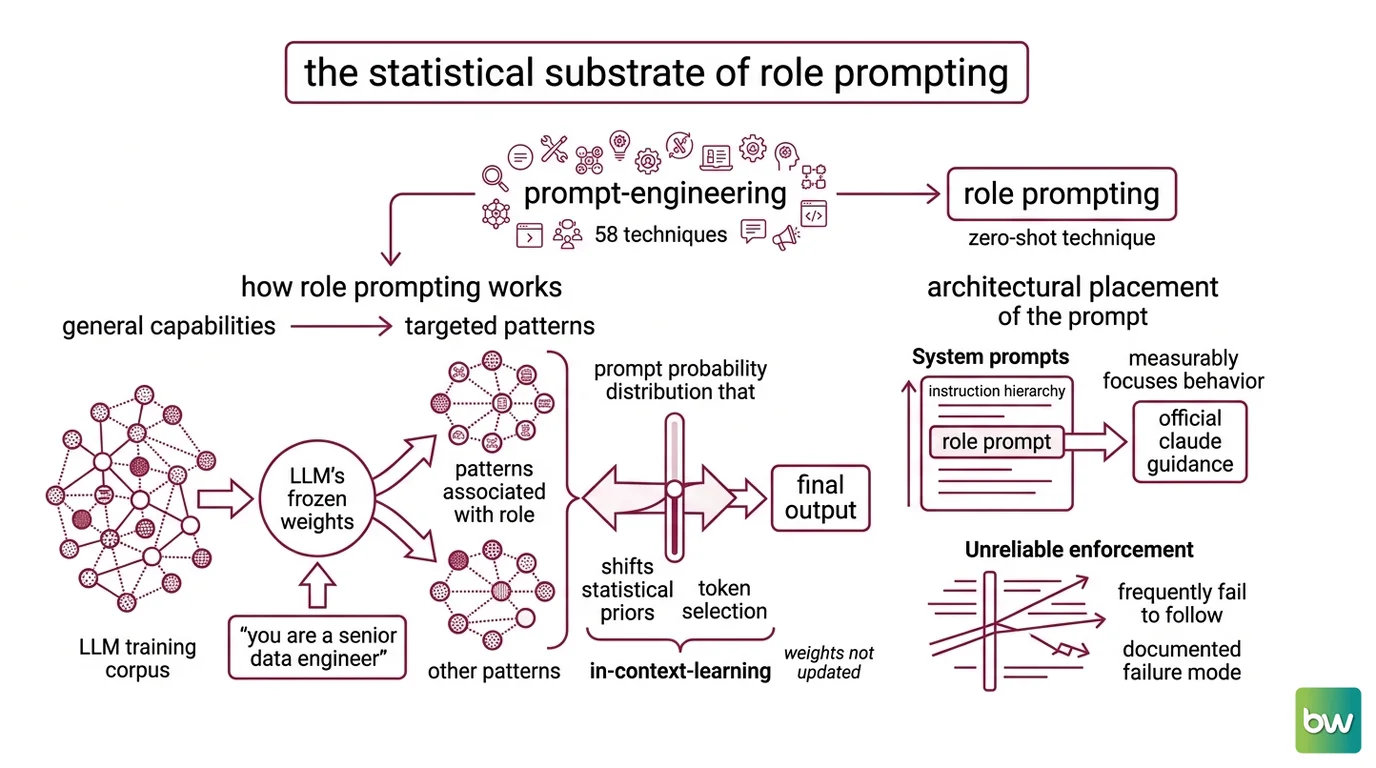
Prompt Engineering encompasses 58 documented techniques, and role prompting occupies an unusual position among them. It is classified as a zero-shot technique — it provides no examples of the target behavior, only a description of an identity. Whether that identity produces anything useful depends entirely on what the model’s weights already contain about that identity and how the role connects, structurally, to the requested task.
what do I need to understand about LLMs before using role prompting
The foundational prerequisite is this: an LLM has no expert modes to switch into.
Not expertise. Activated probability distributions.
When you assign a role — “You are a senior data engineer” — you are not unlocking a capability waiting behind a door. You are shifting the statistical priors the model samples from, biasing token selection toward patterns associated with how data engineers write in the training corpus. This is In Context Learning at its most basic: the model’s frozen weights contain everything it knows, and the prompt restructures conditional probabilities for that inference pass without updating those weights. A role describing a “19th-century telegraph operator analyzing machine learning” produces outputs that combine whatever patterns the model has for both domains — not actual telegraph operator knowledge applied to ML.
Architectural placement is consequential in ways that most tutorials skip. Even a single sentence of role definition in a system prompt measurably focuses behavior and tone — official Claude guidance is explicit on this point (Anthropic Docs). The System Prompts position is designed to give the role priority in the instruction hierarchy. The complication is that this priority is unreliably enforced: models frequently fail to follow even unconflicted system prompts in practice, a failure mode documented consistently across evaluation conditions (IHEval 2025). The role you define in a system prompt is a weighted prior, not a locked setting.
Context Window dynamics compound this. Information placement within a long context follows a U-shaped accuracy curve — the model processes content near the beginning and end more reliably than content buried in the middle. A role definition placed at the start of a long system prompt can effectively fade as the conversation accumulates tokens. Context Engineering — the deliberate structuring of what appears where in the context — is not a separate discipline from role prompting; it is a prerequisite condition for the role to remain active across a full interaction.
Multi-turn conversations introduce a related failure mode that OpenAI’s documentation flags directly: instructions from previous turns are not present unless explicitly maintained in the context. In a long exchange, a persona must be periodically re-established — the model does not carry it the way human memory carries the beginning of a conversation.
Finally, Persona Simulation has a security surface that belongs in the prerequisite picture. Role-based conditioning is a primary jailbreak vector: the same weight-shifting mechanism that makes a “security researcher” persona useful for analyzing vulnerabilities makes it useful for extracting information the model would otherwise decline to provide. What you assign as a role also defines the attack surface.
When the Costume Doesn’t Fit the Task
Role prompting’s effectiveness splits sharply along a single axis: whether the task depends on stylistic alignment or on factual accuracy encoded in the model’s weights. These are not different levels of the same effect — they are different mechanisms, and interventions that help one category can actively harm the other. Understanding where the boundary sits is the difference between a useful technique and an unreliable one.
when does role prompting fail to improve LLM output quality
Accuracy gains from role prompting measure approximately 0.01% on accuracy-based benchmarks — statistically negligible, indistinguishable from noise across 1,500+ papers analyzed in The Prompt Report. This finding covers factual question answering, mathematics, coding, and tasks assessed on the MMLU benchmark. On these tasks, the expert persona the model simulates cannot exceed the factual or computational knowledge encoded in its weights. Assigning a cardiologist role does not give the model access to clinical data it was not trained on.
The contrast with stylistic and reasoning tasks is what makes the technique confusing to evaluate in aggregate. Under zero-shot conditions on ChatGPT models circa 2023, Last Letter Concatenation performance rose from 23.8% to 84.2% with role prompting applied, and AQuA from 53.5% to 63.8% (Kong et al. 2024). These are tasks with a pattern-following structure, not purely factual recall. The proposed mechanism — that role prompting implicitly triggers Instruction Following patterns associated with expert reasoning — is still debated; it is a plausible explanation, not an established causal account. Exact magnitudes on post-2024 RLHF-trained models may also differ from these pre-2024 measurements.
The double-edged character of persona assignment runs deeper than a simple style-versus-accuracy divide. Persona assignment degraded performance on 7 of 12 reasoning datasets in LLaMA3-specific testing; on AQuA, 13.78% of previously-correct answers became wrong once a persona was applied (Kim et al. 2024). Expert personas don’t amplify capability; they redirect it — and the redirection is not always toward the target.
Across 1,140 open-ended questions, 38 expert roles, and 6 domains, persona prompting “systematically increases expertise depth while reducing clarity” — a trade-off that aggregate metrics obscure (Xiao et al. 2026). In medicine and psychology, advisory improvements were measurable; in finance, law, and technical domains, the pattern reversed. These findings apply to open-ended questions specifically; generalization to structured or closed tasks is limited by the study’s scope. The model producing responses that sound more expert does not mean those responses are more accurate or more accessible.
The root mechanism is training-data dependency. How well Context Engineering through persona assignment works depends, fundamentally, on how richly each role is encoded in the LLM’s training data. A role with dense representation in the corpus — “experienced software developer,” “high school science teacher,” “creative writing critic” — has a coherent probability cluster behind it.
Form without function.
A role with sparse representation produces surface features of the identity without the underlying precision. And crucially, the user has no reliable way to know, before testing, which category a given role falls into for a given model.
What the Evidence Predicts About Your Use Cases
The mechanism suggests clear if/then predictions worth making explicit before applying role conditioning to any task.
If the task requires stylistic register, domain vocabulary, or advisory tone — writing quality, roleplay coherence, safety framing, explanatory style — a well-placed persona in the system prompt position will reliably shift the output toward that domain’s conventions. The improvement is real; it is probabilistic rather than cognitive, but it is reproducible.
If the task requires factual accuracy in a domain where the model may have sparse or outdated training coverage, the persona changes how the output sounds without changing what the model knows. A cardiologist persona on a question about a recent drug interaction produces confident-sounding output with the same factual ceiling as an unroled response — sometimes lower, if the persona biases the model away from hedging toward overconfident answers.
The instruction-following compliance gap is the third variable most applications underestimate. A role that specifies complex compound behavior — “always use metric units, always respond in German, always cite sources before answering” — is competing against everything else in the context simultaneously. A role assignment is not a locked configuration; it is a weight on a probability distribution, and other contextual factors can shift that weight mid-conversation.
In multi-turn interactions, context engineering strategies are not optional — they are the mechanism by which the role survives a long conversation. Periodically restating the role, structuring system prompts to keep role-relevant content in positions with high attention weight, or building re-injection into the application architecture are not optimizations. They are prerequisites for consistent behavior.
The security surface deserves explicit acknowledgment. Prompt Leakage risk scales with multi-turn interaction complexity: multi-turn attack success rates on role-based conditioning rose from 17.7% to 86.2% via sycophancy exploitation across multiple models (Agarwal et al. 2024). A role definition in a system prompt that contains operational instructions or sensitive context is not protected by its placement in the instruction hierarchy — the hierarchy is unreliably enforced, as the compliance research above demonstrates.
For complex tasks where a single static expert role is insufficient, Meta Prompting extends the mechanism in a more useful direction. Rather than assigning one identity and hoping it covers the task, meta-prompting transforms a model into a task-agnostic conductor that breaks work into sub-problems and routes each to an appropriate role instance dynamically. The in-context learning mechanism is the same; the architecture is more deliberate about which role applies to which sub-task.
When it breaks: Role prompting degrades measurably on factual and mathematical tasks where the role cannot supply knowledge not present in the model’s weights; in multi-turn conversations without explicit role re-establishment; and whenever instruction-following compliance is assumed rather than verified on held-out examples.
The Data Says
Role prompting is not a universal amplifier — it is a prior-shifting mechanism, effective when the target prior is richly encoded in training data and the task is alignment-dependent. On accuracy-dependent tasks, the technique introduces noise or actively degrades performance; on advisory and stylistic tasks, it reliably shifts the output register. The prerequisite knowledge isn’t background reading — it’s the operational distinction that determines whether you’re using a real mechanism or a convincing-sounding one.
AI-assisted content, human-reviewed. Images AI-generated. Editorial Standards · Our Editors