Prerequisites and Technical Limits of Human Evaluation: Why Automated Metrics Can't Replace Raters
ELI5
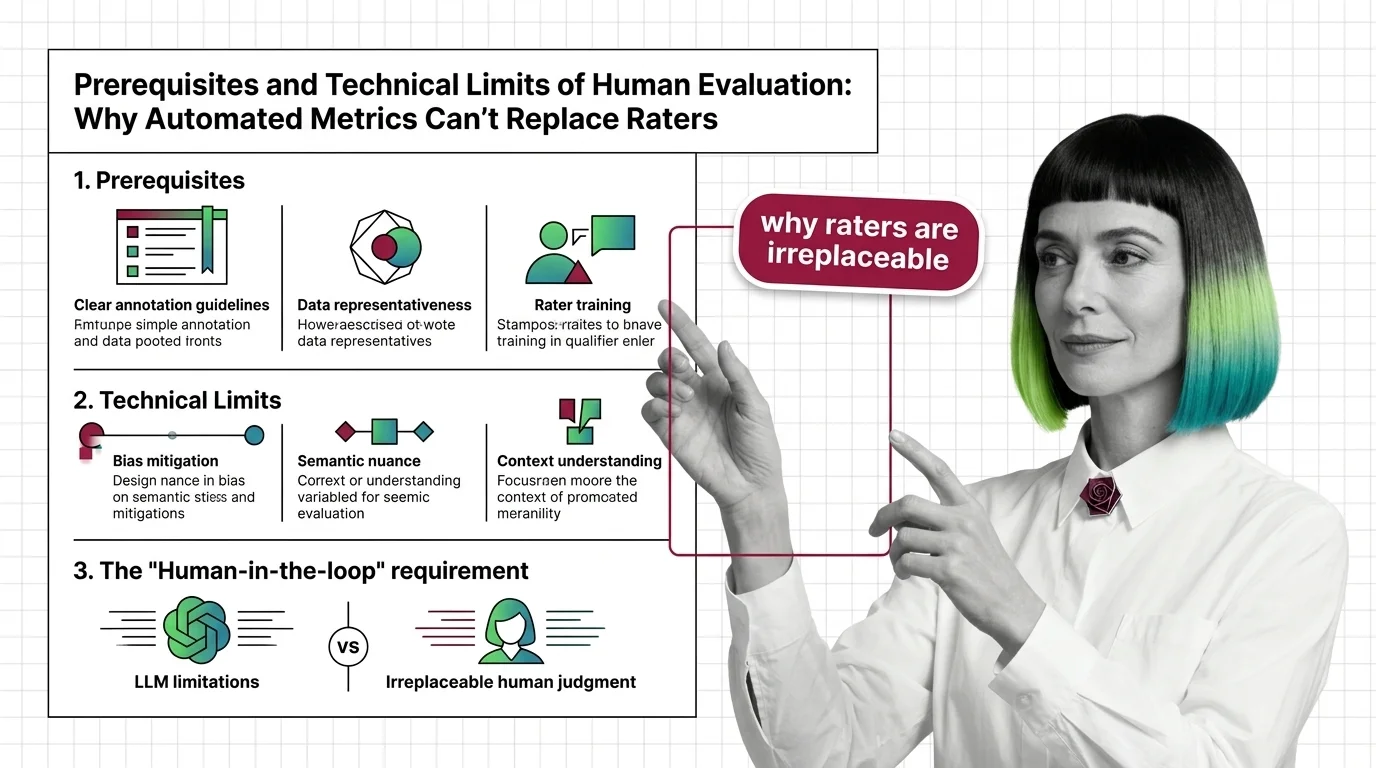
Human evaluation is how you measure what automated metrics miss: whether an AI’s response actually helped, misled, or subtly failed the person asking. It requires trained raters, structured rubrics, and an agreement threshold before any scores count.
An evaluation study can be technically correct and scientifically worthless at the same time. The math will run. The kappa scores will print. The final leaderboard will look authoritative. And every number in it will be measuring something slightly different from what you think.
That is the failure mode nobody talks about when they argue over whether BLEU or an LLM judge is better. The question isn’t which is more accurate — it’s whether you’ve built the evaluation apparatus correctly in the first place. Garbage in, precise-looking garbage out.
The Infrastructure You Need Before a Rating Counts
Designing a Human Evaluation for AI study is not a matter of recruiting five volunteers and averaging their scores. The prerequisites are structural, and skipping any one of them doesn’t degrade your results gradually — it invalidates them categorically.
What do you need to understand before designing a human evaluation study?
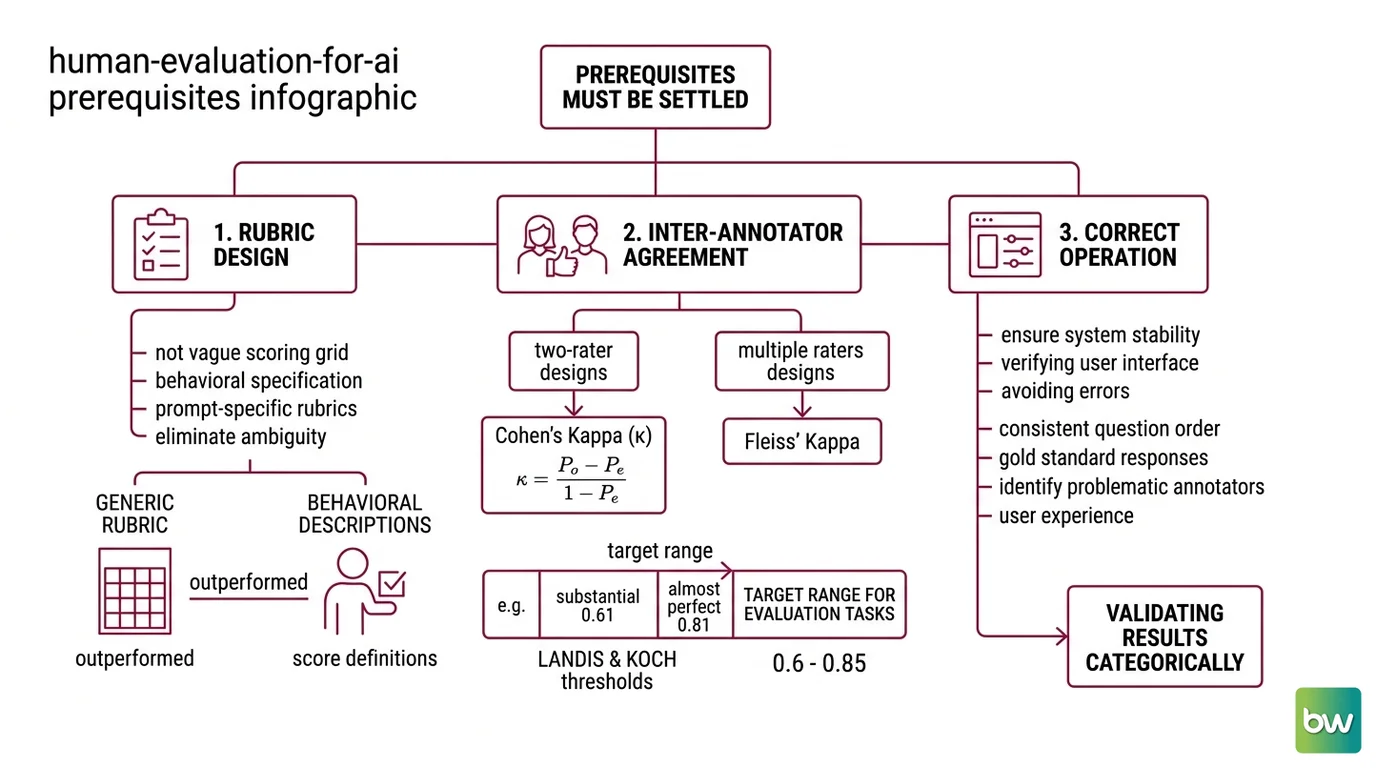
Before a single response gets rated, three things must be settled: what the raters are measuring, whether different raters agree on what they’re measuring, and whether the tool used to capture ratings is operating correctly.
Rubric design comes first. A rubric is not a vague scoring grid — it is a behavioral specification. Prompt-specific rubrics substantially outperform generic ones, and behavioral descriptions (what score X looks like in practice) eliminate ambiguity far better than numeric-only labels. If your rubric says “rate helpfulness from 1 to 5,” you have not written a rubric. You have written a wish. Two raters will interpret “3” differently on every response they see.
The second prerequisite is inter-annotator agreement measurement. Cohen’s Cohen's Kappa is the standard for two-rater designs. The formula accounts for chance agreement: κ = (P_o − P_e) / (1 − P_e), where P_o is observed agreement and P_e is the agreement you’d expect from random labeling (arxiv 2603.06865). The Landis & Koch scale maps the result to verbal categories — “Substantial” starts at 0.61, “Almost Perfect” at 0.81. These thresholds were built for medicine, not NLP. They were calibrated for clinical diagnosis in 1977. In practice, κ > 0.95 on a non-trivial language task typically signals over-constrained guidelines, not real quality (arxiv 2603.06865). The useful range to target for most evaluation tasks sits between 0.6 and 0.85.
For designs with more than two raters, Fleiss’ Kappa generalizes the calculation. For continuous scores rather than categories, the Intraclass Correlation Coefficient is more appropriate than either Kappa variant. Which metric fits depends on the annotation task structure — not on which produces the most flattering number.
Annotation tooling is the third prerequisite, and it’s the one most teams underestimate.
Label Studio is the dominant open-source platform for this purpose, currently at version 1.23.0 (Label Studio Docs). It handles multi-modal annotation, custom
Rubric Design interfaces, and inter-annotator agreement tracking. One important operational note: the Label Studio SDK 2.0 introduces breaking changes for automated pipelines. Existing integrations should pin to label-studio-sdk<2.0.0 until migration is complete. Skipping this step means annotation automation that worked last month may silently fail today.
None of these prerequisites are optional framing. They are the validity conditions for your study. A leaderboard built on vague rubrics and low agreement scores doesn’t measure model quality — it measures annotation variance.
What Automated Metrics Actually Measure
The appeal of automated evaluation is obvious: no rater recruitment, no annotation costs, no inter-rater variance. The problem is not that BLEU or LLM as a Judge are poorly designed. The problem is that they measure something structurally different from human judgment, and the gap is not closable by running more evaluations.
Why is human evaluation still irreplaceable by automated metrics and LLM judges?
BLEU and ROUGE operate on n-gram surface matching. They compare the distribution of word sequences in a candidate output against one or more reference outputs. The original BLEU paper was explicit about this: it measures one aspect of quality and was designed to be used alongside human evaluation, not instead of it (Papineni et al. 2002). That caveat vanished from most downstream usage. A meta-evaluation of 769 machine translation papers found that BLEU fails to capture semantic equivalence in more than half of paraphrase cases, and that adversarial inputs can score near-perfect on BLEU while producing outputs that are nonsensical to any human reader (arxiv 2106.15195).
LLM judges represent the current best attempt to replace human raters with something scalable. The foundational paper on the approach — Zheng et al. (2023), introducing MT-Bench and Chatbot Arena — found that strong LLM judges like GPT-4 achieve more than 80% agreement with human raters, matching the human-human agreement baseline on many tasks (Zheng et al. 2023). On its surface, that looks like a solved problem.
That 80% agreement figure conceals where the disagreements cluster. They are not random. Three systematic biases account for most of it: position bias (the judge prefers whichever response appears first in a pairwise comparison), verbosity bias (longer responses are favored regardless of quality), and self-enhancement bias (a model tends to rate its own outputs higher than competing models rate them), per Zheng et al. (2023). A subsequent study found that when evaluating three or four options simultaneously, the robustness rate for most LLM judges drops below 0.5 — meaning the ranking is less reliable than a coin flip for multi-option comparisons (arxiv 2410.02736).
SWE Bench takes a structurally different approach. Rather than asking a judge whether a response is good, it asks whether a patch passes the test suite — a binary, deterministic criterion grounded in human-authored code. The Verified subset consists of 500 tasks manually validated by working software engineers to confirm that each issue is genuinely solvable and the test suite provides a fair signal (SWE-bench). The result is an evaluation instrument that doesn’t require any judge, human or model — the ground truth is executable. The practical limitation is that this only works for tasks with verifiable outputs, which excludes most of what people actually want to evaluate.
The broader pattern is: automated metrics optimize for something measurable as a proxy for quality. The proxy holds well near the center of the distribution and breaks at the edges — exactly where quality judgments matter most.
What the Measurement Apparatus Predicts
Understanding the mechanics of evaluation failure turns passive knowledge into predictive reasoning.
If you run a pairwise preference study without controlling for position, expect that the first response will win more often than the quality difference justifies — not because of selection bias in your sample, but because position bias is structural in how both LLM judges and many human raters process alternatives.
If your Elo rating leaderboard is built on Chatbot Arena, interpret score gaps carefully. A 100-point gap corresponds to roughly a 64% winrate, not an absolute quality difference. As of January 2026, the platform rebranded from LMArena to Arena at arena.ai, and a methodology update called Style Control shifted Elo scores by 20–40 points without any underlying change in model quality. The leaderboard position you see today is not a stable measure of the position three months ago.
If your rubrics are generic rather than task-specific, expect that your inter-annotator agreement scores will systematically underestimate the actual task difficulty. Generic rubrics create shared vocabulary without shared interpretation — raters converge on labels while diverging on what those labels mean.
Rule of thumb: A kappa below 0.6 means your raters are measuring different things. Redesign the rubric before adding more raters or more tasks.
When it breaks: Human evaluation fails when the annotation task is ambiguous enough that rubric redesign cannot resolve rater disagreement — typically in open-ended generation tasks where quality is genuinely multi-dimensional and no single axis captures what matters.
The Structural Asymmetry Nobody Names
There is a detail that gets lost when teams frame this as “human vs. automated.” The real distinction is between evaluation instruments that surface measurement error explicitly and those that hide it.
Human evaluation with properly measured inter-annotator agreement shows you exactly where your rubric is failing. A kappa of 0.45 is not a bad result — it is information about your task. It tells you that raters are disagreeing, which means the criterion is ambiguous, which means your evaluation is measuring something other than what you intended. You can redesign from there.
BLEU gives you a number. It does not tell you whether that number reflects quality or surface similarity or the particular choice of reference translations. The measurement error is present; it simply isn’t surfaced.
LLM judges with documented biases occupy the middle ground. The biases are known and named (Zheng et al. 2023). Calibration strategies — using calibrated scoring rubrics, averaging over position-swapped comparisons, excluding self-evaluations — can reduce but not eliminate them. The remaining systematic error is smaller than raw BLEU error on semantic tasks, larger than a well-run human study on multi-option ranking tasks.
Security & compatibility notes:
- Label Studio SDK 2.0 (breaking change): Existing automated annotation pipelines using the Label Studio SDK must pin to
label-studio-sdk<2.0.0until migrated. The 2.0 release introduces incompatible API changes. Migration guide: https://labelstud.io/blog/label-studio-sdk-2-0-0-released-your-migration-guide/
The Data Says
Human evaluation is not a fallback for when automated metrics seem insufficient — it is the validity anchor for calibrating every other instrument. The prerequisite infrastructure (rubric specification, agreement measurement, tooling stability) determines whether your scores measure model quality or annotation variance. An LLM judge achieving 80% human agreement is useful; a human study with inter-annotator agreement below 0.6 is not more reliable just because humans did it.
AI-assisted content, human-reviewed. Images AI-generated. Editorial Standards · Our Editors