Prerequisites and Technical Limits of Generative Media APIs
ELI5
A generative media API is a hosted service — fal.ai, Replicate, Vertex AI — that turns a prompt into an image, video, or audio file. Most of them don’t return that file in the same call you send.
Your integration test sends one request, waits two seconds, and gets a finished video back. Ship the same code against fifty concurrent users and the video never arrives — not because the model failed, but because nothing in your code was built to wait. The response you were polling for already came and went, delivered to an endpoint nobody was listening on.
The Request Isn’t the Response
Treat a Generative Media APIs call like a typical REST request — send, wait, receive — and the abstraction breaks immediately. Image generation can take a few seconds; video generation routinely runs past whatever timeout an HTTP client enforces by default. So the providers don’t answer the phone. They take a message and call back.
What do you need to know before integrating a generative media API into your app?
Before the first API call, four things need to be true: your code can’t block on the response, your completion handler is idempotent, your account has a funded payment method, and you know how many requests per minute the provider actually allows — because hitting that ceiling on launch day is a common failure mode, not an edge case.
The first one is the architecture problem, and it deserves the most attention.
Fal AI’s Queue API is a clean illustration: you submit a job, the API hands back a request_id in milliseconds, and the actual image or video lands later — either pushed to a
Webhook URL you registered, or pulled by polling that request_id (fal Docs). Not a phone call. A claim ticket.
That claim ticket comes with fine print. If your webhook endpoint doesn’t return a 200 within roughly 15 seconds, fal.ai retries delivery — up to ten times over a window of about two hours (fal Docs). Good news for reliability. Bad news if your handler isn’t idempotent: the same completed job can arrive twice, and a naive handler writes the same video to your database twice, or bills a customer’s account twice.
The Aggregator Bet Versus the Platform Bet
Two architectural philosophies compete for the same integration decision, and they optimize for opposite things. One maximizes catalog breadth: hundreds of models from dozens of labs behind a single API contract. The other maximizes platform depth: a narrower model set wrapped in the identity, quota, and billing tooling an enterprise already trusts.
What is the difference between a dedicated media API and a general-purpose AI platform like Vertex or OpenAI?
fal.ai lists more than 600 models behind one API contract; Replicate runs over 100 curated “Official Models” alongside thousands of community-submitted ones. Both bill in prepaid credits, metered per output — fal.ai’s Flux Dev image model runs $0.025 per image, as of mid-2026 (fal Docs). Neither asks for a cloud IAM role or an enterprise billing account before the first call; an API key is the whole onboarding flow.
Vertex AI and OpenAI’s image API invert that trade. Vertex offers two first-party model families — Imagen and Veo — priced and rate-limited inside Google Cloud’s existing IAM and quota system; Veo 3 runs $0.50 per second of video without audio, $0.75 with audio (Google Cloud Docs). OpenAI’s image API prices per image by quality and size, roughly $0.005 to $0.21 (OpenAI API Docs). Fewer models. More enterprise scaffolding already in place.
| Dedicated aggregator | General-purpose platform | |
|---|---|---|
| Examples | fal.ai, Replicate | Vertex AI, OpenAI image API |
| Catalog | 600+ models (fal.ai); 100+ Official + community models (Replicate) | A handful of first-party models (Imagen, Veo, GPT Image) |
| Onboarding | API key, prepaid credits | Cloud IAM role or enterprise billing account |
| Rate-limit philosophy | Per-account ceiling, queue-priority | Tiered by cumulative spend |
The decision isn’t really about output quality — it’s about which constraint your team can absorb. A team iterating across niche checkpoints wants the aggregator. A team already inside a cloud’s compliance perimeter, with budget reviews tied to a single bill, wants the platform.
Some teams refuse to make the bet at all. LiteLLM’s video- and image-generation interface is one example of Multi Provider Abstraction applied to this exact problem: one call signature routing to OpenAI’s Sora, Google’s Veo, ModelsLab, or Kling, with async polling, cost tracking, and fallback chains handled underneath (LiteLLM Docs). It’s a newer pattern, still being actively extended — but it turns “which provider” from an irreversible architecture decision into a configuration line.
Where the Pipe Actually Narrows
Once the architecture and the provider are settled, the constraint that decides whether the integration survives real traffic is rate limits and cold starts — and these vary by an order of magnitude across providers, at least as of mid-2026. None of it is about model quality. It’s about how many requests the pipe carries per minute, and how long the tap takes to start flowing.
What are the latency and rate-limit bottlenecks of hosted generative media APIs in 2026?
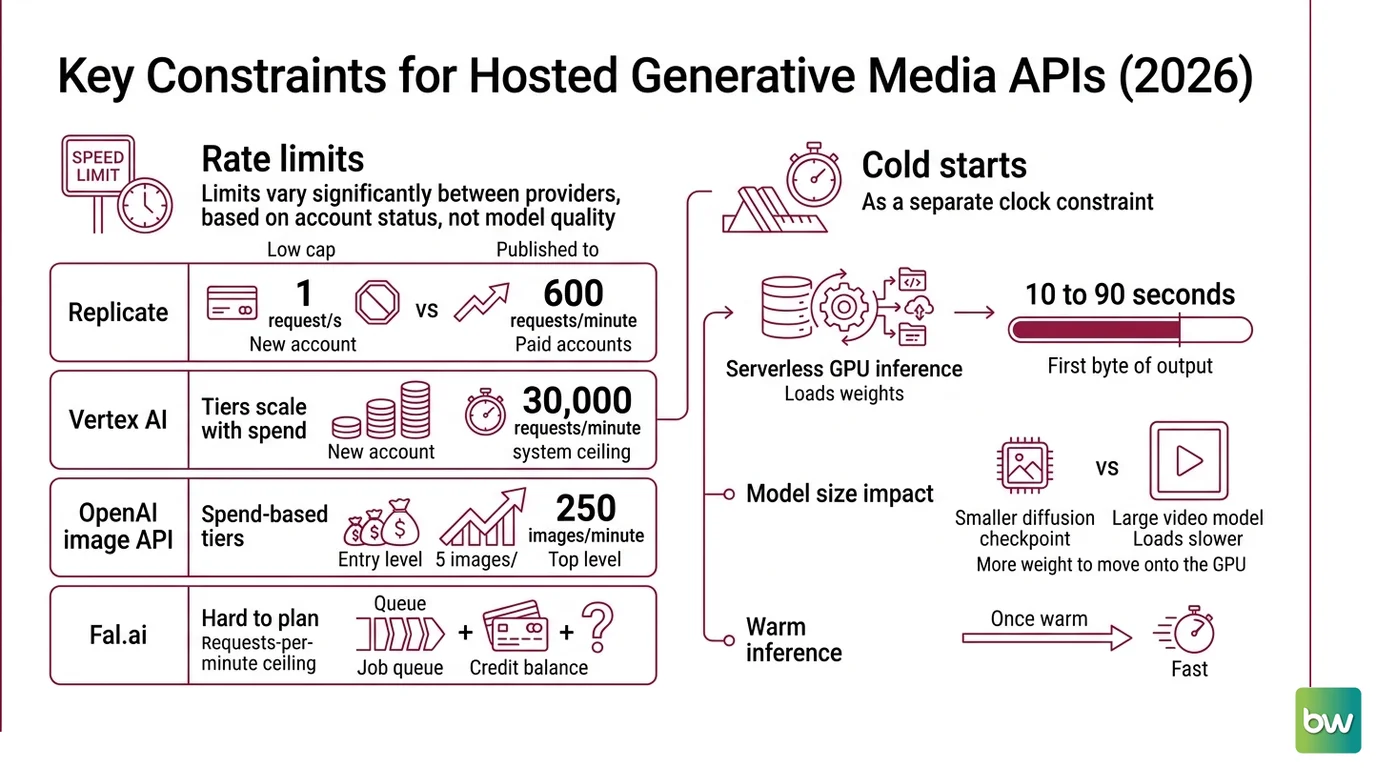
Replicate publishes its ceiling directly: 600 requests per minute for creating new predictions, 3,000 per minute for everything else — but an account with no payment method on file is capped at 1 request per second, six per minute (Replicate Docs). That’s not a typo. It’s the real Rate Limiting number most teams hit first, in testing, weeks before the published limit ever matters.
Vertex AI states a system ceiling of 30,000 requests per minute per model per region — generous on paper, but the actual throughput tier a project gets scales with its rolling 30-day spend, so a new account never sees that number on day one (Google Cloud Docs). OpenAI’s image API follows the same shape: tiers run from roughly 5 images per minute at the entry level to around 250 per minute at the top, climbing as cumulative spend climbs (OpenAI API Docs). fal.ai skips the published-table approach entirely — concurrency is governed by the job queue and your credit balance rather than a fixed requests-per-minute ceiling, which makes its real capacity harder to plan around in advance, not easier.
Underneath all of these limits sits a separate clock: the cold start. Serverless GPU inference commonly takes 10 to 90 seconds to spin up before the first byte of output exists, depending on model size — a smaller diffusion checkpoint loads faster than a billion-parameter video model simply because there is less weight to move onto the GPU. Once warm, fal.ai and comparable providers report median image latency around 2.3 to 2.5 seconds, against roughly 3.5 seconds for OpenAI’s image API (ModelsLab). The gap between a cold request and a warm one is often larger than the gap between any two providers’ warm latency.
What the Queue Predicts About Your Integration
If you treat any of these APIs like a synchronous REST endpoint and block your request thread waiting for the file, you will burn through timeout budgets the first time a video job takes forty seconds instead of four — regardless of which provider you picked. The fix is architectural, not a model swap.
If your webhook handler isn’t idempotent, expect a duplicate write the first time a retry arrives a few seconds late: the same video saved twice, the same customer billed twice. The same Exponential Backoff discipline that protects you from arriving too early on a slow job also keeps you under Replicate’s 600-per-minute ceiling without ever tripping a 429 — a tight retry loop is what turns a generous rate limit into a tight one.
If your Replicate account has no payment method attached, your real bottleneck during testing is 1 request per second, not the 600 advertised in the docs — a detail that explains a surprising share of “why is this so slow in staging” tickets.
Rule of thumb: Budget engineering time for the queue and the retry logic, not just the prompt — reliability in a generative media integration lives almost entirely in the parts that never touch the model.
When it breaks: A non-idempotent webhook handler paired with a tight polling loop turns one slow job into duplicate charges and duplicate output files — and once concurrent users multiply past whatever ceiling the provider actually enforces, the resulting cascade of failed retries looks like a model outage, but isn’t one.
The Industry Quietly Agreed on One Thing
Webhook security used to be provider-specific — a custom header here, an undocumented shared secret there, copy-pasted between integrations that trusted each other a little too much. That’s converging, and fal.ai’s implementation shows the current shape of it: an ED25519 signature verified against a published JWKS endpoint, with four headers checked against a window of roughly five minutes to block replay attacks (fal Docs).
Not a coincidence. A convergence forced by an identical threat model: anyone who can guess your webhook URL can also forge a “generation complete” event, and a five-minute clock is cheap insurance against someone replaying a real one they captured in transit.
Security & compatibility notes:
- fal.ai parameter naming: Snake_case parameters (
image_url,guidance_scale) are deprecated in favor of camelCase, and a newIDLErunner state was added — both can silently break an existing integration. Check fal.ai’s changelog before upgrading client code.- OpenAI GPT Image 1: Deprecates October 23, 2026. Migrate to GPT Image 1.5 or GPT Image 2 before then.
The Data Says
Generative media integrations don’t fail because the model produced something wrong. They fail because the architecture around the model is what actually breaks — the queue, the webhook, the rate limit, treated as an afterthought. Pick the provider that fits your catalog and compliance needs; then spend the real engineering budget on retries, idempotency, and signature verification, because that is where production traffic finds the edges.
AI-assisted content, human-reviewed. Images AI-generated. Editorial Standards · Our Editors