Temporal Consistency, Identity Drift, and the Technical Limits of AI Video Editing
ELI5
AI video editing tools don’t modify pixels — they regenerate each frame from a learned probability distribution. That’s why an edit looks flawless in one frame but drifts or loses facial identity as the clip runs longer.
Watch an AI-edited video clip twice. The first pass looks flawless — a removed sign, a swapped jacket, a face whose eyeline now meets the camera. Scrub through frame-by-frame on the second pass, and something else appears: a jawline subtly reshaped from where it started, a shadow flickering where no light source moved. The video doesn’t have a memory problem. It has no memory at all.
What Counts as “Editing” When the Model Redraws Every Frame
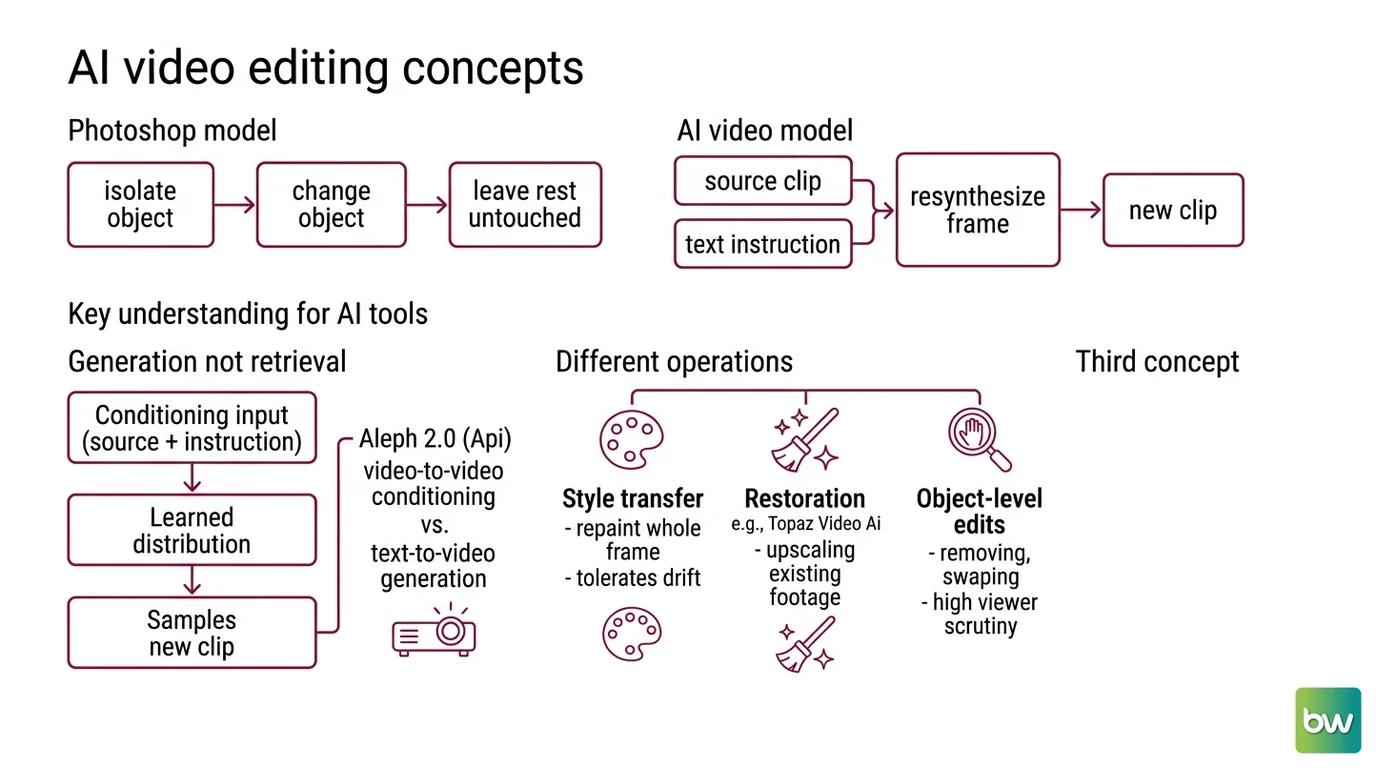
Most people bring a Photoshop mental model into their first AI video edit: isolate the object, change it, leave the rest untouched. That assumption is wrong, and that gap explains most of the disappointment in this category. A AI Video Editing system conditioned on a source clip and a text instruction does not mask and composite — it resynthesizes the frame from scratch, guided by what the source clip and the instruction suggest is plausible.
What Do You Need to Understand Before Using AI Video Editing Tools?
Three concepts, in order of how often they get skipped.
First: in-context editing is generation, not retrieval. In Context Video Editing means the model receives a source clip plus an instruction as conditioning input and produces a new clip sampled from its learned distribution — it is not pulling a “true” edited version out of storage. Runway’s flagship model for this task, Runway Aleph 2.0, has been available via API since June 2026 and is built for video-to-video conditioning, not text-to-video generation (Runway API docs). That distinction matters: a generator has no source frame to stay faithful to; an editor is graded on what it preserves.
Second: editing, restyling, and restoration are three different operations, even when product pages blur them together. Style Transfer repaints an entire frame toward a target aesthetic and tolerates drift because there’s no fixed reference to compare against. Restoration tools like Topaz Video AI take a third path — upscaling and cleaning up existing footage rather than generating new content, a cheaper and more constrained problem than what Aleph or Pika attempt. Object-level edits — removing a sign, swapping a prop — sit at the hard end: viewers know exactly what the unedited frame looked like, so any inconsistency reads as an error rather than a style choice.
Third: most tools here share the same underlying architecture, so a limitation in one tool tends to show up in a competitor’s too, regardless of how the marketing differs. Pika takes a different product angle — extending existing footage rather than performing scene-by-scene video-to-video edits — but it samples frames the same way Aleph does, and the failure modes below apply to both.
The Math Behind the Flicker
Most video diffusion architectures share the same constraint: attending fully across every frame pair in a clip is computationally implausible, so they process frames with limited cross-frame interaction — enough to look coherent at a glance, not enough to lock geometry in place. That compromise isn’t a bug introduced by a careless team. It’s a deliberate trade against compute, and it shows up exactly where human perception is most sensitive: faces.
Why Do AI Video Editing Tools Struggle With Temporal Consistency Across Frames?
The root cause is structural. Research on temporal-consistent video restoration traces the problem to independent per-frame diffusion with insufficient inter-frame interaction — each frame samples close to independently, conditioned on a shared context, but that conditioning nudges probability rather than pinning geometry the way a 3D mesh would (arXiv, Temporal-Consistent Video Restoration). Fixes exist — pseudo-3D convolutions, sparse-causal attention layers that let later frames reference a sparse set of earlier ones — but the same research notes they cost compute and scale poorly as clip length grows.
Not a rendering glitch. A sampling problem.
Temporal Consistency is the property being lost, frame by frame, as small independent sampling decisions accumulate into a visible drift. Why this mechanism produces drift instead of uniform blur is still unsettled — sparse-causal attention is one plausible explanation, but the literature hasn’t settled on a single account of why faces degrade fastest.
When the Face Is Not a Stored Object
Identity drift is a special case of the same problem, and it’s the one viewers notice first. Research on identity-preserving video generation found that models condition on first-frame features that prioritize global semantic alignment over fine-grained identity traits — eye shape, jaw contour — and that these small errors accumulate frame to frame because identity isn’t stored anywhere as an object (arXiv, Identity-Preserving Video Generation). The model isn’t trying to preserve a specific jawline — it’s trying to preserve the statistical signature of “looks like this person,” and those are not the same target. Some research borrows an idea from Text-to-3D pipelines — anchoring a face to a persistent 3D-ish representation instead of resampling its 2D projection every frame — but that inherits the same compute cost as the other inter-frame fixes.
Where the Seams Show: Lip Sync and Object Removal in 2026
Two tasks expose these limits faster than any other use case, because both demand frame-perfect precision in exactly the regions human perception is most sensitive to: faces and the physical continuity of a scene. Neither is a separate bug — both sit downstream of the same per-frame sampling and loose conditioning described above, just under more scrutiny.
What Are the Technical Limitations of AI Lip Sync and Object Removal in 2026?
Runway Aleph 2.0, the current leader for in-context video-to-video editing specifically, caps a single edit at clips up to 30 seconds at 1080p, up to 10 cuts or scene changes, and up to 5 keyframe anchor images (Pexo). Those numbers aren’t arbitrary; they sit near where inter-frame conditioning stops holding identity and geometry stable. Lip sync work compounds the identity-drift problem directly — a mouth has to track phonemes precisely while the rest of the face holds still, and that’s the exact pairing AI Avatar Generation pipelines depend on, which is why small per-frame errors are so visible there.
Object removal is where the field is moving fastest, because a reappearing object reads as a glitch, not a drift — the most literal failure of all. Netflix open-sourced VOID in April 2026 for physics-preserving object removal (Hugging Face Papers), and Runway offers a browser inpainting tool that tracks objects across moving-camera shots rather than treating each frame as an independent mask. Both are attempts to inject a constraint the base architecture doesn’t have natively — some notion of physical continuity — into a process that otherwise has none. Video Inpainting has effectively become the proving ground for whether per-frame diffusion can be made to respect a scene it can’t actually see in 3D.
Consistency, in other words, is something every one of these tools is still buying — not something any of them has for free yet.
What the Architecture Predicts for Your Workflow
Once you know the mechanism, the failure modes stop being surprises and start being predictions you can plan around.
If a shot needs to run longer than a platform’s stated cut-and-keyframe ceiling, expect to stitch multiple generations together and accept a visible seam at the join — re-anchoring is unavoidable past that point. If a face speaks or emotes for more than a few seconds, expect identity drift to compound with shot length rather than stay flat; the error is cumulative, not a fixed per-edit cost. If the brief requires pixel-perfect continuity — a specific logo, an exact brand color, an object that must be identical rather than merely similar — expect manual touch-up downstream; the model conditions on “looks like” rather than “is identical to,” and that distinction is the entire failure surface.
Rule of thumb: treat clip length as a drift budget, not a creative constraint — the longer the shot, the more error accumulates per frame, regardless of which vendor generated it.
When it breaks: identity drift compounds fastest in long, single-take shots with a visible, emoting face; splitting the shot into shorter generations and re-anchoring on a fresh keyframe resets the error budget, but it trades one failure mode for another — drift for a visible cut at the seam.
Why Compute Cost Killed a Product Before Quality Did
An H100 GPU rented on-demand runs roughly $2.29 to $3.12 an hour in 2026, with spot pricing as low as $1.03 (Spheron Network). That single number is the real ceiling on every fix described above: sparse-causal attention, longer inter-frame context, and physics-aware inpainting all buy consistency by spending more compute per frame.
On the product side, that price tag shows up directly in what these tools charge. Runway’s API prices Aleph 2.0 generation at 15 credits per second of output, at $0.01 per credit (Runway API docs) — a direct, per-second readout of how much a temporally-consistent edit actually costs to produce.
The clearest cautionary tale is a product that no longer exists. OpenAI’s Sora is being discontinued — web and app access ended in April 2026, with API access following in September 2026 (OpenAI Help Center). Reporting at the time attributed the shutdown in part to compute cost reportedly running near seven figures a day against a shrinking active-user base, though that specific figure traces to coverage rather than an OpenAI-published number and should be read as a widely repeated estimate, not a confirmed one. Whatever the exact figure, the direction is the lesson: a technically capable model can still be economically unsustainable to keep running — the same per-frame compute tax that fixes temporal consistency is the tax that made Sora’s economics fail first.
Security & compatibility notes:
- OpenAI Sora discontinuation: Web and app access ended April 26, 2026; API access ends September 24, 2026. Any workflow still built on Sora needs a migration plan now.
The Data Says
AI video editing tools don’t edit pixels; they resample frames from a learned distribution conditioned on a source clip, and the limitations downstream — temporal flicker, identity drift, hard caps on clip length — all trace back to that one structural fact. The fixes that exist work, but they cost compute, and that cost isn’t theoretical: it’s the same economics that ended Sora. Plan clip length and shot duration as a compute-and-drift budget, not a creative afterthought.
AI-assisted content, human-reviewed. Images AI-generated. Editorial Standards · Our Editors