Prerequisites and Hard Limits of Real-Time AI Generation: Inference to Hardware Bottlenecks
ELI5
Real-time AI generation means producing image, audio, or video fast enough to feel instant — under roughly 300 milliseconds. Image and voice models reach that with few-step inference; video can’t, since it needs far more compute per second of output.
A text-to-image model can turn a prompt into a finished frame faster than you can blink — SDXL Turbo renders a 512×512 image in 207 milliseconds, fast enough to redraw a webcam feed live. Point the same diffusion math at ten seconds of 720p video, and the GPU runs out of memory before the first scene finishes rendering. Same architecture family, same denoising loop. One modality crossed the real-time threshold years ago; the other still can’t clear the hardware bar.
The Latency Budget Hiding Behind Every Demo
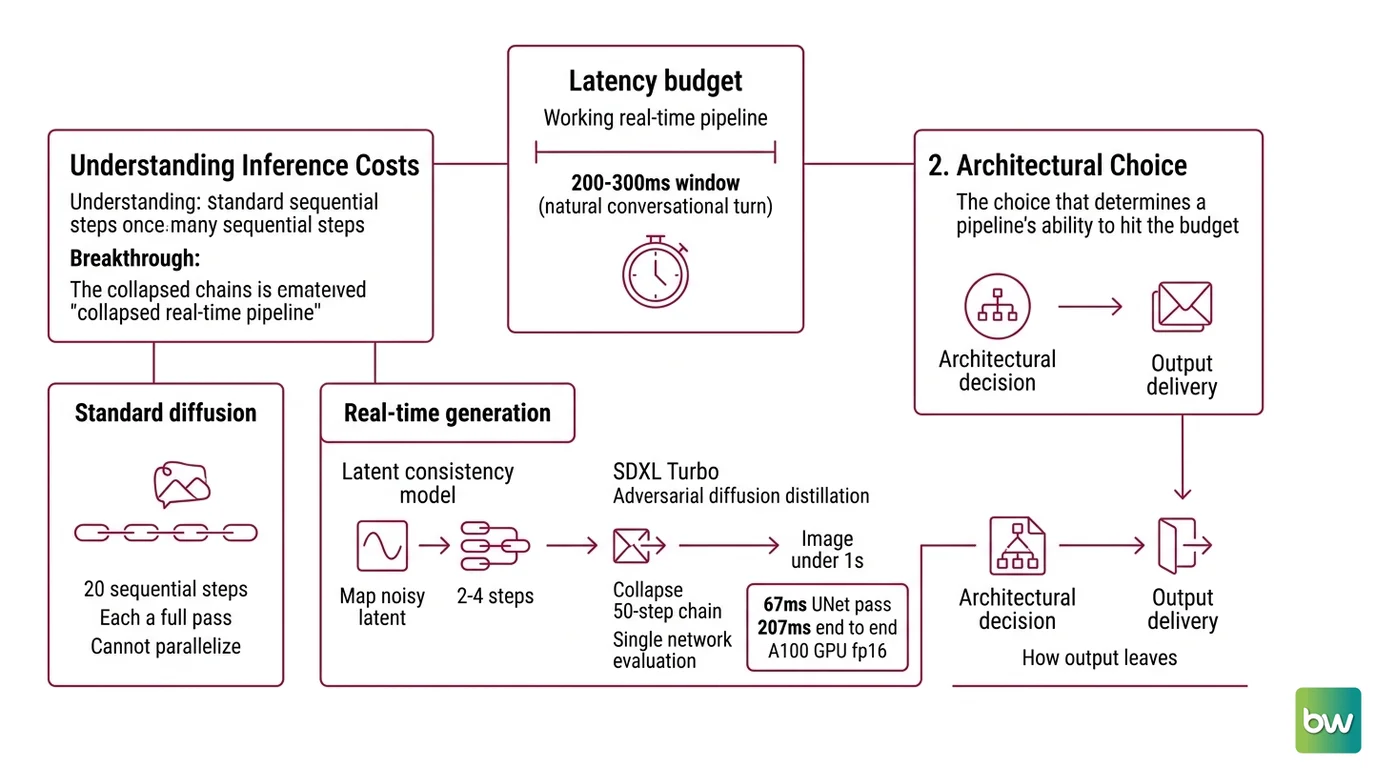
Every real-time demo hides a budget nobody states out loud: total time from request to usable output has to land inside the window human perception treats as instantaneous, somewhere around 200 to 300 milliseconds for a natural conversational turn. Building a Real-Time AI Generation system means hitting that budget consistently, under real load, not just in a demo recorded under ideal conditions. Two architectural choices decide whether a pipeline can hit that number, and most teams discover them only after the system already misses the window in front of real users, not before.
What do you need to understand before building a real-time AI generation system?
Three pieces of prior knowledge separate a working real-time pipeline from a demo that times out under load.
The first is what Inference actually costs. A standard diffusion model denoises an image over 20 to 50 sequential steps; each step is a full forward pass through the network, and the steps cannot run in parallel because step N needs the output of step N-1. Real-time image generation only became possible once researchers found ways to collapse that chain. The Latent Consistency Model approach, introduced by Luo et al. in 2023, maps a noisy latent directly toward a clean one in as few as two to four steps, producing a high-resolution image in under a second. SDXL Turbo pushes further with Adversarial Diffusion Distillation, a technique combining adversarial training with score distillation to collapse a roughly fifty-step denoising chain into a single network evaluation — 67 milliseconds per UNet pass, 207 milliseconds end to end on an A100 GPU, fp16 precision (Stability AI Blog). Neither model trains faster. They simply need fewer sequential steps at inference time, which is the only axis that matters for latency.
The second prerequisite is architectural, not mathematical: how the output leaves the server. A request-response API that waits for the complete output before sending anything back adds the entire generation time to perceived latency. Streaming inference instead pushes partial output — audio chunks, video frames, token deltas — to the client as soon as each piece is ready, typically over a persistent Websocket connection rather than a new HTTP request per chunk. Gradium’s own March 2026 benchmark found that multiplexing several requests over one persistent WebSocket connection, instead of opening a new connection per request, lowered median Time To First Audio from 258 to 214 milliseconds (Gradium Blog) — a saving that has nothing to do with the model and everything to do with connection overhead.
What is the difference between streaming inference and batch inference?
The distinction is architectural, not just a difference in speed.
Batch inference processes many requests together, offline, with no latency requirement — the system collects a queue of jobs, runs them through the GPU in parallel, and returns results whenever the batch finishes. This maximizes GPU utilization but says nothing about how long any single request waits; a job submitted at the start of a batch and one submitted seconds later can both wait the same amount of time. Generative Media Pipelines built for content generation at scale — bulk thumbnail generation for a media library, for instance — are usually batch jobs, because nobody is staring at a loading spinner.
Streaming inference inverts the priority: every request gets a response measured in milliseconds to low seconds, and the system optimizes for that single request’s latency rather than total throughput. Modern inference servers reconcile the two with continuous batching, dynamically grouping incoming requests into a shared batch as they arrive and leave rather than waiting for a fixed batch to fill. The result behaves like streaming from the client’s side — first tokens or first audio bytes arrive quickly — while the server still extracts the throughput benefits of batching underneath. The two modes were never mutually exclusive. They were just optimized for different variables: batch for jobs per hour, streaming for milliseconds per job.
The Wall Between Audio’s 40 Milliseconds and Video’s 80 Gigabytes
Image and audio generation crossed into real-time territory because their per-step compute and memory footprint are small enough to collapse into a handful of steps or a lightweight decoder. Video inherits none of that slack: every frame is a full image-sized denoising problem, multiplied by however many frames make up the clip, and the frames have to stay temporally consistent with each other — a constraint image and audio models never had to solve. That compounding cost is why a 2026 real-time demo can show you a face or a voice, but rarely a moving scene.
What are the technical limitations of real-time AI image and audio generation?
On the image side, the limitation isn’t speed anymore — it’s everything speed cost to get there. Collapsing fifty denoising steps into one or two leaves the model less room to correct course mid-generation, and the visible cost shows up as reduced sample diversity and occasional texture softness compared to a full multi-step run. SDXL Turbo also carries a constraint that has nothing to do with its math: Stability AI releases it under a non-commercial research license, and the company’s own materials now point production use toward Stable Image Core or SD 3.5 instead. Flux.1 Schnell, a newer four-step alternative with broader commercial licensing, is increasingly preferred for production pipelines as of 2026 — though no single model has won outright, since each carries different licensing and ecosystem tradeoffs. A real-time-capable model isn’t automatically a model you’re allowed to put behind a paid product.
Audio has cleared the latency bar more convincingly. Time-to-first-audio — the elapsed time from request to the first playable audio bytes, not headers or metadata — is the metric that matters for voice agents, and the leaders are no longer competing in hundreds of milliseconds. Cartesia’s Sonic-3 reaches roughly 40 milliseconds time-to-first-audio using a State Space Model architecture, which processes sequences linearly instead of the quadratic cost Transformers pay as sequence length grows (Cartesia). But a voice agent’s actual constraint is the full round trip, not just the text-to-speech leg: human conversational turn-taking expects a gap of roughly 200 to 300 milliseconds, and the TTS leg alone should add no more than 100 to 200 milliseconds for the exchange to feel natural (Gradium Blog) — which leaves almost no budget for the speech recognition and language-model steps that have to run before the voice model even starts. The bottleneck moved from “can the model generate audio fast enough” to “does anything else in the pipeline eat the budget first.”
Why can’t AI video generation reach real-time speeds in 2026?
Video multiplies every constraint that image and audio generation solved independently.
A single frame of video is, computationally, an image-generation problem — and a clip needs dozens of those problems solved in sequence, with each frame constrained to stay visually consistent with its neighbors so the result doesn’t flicker or drift. That consistency requirement rules out the trick that made image generation fast: you cannot simply run a one-step distilled model independently on each frame, because nothing then enforces continuity between frames. The memory cost compounds accordingly — a ten-second 720p clip from a model like Wan 2.1 can exceed 80GB of VRAM in illustrative GPU benchmarking (Spheron Blog), a figure well beyond what a consumer card holds; the RTX 4090 carries 24GB, the RTX 5090 carries 32GB.
Hardware is narrowing the gap, but it hasn’t closed it. NVIDIA’s RTX 50-series introduced NVFP4 and NVFP8 quantization formats at CES 2026 — NVFP4 claims up to 3x faster inference and 60% less VRAM for diffusion and video workloads in tools like ComfyUI and models like FLUX.1 and LTX-2 (NVIDIA Developer Blog). That’s a meaningful shift in the math behind this article’s hardware-bottleneck argument. Video generation isn’t blocked by a missing algorithm. It’s an arithmetic problem, not an algorithmic one — better hardware shrinks the gap, but doesn’t close it.
The Architecture Decisions These Numbers Actually Force
None of this is abstract once you’re the one choosing a model for a product. The gap between what a benchmark reports and what a user experiences is where most real-time projects quietly fail.
If you need real-time image generation, pick a few-step distilled model — and check its license before the architecture review, not after. SDXL Turbo’s research-only terms are exactly the kind of constraint that survives a prototype and kills a launch.
If you need real-time voice, the text-to-speech model is rarely your bottleneck once it’s already running in the tens of milliseconds leaders like Cartesia post; the speech recognition and language-model steps that run before it are where the latency budget actually gets spent. Budget the whole conversational loop, not just the synthesis step.
If you need real-time video, you don’t currently have a consumer-hardware option at meaningful resolution and duration — budget for server-side hardware with the newer quantization formats, or drop the real-time requirement and cache what you can.
Generative Media APIs that chain several of these stages together — image into video into audio — inherit every constraint above once per stage, which is why a chained pipeline’s real-time claim deserves more scrutiny than any single model’s benchmark. And if your pipeline streams generated output straight to viewers, build AI Watermarking And Content Provenance into the generation step itself; a verification pass added after the fact reintroduces the latency you just spent an entire architecture trying to remove.
Rule of thumb: If a model’s published speed is under 300 milliseconds, check whether that number describes the model’s forward pass alone or the full round trip a user actually waits through — most vendor benchmarks measure the former.
When it breaks: Every optimization here assumes the bottleneck lives in the model. On a mobile connection, or with an inference server several hundred milliseconds away geographically, network round-trip time can dwarf any saving from fewer denoising steps — and no amount of quantization fixes a latency problem that lives in the network, not the GPU.
The Data Says
Real-time generation isn’t one threshold — it’s three separate engineering problems that happen to share the word “real-time.” Image and audio crossed the line because researchers found ways to collapse sequential computation into one or a few steps; video hasn’t, because temporal consistency forces it to keep paying the sequential cost frame after frame. The hardware gap is narrowing, not closed, which makes the honest architecture decision for 2026 a question of which modality’s real-time claim you can actually trust — not whether real-time AI generation is possible at all.
AI-assisted content, human-reviewed. Images AI-generated. Editorial Standards · Our Editors