Persistent Memory, Persistent Surveillance: AI Agents That Never Forget
The Hard Truth
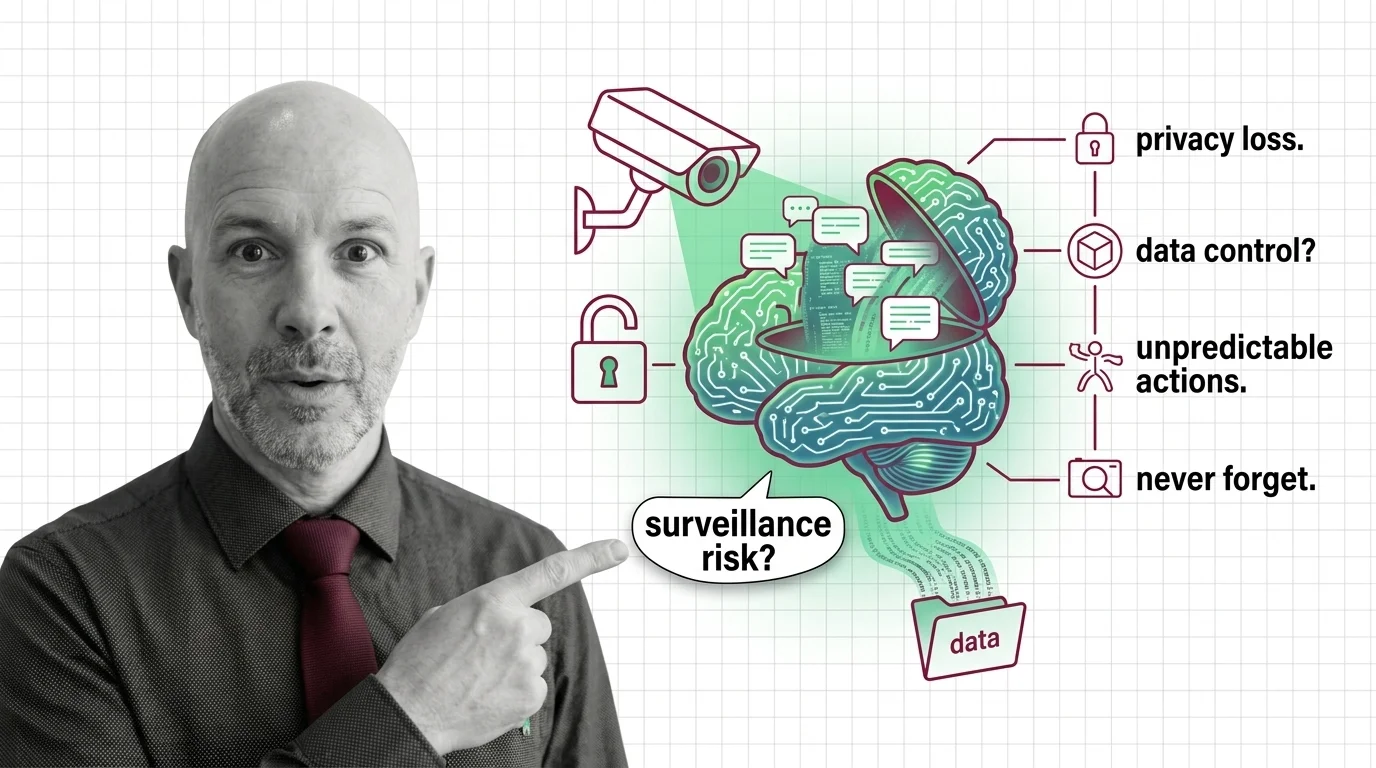
We are quietly building machines whose defining feature is that they remember everything you have ever told them. We have not decided what that obligates them to do, what it obligates us to allow, or what it obligates the people who built them to disclose. The architecture is being built anyway.
A working assistant that forgets you each morning is annoying. A working assistant that remembers everything you said for two years is something else — and we have not yet found the language for what that something is. The product pitch calls it “personalisation.” The engineering pitch calls it state. The honest description is closer to a private dossier that is updated continuously by both of you, only one of whom is allowed to read it.
The Quiet Promise We’ve Been Making
For most of the last two years, the conversation about AI ethics has fixated on what models say. Hallucinations, bias, alignment. Each of those matters. But the deeper move — the one that will define the next decade — is not what models say. It is what they store. Agent Memory Systems are now standard architecture for serious products: durable, queryable, written and rewritten by the agent itself. Tools like Mem0, Zep, Letta, Byterover, Supermemory, Langmem, and the older MemGPT pattern are not exotic anymore. They are the default direction of the field, benchmarked publicly on the Locomo Benchmark and ranked on vendor leaderboards.
The question worth asking is not whether memory is useful. It obviously is. The question is what kind of relationship a person is entering when they speak to a system that will keep what they said, recall it without prompting, and act on it later. Whose record is it? Whose to erase? Whose to weaponise?
The Case for Memory We Cannot Dismiss
The strongest version of the pro-memory argument deserves to be taken seriously, because it is mostly right. Without persistent memory, agents are useless for anything that takes more than a single conversation: case management, tutoring, long-running research, accessibility support, anything that requires building up context over weeks. A medical assistant that forgets your allergies is not safer than one that remembers them — it is more dangerous. A care companion that cannot retain the names of your family members is performing a kind of digital cruelty.
There is also a fairness argument. Without memory, every user has to re-explain themselves at the start of every session, and that cost lands hardest on the people who can least afford it: people writing in a second language, people with cognitive load issues, people who are already overwhelmed. Memory is, in this view, an accommodation.
This is not a strawman. Thoughtful researchers, including teams behind the most disciplined memory tools, genuinely believe that done correctly, memory is closer to dignity than to surveillance. The disagreement is not about whether memory matters. It is about what “done correctly” means, and whether the current architecture is anywhere close to it.
What Memory Actually Is When a Machine Holds It
Here is the assumption hiding inside the optimistic case: that machine memory is just a more reliable version of human memory. It is not. It is a different category of thing.
Human memory is reconstructive, biased toward recent emotion, and quietly self-correcting. It forgets in patterns that protect us. Machine memory is the opposite — durable, indexable, recalled with mechanical confidence even when wrong. Worse, it is rewritable from the outside. The MemoryGraft attack demonstrated under lab conditions in late 2025 (arXiv 2512.16962) that an attacker can implant fabricated “successful experiences” into an agent’s long-term store. The agent does not notice. It treats the implanted memory as a learned heuristic and recalls it across sessions. An earlier attack class, MINJA (arXiv 2601.05504), showed comparable injection success in idealised conditions. Real-world success rates with pre-existing legitimate memories are lower, but the architectural vulnerability is genuine.
The shift this implies is brutal: prompt injection ends when the context window closes; memory poisoning persists, as Unit 42 has detailed, across dozens of subsequent tasks. Microsoft’s security team disclosed in February 2026 a class of attacks where adversaries manipulate persistent agent memory specifically to bias future recommendations for commercial gain (Microsoft Security Blog). The attack does not break the agent. It quietly rewrites whose interests the agent is serving.
OWASP responded by spinning up a dedicated runtime project, OWASP Agent Memory Guard, scoped to the persistent-memory threat class — an evolution of the LLM08 entry from the 2025 top ten into the new agentic ASI06. That a global security body felt the need to create a new project, rather than extending an existing one, tells you something about how unfamiliar the terrain is.
The Bureaucratic Mirror
It helps to look backwards. The twentieth century already had a long, painful argument about institutions that remembered too much: tax records, employment files, medical archives, security dossiers. Every one of those debates ended in roughly the same place. Some memory is necessary for the institution to function. Most memory becomes hazardous over time. Therefore: purpose limitation, retention windows, audit rights, the right to challenge what is on file about you.
This is the architecture European data protection law has been building for a generation, and it is precisely the architecture that persistent agent memory disrupts. The Spanish data protection authority published one of the most detailed European analyses of agent architecture in February 2026 (AEPD), explicitly carving out “memory and RAG poisoning” as a distinct threat and treating an agent’s memory layer as a regulated processing activity in its own right. The European Data Protection Supervisor placed agentic AI on its TechSonar with persistent memory cited as a primary structural risk — extensive profiling, retention beyond original purpose (EDPS).
Now stack that against the EU AI Act, which becomes fully applicable in August 2026 and requires high-risk systems to retain audit trails for up to a decade (EU AI Act Article 10–12). The collision is real: the same memory layer that satisfies the auditor may violate the user’s right to erasure under GDPR Article 17. We have built two regulatory regimes that demand opposite things from the same database.
Why Memory Becomes Governance
Persistent memory is not a feature. It is the quiet relocation of governance from public rules to private databases — and that relocation is happening in our blind spot.
When an institution remembered things about you in 1995, the memory lived inside processes that had names: the file, the registry, the clerk. You could, in principle, find it. You could challenge it. The memory was bureaucratic, but it was visible. Persistent agent memory is the same kind of power, redistributed into systems that are mostly invisible and mostly unaccountable. Supermemory-style products and self-editing memory architectures rewrite their own contents based on agent-internal heuristics. By the time the user sees an output shaped by memory, the memory itself is often impossible to reconstruct.
OpenAI’s consumer memory feature is, to its credit, the most user-facing exception: users can view, edit, delete individual memories or disable the feature entirely, and the company says it actively steers ChatGPT away from proactively remembering sensitive details unless explicitly asked (OpenAI Help Center). That is a model worth pointing to. But it is also the consumer surface of a much larger pattern, where developer-side memory layers — operating inside enterprise agents, customer-service systems, internal copilots — have no equivalent transparency obligation toward the people they are profiling.
Even when a user successfully deletes a record, residual influence may persist in summarised facts, embeddings, or fine-tuned weights. As the EMILDAI analysis put it bluntly, true erasure is technically contested. We have not yet built the system that can honestly say it has forgotten you.
What We Owe Ourselves Before the Architecture Hardens
So what do we sit with? Not solutions — the architecture is moving too fast for any single recommendation to outlive the next deprecation cycle, as Zep’s February 2026 SDK transition reminded everyone. But there are questions worth refusing to skip past.
Who in your organisation can read what an agent remembers about a user, and who logged that read? If your answer is “we haven’t decided,” the decision is already being made by whoever wrote the database schema. The IAPP framing — that memory must become a structured, classified, auditable system rather than a raw data store — is closer to honesty than to compliance theatre.
Does the user know the memory exists? Not in the terms-of-service sense. In the sense that they could, on a Tuesday afternoon, ask “what does this system know about me,” and receive a real answer in language they understand. If the architecture cannot support that conversation, the architecture is not finished, regardless of what the leaderboard says.
And when somebody else — an attacker, an advertiser, a vindictive ex-employee — manages to write into the memory, the absence of a credit-bureau-style dispute process for poisoned recall is going to look, in retrospect, like one of the obvious gaps of this decade.
Where This Argument Could Be Wrong
This argument is most vulnerable in two places. First, it underweights how badly the memoryless alternative serves vulnerable users — and a future where regulation accidentally outlaws useful memory tools for accessibility or healthcare would be a real loss, not a moral victory. Second, it presumes that current poisoning research generalises; under realistic conditions with pre-existing legitimate memory, attack success rates drop substantially, and a more disciplined defence-in-depth posture may make these scenarios genuinely rare. If both of those turn out to be true at scale, the urgency softens — though not the underlying governance question.
The Question That Remains
We have built systems whose entire selling point is that they remember us, and we have not yet built the institutions that decide what that should mean. The architecture is hardening fast. What kind of memory do we want our machines to have — and what kind of forgetting do we still owe each other?
AI-assisted content, human-reviewed. Images AI-generated. Editorial Standards · Our Editors