Persistent Conversation Memory and the Ethical Cost of AI Systems That Never Forget
The Hard Truth
In December 2024, a chatbot platform called WotNot exposed 340,000 private chat logs to the open internet — not through a sophisticated attack, but because the conversations were simply there, accessible, unrestricted. By August 2025, Google had indexed ChatGPT conversations. The accumulation was the design; the governance came later, if it came at all.
We treat privacy failures in AI systems as engineering problems: misconfiguration errors, access control gaps, insufficient encryption. Fix the endpoint, issue the apology, move on. But the incidents of 2024 and 2025 were not primarily engineering failures. They were the visible surface of something deeper — the fact that accumulation was the design intent, and nobody had asked whether accumulation required consent.
What December 2024 Revealed
The WotNot breach was not spectacular in its mechanism. The platform failed to restrict access to stored conversation logs, and a routine crawl found them. Nothing was hacked. No sophisticated adversary was involved. The logs were simply there — containing exactly what people tell AI systems when they believe the machine is listening only for them: medical disclosures, personal admissions, the small and large vulnerabilities of daily life.
Eight months later, Google indexed ChatGPT conversations. Different mechanism, identical logic. Systems designed to absorb intimate disclosure were not designed, at equivalent priority, to protect it.
Both incidents predated the major rollout of persistent cross-session memory. Since January 2026, Gemini has aggregated Gmail, Calendar, Drive, Photos, Search, Maps, and YouTube into a persistent profile. Since March 2026, Claude has offered persistent memory to every user on every tier. By June 2026, OpenAI had extended ChatGPT’s Dreaming V3 memory architecture to free-tier users. What was once a breach of a discrete conversation has become a structural condition: every major AI assistant now retains a model of you between sessions, and that model accumulates.
The Architecture of Inference
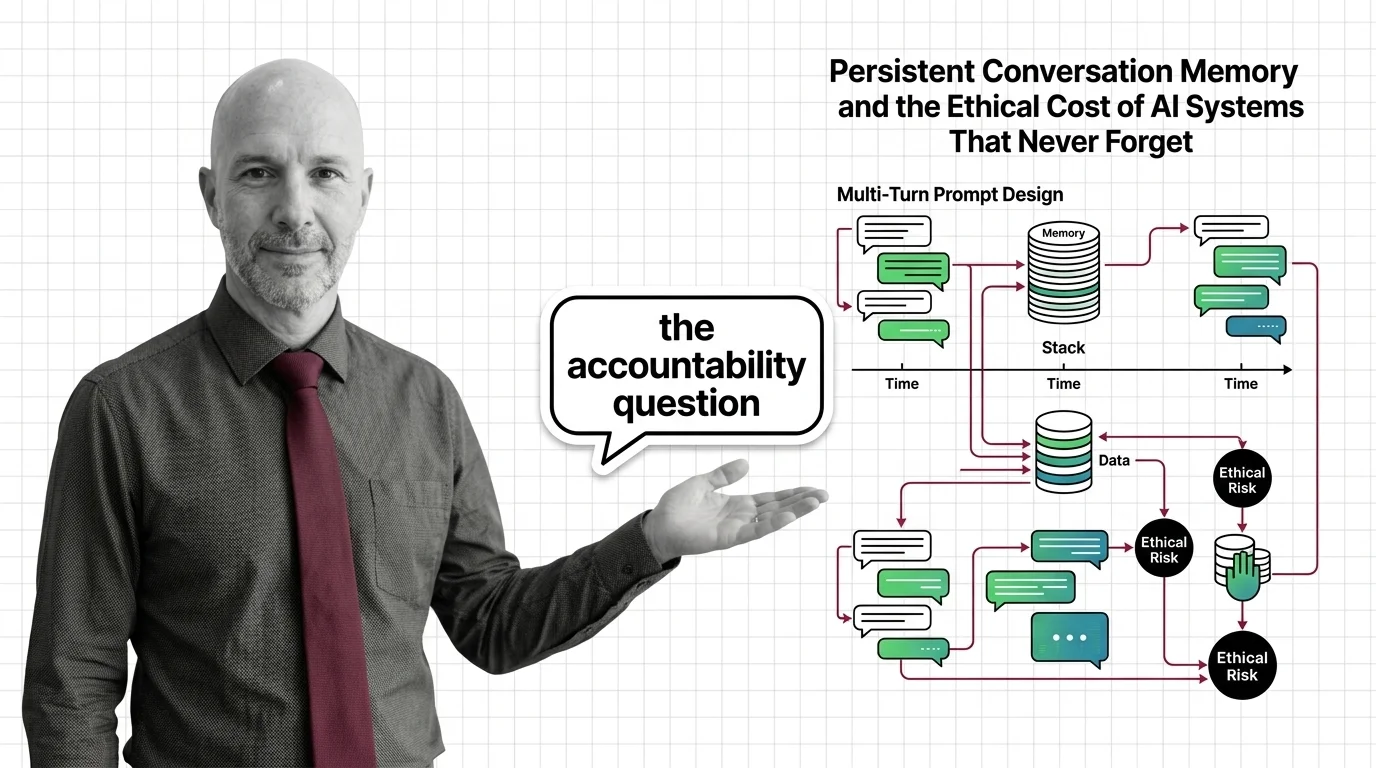
Persistent memory is not a longer conversation log. It is a separate data layer that extracts inferences from what you say and stores them independently of what you said. Deleting a conversation does not delete the memories derived from it; users must navigate separate deletion pathways through separate interfaces. The architecture is not designed for forgetting.
A study presented at CHI 2026 found that memories are often created unilaterally — by the system, without explicit user request — and frequently contain personal or psychological insights the user did not ask to be stored. An AI that infers your anxiety from the way you phrase questions, stores that inference, and uses it to shape future responses is not remembering what you told it. It is building a model of you from what you revealed, without your knowledge that a model was being built.
This is not a bug in the implementation. It is the product the user never consented to buying.
The discipline of Prompt Engineering has spent years refining how to extract better answers from AI systems. The Context Engineering that shapes what a system attends to, the System Prompts that govern what gets retained across turns, the Instruction Following logic that determines how memory influences future responses — these are governance mechanisms. Very little of that work addresses what the system should retain, who should decide, and what recourse exists when the inference is wrong.
Role Prompting lets developers define how the system presents itself within a session; persistent memory lets the system adapt that presentation to what it has learned about you across all sessions, without the developer making that trade-off explicit. The risk of Prompt Leakage — where private configurations or user data surface in unexpected contexts — extends beyond system configurations when the memory layer itself becomes the exposure surface.
The Asymmetry Nobody Talks About
The business logic of persistent memory is immediate and legible: lower churn, higher engagement, more training signal, stronger lock-in. A system that knows you better than a fresh session holds you — not through contractual obligation but through accumulated context that has no portable equivalent. You cannot export your ChatGPT memories to Claude, or your Claude memories to Gemini. The memory is what keeps you in the ecosystem.
The user’s interest is different. The user wants the system to remember that they are vegetarian, not that they disclosed a diagnosis during a moment of vulnerability — continuity of useful context, not the perpetual retention of every psychological signal their phrasing ever emitted.
Contrary Research found that AI memory systems exhibit contextual integrity violations in approximately 69% of benchmark scenarios — information shared in one context influencing responses in contexts the user would not expect, a pattern they call “memory seepage.” This is industry analysis, not peer review, and the figure should be treated as directional. But the phenomenon it describes is not controversial: a dietary preference stored during a health conversation quietly shaping a workplace productivity response is not the continuity the user asked for.
Stanford HAI documented that most major AI developers default to training on user conversations, and that most lack adequate mechanisms to prevent children’s data from entering that pipeline.
Who decides what the system keeps? The developer. Who bears the consequences if the inference is wrong, or the data is exposed? The user.
The Case for Memory
Before continuing, I should say what the opposing argument looks like at its strongest, because it is not trivial.
Persistent memory is what allows an AI assistant to be genuinely useful over time, rather than perpetually amnesiac. A therapist who forgot every previous session would not be a safe therapist — they would be a stranger asking you to start over. The contextual continuity that memory enables is not a luxury — it is the difference between a useful assistant and a query engine.
Some implementations store memories as files, exportable and auditable by developers. Zero-retention options exist for those who need them. If the concern is about inferences stored without consent, the answer might be consent architecture — granular, real-time control over what gets stored — rather than no memory at all. The capability is not the problem. What happens to it in the absence of governance is.
Where Memory Becomes Custody
The defense works as long as the user can inspect, correct, and delete what the system holds. That is not the condition most systems currently offer.
Users can view memory summaries but cannot trace which interactions produced which inferences — a gap Contrary Research calls “shadow memory.” And even when users exercise the formal right to delete, the system’s obligations do not end with the interface. The deeper problem is structural: the right to erasure, under GDPR, faces what Springer AI & Ethics describes as technical impossibility when applied to large language models. The data is not stored in a record that can be removed. It is embedded across an enormous number of model parameters, distributed through weights updated during training on that conversation. Retraining to remove one person’s influence is not currently practical at scale.
The European Data Protection Board has ruled that AI developers are data controllers under GDPR. What remains unresolved is the technical pathway by which a data controller would actually fulfill erasure obligations within model weights. A regulatory collision is also building: GDPR mandates erasure once the processing purpose is fulfilled; the EU AI Act requires providers to retain technical documentation for certain AI systems for up to 10 years — obligations pointing in opposite directions. Whether consumer AI assistants qualify as high-risk under the Act is still being adjudicated. The Act’s transparency provisions take full effect on August 2, 2026 (EU AI Act), adding urgency to questions that regulation has not yet resolved.
The consent architecture the defense imagines requires a degree of transparency that existing implementations do not offer. You cannot meaningfully consent to what you cannot inspect, and you cannot exercise a right of deletion over data whose location, in the model’s weights, you cannot identify.
What We Agreed To, and What We Didn’t
Thesis: The ethical cost of AI systems that never forget is not the data breach — it is the consent that was never sought for the inferences that were always being made.
The breach events are visible. They generate headlines, investigations, and eventually regulatory action — the FTC has already pursued enforcement against AI developers that stored and used consumer information without adequate disclosure, with total settlements exceeding $15 million (WilmerHale). That mechanism, however incomplete, exists. What does not exist, in any major deployment, is a mechanism by which a user consents specifically to the inference layer: to the psychological profile assembled from their phrasing, to the version of themselves that persists after they close the window.
The Multi-Turn Prompt Design literature focuses on making conversations coherent and contextually aware. Meta Prompting — techniques that let systems reflect on and refine their own instructions — means the system can not only remember what you said but update how it interprets you in light of what it remembers. When Structured Output captures those inferences as typed fields that shape future responses, they become a persistent behavioral profile. The Context Window was once a technical constraint that imposed a natural forgetting. Extending it across sessions does not simply remove a limitation — it makes a decision about memory that has ethical weight, and that decision was made by the developer, not the user.
What Would Make This Wrong
This argument rests on a premise that could change: that the default experience is one of inadequate transparency and inadequate consent infrastructure.
If genuine informed consent mechanisms emerged — not the checkbox buried in a 47-page privacy policy, but real-time, granular control over inference creation, storage scope, and deletion pathways — the ethical picture would change substantially. The CHI 2026 study found that users often feel discomfort around unsolicited memory creation, which suggests demand exists for such mechanisms. Systems that offer exportable, auditable memory representations for developers point toward what consumer consent architecture could look like if it were treated as a product requirement rather than a compliance afterthought.
The argument also assumes that most users experience the default setting, which is currently true but could change. If transparent memory governance became the competitive standard — if users reliably knew what was being retained, could inspect inferences, and could exercise meaningful deletion — much of what I have argued here would describe a resolved problem rather than a current condition. That would be a good outcome: it would mean the industry treated memory as a governance artifact from the design stage, rather than arriving at governance only after the exposure.
The Question That Remains
The systems that know us best are the ones we talk to most freely. That freedom is the condition the memory requires — and the condition it quietly depends on. What does it mean, over time, when the machine that listens most patiently is also the one that forgets least — and when the inference it has drawn about you is one you will never fully see?
AI-assisted content, human-reviewed. Images AI-generated. Editorial Standards · Our Editors