Patronus Lynx, Vectara HHEM, and Bedrock Contextual Grounding: How RAG Faithfulness Tooling Evolved in 2026
TL;DR
- The shift: RAG Guardrails And Grounding just consolidated from research demos into a production layer with three real vendors.
- Why it matters: Faithfulness is now a procurement decision, not a paper. The default slot in your stack is up for grabs right now.
- What’s next: The grounding score becomes a billable line item and an SLA metric — not a debugging tool.
For two years, “RAG hallucinations” was a paper title. Now it’s a line in a procurement spec. Three vendors just answered the same question with three incompatible architectures — and the way you pick between them defines your next two years of evaluation cost, vendor lock-in, and incident response.
The Faithfulness Layer Just Got Three Real Vendors
Thesis: The Guardrails category for RAG just consolidated around three incompatible bets — open-source local, vendor-coupled API, and platform-native — and the architectural choice you make now determines whether faithfulness is a feature you own, rent, or outsource.
This is not another tools roundup. It’s a market split.
For most of 2024, Hallucination detection was hand-rolled. Teams chained an LLM judge, a retrieval check, and a prompt template. Some shipped TruLens. Most shipped nothing.
The last twelve months ended that improvisation. Three production-grade options now occupy the space — and they don’t agree on what the product even is.
That disagreement is the story.
Three Bets on the Same Problem
The first bet is local and open. Patronus released Patronus Lynx as an open-source hallucination detection model fine-tuned from Llama-3, in 8B and 70B variants. On the PubMedQA medical-inaccuracy benchmark, Lynx-70B scored 8.3% higher than GPT-4o (Patronus Blog). That’s a Llama derivative beating a frontier API on a regulated-domain task.
You can run it on your own infrastructure. The faithfulness check never leaves your VPC.
The second bet is vendor-coupled. Vectara HHEM now ships in two forms. HHEM-2.3 returns a faithfulness score automatically with every Vectara Query API call, with reduced latency versus the 2.1 generation (Vectara’s hallucination leaderboard). HHEM-2.1-Open runs on a consumer GPU like an RTX 3080 or a modern CPU, supports English, French, and German, scores documents up to 4,096 tokens, and clocks under 1.5 seconds on Intel Xeon (Vectara Blog).
Vectara also added FaithJudge — a few-shot LLM-as-a-judge — to the leaderboard ensemble alongside HHEM-2.3, pushing human-agreement scores higher (Vectara FaithJudge GitHub). The latest leaderboard refresh, last updated April 28, 2026, evaluates documents up to 32K tokens spanning law, medicine, finance, education, and technology (Vectara Blog).
That dataset shift matters. Pre-2025 leaderboard numbers are not directly comparable to current ones — different documents, different difficulty.
The third bet is platform-native. AWS Bedrock Contextual Grounding went GA at the July 2024 AWS Summit and now ships two scores from 0 to 0.99 — Grounding (response factually supported by source) and Relevance (response answers the query) — at $0.10 per 1,000 text units (AWS Bedrock Docs; Amazon Bedrock pricing page). Limits: 100K characters of grounding source, 1K of query, 5K of response.
And the kicker: the ApplyGuardrail API lets teams run Bedrock Guardrails on non-Bedrock models (AWS Bedrock Docs). AWS just turned its guardrail layer into a model-agnostic billable service.
That’s not a product update. That’s a market move.
Who Moves Up
Vectara turned faithfulness into a leaderboard authority. The hallucination leaderboard is now the de facto reference enterprise teams cite when defending an architecture choice — and HHEM-2.3 is bundled into every API call. Distribution and benchmark authority in one stack.
AWS gets the long tail. Most enterprises that already use Bedrock will use Contextual Grounding by default. Adding ApplyGuardrail extends that gravity to teams running OpenAI or Anthropic models elsewhere.
Open-source teams using Lynx through Nemo Guardrails get the third spot — air-gapped, regulated, and free. NVIDIA’s library already integrates Lynx as a fact-checking rail. If you’re in healthcare, finance, or government, this is your default.
Three winners. Three different customer profiles.
Who Gets Left Behind
Standalone hallucination-scoring startups without distribution. The “we have a better judge model” pitch just got compressed by Vectara’s bundled-with-API motion and AWS’s platform default. Selling a faithfulness API as a standalone product in mid-2026 is selling a feature into a category that just consolidated.
Teams running RAG Evaluation as a one-time benchmark instead of a runtime check. Faithfulness without instrumentation is theater. If you score retrievals at eval time and stop there, you’re scoring last week’s data.
Hand-rolled prompt-judge scripts. They worked when the alternative was nothing. The alternative is no longer nothing.
You’re either running a real Grounding layer in production or you’re building one this quarter.
What Happens Next
Base case (most likely): Faithfulness scores become a contractual SLA metric in enterprise RAG agreements. Teams pick one of the three vendors based on existing platform gravity — Bedrock customers default to Contextual Grounding, Vectara customers stay coupled, regulated and air-gapped teams pick Lynx via NeMo Guardrails. Signal to watch: The first major SaaS vendor publishing a “minimum grounding score” in its terms of service. Timeline: Within twelve months.
Bull case: A standardized open faithfulness score emerges — driven by the Vectara leaderboard’s 32K-token refresh becoming the public benchmark — and procurement teams start requiring it across vendors. Faithfulness becomes a comparable metric, not a vendor claim. Signal: A second major cloud platform (Azure, GCP) shipping a contextual grounding equivalent priced against Bedrock’s $0.10 per 1,000 text units. Timeline: Twelve to eighteen months.
Bear case: Without a public head-to-head benchmark of the three on the same dataset, procurement stalls and vendor lock-in deepens. Each vendor publishes its own self-favoring numbers; buyers pick on platform, not quality. Signal: Two more quarters with no neutral comparative benchmark. Timeline: Already underway.
Frequently Asked Questions
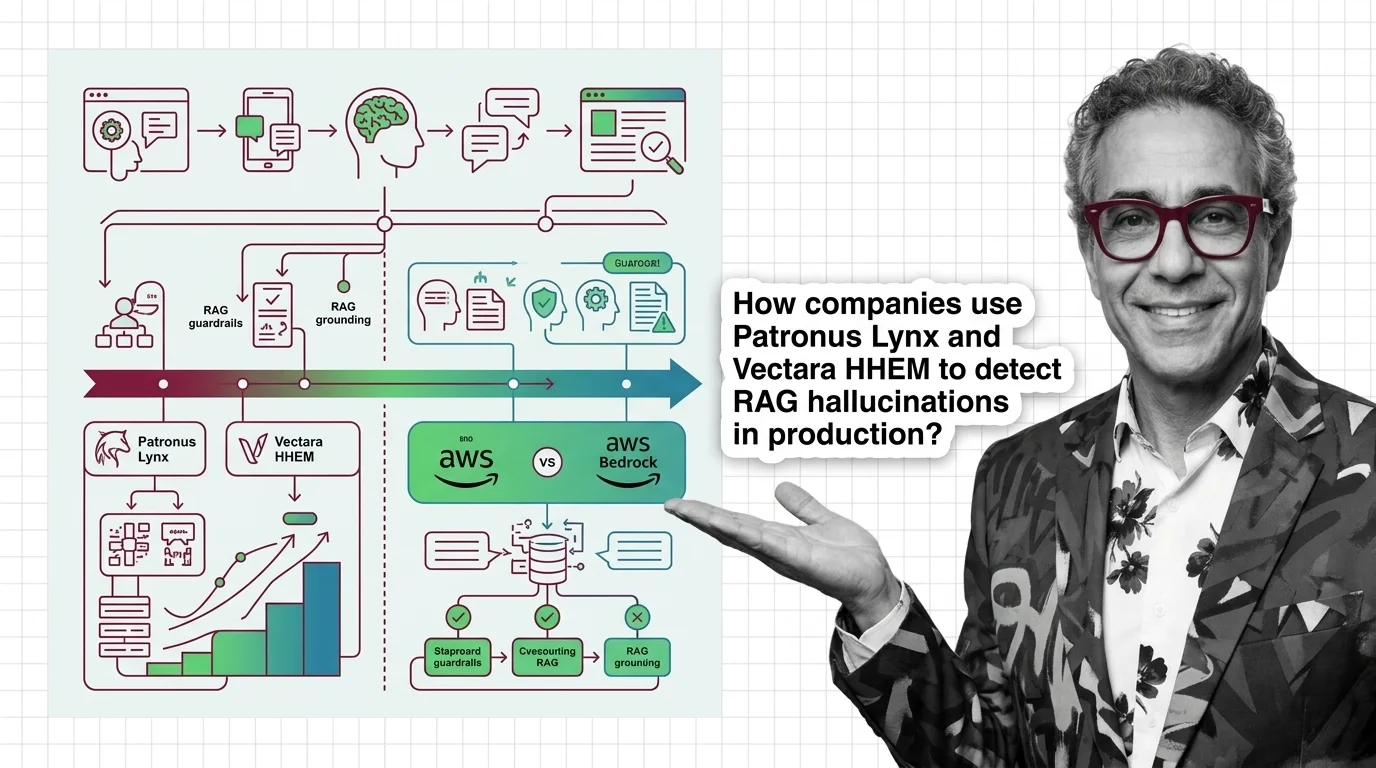
Q: How are companies using Patronus Lynx and Vectara HHEM to detect RAG hallucinations in production? A: Lynx runs locally as a fact-checking rail inside NeMo Guardrails, ideal for regulated and air-gapped deployments. HHEM-2.3 ships embedded in every Vectara Query API call, returning a faithfulness score per response with sub-second latency.
Q: How does AWS Bedrock Contextual Grounding compare to dedicated RAG guardrails tools in real deployments? A: Bedrock returns two scores — grounding and relevance — at $0.10 per 1,000 text units, with the ApplyGuardrail API extending coverage to non-Bedrock models. No public head-to-head benchmark against Lynx or HHEM exists yet, so head-to-head accuracy claims remain speculative.
Q: Where are RAG guardrails and grounding tools heading in 2026 and beyond? A: Toward runtime SLAs and billable scoring lines. Expect faithfulness scores to appear in enterprise contracts, leaderboard methodology shifts to ensemble approaches like HHEM plus FaithJudge, and a second cloud platform shipping a Bedrock-equivalent grounding API.
The Bottom Line
The faithfulness layer just stopped being a research problem and started being a procurement question. Three real vendors, three incompatible architectures, no neutral benchmark — pick on platform gravity, not on marketing claims, and instrument grounding as a runtime SLA before your competitors put it in their contracts.
You’re either shipping a grounding layer this quarter or you’re explaining its absence to your next enterprise customer.
AI-assisted content, human-reviewed. Images AI-generated. Editorial Standards · Our Editors