Neural Networks in Action: How GPT and LLaMA Differ and What's Changing in 2026
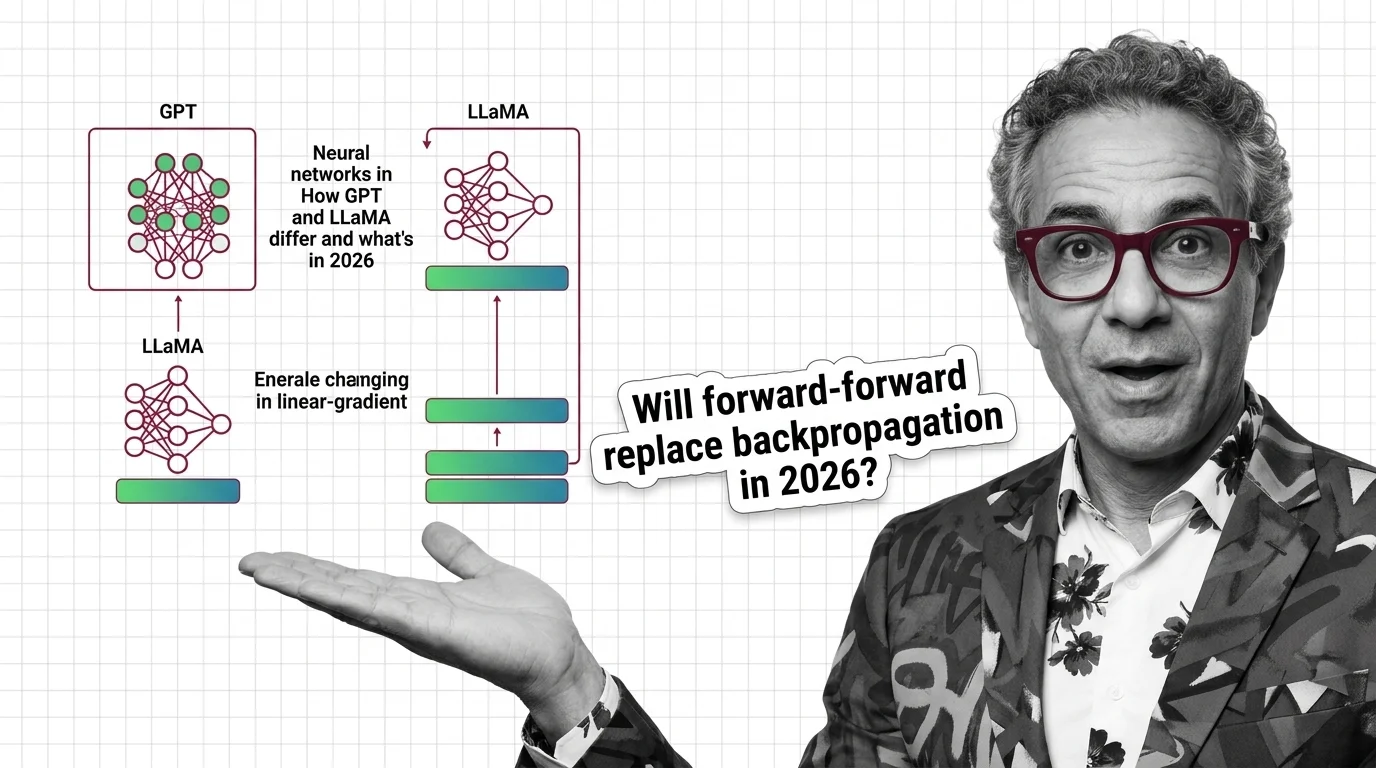
Table of Contents
TL;DR
- The shift: All three major labs now ship routing or mixture-of-experts architectures, ending the monolithic transformer era
- Why it matters: Architecture choice determines inference cost and capability ceiling — the wrong model stack costs you on every API call
- What’s next: 1-bit networks and backpropagation alternatives target the compute floor, but neither has reached production scale
For three years, the Neural Network Basics for LLMs playbook was simple: stack layers, feed data, scale the transformer. That playbook expired. GPT-5, LLaMA 4, and Gemini 3 all moved to routing and mixture-of-experts designs — but their implementations reveal three fundamentally different bets about where the real bottleneck lives.
The Monolith Era Just Ended
Thesis: The convergence on routing architectures across all three major labs is the market admitting that monolithic scaling hit its economic ceiling.
OpenAI, Meta, and Google each shipped a form of sparse computation within the past year. Not because routing is new. Because full-model inference became too expensive to sustain at scale.
GPT-5 runs a router-based system that directs queries between a fast model and a deeper reasoning model in real time (OpenAI Blog). LLaMA 4 takes classic MoE: Scout runs 109B total parameters but activates only 17B per query across 16 experts; Maverick scales to 400B total with 128 experts, still activating only 17B (Meta AI Blog). Gemini 3.1 Pro uses sparse MoE with multimodal fusion and posts a 78.8% Intelligence Index score, ranking first as of February 2026 (Artificial Analysis).
Three labs. Three designs. One conclusion: full-model activation is legacy.
Three Architectures, One Direction
The differences matter more than the similarities.
GPT-5 is a bet on orchestration. The router picks the path. You get the output. You don’t see the routing logic. GPT-5.4 pricing sits at $2.50 per million input tokens — a premium that buys the intelligence of the routing layer itself (OpenAI Pricing). OpenAI’s exact parameter count remains undisclosed.
LLaMA 4 is a bet on efficiency at the edge. Maverick delivers competitive output while activating a fraction of its total parameters. Scout pushes context to 10M tokens using an iRoPE architecture with interleaved attention layers (Meta AI Blog). Open-weight licensing means you can run it, inspect it, modify it. Meta’s largest variant — Behemoth, roughly 2T total parameters with 288B active — was still in training at the time of Scout and Maverick’s release. Its current status remains unconfirmed.
Gemini 3.1 Pro is a bet on multimodal fusion. Sparse MoE across text, code, image, video, and audio in one architecture, priced at $2.00 per million input tokens (Artificial Analysis). Google’s edge is integration depth — but without a published technical whitepaper, the MoE internals stay opaque.
The Backpropagation pipeline, the Gradient Descent loops, the Activation Function choices, the Cross Entropy Loss objectives — none of that changed. What changed is how trained weights get activated at inference. That shift is where the money moves.
Who Moves Up
Open-weight teams gain the most ground.
LLaMA 4’s licensing on Hugging Face gives any team the ability to fine-tune a frontier-class MoE model without an API dependency. For organizations that need data on-premises or behavior customization beyond prompt tuning, that’s a strategic moat.
Cost-conscious builders win too. Sparse activation means you pay compute for 17B parameters even when the full model holds 400B. That math rewrites every inference-heavy ROI calculation.
The education ecosystem gets a real upgrade. Karpathy’s nanoGPT — the repo that taught a generation how neural networks actually train — was deprecated in November 2025. Its replacement, nanochat, covers the full pipeline from tokenization to chat UI for roughly $48 on 8xH100, under MIT license (Karpathy’s GitHub). The educational ladder just extended from toy models to production-grade systems.
Who Gets Left Behind
Anyone treating models as interchangeable black boxes.
The routing and MoE split means GPT-5, LLaMA 4, and Gemini 3 now have structurally different strengths. Swapping one for another is an architecture decision, not a config change. Teams that haven’t evaluated which routing strategy fits their workload are overpaying or underperforming. Likely both.
The old Vanishing Gradient problem shaped how deep networks got trained. The new sparse-activation paradigm is shaping how they get deployed. Different era, same lesson: ignore the structural shift and the cost catches up.
What Happens Next
Base case (most likely): MoE and routing become the default for all frontier models by end of 2026. Inference costs drop as sparse activation matures. The Adam Optimizer and standard PyTorch training loops stay unchanged — the disruption is at inference, not training.
Signal to watch: A fourth major lab shipping a publicly documented MoE architecture.
Timeline: Q3-Q4 2026.
Bull case: 1-bit networks reach production scale. BitNet b1.58 already runs at 0.4GB memory with up to 6x faster inference and 82% lower energy use — but only at 2B parameter scale so far (Microsoft Research). If ternary weights scale to frontier sizes, inference cost drops by an order of magnitude.
Signal: A 70B+ 1-bit model matching MoE performance on standard benchmarks.
Timeline: Late 2026 at earliest. More likely 2027.
Bear case: The forward-forward algorithm (Hinton, 2022) and NoProp (2025) — both designed to replace backpropagation with local learning rules — fail to close the performance gap. As of April 2026, neither has reached production-scale deployment. Backpropagation’s dominance continues and the compute floor stays fixed.
Signal: No peer-reviewed result matching backprop at scale within 12 months.
Timeline: Ongoing.
Frequently Asked Questions
Q: How does neural network design differ between GPT, LLaMA, and Gemini architectures?
A: GPT-5 routes queries between specialized sub-models in real time. LLaMA 4 uses classic MoE with 16-128 experts, activating only 17B parameters per token. Gemini 3 applies sparse MoE across all modalities. All three reduce inference cost through selective activation rather than running the full model.
Q: How does Andrej Karpathy’s nanoGPT teach neural network fundamentals from scratch?
A: nanoGPT was deprecated in November 2025. Its successor, nanochat, teaches the full LLM pipeline — tokenization through chat UI — on real hardware for about $48 on 8xH100, making production-grade neural network training accessible under MIT license.
Q: Will forward-forward algorithm and 1-bit networks replace backpropagation in 2026?
A: Not in 2026. The forward-forward algorithm remains research-stage with no production deployment. BitNet shows strong efficiency at 2B parameter scale but is unproven at larger sizes. Backpropagation stays dominant — the current disruption targets inference economics, not training.
The Bottom Line
The architecture race split into three lanes — routing, sparse MoE, and multimodal fusion. The monolithic transformer is legacy.
You’re either evaluating these architectures for your workload now, or you’re locking in inference costs the market already moved past.
Disclaimer
This article discusses financial topics for educational purposes only. It does not constitute financial advice. Consult a qualified financial advisor before making investment decisions.
AI-assisted content, human-reviewed. Images AI-generated. Editorial Standards · Our Editors