MMLU Leakage, LiveCodeBench, and the 2026 Race to Build Contamination-Proof AI Evaluation
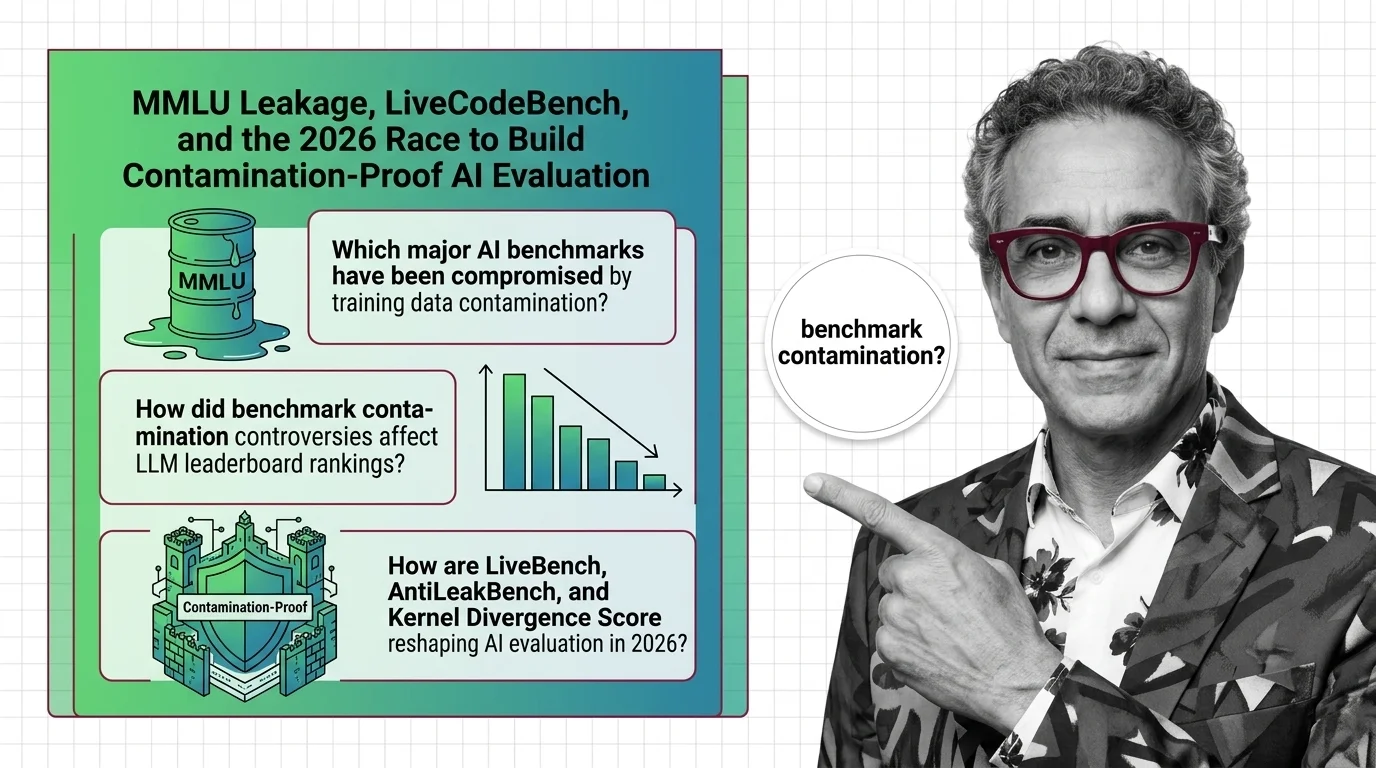
Table of Contents
TL;DR
- The shift: AI’s most trusted benchmarks are contaminated — models memorized answers, and the scores that shaped industry credibility don’t measure real capability
- Why it matters: Leaderboard rankings drove funding rounds, hiring decisions, and adoption bets built on hollow numbers
- What’s next: Contamination-resistant evaluation — LiveBench, MMLU-CF, Kernel Divergence Score — is replacing the old stack in 2026
The AI industry built its credibility on benchmarks. MMLU Benchmark scores. Leaderboard positions. Clean numbers on a clean chart. Then Microsoft stripped the answer choices from MMLU questions — and watched models reproduce the exact original options from memory. That wasn’t Model Evaluation. That was memorization dressed as intelligence.
The Scoreboard Was Built on Memorized Answers
Thesis: The AI evaluation system didn’t just have gaps — it structurally rewarded the contamination it was supposed to detect.
For two years, MMLU was the gold standard. 15,908 questions across 57 subjects. The number every lab chased.
The problem: models weren’t solving those questions. They were recalling them.
Microsoft’s MMLU-CF — a contamination-free rewrite — exposed the scale. GPT-4o dropped from 88% to 73.4% when memorized answer patterns were removed (Microsoft Research). Llama-3.3-70B fell 17.5 percentage points. Every frontier model tested showed double-digit declines.
The approach works like an Ablation Study — strip the memorizable component and measure what remains. What remained was far less impressive.
And the exam itself was broken before the cheating started. A June 2024 audit flagged 6.5% of all questions as containing errors. The Virology subset hit a 57% error rate.
The industry’s most cited exam was graded wrong and leaked to the students.
Three Proof Points, One Direction
The contamination trail runs well beyond MMLU.
GSM8K — the standard for measuring mathematical reasoning — showed up to 8% accuracy drops when researchers tested models on GSM1k, a parallel set with fresh problems (Zhang et al., NeurIPS 2024). The Mistral and Phi model families showed systematic overfitting. Not edge cases. Patterns.
Codeforces data made the mechanism visible. GPT-4 solved easy problems from before its training cutoff. After the cutoff: zero. Performance correlated directly with how much code appeared on GitHub before the data was collected.
Then the LLaMA 4 controversy broke the story open. Meta tested 27 private model variants and submitted “Llama-4-Maverick-03-26-Experimental” to Chatbot Arena — ranked #2. The unmodified open-weight release dropped to #32 (TechCrunch). The submitted variant was optimized for human preference with verbose, emoji-heavy responses — a different game than the one customers were buying into.
In January 2026, departing Meta AI chief Yann LeCun confirmed it: “Results were fudged a little bit” — with different models used for different benchmarks (Slashdot). This wasn’t direct Benchmark Contamination in the training-data sense — Meta selected favorable model variants rather than training on test sets. But the outcome was identical: scores that don’t map to real capability.
The Replacement Stack Is Live
The organizations building contamination-resistant evaluation already shipped.
LiveBench refreshes questions monthly from math competitions, arXiv, and news — making memorization structurally impossible. ICLR 2025 Spotlight, co-authored by Yann LeCun and Tom Goldstein (White et al.). As of publication, top models scored below 70%. A number that measures capability, not recall.
MMLU-CF rewrites MMLU with 20,000 contamination-free questions. The score drops are the feature — they reveal what the originals hid.
The Kernel Divergence Score, published at ICML 2025, attacks contamination from the detection side — measuring whether a model’s behavior on benchmark data diverges from its behavior on unseen data (Choi et al., ICML 2025). Near-perfect correlation with actual contamination levels. Open-source.
AntiLeakBench automates benchmark construction from knowledge explicitly absent in training sets, with fully automated refresh cycles. No human labor required for updates.
And the index providers are responding. Artificial Analysis dropped MMLU-Pro and LiveCodeBench from its Intelligence Index v4.0 in January 2026, replacing them with evaluations that emphasize real-world task performance.
The old benchmarks measured who memorized more. The new ones measure who can think.
Security & compatibility notes:
- LiveCodeBench evaluation bug: A known issue treating
###as an EOS token impacted results by over 50% in some configurations. Resolution status for the latest version (v6) is unclear — treat LiveCodeBench scores with caution until confirmed fixed.
Who Gets Burned
Any organization that selected models based on MMLU rankings just learned their selection process was compromised.
The real Confusion Matrix isn’t between correct and incorrect answers — it’s between genuine capability and memorized test data. Teams that trusted Precision, Recall, and F1 Score benchmarks inflated by contamination are now reassessing vendor decisions they thought were settled.
Model providers who invested in benchmark optimization over genuine capability face a credibility reset. When your model drops 17 points on a contamination-free rewrite, no pitch deck survives that.
You’re either publishing contamination audits alongside your scores or you’re asking customers to trust numbers you can’t defend.
What Happens Next
Base case (most likely): Monthly-refresh benchmarks become the industry default by late 2026. Static benchmarks lose credibility for model comparison. Labs adopt contamination detection as standard practice. Signal to watch: Major cloud providers citing LiveBench or MMLU-CF in product announcements instead of original MMLU. Timeline: Q3-Q4 2026.
Bull case: A unified contamination-detection standard emerges — KDS-style post-hoc analysis combined with refresh-based benchmarks. Labs publish contamination audits alongside capability scores. Signal: An industry consortium adopts contamination detection as a certification requirement. Timeline: Mid-2027.
Bear case: The evaluation arms race continues without standardization. Labs find ways to game refresh-based benchmarks through rapid data ingestion. Trust in quantitative evaluation erodes further. Signal: A contamination scandal involving a refresh-based benchmark. Timeline: Within 12 months.
Frequently Asked Questions
Q: Which major AI benchmarks have been compromised by training data contamination? A: MMLU is the most documented case — Microsoft’s MMLU-CF showed double-digit score drops across all frontier models when memorized patterns were removed. GSM8K showed up to 8% accuracy drops on fresh problems. Codeforces data showed zero performance past training data cutoffs.
Q: How did benchmark contamination controversies affect LLM leaderboard rankings? A: Rankings misrepresented real capability gaps between models. Meta’s LLaMA 4 dropped from #2 to #32 on Chatbot Arena when the open-weight version replaced the optimized submission. MMLU-CF revealed every tested frontier model was significantly overrated on the original benchmark.
Q: How are LiveBench, AntiLeakBench, and Kernel Divergence Score reshaping AI evaluation in 2026? A: LiveBench uses monthly question refreshes to prevent memorization. AntiLeakBench automates benchmark construction from training-absent knowledge. KDS detects contamination post-hoc with near-perfect accuracy. Together they form the first contamination-resistant evaluation stack.
The Bottom Line
The AI industry’s evaluation infrastructure was compromised — not by one bad actor, but by structural incentives to optimize for scores over capability. The replacement stack is live and gaining adoption. You’re either evaluating models on contamination-resistant benchmarks or making decisions on numbers that measure memorization.
Disclaimer
This article discusses financial topics for educational purposes only. It does not constitute financial advice. Consult a qualified financial advisor before making investment decisions.
AI-assisted content, human-reviewed. Images AI-generated. Editorial Standards · Our Editors