Microsoft GraphRAG vs LightRAG: The Accuracy-Cost Race in 2026
TL;DR
- The shift: Knowledge Graphs For RAG bifurcated into two production patterns — Microsoft’s depth-first stack and HKUDS LightRAG’s token-light query path.
- Why it matters: The accuracy ceiling and the inference bill now sit on opposite ends of the same architecture diagram. Pick wrong and you pay either way.
- What’s next: Neo4j becomes the convergence layer both camps target — and the substrate enterprise teams standardize on through 2026.
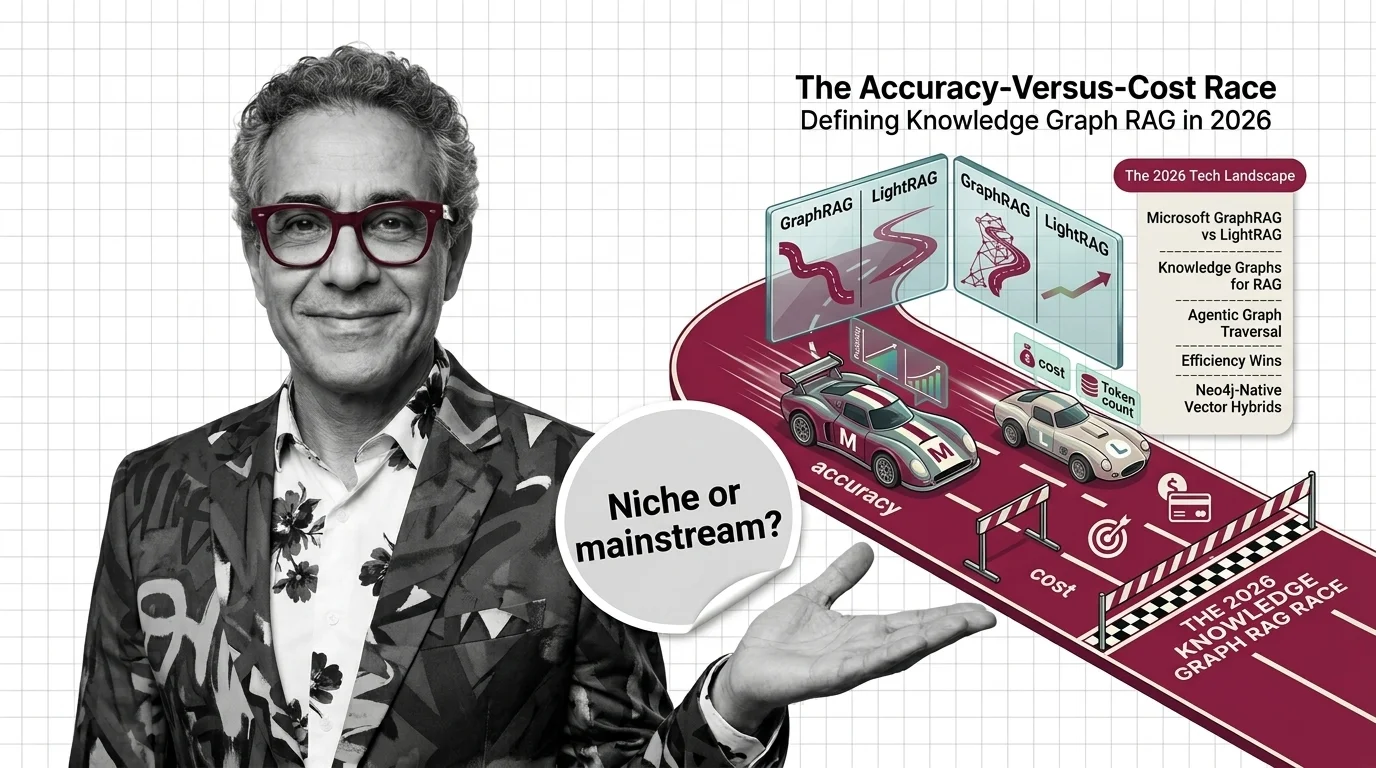
The graph-RAG market just stopped being one market. Two reference implementations now sit at opposite ends of the cost-quality curve, and they’re both shipping into production. Anyone choosing a knowledge-graph stack in 2026 isn’t picking a vendor — they’re picking a cost philosophy.
The Architecture Race Just Split in Two
Thesis: Knowledge-graph RAG has bifurcated into a depth-first axis (Microsoft GraphRAG plus LazyGraphRAG) and an efficiency-first axis (LightRAG), with Neo4j-native vector hybrids absorbing both as the production substrate.
This is no longer the early-2024 conversation about whether to add a graph layer to RAG. That debate is settled. What’s contested now is how much graph and how expensive the indexing and query path should be.
Microsoft’s stack invests heavily upfront — community detection, hierarchical summarization, multi-document corpus modeling — and then leans on LazyGraphRAG to drop the query bill. HKUDS LightRAG inverts the trade: lightweight indexing, dual-level retrieval, and a near-vector token cost on every query.
Both camps work. They just don’t optimize for the same buyer.
That’s not two competitors. That’s a market split.
Two Releases, One Direction
Look at what shipped, and the pattern stops being subtle.
Microsoft’s research team kept the Microsoft GraphRAG v3.x line moving through 2026, with the repo explicitly framed as research code rather than a supported product, per Microsoft Research. LazyGraphRAG, the cost-optimized variant, runs at roughly 0.1% of full GraphRAG’s indexing cost — identical to vector RAG — and outperforms GraphRAG Global Search at 4% of its query cost (Microsoft Research Blog). It’s already integrated into Microsoft Discovery and ships as a Solution Accelerator for Azure Database for PostgreSQL.
HKUDS shipped LightRAG v1.4.15 in April 2026, building on the EMNLP 2025 paper acceptance (OpenReview). The 2026 release line added RAGAS evaluation, Langfuse tracing, reranker support, and OpenSearch as a unified backend (LightRAG GitHub repository). On the LightRAG authors’ own benchmarks, the system reports Agriculture 54.8% versus 45.2% and Legal 52.8% versus 47.2% accuracy against GraphRAG (LightRAG paper, arXiv 2410.05779) — author benchmarks, so independent reproductions vary.
The shared destination is Neo4j. Cypher 25’s SEARCH clause with in-index filtering went GA in Neo4j 2026.02 (Neo4j GraphRAG Python issue tracker), and the Neo4j GraphRAG Context Provider for Microsoft Agent Framework is live on Microsoft Learn.
Two stacks, one substrate. Neither camp wants to fight the database layer.
Who Moves Up
Neo4j wins by being the convergence point. Both Microsoft’s stack and LightRAG list it as a first-class storage backend, and Microsoft Agent Framework now ships with a Neo4j context provider. When two competing reference architectures both target your database, you stop being optional infrastructure.
LangGraph and LlamaIndex Workflows win the orchestration tier. They’re the de-facto pair for Multi-Hop Reasoning pipelines in 2026, and LlamaIndex already ships an Agentic GraphRAG example with Vertex AI.
Enterprise teams in legal, medical, and financial use cases win on the depth axis — the Community Detection and global-search patterns Microsoft built are still the highest-accuracy answer for ambiguous, multi-hop queries where hallucination cost is enormous.
LightRAG wins the long tail: mid-market deployments where Entity Extraction quality matters but a 6,000× query-phase token gap (LightRAG paper, query phase only — indexing costs are comparable) determines whether the project survives a CFO review.
Who Gets Left Behind
Vector-only RAG vendors who priced their pitch on simplicity. The accuracy gap on multi-hop and relationship-aware queries is now publicly documented — Neo4j’s NODES 2025 sessions report 20–35% precision improvement on enterprise benchmarks. “Just embed the docs” is no longer a defensible architecture for high-stakes retrieval.
Custom in-house Knowledge Graph pipelines built before 2025. If your team is hand-rolling entity resolution and Cypher Query Language retrievers while two open-source reference stacks ship monthly releases, you’re maintaining a fork of a problem someone else already solved.
Single-pattern RAG platforms that picked an axis and stopped. The 2026 enterprise buyer doesn’t want depth or efficiency — they want a stack that lets them dial between the two without rebuilding the index layer.
That stack exists now. It’s everyone else’s roadmap problem.
What Happens Next
Base case (most likely): Neo4j-native hybrid graph-vector becomes the default enterprise pattern by late 2026, with Microsoft and LightRAG functioning as the two reference implementations on top. Signal to watch: Major cloud vendors shipping managed GraphRAG-on-Neo4j services as first-class offerings. Timeline: 9–12 months.
Bull case: Hybrid vector-plus-graph adoption hits the industry-forecast 85% of enterprises by year-end (NStarX projection — treat as analyst estimate, not measured adoption), and LazyGraphRAG-style lazy indexing becomes table stakes across every commercial RAG platform. Signal: Multiple Tier-1 RAG vendors announcing Cypher 25 SEARCH integrations in the same quarter. Timeline: 6–9 months.
Bear case: Agentic graph traversal absorbs both patterns into a single agent-orchestrated retriever, and the GraphRAG-versus-LightRAG distinction collapses into a tool-choice inside LangGraph. The 3–10× token and 2–5× latency penalty of agentic RAG (MarsDevs Agentic RAG 2026 Guide) keeps it niche, but the architectural framing shifts under everyone. Signal: LangGraph or LlamaIndex shipping a unified GraphRAG retriever that abstracts both stacks. Timeline: 12–18 months.
Frequently Asked Questions
Q: How are companies actually deploying Microsoft GraphRAG and LightRAG in production knowledge bases in 2026? A: Enterprises run Microsoft’s stack on Azure PostgreSQL or Neo4j for high-stakes, multi-hop legal and medical retrieval. LightRAG dominates mid-market deployments where token cost decides project viability. A widely-cited 2026 industry case reports a customer-support team cutting ticket resolution from 40 to 15 hours after moving to GraphRAG patterns.
Q: Where is knowledge graph RAG heading in 2026 — LightRAG efficiency wins, agentic graph traversal, and Neo4j-native vector hybrids? A: All three trends are real and not exclusive. LightRAG wins on query token cost. Agentic graph traversal wins on ambiguous multi-hop queries. Neo4j-native hybrids win the substrate war. The 2026 enterprise stack typically combines all three, with Neo4j as the shared storage layer.
Q: Will GraphRAG replace vector-only RAG by 2027 or remain a niche pattern for high-stakes domains? A: Neither. Vector-only RAG survives for short-context, single-hop queries where graph overhead is unjustified. GraphRAG patterns become the default for relationship-aware retrieval. The realistic 2027 picture: hybrid vector-plus-graph as standard, pure-vector as the cheap path, pure-graph as a rare specialist choice.
The Bottom Line
The graph-RAG architecture is no longer a single technology pick — it’s a cost-versus-accuracy dial enterprise teams will be tuning for the next two years. Bet on Neo4j as the substrate, evaluate both reference stacks against your token budget, and assume agentic graph traversal absorbs the orchestration layer above them.
You’re either tuning that dial now or paying the bill later.
AI-assisted content, human-reviewed. Images AI-generated. Editorial Standards · Our Editors