Meshy-6, Seed3D 2.0, and Tripo 3.0: Who Leads the 2026 Text-to-3D Race
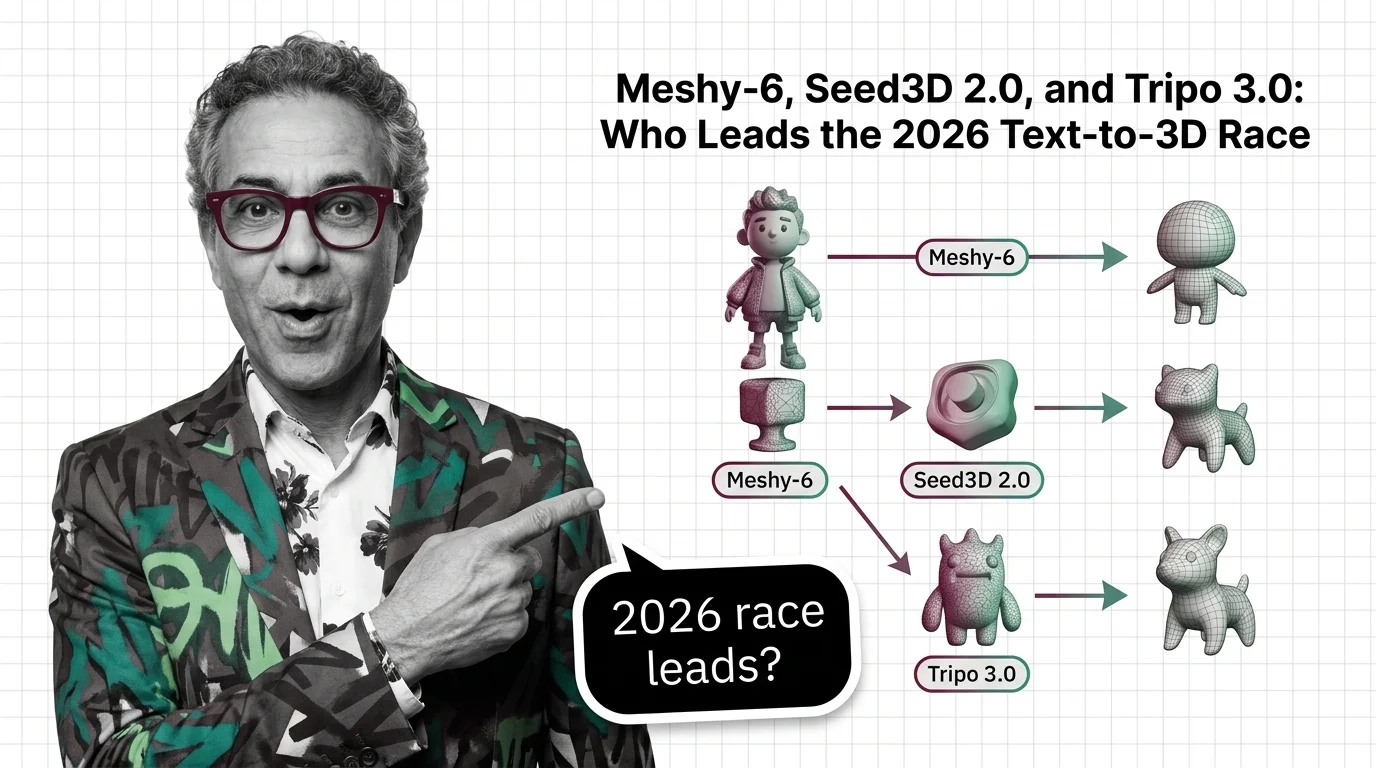
TL;DR
- The shift: The 2026 text-to-3D market split into two tracks — high-fidelity production meshes and sub-2-second engine-ready low-poly.
- Why it matters: Studio workflows and game pipelines now need different tools, and picking the wrong one costs weeks.
- What’s next: Sub-2-second clean topology is already shipping — real-time 3D synthesis at production scale is the next marker to watch.
Three Text-to-3D releases dropped in under four months — and the market didn’t consolidate around a winner. It bifurcated. Meshy-6 in January, Tripo H3.1 and Smart Mesh P1.0 in March, Seed3D 2.0 in April. By mid-2026, the competitive map looks nothing like it did twelve months ago.
The Split Already Happened
Thesis: Three independent releases in Q1 2026 confirmed what the roadmaps were signaling — text-to-3D is now two markets running in parallel, not one.
High-fidelity output. Ultra-fast low-poly. Different tools. Different production contexts.
You need both. They are not interchangeable.
The race question isn’t “which platform is best” anymore. It’s “which track are you building for?”
Three Platforms, Two Tracks
Meshy-6 went GA on January 18, 2026 (Meshy Blog). Standard output reaches up to approximately 600K faces, with a Low Poly Mode built for game developers — Mesh Topology that arrives engine-ready without manual retopology.
The Pro tier runs $20/month with API access and a 60% faster processing queue (Meshy’s pricing page). Speed and integration, not maximum polygon count.
Tripo moved in two directions simultaneously. H3.1 shipped in March 2026 as the flagship high-fidelity model — up to 2 million polygons in Ultra mode, richer geometry precision for production-grade hero assets (Technology.org).
The same month, Tripo Smart Mesh P1.0 launched as a separate track: native 3D diffusion trained for structured low-poly output in approximately 2 seconds, with characters exporting in T-Pose with Mixamo-ready skeleton binding (Tripo3D Blog).
Tripo isn’t hunting for a middle ground. It’s occupying both ends of the market deliberately.
Seed3D 2.0 shipped April 23, 2026, from ByteDance’s Seed team. The architecture is a two-stage diffusion transformer — coarse geometry first, then fine detail — with unified PBR Materials generation via Mixture of Experts and VLM priors (ByteDance Seed Blog).
In a human evaluation using 60 experienced 3D modelers across roughly 200 test cases, Seed3D 2.0 hit a win rate above 69% against mainstream models and outperformed Tencent HY3D-3.1 on shape and textured asset quality. The quality bar is real.
The access caveat: Seed3D 2.0 runs through ByteDance’s Volcano Engine platform. No confirmed global API endpoint exists as of mid-2026. Western developers face genuine friction getting there.
API compatibility notes (Meshy):
- meshy-4 retired (BREAKING): All API requests using
ai_model: meshy-4are no longer supported. Migrate toai_model: meshy-6or"latest"immediately — meshy-4 is already gone.art_styledeprecated (WARNING): Designed for legacy Meshy-4/5; will be removed in a future release. Meshy-6 Preview does not use it.symmetry_modeandenable_pbrdeprecated (WARNING):symmetry_modeno longer affects output;enable_pbrfor meshy-4 will be removed.
The migration isn’t optional. It’s already overdue.
Who Moves Up
Game studios and indie developers win on both tracks. Meshy-6’s Low Poly Mode and Tripo’s Smart Mesh P1.0 cut UV Mapping and retopology time significantly.
Meshy claims 50 assets produced in 2 hours versus weeks of traditional modeling — that figure comes from Meshy’s own blog without independent third-party verification. The directional shift in pipeline speed is real regardless.
E-commerce and AR teams have a concrete near-term case. Approximately 61% of consumers prefer retailers offering AR product experiences, and the AR e-commerce market reached $5.87 billion in 2024 on a trajectory projected toward $38.5 billion by 2030 (XICTRON). Rapid Image-to-3D conversion and text-to-3D together compress what used to be multi-week asset production timelines.
The deepest competitive moat belongs to Tripo’s developer ecosystem. Approximately 6.5 million users, over 90,000 API developers, and more than 100 million assets generated as of early 2026 (Scenario.com). That installed base doesn’t rotate overnight.
Who Gets Left Behind
Meshy-4 is already retired, not deprecated. Existing integrations hardcoded to the old API model alias are broken today.
Teams that abstracted behind "latest" are fine. Everyone else has a migration waiting.
Anyone who still assumes one text-to-3D platform covers all use cases is building on the wrong premise. A game pipeline needing 2-second retopo-clean assets and a cinematic team needing 2M-polygon hero objects are not shopping at the same store.
Western teams chasing Seed3D 2.0’s quality lead face a real access problem. The benchmark results are compelling — the Volcano Engine constraint is not.
If ByteDance opens a global endpoint, the competitive map shifts materially. Until then, Seed3D 2.0 is a signal to track, not a platform to deploy on.
What Happens Next
Base case (most likely): The two-track structure firms up through the second half of 2026. Tripo’s Smart Mesh P1.0 becomes the reference standard for game pipeline low-poly delivery. High-fidelity competition between Tripo H3.1 and Seed3D 2.0 intensifies — assuming global access opens. Signal to watch: Seed3D 2.0 announcing a non-Volcano Engine API endpoint. Timeline: 12-18 months for track consolidation.
Bull case: Sub-2-second generation quality reaches Gaussian Splatting-class photorealism. Real-time 3D synthesis becomes viable for on-demand production asset generation — not just greyboxing. Signal: Any platform shipping real-time generation at production-acceptable quality on consumer hardware. Timeline: Late 2026 to 2027 at earliest.
Bear case: PBR material quality remains inconsistent across all three platforms at edge cases — complex organic shapes, translucent surfaces, fine surface detail. Studios revert to NeRF-based capture workflows for production-critical hero assets. Signal: Three consecutive quarters of flat adoption in enterprise studios despite falling per-unit prices. Timeline: Visible by end of 2026.
Frequently Asked Questions
Q: How are game developers using text-to-3D tools in production asset pipelines in 2026? A: Game developers use low-poly modes — Meshy-6 Low Poly Mode and Tripo Smart Mesh P1.0 — for rapid prototyping and greyboxing. Engine-ready topology reduces manual retopology work. Meshy claims dramatically faster asset throughput versus traditional modeling, though that figure is self-reported without independent verification.
Q: Real-world examples of text-to-3D in e-commerce, AR, and film production? A: E-commerce teams generate rapid 3D for AR try-before-you-buy product views. The AR e-commerce market reached $5.87B in 2024, projected at $38.5B by 2030 (XICTRON). Film production uses text-to-3D for early storyboard mockups and set-dressing blocking before committing to expensive manual modeling passes.
Q: Where is text-to-3D heading in 2026: faster generation, cleaner topology, or real-time 3D synthesis? A: All three, on different timelines. Tripo’s Smart Mesh P1.0 already delivers clean low-poly in approximately 2 seconds (Tripo3D Blog). Seed3D 2.0 pushes PBR and geometry fidelity. Real-time synthesis at production scale is the next frontier — no platform has arrived there yet.
The Bottom Line
Three releases in four months confirmed the structure. Text-to-3D is two markets now, not one. You’re either building for speed and game-pipeline integration, or for maximum-fidelity production assets.
The window for picking the wrong track is open. It won’t stay open.
AI-assisted content, human-reviewed. Images AI-generated. Editorial Standards · Our Editors