Mel Spectrograms, Speaker Embeddings, and the Technical Limits of Zero-Shot Voice Replication
ELI5
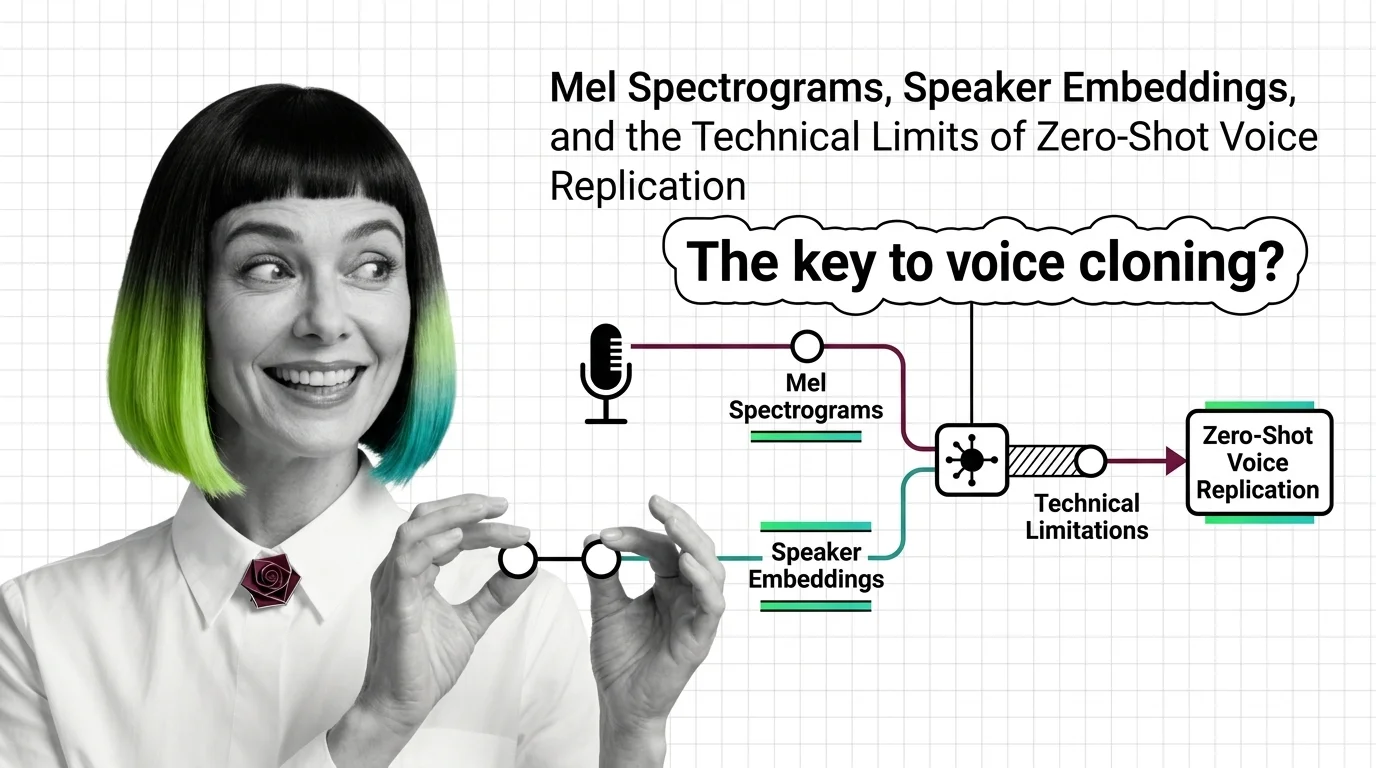
Voice cloning converts a few seconds of someone’s speech into a mathematical fingerprint of their voice, then conditions a synthesis network on that fingerprint to generate new audio. The fingerprint encodes timbre, rhythm, and identity as a single high-dimensional vector.
Researchers expected cloned voices to sound slightly worse than originals — perceptibly artificial, somehow flatter. A 2026 preprint found the opposite: listeners rated cloned voices as more authoritative, warmer, and more human-like than the source recordings, and were more willing to share sensitive information with them (Voice “Cloning” is Style Transfer, arxiv 2605.16578, peer review pending). The direction of the error is geometrically predictable once you understand what speaker embeddings actually encode — and it is exactly the kind of detail that benchmark papers on voice cloning do not surface.
The anomaly points toward a mechanism. So: what is actually happening inside these systems?
The Signal Underneath Speech
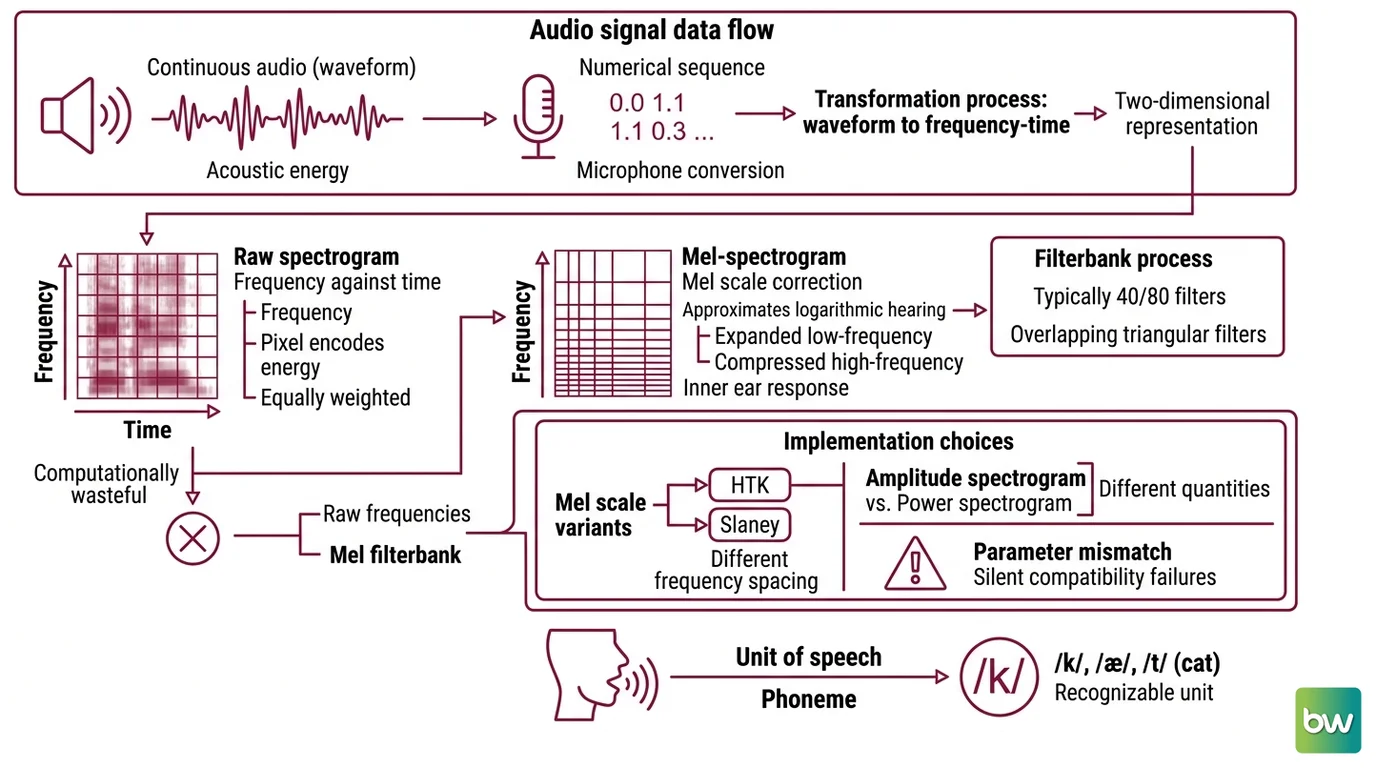
Audio exists first as pressure waves — a continuous stream of acoustic energy that a microphone converts into a discrete numerical sequence. A neural network cannot train directly on raw waveforms at the scale voice cloning requires, so the first transformation is a shift into a two-dimensional frequency-time representation.
What do you need to understand before learning about voice cloning?
The prerequisite is understanding what audio looks like to a model.
A spectrogram plots frequency against time: the horizontal axis is time, the vertical axis is frequency, and each pixel encodes energy at that frequency-time coordinate. Raw spectrograms weight all frequencies equally, which is computationally wasteful because human hearing does not work that way. We resolve fine distinctions between 200 Hz and 2000 Hz, and hear much coarser differences at higher frequencies. A Mel Spectrogram corrects for this by applying the Mel scale, which compresses the high-frequency axis and expands the low-frequency axis to approximate the logarithmic response of the inner ear.
In practice, the Mel filterbank divides the frequency axis into overlapping triangular filters — typically 40 or 80 of them, depending on the task and sample rate (Hugging Face Audio Course). Beyond filter count, implementation choices matter: “htk” and “slaney” are two common Mel scale variants that produce different frequency spacings, and amplitude versus power spectrograms are not interchangeable. A parameter mismatch between Mel implementations is one of the most common silent compatibility failures when porting voice models between frameworks — the inputs look the same dimensionally but encode different quantities.
Below the spectrogram, the unit of speech is the Phoneme: the discrete perceptual category that corresponds to a recognizable unit of sound. /k/, /æ/, /t/ in “cat” — three phonemes, three distinct filter activation patterns in the spectrogram. A Text-to-Speech system converts spelling to phoneme sequences first, because the mapping from grapheme to sound is irregular across languages. Those phoneme sequences then drive frame-by-frame synthesis of spectrogram output.
Prosody — the patterns of stress, rhythm, and intonation that carry meaning above the phoneme level — is present in both the energy contour of spectrogram frames and the timing between phoneme transitions. A speaker’s recognizable identity resides in both dimensions: the characteristic frequency envelope of their voice (timbre) and the rhythmic signature they impose on sequences of sounds. This is what makes the mel spectrogram the right interface between the speaker-encoding stage and the synthesis stage in most modern architectures: it simultaneously encodes what was said, how it was said, and who said it.
Before any cloning happens, this representation must be consistent across the reference recording and the synthesis target. Noise, channel mismatch, or resampling artifacts in the reference audio contaminate all three signal components before the speaker encoder ever runs.
Speaker as a Point in Space
Voice Cloning systems are, structurally, three networks arranged in sequence: a speaker encoder that extracts identity from a reference recording, a synthesis network that conditions on that identity to generate mel spectrogram frames from text, and a Vocoder that renders those frames as a waveform. Understanding each stage requires treating the speaker not as an abstract identity but as a specific coordinate in a high-dimensional space.
What are the main components of a voice cloning system?
The speaker encoder converts a reference recording into a Speaker Embedding: a fixed-dimensional vector encoding identity, independent of what was said. Two architectures dominate the literature. The d-vector uses a 3-layer LSTM followed by a fully connected layer, trained with Generalized End-to-End (GE2E) loss — which maximizes within-speaker embedding similarity while minimizing cross-speaker similarity (Speaker embedding review). The x-vector replaces the LSTM with a time-delay neural network (TDNN) and adds temporal statistics pooling (TSP) to aggregate frame-level information into a single utterance-level representation before projection to the fixed output size (X-Vectors paper). The output in both cases is a point in Embedding space — a compressed encoding of who is speaking, divorced from the acoustic content of the reference clip.
The synthesis network takes text (converted to phonemes), the speaker embedding, and predicts mel spectrogram frames conditioned on both. The reference architecture here is Tacotron 2, a sequence-to-sequence model with attention that conditions a downstream vocoder on predicted mel spectrograms, achieving a Mean Opinion Score (MOS) of 4.53 against 4.58 for professional studio recordings (Tacotron 2 paper). That 0.05-point gap changed what the field believed was achievable from learned synthesis.
The vocoder converts mel spectrogram frames back to a raw audio waveform — the same transformation central to AI Music Generation systems, though the upstream conditioning signal differs: voice identity in cloning versus musical style in generation. WaveNet was foundational but computationally expensive for real-time inference; HiFi-GAN, the dominant open-source vocoder in current production stacks, generates 22 kHz audio in real-time on both GPU and CPU at MOS 4.36, with a model size of 13.92 MB (HiFi-GAN, AI-Scholar).
The speaker embedding is the only pathway through which identity enters the synthesis — the vocoder receives mel frames without access to the embedding and cannot correct an identity error the synthesis network introduced upstream.
Zero-shot voice cloning extends this pipeline by requiring generalization from a reference recording of a speaker the system has never seen in training. Microsoft’s VALL-E 2 reduced the required reference audio to 3 seconds and achieved what the field calls human parity on the LibriSpeech and VCTK benchmarks — the first model to reach that threshold (Synced Review). It is not publicly released; Microsoft cited voice imitation and fraud risk as the reasons (Decrypt). As of mid-2026, leading accessible alternatives include ElevenLabs Eleven v3 (GA February 2, 2026, 74 languages), Chatterbox from Resemble AI, which clones from a 10-second sample, and Qwen3-TTS from Alibaba, which clones from a 3-second sample under Apache 2.0 (Local AI Master).
Where Zero-Shot Breaks
Zero-shot performance is typically measured by speaker similarity — how closely the cloned output matches the target as judged by a separate speaker verification model. A common target is cosine distance ≥ 0.75 between reference and synthesized embeddings (Zero-shot voice cloning thesis), though this threshold varies across evaluation setups and should be treated as an approximate calibration point rather than a universal specification.
What are the technical limitations of current voice cloning models?
The benchmark results are misleading in a specific way.
Human parity claims for VALL-E 2 hold for LibriSpeech and VCTK — datasets composed predominantly of English-language read speech, recorded under controlled conditions, from a relatively narrow demographic. Benchmark conditions are, by design, favorable: clean reference audio, standard accents, minimal prosodic complexity. Models trained and evaluated on this distribution have not been demonstrated to generalize to conversational speech, strong regional accents, dysphonic voices, or speakers with high prosodic variance. The research is explicit on this: benchmark human parity likely does not extend to those populations.
Not a limitation of VALL-E 2 specifically. A limitation of what “human parity” means when the benchmark is read speech.
This failure mode is geometric. Speaker embeddings work by compression — they discard everything that doesn’t cluster with the training distribution in order to produce a compact, generalizable representation. Speakers whose vocal characteristics map to sparsely populated regions of the training manifold (because they were underrepresented in training data) receive embeddings with weaker statistical support. The synthesis network, conditioned on a poorly-grounded embedding, generates output that converges toward the nearest dense region of speaker space rather than the intended target. The cosine similarity score may still read as acceptable; the subjective quality does not.
The spoofing detection side reveals a different structural failure. Antispoofing models trained on ASVspoof 2019 data achieve approximately 1% Equal Error Rate (EER) on that benchmark. When evaluated on ASVspoof 5, which includes output from more recent synthesis systems, those same models collapse to an EER in the range of 15–20% (CallSphere Blog; treat as indicative rather than definitively benchmarked, as the source is an industry blog rather than a peer-reviewed evaluation). A detection system calibrated against older synthesis methods is statistically blind to newer ones. This is not surprising — it is the expected outcome when a classifier is trained on a closed distribution and then evaluated against a target that has moved. The implication is that enterprise voice authentication systems built on older antispoofing models are operating with materially degraded reliability against current synthesis quality.
The homogenization finding from the 2026 preprint (arxiv 2605.16578, peer review pending) adds a third dimension. Research found reduced variance in accent, speaking rate, and audio embedding space across cloned voices — meaning zero-shot cloning does not faithfully preserve the statistical texture of the original voice. It pulls the output toward the center of the training distribution. Irregular vocal qualities get smoothed; average vocal qualities get amplified. This is the geometric explanation for why cloned voices test as more authoritative and warmer than the originals: the averaging effect removes the idiosyncratic roughness that marks a voice as genuinely individual while preserving the features that pattern-match to “credible, assured speaker.”
Not degraded replication. Style transfer with a systematic bias toward the distributional mean.
The broader open-source tooling ecosystem for voice synthesis saw significant churn in 2025 and early 2026 — archived repositories, acquisitions, and withdrawn inference code. Before integrating any specific library beyond the models named here, verify current maintenance status and license terms independently.
What the Geometry Predicts
Treating the speaker as a coordinate in embedding space produces testable predictions about where systems will succeed and where they will fail.
If the reference audio is short, noisy, or contains overlapping speech, the speaker encoder extracts a noisier embedding — a coordinate with greater uncertainty in its exact location. The synthesis network, conditioned on an uncertain coordinate, generates mel spectrogram frames that reflect that uncertainty as acoustic artifacts. The vocoder renders those artifacts faithfully. This is why reference audio quality is not a soft preference but a structural constraint: the encoder is performing lossy compression, and the information lost in that compression cannot be recovered downstream.
If the reference speaker’s characteristics are at the edge of the training distribution — strong regional accent, atypical speaking rate, vocal pathology — the synthesis network will be generating frames in a region of its output space it has seen infrequently during training. The synthesized voice will drift toward the nearest high-density region in speaker space: closer to some average, and less like the intended target. Cosine similarity scores may report acceptable identity distance even as subjective listener evaluation shows a voice that sounds like someone else.
Conversely, a reference speaker close to the distributional center of the training data will receive smooth, confident synthesis — and the output will sound, to listeners unfamiliar with the original, credibly like the target. The system is not reproducing the voice; it is generating an approximation optimized for distributional plausibility, not fidelity.
Rule of thumb: Speaker similarity score above threshold is necessary but not sufficient evidence of successful cloning — subjective evaluation by listeners who know the original speaker reveals failures that cosine distance misses, because cosine distance compares embeddings, not voices.
When it breaks: Zero-shot models lose speaker fidelity most severely when the reference recording contains overlapping speech, heavy background noise, or vocal characteristics from underrepresented demographics in the training data. These conditions push the extracted embedding toward low-density regions of speaker space, where the synthesis network has learned unreliable mappings, causing output to converge toward an averaged voice rather than the intended identity.
The Data Says
Voice cloning achieves measurable parity with professional recordings on controlled benchmarks because benchmark conditions are, by design, favorable: clean audio, standard accents, minimal prosodic complexity. Off-distribution speakers — accented, expressive, dysphonic — reveal what speaker embeddings actually encode: a compression-biased summary of voice identity, not the voice itself. The anomaly (cloned voices rated as more authoritative than originals) follows directly from that compression. The direction of the failure is not a defect; it is the system working as designed, which is precisely why understanding the mechanism matters before working with the outputs.
AI-assisted content, human-reviewed. Images AI-generated. Editorial Standards · Our Editors