Mandatory Watermarking, Privacy Trade-offs, and Whether Content Provenance Can Stop Misinformation
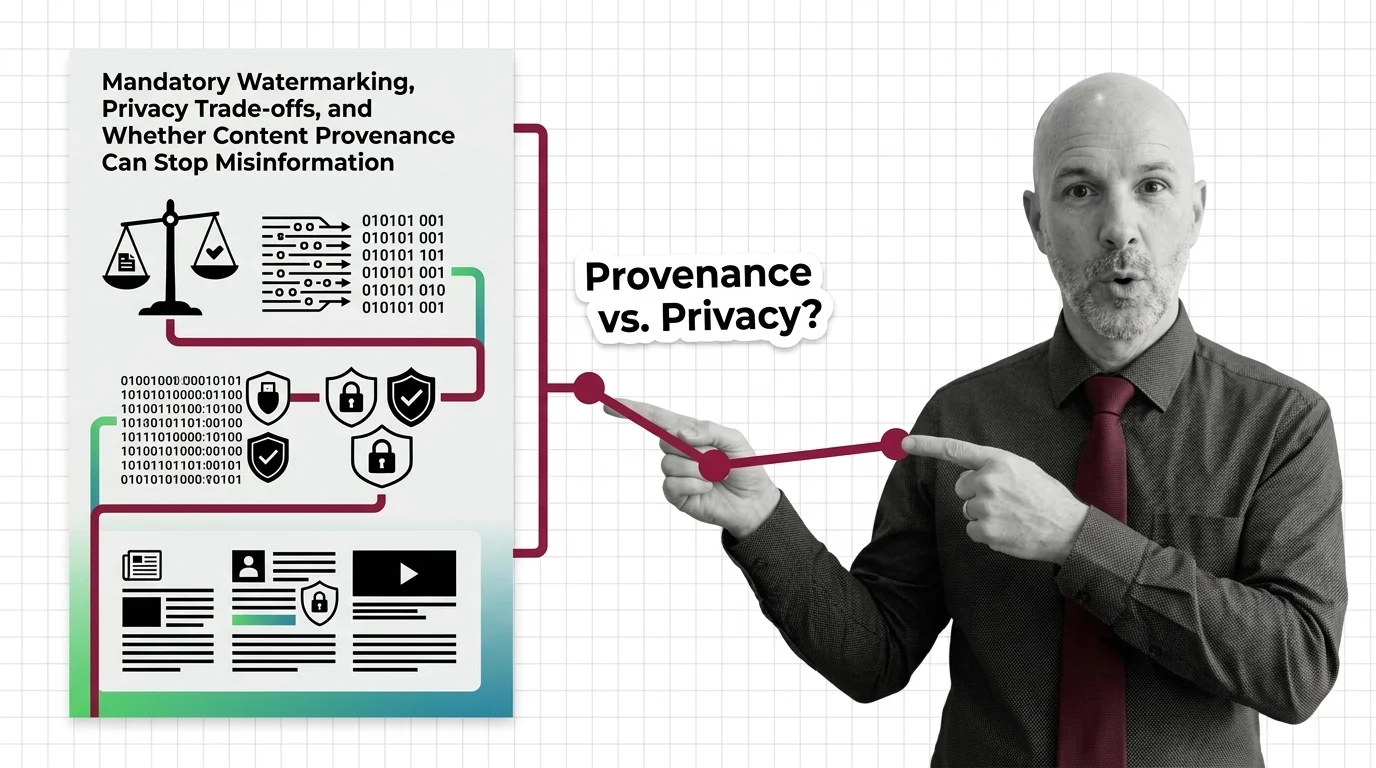
The Hard Truth
Every credible technologist studying AI safety agrees on this much: synthetic media without provenance is a civilizational hazard, and the only serious fix is to mark it by law, everywhere, all the time. The EU has mandated it, California has mandated it, and roughly six thousand companies have signed onto a shared standard to make it happen. The debate is already over.
In March 2026, an independent researcher quietly posted code that strips Google’s invisible watermark from AI-generated images while leaving the picture untouched. Google has not confirmed the break. It has not denied it either. Somewhere between those two silences sits the actual state of the technology we’re about to make mandatory for the entire internet.
The Case That Convinced Two Governments
The argument for mandatory AI Watermarking And Content Provenance is not naive, and it deserves full strength before anyone complicates it. Generative systems can now produce a fabricated video of a public official, or a photograph of an event that never happened, in seconds, at a quality that defeats the human eye. Self-regulation hasn’t kept pace, so lawmakers stopped asking nicely. The EU’s AI Act requires AI-generated audio, image, video, and text to carry a machine-readable, detectable mark once Article 50 becomes fully applicable on August 2, 2026, with penalties reaching €15 million or 3% of global turnover (EU AI Act, Article 50). California’s AI Transparency Act takes effect the same day, requiring visible and invisible watermarking plus a free public detection tool from any provider with a million or more monthly California users (California Legislative Information). Behind both stands a coalition of more than six thousand members — Google, Microsoft, Adobe, Meta, OpenAI, Sony, the BBC, Amazon — that has spent years building Content Credentials into a working, cross-industry standard, not a patchwork of competing formats (C2PA). What that consensus is actually selling, though, is a separate question from what it claims to be selling.
What the Mark Also Records
Here is what the steelman skips past. Digital Watermarking and content provenance are not one thing wearing two names — they are two different jobs the same trail of data is made to do. A watermark is the Embedding of a signal into pixels or waveform that survives compression and cropping, quietly saying this was machine-made. Provenance is broader: a manifest traveling with the file, applying Cryptographic Hashing to every edit so tampering is detectable, closed with a Digital Signature that ties the chain to an identity. So does proving what content is also prove who made it? C2PA’s own harms assessment says yes — it admits the manifest can cause “inadvertent disclosure of sensitive information,” because the action log can record exactly how, where, and on what device an image was made, and that log cannot simply be redacted (World Privacy Forum). For most people, that’s a curiosity. For a journalist filing under a government that prosecutes journalists, or a domestic violence survivor whose metadata could reveal a location, it is not. That identity is the crack.
The Same Coalition, Read the Other Way
Run the steelman’s own evidence backward and it stops proving what it was built to prove. Start with adoption: a mandate only constrains those who comply, and the people most motivated to deceive are, by definition, least likely to volunteer a trail back to themselves. Misinformation researchers reviewing these tools have been blunt: the results “don’t seem promising,” since participation stays voluntary where it matters most, and the burden of checking a label falls on an audience that mostly won’t (NBC News). Should marking be mandatory, then, or voluntary? The honest answer is the question has already been half-settled the wrong way: mandatory for the compliant, optional in practice for everyone else. Durability fares no better: a peer-reviewed analysis of removal attacks found the exploit chain that strips a mark from a protected image is, in most designs, also sufficient to forge one onto something never protected (OpenReview). Stripping and forging are the same vulnerability, viewed from either side of one gate. Put plainly: a regime the willing follow and the dishonest ignore is not a defense against misinformation. It is a compliance ritual that looks like one.
Security & compatibility notes:
- Google SynthID (image watermark): An independent researcher’s March 2026 method claims to strip the invisible mark from Gemini/Nano Banana images via a non-neural frequency-domain technique, quality preserved. Google has not confirmed or patched it — treat the claim as reported, not settled.
- C2PA signing infrastructure (Nikon): A vulnerability forced revocation of all certificates issued through Nikon’s in-camera signing in 2025; as of early 2026 the service had not been restored — a sign of how fragile this standard’s trust layer can be in practice.
What the Mandate Is Actually Built to Protect
Thesis: Mandatory, universal content provenance as currently architected protects institutions’ need to be seen acting on misinformation more than it protects the public from misinformation itself — and it does so by quietly converting an anonymity problem into an identity-disclosure requirement.
That is not a conspiracy; it is what happens when “do something verifiable” becomes the goal instead of “make deception costlier than truth.” A government under pressure to respond to deepfakes can point to a mandate, a fine schedule, a published standard, and call its job done — even while the claim doing the real work, that the mark stops the harm, was never the strongest part of the case. The strongest part was always that doing nothing looked worse. Content Provenance, as a record-keeping idea, is not the problem; demanding that record-keeping double as proof of identity, for everyone, by default, is — and that demand falls heaviest on those who can least afford to be found.
The People the Mandate Doesn’t Picture
Picture who the mandate’s authors had in mind: a state actor running an influence campaign, a scam built on a cloned voice, a fabricated video timed to an election. Now picture who actually carries a verifiable device fingerprint into the photos and clips a compliant device produces, whether they want one or not — the freelance journalist filing from a country where bylines get people arrested, or the abuse survivor using an AI tool to alter their voice or face for the precise purpose of not being identified. C2PA’s identity-assertion feature — the part of the standard that could let someone prove “this is authentic” without proving “this is me” — was pulled from the core specification in 2024, handed to a separate working group that has, so far, produced little that reaches real products (World Privacy Forum). Meanwhile the verification infrastructure itself is priced for institutions, not individuals: Digimarc, Truepic, and Steg.AI all sell the same enterprise-only model — custom quotes, nothing a freelance journalist could subscribe to. The newsroom can afford to authenticate its footage. The stringer feeding it often cannot — and under a mandate built around marking by default, may not be able to safely decline to try.
Where This Argument Could Fail
This argument is not unconditional. If the identity-assertion work C2PA shelved in 2024 matures into something that reaches real products — pseudonymous certificates proving machine origin without proving a person’s name, location, or device — the privacy cost described here stops being structural and becomes a fixable implementation gap. If detection infrastructure becomes a public utility rather than enterprise software, the economic-exclusion half of this argument weakens too. Neither change is hypothetical; both are already named, in writing, by the organizations building this stack. What would make this wrong is not a different argument — it’s the same architecture, finished properly instead of rushed out under deadline pressure from regulators who needed something to point to by August 2026.
The Question That Remains
A mandate that proves what something is by also proving who made it solves the misinformation problem for institutions that can afford to comply, and creates an exposure problem for everyone who cannot afford not to. Maybe that trade is still worth making — collective trust is not nothing, and neither is the cost of a fabricated video deciding an election. But nobody designing this system has had to answer, in public, which matters more: a society’s ability to tell real from fake, or a person’s ability to disappear into the crowd when disappearing is the only thing keeping them alive?
AI-assisted content, human-reviewed. Images AI-generated. Editorial Standards · Our Editors