LLM Gateway Latency, Single Points of Failure, and the Hard Engineering Limits of Proxy Architecture
ELI5
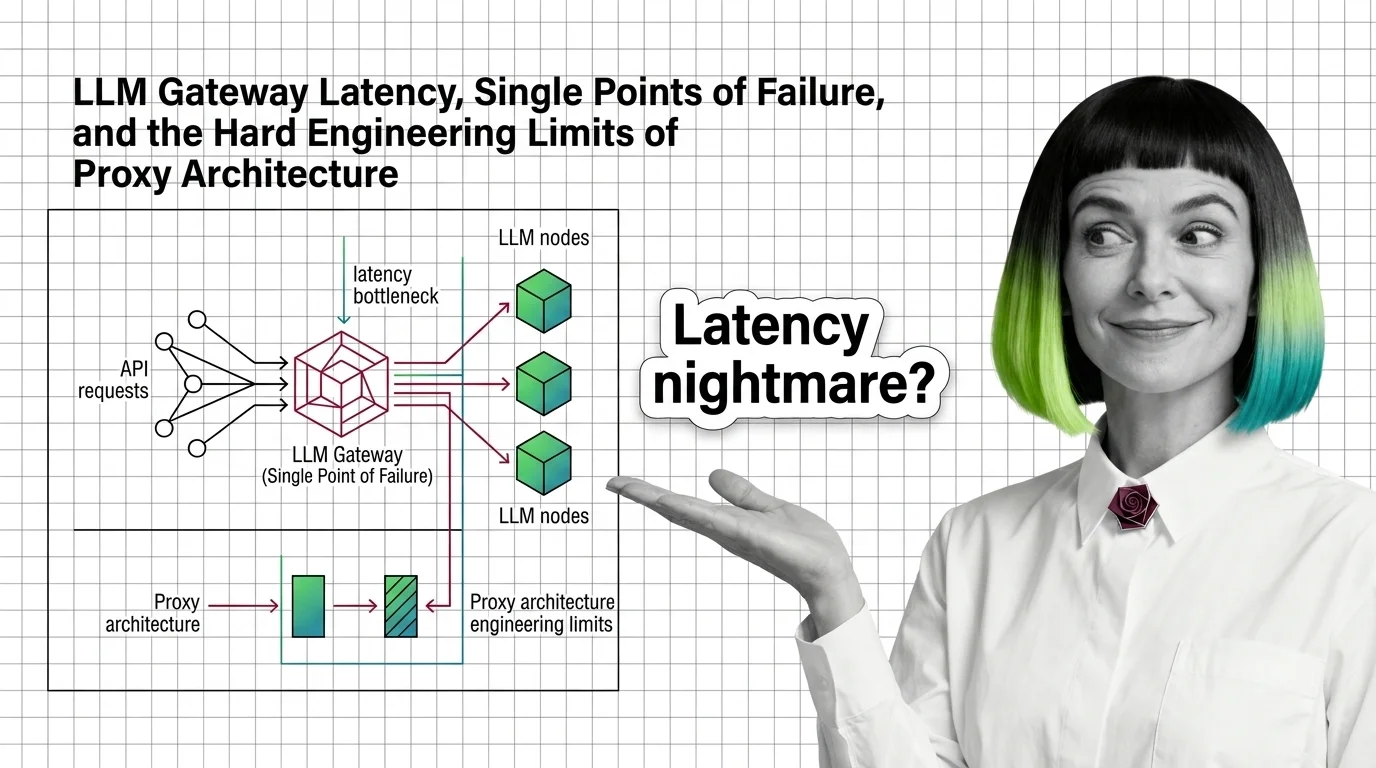
An LLM gateway adds a thin proxy layer between your application and AI providers. At steady state it costs 2–12ms of overhead. The real risks are architectural: it becomes a single point of failure and its security posture requires active maintenance.
Every team building on hosted LLM APIs eventually encounters the same advice: put a gateway in front of your calls. Centralize your keys, add fallbacks, collect metrics. The advice is sound. What rarely follows the advice is a precise account of what the gateway costs — not in dollars, but in latency distribution, failure surface, and security exposure.
Those costs are not equally distributed across implementations, and they compound differently at scale. A 12ms gateway overhead on a 4-second inference call is noise. That same 12ms multiplied across five sequential agent calls, at high request volume, through a Python runtime under database pressure, is a different conversation entirely.
The Misconception Embedded in Every Gateway Benchmark
Before examining what gateways cost, it’s worth pausing on how gateway benchmarks are produced — because the methodology determines what the number actually measures.
The Kong-authored benchmark comparing Kong AI Gateway, LiteLLM, and Portkey used a WireMock mock backend, zero active policies, 12 CPUs, and 400 virtual users over three minutes (Kong Blog). Under those conditions — no real model inference, no authentication, no rate limiting — Kong recorded a P95 latency of ~16ms; Portkey came in at ~47ms; LiteLLM at ~112ms.
Those numbers are real, but they measure something specific: the gateway’s own processing overhead when the backend is instantaneous. In production, where LLM inference runs 2–5 seconds (DigitalApplied), a 16ms vs. 112ms overhead difference collapses to rounding error. Independent estimates put the real-world gap between gateways at 50–100% — not the 859% headline the Kong benchmark produces against LiteLLM. The Caution flag here is deliberate: treat Kong’s own benchmark numbers as a lower bound on the gap, not a measurement of production conditions.
Not a flaw. A category error.
What the Overhead Numbers Actually Mean in Production
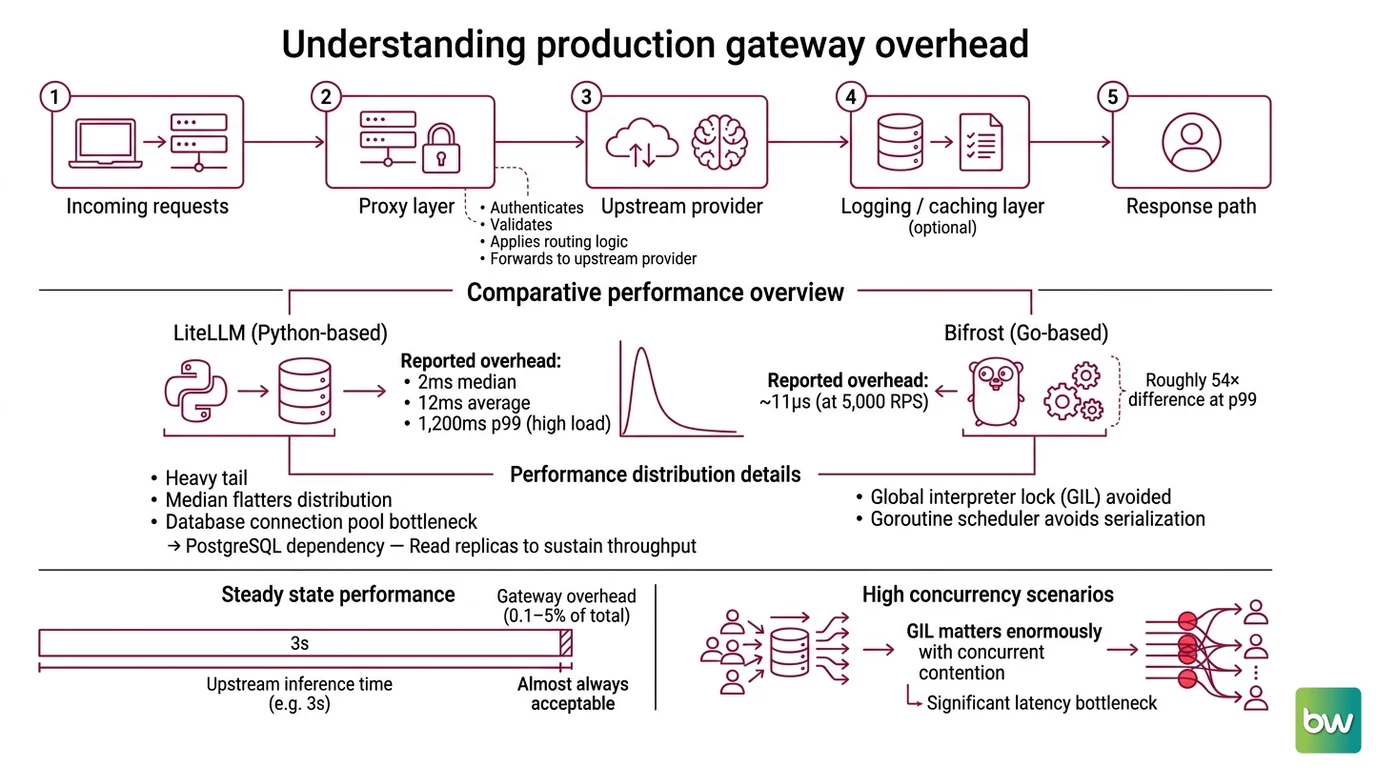
The architecture of an LLM Gateway follows a recognizable pattern: incoming requests hit the proxy layer, which authenticates, validates, applies routing logic, and forwards to the upstream provider. The response travels the reverse path, optionally passing through a logging or caching layer. Each hop has a cost, and those costs accumulate differently depending on the runtime the gateway is built on.
LiteLLM’s self-reported overhead across four instances sits at 2ms median and 12ms average (LiteLLM Docs). Under sustained load — two instances, high concurrency — that P99 climbs to 1,200ms. The distribution is non-Gaussian; it has a heavy tail that the median flatters. The bottleneck is not the HTTP routing. It is the database connection pool: LiteLLM’s PostgreSQL dependency begins saturating beyond 5,000 RPS, requiring read replicas to sustain throughput (LiteLLM Docs).
Go-based implementations sit at a different point on the distribution. Bifrost, a Go-based gateway, reports ~11 microseconds of overhead at 5,000 RPS (DigitalApplied). That is roughly a 54× difference at P99 versus Python-based gateways under equivalent load. The mechanism is structural: Python’s global interpreter lock introduces serialization overhead that Go’s goroutine scheduler avoids. The GIL doesn’t matter much at low concurrency; it matters enormously when hundreds of concurrent requests contend for the interpreter.
At steady state, this overhead is almost always acceptable. Gateway overhead sits at 0.1–5% of total latency when inference is running live (DigitalApplied). The math works in the gateway’s favor: if inference costs 3 seconds and the gateway adds 12ms, the gateway is not your problem.
Does adding an LLM gateway introduce noticeable latency to AI API calls in production?
The precise answer depends on where you sit on the cache-hit spectrum and the concurrency curve.
On a cache hit — where the gateway returns a semantically identical prior response — latency drops below 5ms (DigitalApplied). The gateway, at that point, is faster than the baseline it replaces. On a cache miss with low concurrency, the overhead is in the 2–50ms range depending on implementation language and active policies. On a cache miss under high concurrency, with a Python-based gateway and database pressure, that overhead can spike to seconds.
The latency math only becomes adversarial in agentic pipelines. Multi-agent scenarios chain sequential LLM calls; five sequential calls through a Python gateway at 40ms overhead each produce 200ms of cumulative gateway tax. Through a Go or Rust gateway, the same five calls add negligible overhead. The architecture choice at the gateway layer has downstream consequences that single-request benchmarks don’t surface.
The Failure Surface You Actually Need to Model
Latency overhead is the metric that gets benchmarked. Single points of failure are the metric that get teams paged at 2am.
An API Gateway inserted into every LLM call path becomes the mandatory intermediary for every request. If it fails, the application fails — not gracefully, not partially, but completely, unless fallback paths are explicitly engineered. The question is not whether gateways can fail; it’s how long recovery takes when they do.
What are the technical limitations and failure modes of LLM gateways at scale?
Failure modes stratify by cause. Provider-side degradation is the most common trigger: an upstream LLM provider experiences an outage or rate-limit event, and the gateway must detect it and route around it.
Real incident data from 2026 production environments reveals what the MTTR looks like with and without automated fallback (AppScale Blog):
- Anthropic cluster failure: 51 minutes offline before a manual provider swap to OpenAI
- OpenAI 4-hour degradation: 2 hours, 11 minutes offline for one analytics pipeline
- Gemini 2.0 Flash Rate Limiting event: 38 minutes offline for an eval pipeline
Without a gateway implementing automated Fallback Strategy, the mean recovery time for real provider incidents ran 38–128 minutes — the entire range representing manual intervention latency, not technical recovery time. With a gateway configured for provider fallback, MTTR drops to 15–45 seconds (DigitalApplied). Automated fallback compresses incident recovery time by a factor of roughly 60–200x compared to manual intervention across documented production failures.
That is the strongest empirical argument for the gateway pattern. Not latency reduction. Not cost tracking. Recovery speed.
But the gateway that enables automated fallback is also the system that, if it fails itself, eliminates the fallback. The failure surface has two faces: it protects against provider failures, and it introduces a new class of gateway-level failures. A misconfigured circuit breaker per provider+model combination (the recommended architecture from DigitalApplied) that trips on a healthy provider will route all traffic to a secondary that may not have the capacity to absorb it. A gateway that loses its Redis connection may stop caching without surfacing an obvious error. A database saturation event at the gateway layer looks, from the application’s perspective, like LLM latency — it doesn’t self-announce.
The recommended mitigation is to model the gateway as infrastructure, not middleware: health checks, separate circuit breakers per provider+model combination, and observable fallback state. A Virtual Keys architecture — where application-facing credentials are abstracted from provider credentials at the gateway layer — adds a second benefit: credential rotation and provider swaps don’t require application redeployment. They require a gateway configuration change.
What the Security Surface Looks Like at Scale
The failure modes described above are operational. There is a separate class of failure that arrived in 2026 and belongs in any honest accounting of gateway risk.
LiteLLM, the most widely deployed open-source gateway by install count, was hit by two distinct incidents within months of each other. A critical SQL injection vulnerability (CVE-2026-42208, CVSS 9.3) affecting versions 1.81.16 through 1.83.6 was exploited actively within 36 hours of disclosure and reached CISA’s Known Exploited Vulnerabilities catalog (LiteLLM Docs). Separately, the litellm 1.82.7 and 1.82.8 packages on PyPI carried a credential-stealing payload for approximately 40 minutes before removal — a supply chain attack that affected any installation pulled during that window (HeroDevs Blog).
The gateway that centralizes API key management also centralizes the attack surface for those keys. A compromised gateway doesn’t just expose one provider credential; it exposes all of them.
Security & compatibility notes:
- LiteLLM SQL Injection (CVSS 9.3): Critical vulnerability (CVE-2026-42208) in versions 1.81.16–1.83.6, actively exploited, CISA KEV listed. Also: second CVE (CVE-2026-42271) listed. Fix: upgrade to v1.83.7+ immediately (v1.83.10-stable recommended); rotate all credentials.
- LiteLLM Supply Chain Attack (March 2026): Versions 1.82.7 and 1.82.8 on PyPI were poisoned with a credential-stealing payload. If installed, rebuild containers and rotate all secrets.
The Portkey situation adds a different dimension. Portkey was acquired by Palo Alto Networks, with the acquisition closing May 29, 2026, integrating into Prisma AIRS (Palo Alto Press). Teams evaluating Portkey as an independent open-source gateway should note that its post-acquisition roadmap — including open-source continuation — is unconfirmed as of June 2026. This is a WARNING, not a BREAKING alert: Portkey installations continue to function, but new dependencies on it as a standalone product carry strategic uncertainty.
What the Mechanism Predicts About Trade-offs
Understanding the gateway as a proxy layer with specific failure modes produces a set of predictions that should inform architectural decisions:
If you are running Python-based LiteLLM at high concurrency — above a few thousand RPS — you should expect database connection saturation before you hit CPU or network limits. The fix is PostgreSQL read replicas, not more gateway instances.
If you are building multi-agent pipelines where sequential LLM calls are the critical path, the implementation language of your gateway matters far more than any single-request benchmark suggests. A Python gateway at 40ms average overhead adds 200ms across five hops; a Go gateway adds microseconds.
If your application cannot tolerate more than a minute of provider outage, a gateway with automated fallback is the only way to achieve that SLA without manual on-call escalation. But the gateway itself requires the same uptime requirements as your application — it is no longer auxiliary infrastructure.
Rule of thumb: measure your gateway’s P99 latency under load, not P50. The tail is where the architectural choices show up.
When it breaks: Gateway overhead becomes a primary bottleneck — not a background cost — when the gateway’s own dependencies (database, Redis, downstream health checks) degrade. This failure mode is silent from the application’s perspective and requires gateway-level observability to distinguish from upstream LLM latency.
The Trade-off That Doesn’t Disappear
There is a version of this analysis that concludes: the latency costs are small, the failure recovery benefits are large, therefore gateways are always the right choice. That conclusion is too clean.
The gateway introduces a new operational dependency that requires active maintenance — not just updates, but security monitoring, credential rotation discipline, and observable failure state. The LiteLLM vulnerability window demonstrates that a widely deployed open-source gateway can carry critical security exposure for teams who did not track the CVE disclosure timeline. The supply chain attack demonstrates that even the installation step is an attack surface.
Not every team has the operational bandwidth to treat the gateway as production infrastructure requiring the same rigor as the application it serves. For those teams, the centralization the gateway provides also centralizes the operational debt.
The Data Says
At steady state, gateway overhead runs 0.1–5% of total LLM inference latency — statistically negligible for single-request workloads. The real architectural trade-off is elsewhere: automated fallback compresses provider incident recovery from tens of minutes to under a minute, but the gateway layer that enables this also requires production-grade uptime, active security maintenance, and observable failure state. The implementation language — Python vs. Go vs. Rust — matters primarily in high-concurrency multi-agent scenarios where overhead compounds across sequential calls.
AI-assisted content, human-reviewed. Images AI-generated. Editorial Standards · Our Editors