LLM Failover in Production 2026: Bifrost Benchmarks, Real Outages, and the AI Gateway Race
TL;DR
- The shift: The AI gateway category crossed from optional tooling to production-critical infrastructure — not because the market decided it, but because providers kept going down.
- Why it matters: Major LLM outages across 2025 and 2026 exposed single-provider deployments as an architectural liability.
- What’s next: Gateways are converging on the same feature set; the race is now decided by runtime performance, governance depth, and ecosystem fit.
LLM providers are not five-nines infrastructure. The past twelve months made that undeniable.
While teams debated whether failover was worth the integration cost, the outage record was answering the question for them. And the infrastructure built to fill that gap moved fast.
The Single-Provider Bet Just Ended
Thesis: The LLM Gateway category crossed from optional complexity to mandatory production infrastructure this year — not through a market announcement, but through repeated provider failures.
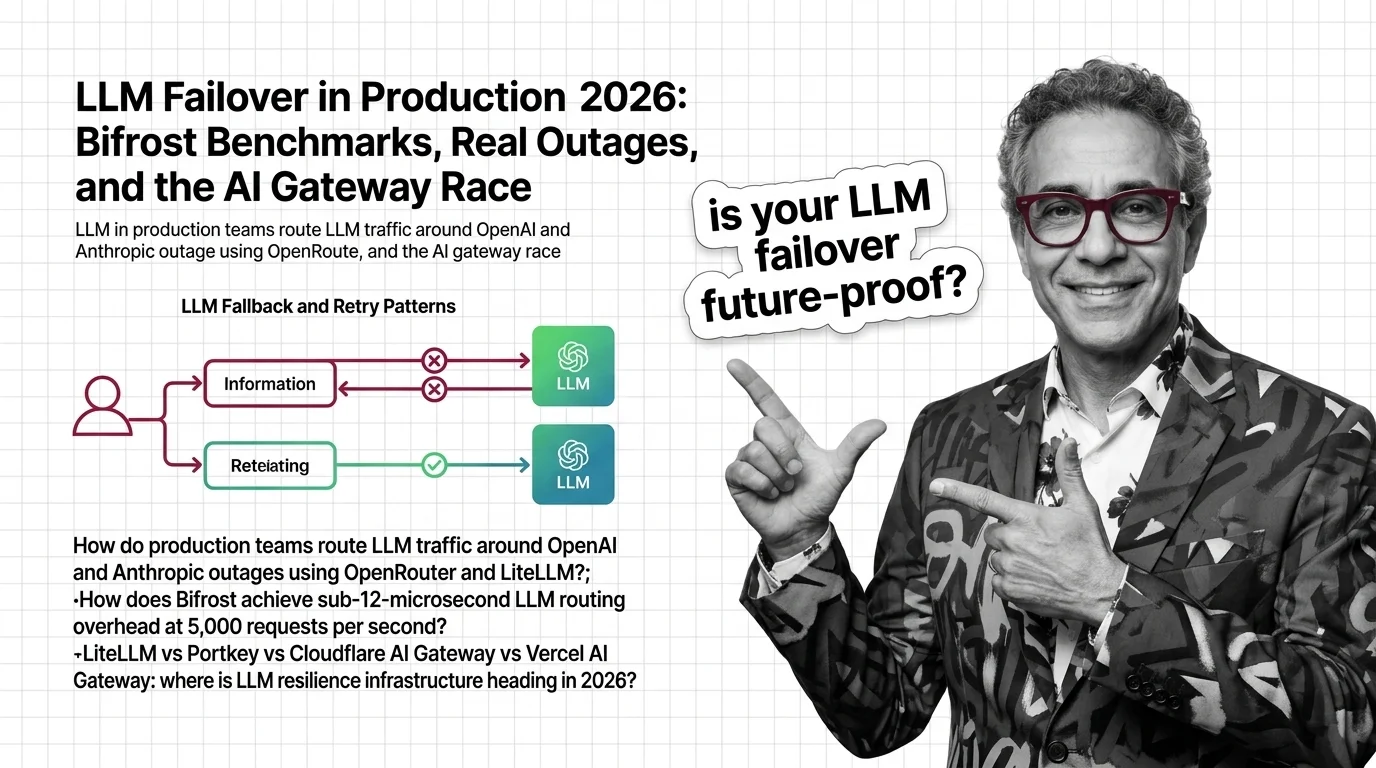
Teams have known about LLM Fallback And Retry Patterns as a design pattern for years. But adoption was elastic — engineering teams implemented Fallback Strategy logic only when an incident forced the issue. The incident record made that calculus permanent.
Anthropic’s 90-day uptime as of April 2026 was approximately 98%, well below the five-nines threshold serious production infrastructure is expected to hold (PYMNTS.com). That number closes the debate.
The API Gateway market is responding. Six significant routing layers now compete for the production LLM stack, and each made a major move in the past quarter.
You’re either running multi-provider routing, or you’re running a single point of failure. Those are the only two configurations that matter.
The Outage Record That Built This Category
The pattern isn’t subtle.
OpenAI’s global outage in mid-2025 ran over fifteen hours — ChatGPT, Sora, and the API all affected simultaneously (Storyboard18). Anthropic had four separate major outages in the first half of 2026 alone, including a widescale failure that hit the API, developer console, and Claude Code at the same time (deployflow.co).
Teams running direct API calls with no Circuit Breaker or Exponential Backoff configuration discovered this the hard way. The infrastructure responding to it is moving.
LiteLLM shipped v1.90.0 in late June 2026 — six new providers, OpenTelemetry v2 metrics parity, and a streaming-reliability sweep (LiteLLM Docs). It now covers 100+ providers behind an OpenAI-compatible interface with three distinct fallback types: standard, content-policy, and context-window. Default circuit configuration: three failures trigger a 30-second cooldown. Rate Limiting is configurable per provider.
Openrouter handles 70+ providers at over 100 trillion tokens per month. Its health window drops 5xx providers to the back of the routing queue within 30 seconds and routes remaining traffic using inverse-square cost weighting among healthy providers (OpenRouter Blog).
Portkey fully open-sourced its gateway in Q1 2026 after a $15 million Series A, now processing over one trillion tokens per day across more than 24,000 organizations (GlobeNewswire). Support for 1,600+ LLMs and more than 50 guardrail types.
Bifrost — a Go-based challenger from Maxim AI — claims eleven-microsecond routing overhead at 5,000 requests per second with a 100% success rate (Bifrost GitHub). Maxim AI’s own comparison puts Bifrost at 50× the throughput of Python-based routers under concurrent load (Maxim AI Blog). Neither figure has been independently reproduced — no third-party methodology or hardware specifications are published. Treat them as directionally interesting rather than verified.
Security & compatibility notes:
- LiteLLM Supply Chain Attack (March 2026): Malware in v1.82.7 and v1.82.8 harvested SSH keys, cloud credentials, and Kubernetes secrets. Fix: Upgrade to v1.83.0 or later. Current verified-safe version: v1.90.0 (LiteLLM Docs).
The volume numbers tell the story from the demand side. A hundred trillion tokens per month doesn’t route through a network because people are experimenting. It routes there because failure is unacceptable.
Positioned to Win
The clear winners are teams that already have Model Routing infrastructure in place — or who move before the next incident.
Portkey made the most strategically significant move of the quarter: open-sourcing a product that was previously SaaS-only while simultaneously closing a $15 million raise. That’s a land-and-expand play. The governance depth — 50+ guardrails, MCP Gateway with OAuth 2.1 — targets enterprise compliance requirements that simpler routers don’t address. Portkey’s commercial tier pricing post-open-source is not yet fully documented, but the strategic intent is clear.
OpenRouter benefits from every outage event without lifting a finger. When a provider degrades, teams routing through OpenRouter experience partial degradation rather than total failure. At the scale it operates, the network effects compound on each incident.
Cloudflare AI Gateway carries structural advantages the others don’t: zero-ops edge deployment, a free tier, and spend-limit-based fallback added this year. For teams already inside Cloudflare’s network, the friction cost of adding LLM failover is near zero.
Bifrost is the latency play. If the Go-based architecture direction holds at real-world scale, sub-millisecond routing overhead becomes significant for teams where every microsecond on the Graceful Degradation path matters.
The winning teams aren’t necessarily on the best gateway. They’re the ones who classified this as infrastructure before the next outage made the decision for them.
Exposed to the Next Outage
Single-provider deployments without routing.
If your production LLM stack is a direct API call to one provider with no configured failover layer, 2026’s outage record already cost you. The next one will too.
Teams that added monitoring without adding routing sit in the second-worst position. They know when they’re down. They still can’t recover automatically.
And specifically for LiteLLM users: anyone running v1.82.7 or v1.82.8 has a compromised deployment regardless of how well the routing logic is tuned. The supply chain attack from March 2026 was not cosmetic — malware with active SSH key and credential harvesting. Upgrading to v1.83.0 or later is not optional.
You’re either patched and protected, or you’re running a known-compromised gateway. That’s a remediation queue item, not a risk calculation.
What Happens Next
Base case (most likely): Gateways commoditize. Fallback, retry, and cost controls become table stakes — and larger infrastructure players absorb the category. Cloudflare’s edge positioning makes it the natural consolidator over time. Signal to watch: Cloudflare AI Gateway adding guardrail capabilities comparable to Portkey’s current offering. Timeline: 12-18 months.
Bull case: One gateway achieves enterprise lock-in through compliance coverage (Portkey) or provider breadth (OpenRouter), and the market consolidates around two or three survivors. Signal: A major cloud provider acquires one of the leading gateways. Timeline: 18-24 months.
Bear case: LLM providers invest seriously in reliability and sustain high uptime for multiple consecutive quarters, reducing the urgency for dedicated routing layers. Gateway adoption stalls. Signal: Three consecutive quarters with no major OpenAI or Anthropic outages. Timeline: 24+ months.
Frequently Asked Questions
Q: How do production teams route LLM traffic around OpenAI and Anthropic outages using OpenRouter and LiteLLM? A: OpenRouter detects provider failures via a 30-second health window and automatically moves degraded providers to the back of the routing queue. LiteLLM’s proxy supports three fallback types — standard, content-policy, and context-window — configurable per route, with a default circuit-breaker that activates after three consecutive failures and cools down for 30 seconds.
Q: How does Bifrost achieve sub-12-microsecond LLM routing overhead at 5,000 requests per second? A: Bifrost is written in Go, which avoids the Python GIL threading constraints that limit Python-based gateways under concurrent load. According to Maxim AI’s vendor benchmarks, it sustains eleven-microsecond per-request routing overhead at 5,000 RPS. These numbers are self-reported by the vendor and have not been independently reproduced by third parties.
Q: LiteLLM vs Portkey vs Cloudflare AI Gateway vs Vercel AI Gateway — where is LLM resilience infrastructure heading in 2026? A: All four are converging on the same core feature set — fallback, retry, cost controls, observability. The 2026 differentiators: Portkey leads on governance depth, OpenRouter on provider breadth, Cloudflare on zero-ops edge deployment, Bifrost on raw routing throughput. Vercel AI Gateway is primarily an ecosystem play for Next.js teams. Choose by ecosystem fit, not feature comparison lists.
The Bottom Line
The gateway race is decided. Multi-provider routing is mandatory production infrastructure — the only open question is which layer you build it on. Twelve months of major outages made the argument. Teams that move now pay the integration cost once. Teams that wait pay it during the next outage, plus the downtime.
AI-assisted content, human-reviewed. Images AI-generated. Editorial Standards · Our Editors