LLM-as-Judge vs Human Raters: Scoring A/B Tests Across Prompt Quality, Latency, and Cost
TL;DR
- LLM-as-judge reaches >80% agreement with human raters — comparable to inter-annotator agreement — at a fraction of the cost of manual review, but only with a bias-resistant rubric and the right scoring format.
- Use pointwise scoring for continuous production monitoring; pairwise only when you’re directly comparing two model variants head-to-head.
- Wire judge scores into the same observability trace as latency and token cost — a variant that’s cheaper but degrades quality is not a win.
You ran the A/B test. Variant B was faster and cheaper. You shipped it. Three weeks later, user complaints came in — responses felt vague, incomplete, less useful than before. You had clean latency metrics. You had clean cost metrics. You had no quality metrics. The test told you half the story.
Latency and token cost are trivial to instrument — every LLM SDK hands them to you for free. Quality requires a scoring pipeline you build deliberately. This guide shows you how to spec one that actually works.
Before You Start
You’ll need:
- An LLM observability platform — Langfuse (open-source, self-hostable) or Braintrust
- A model for the judge role — Claude Haiku 4.5 at $1/$5 per MTok (Anthropic Docs) for cost-sensitive pipelines, Claude Sonnet 4.6 at $3/$15 per MTok for higher-stakes scoring decisions
- Traffic Splitting already instrumented for your two variants — even a naive session-level 50/50 split works as a starting point
- Familiarity with A/B Testing for LLMs basics and LLM Observability tooling in your stack
This guide teaches you: How to specify a scoring contract your LLM as a Judge model can execute reliably — rubric design, format selection, and bias mitigation — so your A/B test measures what you think it measures.
The Quality Gap Your Dashboard Won’t Show
Here’s the failure mode, played out across hundreds of production pipelines. You shorten the system prompt to cut latency and cost. Both trend green. You call B the winner. What you didn’t instrument: response completeness, factual accuracy, answer relevance to the actual user question. Your users noticed. Your dashboard didn’t.
The reason this happens so reliably: quality scoring requires a deliberate pipeline. Build it before you run the test — not after the complaints come in.
Step 1: Map the Scoring Pipeline Components
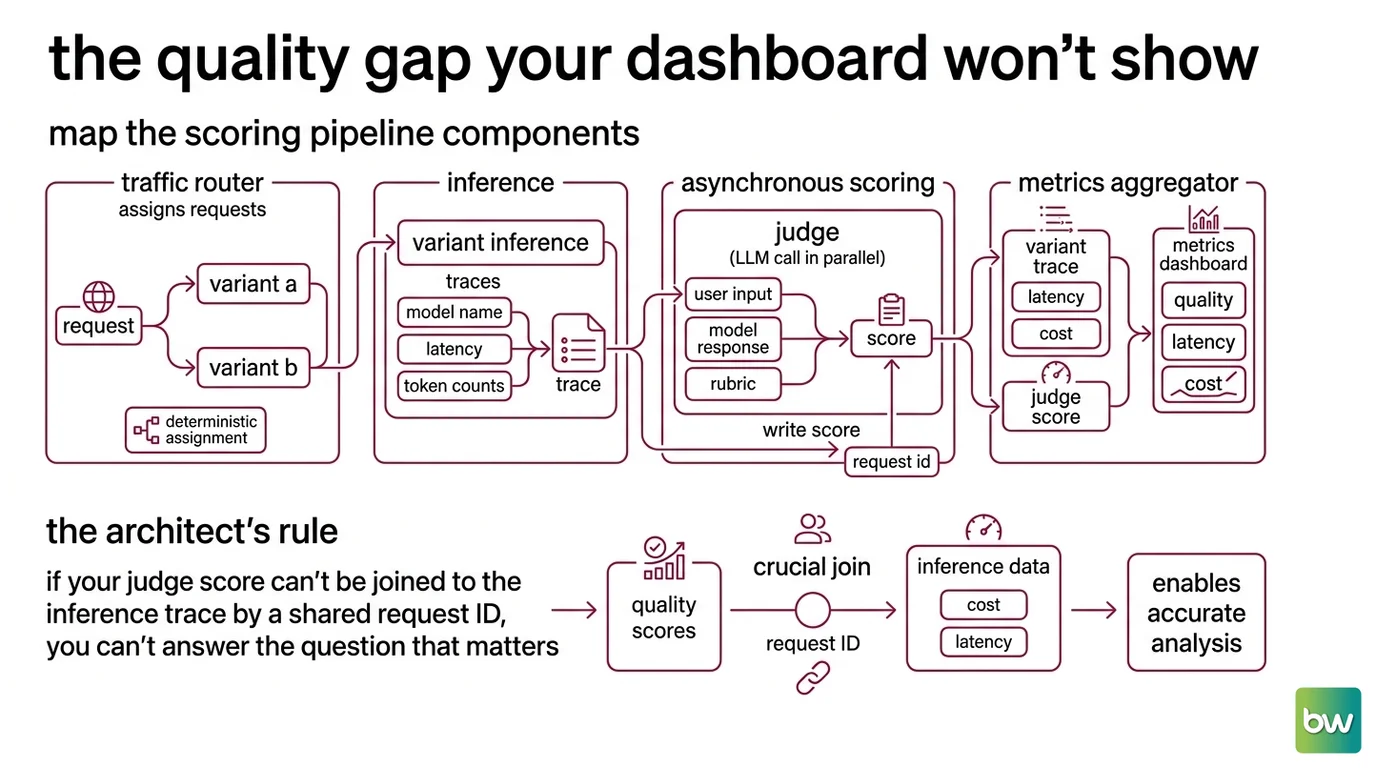
Four distinct concerns. Four distinct components. Before you write a single judge prompt, get clear on what each component does and why it’s a separate concern.
Your pipeline has these parts:
- Traffic router — assigns each incoming request to Variant A or Variant B. In Online Experimentation, assignment must be deterministic per user or session ID. Random per-request splits contaminate your sample — the same user sees different variants across calls and you can’t isolate the effect.
- Variant inference — runs the request through its assigned model or prompt. Each Inference call must emit a trace carrying the variant label, model name, latency, and token counts. Without this trace, you can’t join quality scores to cost data later. The trace is the join key.
- Judge — scores the output against your rubric. This is a separate LLM call, running asynchronously — not on the critical path. It reads the original user input and the model’s response, applies the rubric, and writes a score back to the parent trace by shared request ID.
- Metrics aggregator — collects per-variant scores and surfaces them alongside latency and LLM Cost Management data. This is where the complete picture lives.
The Architect’s Rule: If your judge score can’t be joined to the inference trace by a shared request ID, you can’t answer the question that matters: “Which variant was cheaper AND better?” That join is the entire point of the pipeline.
Step 2: Write the Scoring Contract
The judge will do exactly what you tell it to. Vague rubric, noisy scores. Three decisions to nail before writing a single line of the judge prompt.
Decision 1: Scoring format. Pointwise — score each response independently against a rubric — is more reliable for continuous production monitoring (Evidently AI). It produces per-request scores that aggregate cleanly into variant-level trends. Pairwise — show the judge both A and B, ask which is better — gives a cleaner signal for direct model-vs-model comparisons. Don’t use pairwise for ongoing monitoring; it’s expensive and won’t aggregate into a meaningful per-variant quality trend over time.
Decision 2: Rubric dimensions. Pick two to four dimensions. More than four and inter-dimension correlation muddies your signal. Every dimension needs a concrete failure description — not “was the response good?” but “did the response directly answer the user’s question without introducing factually incorrect claims?” For a code-generation pipeline: correctness, output format adherence, absence of hallucinated imports. For a support chatbot: factual accuracy, completeness, tone appropriateness.
Decision 3: Bias mitigation. Three biases reliably attack LLM judges (arXiv 2306.05685): position bias (the model favors whichever response appears first in pairwise comparisons), verbosity bias (longer responses score higher even when they’re less accurate), and self-enhancement bias (a model asked to judge its own outputs inflates those scores). Bias-resistant judges require position swapping and chain-of-thought scoring. For pairwise comparisons: run each pair twice with the A/B order swapped and count only consistent votes. For all formats: ask the judge to reason before assigning a score — chain-of-thought prompting reduces both verbosity and position bias, as measured in systematic mitigation research (arXiv 2604.23178). For self-enhancement: use a different model tier as the judge than the model under test.
Your context checklist before calling the judge:
- Rubric dimensions written as pass/fail criteria, not descriptions of “good”
- Output format specified — JSON with
score,dimension, andreasoningfields - Chain-of-thought instruction in the system prompt: reason first, then score
- Position swap logic implemented for pairwise format
- Judge model tier and version documented in your Model Registry
The Spec Test: If you can’t describe what a score of 3/5 means in concrete, observable terms for your specific task, your rubric isn’t done. The judge will invent its own definition and apply it inconsistently across requests.
Step 3: Wire the Instrumentation
This is where the components connect. Two jobs for the instrumentation layer: split the traffic and link every judge score back to the inference call that generated it.
Langfuse handles the traffic split through prompt labels. Tag your two prompt versions prod-a and prod-b, then call the Langfuse SDK with the assigned label for each request (Langfuse Docs). Your assignment logic — session-based for consistent user experience, randomized for pure statistical validity — lives in your application code. Every inference call wraps in a trace carrying the variant label, model name, latency, and token counts. The judge runs as a child span of that trace — asynchronously, off the critical path. When the judge returns a score, it writes back to the parent trace as a custom attribute. Now you can query: “P50 quality score by variant, filtered to the last seven days.”
If you’re already using
OpenTelemetry for
Distributed Tracing across a broader service mesh, add a variant attribute to your LLM span, run the judge off the critical path, and write the score back as a span event. The trace structure is what makes the cross-dimension join possible — same principle, different tooling.
Braintrust takes a different approach: experiments live in the UI, scorers (including LLM-as-judge and custom code) are configured per experiment, and CI/CD integration lets you run the scorer suite on each PR before merge (Braintrust Docs). Use Braintrust when you want structured experiment management with human review alongside automated scores. Use Langfuse when you need tight integration with an existing observability stack.
Before committing to a full live traffic split, consider running the new variant as Shadow Testing for a test period. This validates your judge’s baseline agreement on real production requests without exposing users to the variant — a low-risk calibration step before you split live traffic.
Build order:
- Trace instrumentation first — emit variant, model, latency, and tokens from every inference call. Everything downstream depends on this join key.
- Judge prompt and rubric second — validate the prompt manually on a representative set of examples before automating. Your eyes are free. API calls aren’t.
- Async judge invocation third — never on the critical path. A delayed score is acceptable; a delayed response is not.
- Score aggregation last — build the per-variant rollup only after confirming the judge scores consistently.
Step 4: Validate the Judge Before You Trust It
You built the scoring pipeline. Now prove it actually measures what you intended.
LLM judges achieve above 80% agreement with human raters on pairwise quality comparisons — comparable to inter-annotator human agreement, measured in the MT-Bench evaluation (arXiv 2306.05685). That figure applies to general chat quality tasks. Technical domain scoring varies more. Code correctness, domain-specific factual accuracy, and safety classification behave differently from general conversation quality. Treat the baseline as a starting point, not a guarantee for your task.
Validation checklist:
- Hand-label a representative sample of requests against your rubric criteria, scoring each dimension manually
- Run the same set through your automated judge, compute Cohen's Kappa or simple percent agreement per dimension
- Below 80% agreement: rubric dimensions are ambiguous — rewrite the failure definitions with more concrete examples; abstract language like “clear and helpful” is the enemy
- At or above 80%: rubric is calibrated, automate with confidence
- Monitor judge score distributions over time through your observability platform — a sudden shift in mean score without a deployment event signals either judge drift or a change in your traffic distribution; both need investigation
Security & compatibility notes:
- LiteLLM Supply Chain Incident: Versions 1.82.7 and 1.82.8 on PyPI contained a credential-stealing backdoor. Fixed in v1.83.0+. If LiteLLM proxies your judge or inference calls, verify your pinned version is v1.83.0 or above before running this pipeline (LiteLLM Blog).
- Helicone: Acquired by Mintlify (March 2026) and now in maintenance mode — no new integrations, no analytics roadmap, security updates only. Don’t add Helicone as a new dependency for A/B test instrumentation; use Langfuse or Braintrust instead (Helicone Blog).
Common Pitfalls
| What You Did | Why the Judge Failed | The Fix |
|---|---|---|
| One rubric for all test types | Rubric mismatch when task scope differs between variants | Write a rubric per experiment type, not per deployment |
| Judge on the critical path | Added latency to every user request with no user-facing benefit | Run async; write scores back to the trace after the user response |
| Pairwise for ongoing monitoring | Doesn’t produce per-request scores; can’t aggregate into variant trends | Use pointwise for monitoring; pairwise for direct model comparisons only |
| No position swap in pairwise | Position bias selects the first response the majority of the time | Run each pair twice with A/B order reversed; count consistent votes only |
| Same model judges itself | Self-enhancement bias inflates scores for its own outputs | Use a different tier — Claude Haiku 4.5 judging GPT-5.4, or vice versa |
Pro Tip
The rubric you write for your judge is the first concrete definition of “good” your product has ever had. Most teams skip writing this down because there’s no forcing function. The A/B test creates one. Once the definition exists — factual accuracy means this, completeness means that — store it alongside your prompts in your Prompt Versioning And Management pipeline. The rubric compounds: the next experiment inherits it instead of reinventing from scratch.
Frequently Asked Questions
Q: How do I use LLM-as-judge to automatically score A/B test variants for response quality?
A: Run a separate judge call asynchronously after each inference response, passing the user input and model output against a pointwise rubric with two to four pass/fail criteria. The practical detail most teams miss: include a few scored examples directly in the judge system prompt. Concrete examples stabilize scoring consistency faster than rubric text alone — the judge learns the quality bar from cases, not descriptions.
Q: How do I A/B test GPT-4o versus Claude Sonnet 4.5 in a production LLM pipeline?
A: Assign each model a variant label in your traffic router, emit model name as a trace attribute, and use a neutral third model as the judge — a different provider eliminates self-enhancement bias. One practical flag: GPT-4o ($2.50/$10 per MTok, OpenAI Docs) has been a legacy model since GPT-4.1 launched in January 2026 — retired from ChatGPT in February 2026, still available via API, but OpenAI recommends the GPT-5 family for new projects. Claude Sonnet 4.5/4.6 ($3/$15 per MTok, Anthropic Docs) is the current active Anthropic mid-tier.
Q: How do I use A/B testing to reduce LLM inference costs without dropping output quality?
A: Set a quality floor before you start: Variant B must match or exceed Variant A’s baseline quality score before you declare a cost win. Without the floor, cost pressure wins by default. Then test cheaper configurations — smaller model, compressed prompt, tighter context — and stop as soon as any configuration breaks the quality baseline. The savings come from finding the cheapest setup that clears the bar, not the cheapest setup that exists.
Your Spec Artifact
By the end of this guide, you should have:
- four-component pipeline map — traffic router, variant inference, async judge, metrics aggregator — with a clear join key (request ID) connecting all four components
- A scoring contract — format decision (pointwise or pairwise), two to four rubric dimensions with concrete pass/fail definitions, bias mitigation choices (position swap, chain-of-thought instruction, cross-tier judge)
- A validation baseline — percent agreement or Cohen’s kappa against a hand-labeled representative sample, with dimension-level breakdown showing where the rubric is and isn’t working
Your Implementation Prompt
Paste this into Claude Code, Cursor, or Codex to generate the skeleton for your evaluation pipeline. Fill each bracket with your specific values from the checklist in Step 2.
You are building an async LLM evaluation pipeline for A/B testing two prompt variants.

System components to implement:

1. Traffic router
   - Assignment: deterministic based on [session ID / user ID / request ID]
   - Logic: hash the ID, assign variant-a or variant-b consistently per session

2. Variant inference
   - Call [your LLM provider] with the assigned variant's prompt
   - Emit a trace with: variant_label, model_name, latency_ms, input_tokens, output_tokens, request_id

3. Judge (async — not on critical path)
   - Call [judge model, e.g., Claude Haiku 4.5] after inference completes
   - System prompt: "Evaluate the following response. Reason through each dimension first, then output your scores."
   - Rubric dimensions:
     1. [Dimension 1]: Pass if [concrete pass criterion]. Fail if [concrete fail criterion].
     2. [Dimension 2]: Pass if [concrete pass criterion]. Fail if [concrete fail criterion].
   - Output format: {"dimension_1": "pass"|"fail", "dimension_2": "pass"|"fail", "reasoning": "..."}
   - Reference examples in the system prompt: [paste 2-3 input/response pairs with manual scores]
   - Write judge output back to parent trace by request_id

4. Metrics aggregator
   - Group by variant_label
   - Compute: mean score per dimension, latency P50/P95, cost per 1K requests
   - Surface all three in a single dashboard view

Build order: trace instrumentation → judge prompt manual validation → async invocation → aggregation.

Bias mitigation: [position swap if pairwise / chain-of-thought if pointwise]
Judge model: [model name, tier, version — document in model registry]
Ship It
You now have a quality floor your A/B tests can enforce. Latency and cost metrics are still in the picture — but they can’t declare a winner without quality’s signature. The next time a variant looks better on your dashboard, you’ll know whether it actually is.
AI-assisted content, human-reviewed. Images AI-generated. Editorial Standards · Our Editors