Linear-Time Efficiency, Unequal Access: Who Wins and Who Loses as State Space Models Scale
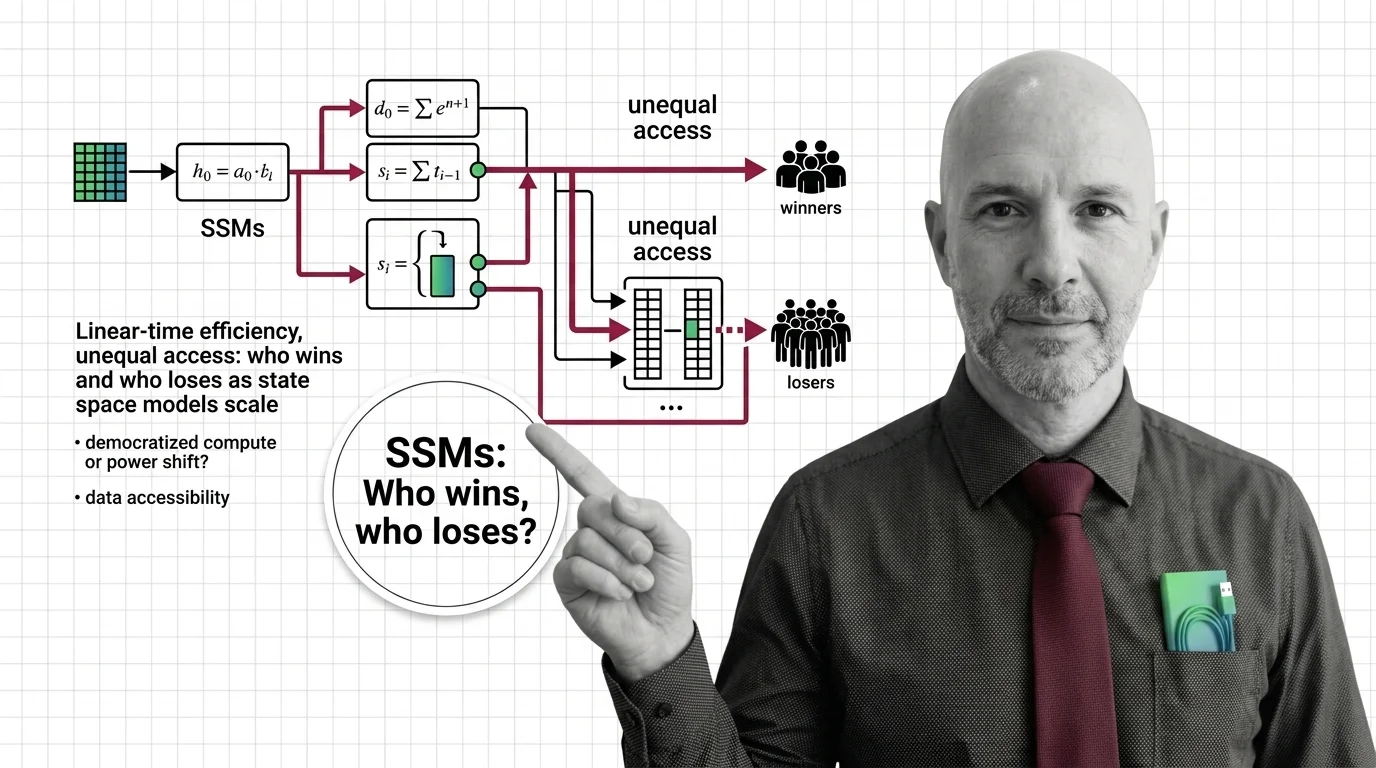
The Hard Truth
Efficiency is the most seductive kind of progress — it arrives looking like a gift. Every watt saved, every token served faster, every context window stretched further feels like generosity handed down from engineering to everyone else. But efficiency never redistributes itself. It is redistributed, by whoever holds the hardware and writes the defaults.
The architectural story of 2026 is that a new family of sequence models has undone a decade of assumptions about what long-context inference should cost. Almost all of the serious releases — Mamba-3, Jamba 1.5 Large, Nemotron-H, Falcon-H1, RWKV-7 — arrive as open-weight projects, a rupture in how frontier AI normally reaches the public. Openness of weights, however, is not openness of access. That is the crack this essay wants to sit with.
The Architecture Changed Faster Than the Conversation
Every dominant computing era arrives wrapped in a story. For the Transformer years, the story was scale — more parameters, more data, more attention heads would produce more capability. The State Space Model wave tells a quieter, more respectable story: the same work can be done with less energy, less memory, less hardware lock-in. It sounds like progress without cost.
The question skipped in most benchmark posts matters most for the people living on the other side of these systems. When it becomes radically cheaper to run a model over a million tokens of someone’s personal history, what changes is not only the economics of inference. It is the economics of watching. The institutions that get to watch first, most, and longest are not picked by lottery.
The Case for Celebrating the Open-Weight Hybrid Wave
The celebration is not flimsy, and it deserves to be presented at its strongest. The new wave of Hybrid Architecture models is genuinely open in a way frontier AI has not been for years. Mamba-3, built on the Mamba Architecture lineage, arrived under an open-source license in March 2026 with roughly seven-times-faster prefill and decode on long sequences against a size-matched Transformer, per VentureBeat. AI21’s Jamba 1.5 Large pushes a 398-billion-parameter mixture-of-experts hybrid to a 256K effective context window under a permissive Jamba Open Model License (AI21 Blog).
NVIDIA released Nemotron-H — replacing ninety-two percent of its attention layers with Mamba-2 blocks — and followed with Nemotron 3 Super, a 120-billion-parameter hybrid MoE (NVIDIA ADLR; MarkTechPost). TII in the UAE released Falcon H1 under an Apache-2.0-based license, with the H1R 7B variant reportedly matching reasoning models seven times its size (Falcon LLM Blog). This is not nothing. For the first time in years, the people writing frontier architecture are not all working in the same two zip codes.
Open Weights, Closed Infrastructure
The assumption hiding inside this celebration is that open architecture translates to open access. It does not, and the gap is widening even as the weights are posted on Hugging Face. Training a 398-billion-parameter mixture-of-experts hybrid — even one whose attention layers have been mostly replaced by Selective Scan blocks — still demands H100 and B200 infrastructure that fewer than a dozen institutions on earth can procure at scale. The architectural breakthrough makes inference cheaper for whoever already has the serving infrastructure. It does not make training cheaper for whoever does not.
Because no independent benchmark has publicly compared per-dollar training cost between SSM-hybrid and dense-Transformer at equal capability, the cost story remains a vendor-told one — something to hold, but not to believe without qualification. The democratization is real for the middle tier and illusory for the edges.
The Printing Press, The Spectrum, and the Memory Layer
There is a historical rhythm worth hearing here. Every time a medium becomes cheaper, access expands — and then concentrates, because the new scarcity is not the medium but the distribution. The printing press made books reproducible; scarcity moved to literacy, translation, and the printer’s license. Broadcast made messages reproducible; scarcity moved to the spectrum license and the advertising relationship. The internet made publishing reproducible; scarcity moved to recommendation and attention. Each of these shifts arrived under a banner of democratization, and each eventually concentrated power in whoever controlled the new bottleneck.
Long Context Modeling is the next chapter in that pattern. When the new capability is keeping a million tokens of someone’s life in working memory at the cost of a few pennies, the scarce resource stops being compute and starts being consent. What RWKV, Linear Attention research, and their SSM cousins actually cheapen is continuous observation at scale — what used to require a surveillance budget now requires a reasonable API bill.
What Linear Time Actually Redistributes
Thesis: State Space Models do not democratize AI compute; they redistribute where concentration happens — from training-time capital to serving-time memory, from per-query cost to persistent observation capacity, and from a handful of US hyperscalers to a longer list of sovereign labs, hardware vendors, and foreign state-backed institutes.
That redistribution is worth examining without reflex. A world where TII, NVIDIA, AI21, a research lab, and a community Apache-2.0 project all produce competitive frontier models is not obviously worse than a world where two US companies do. In some ways it is plainly better — more checking, more architectural diversity, fewer single points of governance failure. But the framing that matters is not who is defeated; it is what gets cheaper and what gets harder to hold accountable. When the cost of keeping a conversation for a year drops by an order of magnitude, the incentive to retain that conversation changes. When the cost of scanning a million-token document drops, the incentive to obtain one changes. Neither shift is governed by anything more formal than a terms-of-service page most users never read.
What We Owe Ourselves to Ask
What does it mean to sit with this seriously? It means taking the ethical implications of state space models becoming the dominant long-context architecture as a first-order question rather than an afterthought. It means asking whether “persistent memory” is a feature we ordered or a condition we were given. When a sovereign lab in the UAE, a hardware vendor, and an Israeli startup are the three fastest movers, which governance regime these models operate under becomes genuinely plural — and contested.
Do state space models democratize AI compute or just shift the concentration of power? The honest answer is: both, partially, and in ways that depend on which layer of the stack you examine. What ought to trouble us is that the only layer with real democratization — open weights — is also the one least relevant to how most people will experience these systems. The interfaces, the defaults, the retention policies, the memory layer above the model: these stay private, and they are where power accumulates.
Where This Argument Could Fall
This case weakens if edge inference matures into genuine commodity — if the energy reductions shown on Jetson and Raspberry Pi benchmarks generalize to LLM-scale workloads, and if on-device hybrids escape the serving-tier bottleneck entirely. It weakens further if governance mechanisms emerge that bind persistent-context systems to consent as tightly as audit binds financial records. Neither is yet visible, but both are plausible.
The Question That Remains
Efficiency is an answer to a question we should be asking more carefully: efficiency for whom, under what oversight, and with what memory of the people being measured? The architecture has changed. Whether the accountability changes with it is, so far, still up to us.
AI-assisted content, human-reviewed. Images AI-generated. Editorial Standards · Our Editors