LangGraph, LlamaIndex Workflows, and Vectara: The 2026 Retrieval-Augmented Agent Landscape
TL;DR
- The shift: Three different starting points — graph DSL, async event loop, managed RAG service — are converging on the same agent primitives.
- Why it matters: Naive retrieval pipelines are being absorbed into agent runtimes. The question is no longer “which RAG?” but “whose orchestrator?”
- What’s next: Teams picking their orchestration layer in mid-2026 will define their AI infra for the next two years.
For two years, retrieval was a sidecar. Vector DB on one side, LLM on the other, glue code in the middle. That stack is gone.
In its place: agents that decide what to retrieve, when to retrieve again, and when to stop. Three reference platforms are setting the pattern. They started from different premises and arrived at the same primitives.
Three Starting Points, One Convergence
Thesis: Retrieval Augmented Agents are not a feature. They’re a runtime layer — and three platforms are racing to define what that runtime looks like.
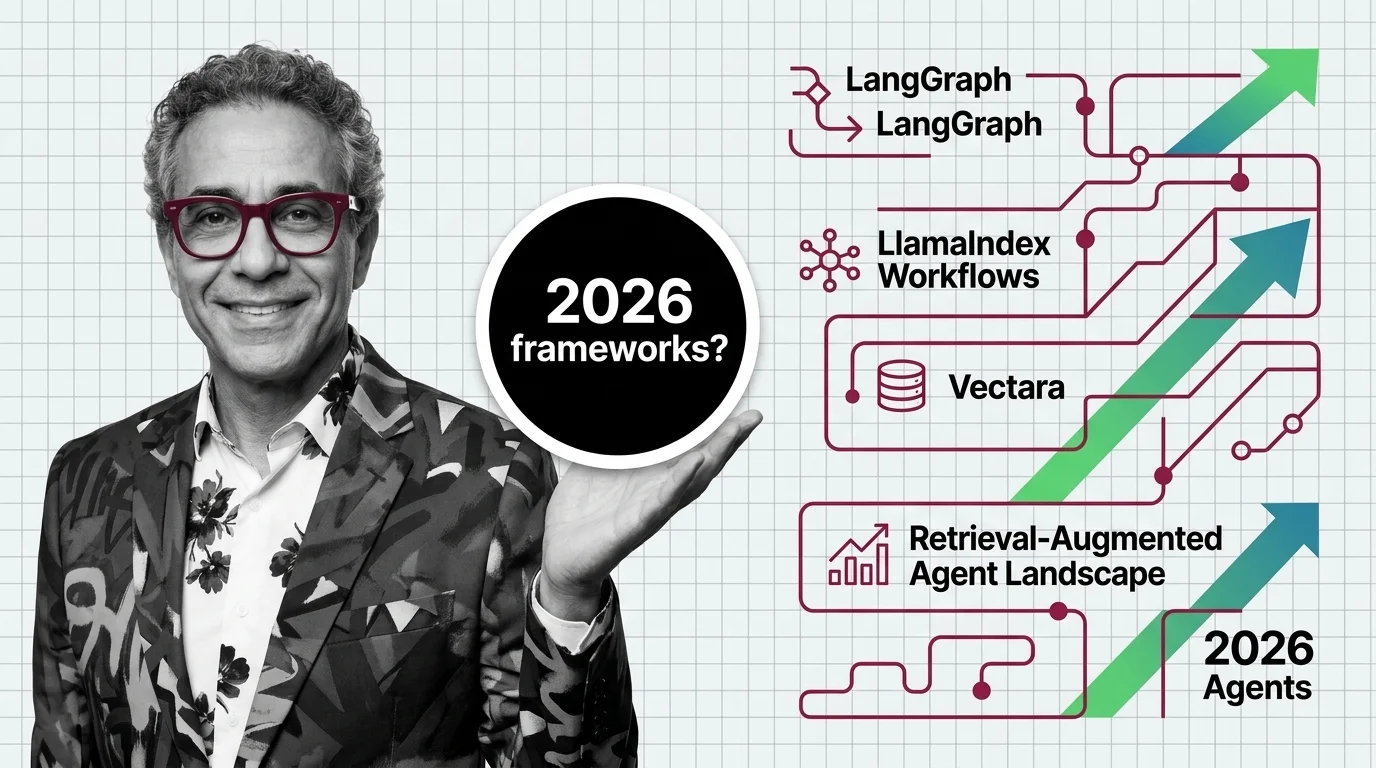
The 2026 stack has three credible reference points: LangGraph 1.0 for stateful graph orchestration, LlamaIndex Workflows 1.0 for event-driven async Workflow Orchestration For AI, and Vectara for managed grounded generation with built-in hallucination guards.
These aren’t competing products. They’re three answers to the same architectural question: how do you run an agent that retrieves, critiques, re-plans, and stays accountable to a source?
Each shipped the same primitives within a short window. Durable state. Sub-agent delegation. Span-level tracing. MCP-based tool calling. Grounding checks.
That’s not coincidence — that’s the market agreeing on what an agentic RAG runtime needs.
The Releases That Defined the Stack
LangGraph 1.0 went GA in October 2025, with named production deployments at Uber, LinkedIn, and Klarna (LangChain Blog). Durable graphs, checkpointing, human-in-the-loop, time-travel debugging — all in one runtime, with minimal breaking changes.
LlamaIndex Workflows 1.0 shipped four months earlier, in June 2025. Its DNA is retrieval-first: typed state, fully async, OpenTelemetry observability out of the box, per LlamaIndex’s docs. By spring 2026, the older Query Pipelines abstraction was fully deprecated.
Vectara moved on a different axis: not orchestration, but the model and evaluator. Mockingbird-2-Echo, its grounded-generation LLM, posted a 0.9% hallucination rate on the HHEM leaderboard at release — beaten only by three much larger frontier models, per the Vectara Blog. Sub-agents launched in late 2025, with Agent Traces and tool-output offloading following this spring (Vectara Docs).
The pattern: a RAG vendor turning into an agent vendor without giving up its grounding heritage.
One signal cuts across all three: hybrid retrieval is the fastest-growing enterprise position, with about a third of teams citing it as their preferred 2026 architecture (Squirro). Naive retrieval is being absorbed into agent toolchains.
It didn’t die. It got demoted.
Who Moves Up
Platforms that bet early on orchestration as a first-class runtime.
LangGraph wins the production-graph segment. The Uber, LinkedIn, and Klarna references give it social proof in regulated enterprise. The v1.0 freeze tells teams: this API will not move under you.
LlamaIndex wins the retrieval-coupled stack. If your agent’s primary job is to parse documents, walk tables, and call tools against your own data, Workflows is the path of least resistance. Its async-first design ages better than synchronous graph DSLs as agent workloads grow more parallel.
Vectara wins the regulated-enterprise grounded segment. Legal, healthcare, financial services — anywhere a hallucination is a liability event. Mockingbird-2 plus HHEM gives buyers something every other stack has to bolt together: a grounded LLM and an automated way to prove it stayed grounded.
The Code Execution Agents story plugs into all three. Each runtime can host a code-exec tool. The differentiator is no longer who has the feature — it’s whose sandbox you trust.
Who Gets Left Behind
Standalone vector DBs sold as a destination product. The signal: hybrid retrieval is up, pure-vector deployments are flat. If your only value proposition is “we store embeddings,” you’re competing with a checkbox feature in every orchestration framework.
Naive RAG pipelines built in 2023. Single-query, single-shot, no critique, no re-plan. They’re being out-engineered by anything that decomposes a question before answering it — the agentic RAG survey by Singh and colleagues on arXiv maps the architectural delta in detail.
Classic LangChain agent abstractions. New agent work in the LangChain ecosystem runs on LangGraph. Teams still maintaining chain-based agents from eighteen months ago are paying maintenance tax on a deprecated path.
Multi-vendor stitching jobs. Bespoke orchestration on top of three libraries plus a vector DB plus a custom evaluator now competes with single-vendor platforms shipping the same primitives integrated. The build-vs-buy line just moved.
What Happens Next
Base case (most likely): The three reference stacks stay distinct but interoperable, with MCP as the connective tissue. Most enterprise buyers pick one orchestrator and one grounded-generation provider — not one of each from the same vendor. Signal to watch: MCP-based tool sharing between LangGraph and LlamaIndex Workflows agents in production case studies. Timeline: Q4 2026.
Bull case: Agentic RAG becomes the default enterprise pattern. Frameworks ship higher-level abstractions — agent plus retriever plus critic as a single import. Adoption accelerates because the cognitive load drops. Signal: Major frameworks publishing reference agents that hide orchestration entirely. Timeline: Mid-2027.
Bear case: Hallucination incidents at high-profile deployments force buyers back to narrower, deterministic retrieval patterns. Agent autonomy is throttled by compliance review. Grounded-generation vendors win at the expense of orchestrators. Signal: Multiple regulated-industry rollbacks publicized within a quarter. Timeline: 18 months.
Frequently Asked Questions
Q: Which retrieval-augmented agent frameworks are leading in 2026? A: LangGraph 1.0 leads stateful graph orchestration, with production deployments at Uber, LinkedIn, and Klarna. LlamaIndex Workflows 1.0 leads retrieval-coupled async orchestration. Vectara leads managed grounded generation. As of mid-2026, these are the three reference points — none is universally “#1.”
Q: Where are retrieval-augmented agents heading in 2026 and beyond? A: Toward convergence. Graph runtimes, event loops, and managed RAG services are all shipping the same primitives: durable state, sub-agent delegation, span tracing, MCP tools, grounding checks. Expect higher-level abstractions and tighter compliance tooling through 2027.
The Bottom Line
The retrieval question is settled — agents own it now. The orchestration question is wide open, and the next two years will name the winners. You’re either picking your runtime layer in 2026 or you’re stuck stitching one together at production scale.
AI-assisted content, human-reviewed. Images AI-generated. Editorial Standards · Our Editors