Seven Frameworks, One Question: What Is an Agent?
TL;DR
- The shift: Multi-agent orchestration has fractured into three competing abstractions — graph state machines, role-based crews, and org-design simulations.
- Why it matters: The framework you bet on now decides what your 2027 production stack looks like — and what you can no longer migrate away from cheaply.
- What’s next: Hyperscaler SDKs are bundling agents into cloud platforms, while open-source upstarts redefine “agent” as an employee, not a function call.
Six months ago there was no consensus on what a multi-agent framework should even look like. Today there are seven serious contenders, and they disagree on something more fundamental than syntax. They disagree on what an agent is. The race is not about who has the cleanest decorator API — it is about which abstraction wins.
The Multi-Agent Stack Just Split Into Three Camps
Thesis: Multi Agent Systems development in 2026 is not a single market — it has split into production veterans, hyperscaler suites, and abstraction-first newcomers, and each camp solves a different problem.
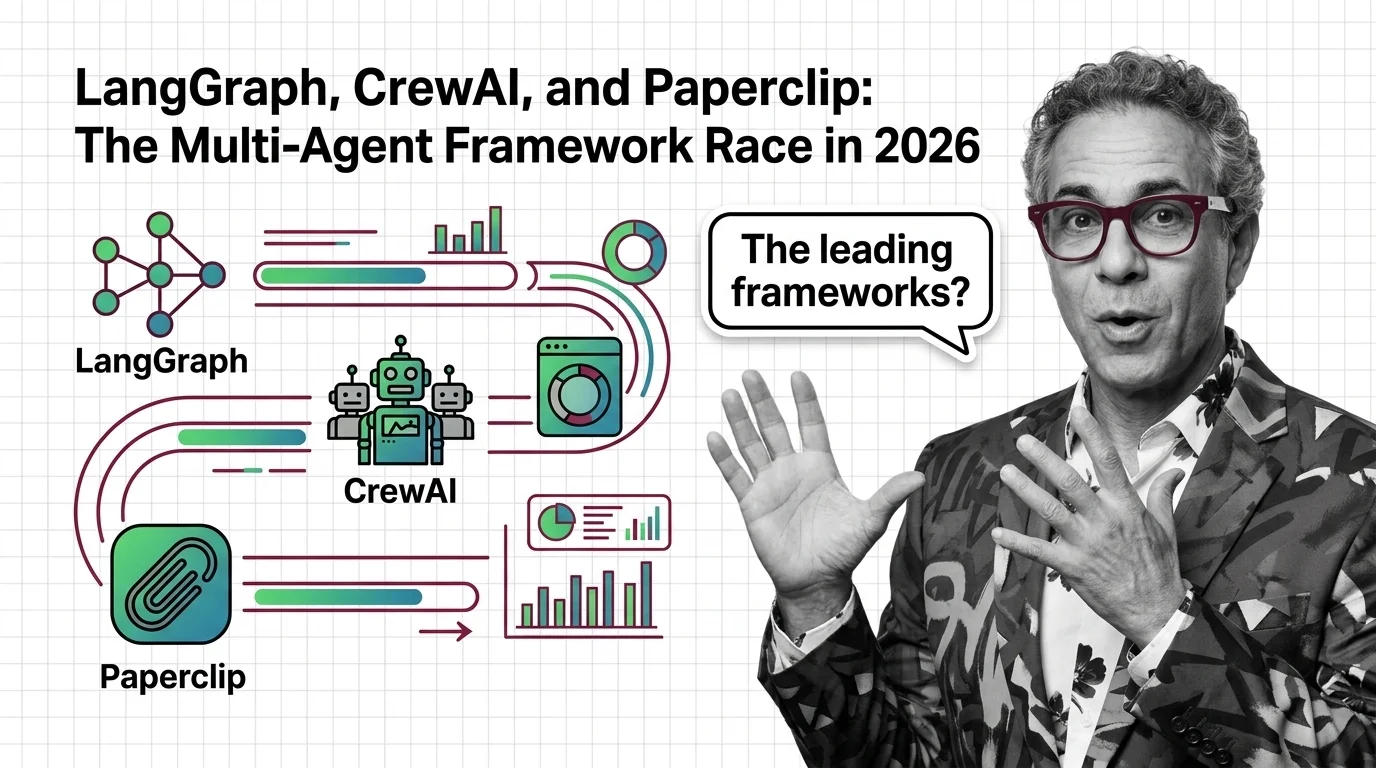
The production veterans got there first. LangGraph hit v1.1.6 in April with 126,000+ stars and a roster nobody else can match — Klarna, Replit, Elastic, Uber, LinkedIn (LangChain Blog). Its bet: agents are state machines, and orchestration is a graph with checkpoints, durable execution, and human-in-the-loop gates baked into the runtime. CrewAI took the opposite bet — that agents are roles in a team, and the easiest mental model wins. Both are shipping in production.
The hyperscalers showed up next, and they showed up bundled. Microsoft Agent Framework, OpenAI Agents SDK, Google ADK, and the Claude Agent SDK all want the same thing: own the agent layer of their cloud or model.
Then Paperclip happened.
That is not a product. That is an argument about what an org chart actually is.
Three Bets, One Market
Group the moves by what they prove, not when they shipped.
Production maturity is no longer optional
LangGraph’s case studies do not read like demos. Replit runs a multi-agent architecture with specialized sub-agents per task on LangGraph (LangChain Case Study). Klarna’s AI assistant — referenced by LangChain marketing as serving 85M active users with an 80% reduction in customer resolution time, though the figure is vendor-reported — is one of the largest deployed agent systems anywhere (LangChain Blog). The signal: enterprises buying agent infrastructure want a track record before a feature list.
Vendor lock-in is being repackaged as agent SDKs
The Microsoft Agent Framework hit v1.0 on April 3, 2026, fusing Semantic Kernel’s enterprise plumbing with AutoGen’s orchestration into one .NET-and-Python SDK with sequential, concurrent, handoff, and group-chat patterns plus A2A and MCP protocols (Microsoft Foundry Blog). The OpenAI Agents SDK got a major April 15 update — sandbox execution via Blaxel, Cloudflare, Daytona, E2B, Modal, Runloop, and Vercel; built-in guardrails; a model-native harness (TechCrunch). Its core abstraction stayed minimal: handoffs, agent-to-agent control transfer with context. Google ADK ships hierarchical agent composition with workflow agents, tightly bound to Gemini Enterprise. The Claude Agent SDK — recently renamed from Claude Code SDK — adds subagents with isolated context windows for parallelization, and Anthropic announced a “dreaming” capability in May 2026 where Managed Agents review recent events to update Agent Memory Systems between tasks (SiliconANGLE).
Different SDKs. Same play. Make the agent runtime inseparable from the cloud or model underneath it.
The newcomers are reframing the problem
Paperclip launched March 4 from a pseudonymous developer, hit 30,000+ stars in three weeks, and crossed 63,000+ by May (Paperclip GitHub). It treats coordination as an org-design problem — roles, budgets, approval gates, goal ancestry. Not “how do agents talk?” but “who reports to whom and who signs off on spend?” That reframe is why developers are starring it faster than any agent project this year.
The Winners
LangGraph won the production benchmark. If you are shipping Swarm Architecture or stateful workflows to enterprise customers right now, the conservative pick is the framework that already runs at Klarna and Replit.
CrewAI won the on-ramp. Roles, crews, and Flows give junior teams a vocabulary they already understand — and the enterprise tier with SOC2, SSO, secret management, and PII masking closes the gap with hyperscaler offerings (CrewAI’s pricing page).
Microsoft and OpenAI won the captive enterprise. Anyone whose stack already lives in Azure or whose team already pays for ChatGPT Enterprise will default to MAF or the Agents SDK. That is not a technical decision. That is procurement gravity.
Paperclip won the conversation. It will not own production this year. But it changed how every other framework has to defend its abstraction.
The Losers
Anyone running AutoGen for new projects. Microsoft put it in maintenance mode and made MAF the official successor (Microsoft Learn). Existing AutoGen code keeps working — but if you start a new project on it in May 2026, you are starting on a frozen runtime.
Anyone treating “agent framework” as a single market category. The teams losing time right now are running bake-offs across LangGraph, CrewAI, and MAF as if they are competing for the same job. They are not. Picking the wrong axis means re-architecting in eighteen months.
Anyone betting that Agent Debate patterns alone will replace orchestration. Multi-agent dialog is a feature inside frameworks now, not a framework itself. If your stack’s differentiator is “agents argue with each other,” you are shipping a demo, not infrastructure.
You are either picking your camp now or paying migration cost later.
What Happens Next
Base case (most likely): The market consolidates into two layers. LangGraph and CrewAI dominate the open-source production tier; MAF, the OpenAI Agents SDK, ADK, and Claude Agent SDK split the hyperscaler-bundled tier by who already pays them. Signal to watch: Enterprise reference customers naming their orchestration framework in case studies, not just their model. Timeline: Six to nine months.
Bull case: Paperclip’s org-design abstraction proves out at one or two scaled deployments, forcing every other framework to add governance primitives. Agents start looking like employees with budgets and reporting lines across every SDK. Signal: A second framework adopting Paperclip-style approval gates and goal ancestry as first-class primitives. Timeline: Twelve months.
Bear case: A high-profile failure — a runaway agent burn or a security breach inside a multi-agent system — triggers enterprise procurement freezes. Frameworks ship features but adoption stalls. Signal: A Fortune 500 publicly pulling an agent project and citing a control-plane failure. Timeline: Possible inside twelve months.
Frequently Asked Questions
Q: Which multi-agent frameworks are leading in 2026? A: LangGraph leads on production maturity (Klarna, Replit, Elastic). CrewAI leads on developer on-ramp. Microsoft Agent Framework leads in Azure shops. OpenAI’s Agents SDK leads where teams are already model-locked. Paperclip is the fastest-rising newcomer, though not yet production-proven.
Q: How are companies using multi-agent systems in production in 2026? A: Replit runs specialized sub-agents per task on LangGraph. Klarna’s AI assistant handles customer support at scale. Enterprise teams pair role-based crews on CrewAI with sandboxed tool execution from the OpenAI Agents SDK to ship governed, auditable agent workflows.
Q: Why did Microsoft replace AutoGen with the Agent Framework, and what does it mean for multi-agent development? A: AutoGen is in maintenance mode; MAF combines Semantic Kernel’s enterprise features with AutoGen’s orchestration into one SDK with .NET and Python support (Microsoft Foundry Blog). For new projects MAF is the official path — AutoGen still runs but no longer gets feature work.
The Bottom Line
The multi-agent framework race is over as a contest for “best library.” It is now a war over which abstraction owns enterprise orchestration — graphs, roles, handoffs, or org charts. Pick the camp that matches how your team actually thinks, not the framework with the loudest GitHub trend.
AI-assisted content, human-reviewed. Images AI-generated. Editorial Standards · Our Editors