Three Agent Frameworks Hit 1.0 GA: The 2026 Production Race
TL;DR
- The shift: production agent frameworks are converging on durable, graph-based orchestration — and consolidating around three names.
- Why it matters: enterprises picking a stack now are choosing a governance posture, not a library.
- What’s next: the standalone-prototype era ends; the durable-state-with-observability era is already here.
Three releases inside seven months redrew the production agent map. LangGraph 1.0 landed with a stability promise. Microsoft collapsed AutoGen and Semantic Kernel into a single SDK and shipped it 1.0. CrewAI quietly crossed twelve million agent executions a day. None of these are roadmap moves. They’re the moves of products that already won — and are now being chosen, in production, by names you recognize.
The Agent Frameworks Comparison Race Just Split Into Two Tiers
Thesis: The production agent market split into a governance-and-durability tier and a time-to-production tier — and every vendor is racing to own one of them, not both.
For two years, framework choice was a weekend exercise. Pip install, run a notebook, demo on Friday. That phase is over. The frameworks that mattered six months ago were the ones that demoed best. The frameworks that matter now are the ones that survive incident review.
The structural change is durable state. Every serious framework now ships checkpointing, replay, human-in-the-loop, and graph orchestration as table stakes. What used to differentiate has become baseline. The new differentiation is who you can sell to: regulated enterprises that need governance, or product teams that need ship velocity.
You’re either choosing a framework for governance, or you’re choosing for speed. The frameworks that try to do both end up owning neither.
Three Releases, One Direction
LangGraph reached 1.0 GA on October 22, 2025, with an explicit “no breaking changes until 2.0” guarantee (LangChain Blog). That promise is the entire point. Enterprise architects will not bet a year of compliance work on a moving API. LangChain named Uber, LinkedIn, Klarna, JP Morgan, BlackRock, Cisco, and Rippling as production users in the same release post.
That’s not a launch list. That’s a moat.
Microsoft moved next. On April 3, 2026, the Microsoft Agent Framework hit 1.0 GA — a unified SDK that absorbs both AutoGen v0.4 and Semantic Kernel into one Python and .NET stack (Microsoft Foundry Blog). AutoGen v0.4, released January 17, 2025 with its layered Core/AgentChat/Applications architecture (AutoGen Blog), now exists in maintenance mode. Bug fixes and security patches only. Feature work has moved to Agent Framework. Microsoft did not deprecate AutoGen — they consolidated it. The effect is the same. New work targets the new SDK.
CrewAI took a different route to the same destination. CrewAI Flows passed 12 million agent executions per day on its production landing page (CrewAI), with roughly two billion Multi Agent Systems workflows over the past year (CrewAI Engineering Blog). Their 2026 enterprise survey of 500 senior leaders found 60% of U.S. Fortune 500 companies running CrewAI in 150+ countries, and 100% of surveyed enterprises planning to expand agentic AI in 2026 (CrewAI Blog).
Three independent vendors. Three durable-state, observability-first releases. One direction.
Security & compatibility notes:
- LangGraph Checkpoint RCE (CVE-2026-27794): Remote code execution via pickle deserialization in the checkpoint caching layer for versions below 4.0.0. Pin to v4.0.0+.
- LangGraph SQLite SQL Injection (CVE-2025-67644): Injection via metadata filter keys in the SQLite checkpoint implementation. Apply the patched release.
- langchain-core “LangGrinch” (CVE-2025-68664, CVSS 9.3): Secret exfiltration / potential RCE in a shared dependency used by LangGraph deployments. Update langchain-core immediately.
- AutoGen v0.4: Maintenance mode after Agent Framework consolidation. New LangGraph-equivalent work should target Microsoft Agent Framework.
Who Moves Up
LangChain. They built the durable Agent Planning And Reasoning substrate before banks asked for it. Their enterprise reference list is now their pricing strategy.
Microsoft. Two competing internal SDKs collapsed into one. .NET and Python parity ships day one. The CIO who already buys Azure now has a first-party agent stack with the same procurement contract.
CrewAI. They optimized for time-to-production while everyone else was still optimizing for benchmark wins. The Fortune 500 self-reported numbers are vendor-tier evidence — but the execution volume is hard to fake (CrewAI).
Vertical platforms. Every framework that ships with checkpointing, Agent Memory Systems, and replay is a platform that compliance teams can sign off on. That moves agentic AI from innovation budget to operating budget.
Who Gets Left Behind
Standalone AutoGen v0.4 deployments. The repo lives, the patches keep coming, but the strategic direction left the building. Teams running it today should plan migration before their next architecture review.
Demo-stage frameworks without checkpointing or observability. The bar moved. If your framework still treats state as an afterthought, you are competing for hobbyist GitHub stars while LangGraph and CrewAI compete for enterprise SOWs.
In-house orchestration scaffolds. Every team that wrote their own agent loop in 2024 is now maintaining a fork of a problem that three vendors solved better. The build-vs-buy math just inverted.
The wrappers selling “agent magic” with no durable state. They were a 2024 product. They are not a 2026 product.
What Happens Next
Base case (most likely): The three-name tier (LangGraph, Microsoft Agent Framework, CrewAI) absorbs the majority of new enterprise pilots through 2026. Smaller frameworks survive in vertical niches but lose mind share. Signal to watch: Cloud providers shipping first-party agent SDKs that bundle checkpointing, observability, and identity. AWS already has the gap. Timeline: Within two quarters.
Bull case: Open standards emerge for agent state, tool calling, and memory portability. Frameworks become substitutable at the orchestration layer, locking competition to UX and observability. Signal: A cross-vendor working group on agent state interchange — or the IETF noticing. Timeline: Late 2026 to mid-2027.
Bear case: Vendor lock-in deepens. Each platform builds proprietary memory, checkpoint, and tool layers that don’t migrate. Enterprises who picked early pay rewrite costs to switch. Signal: Frameworks adding closed protocol extensions instead of joining open ones. Timeline: Already starting.
Frequently Asked Questions
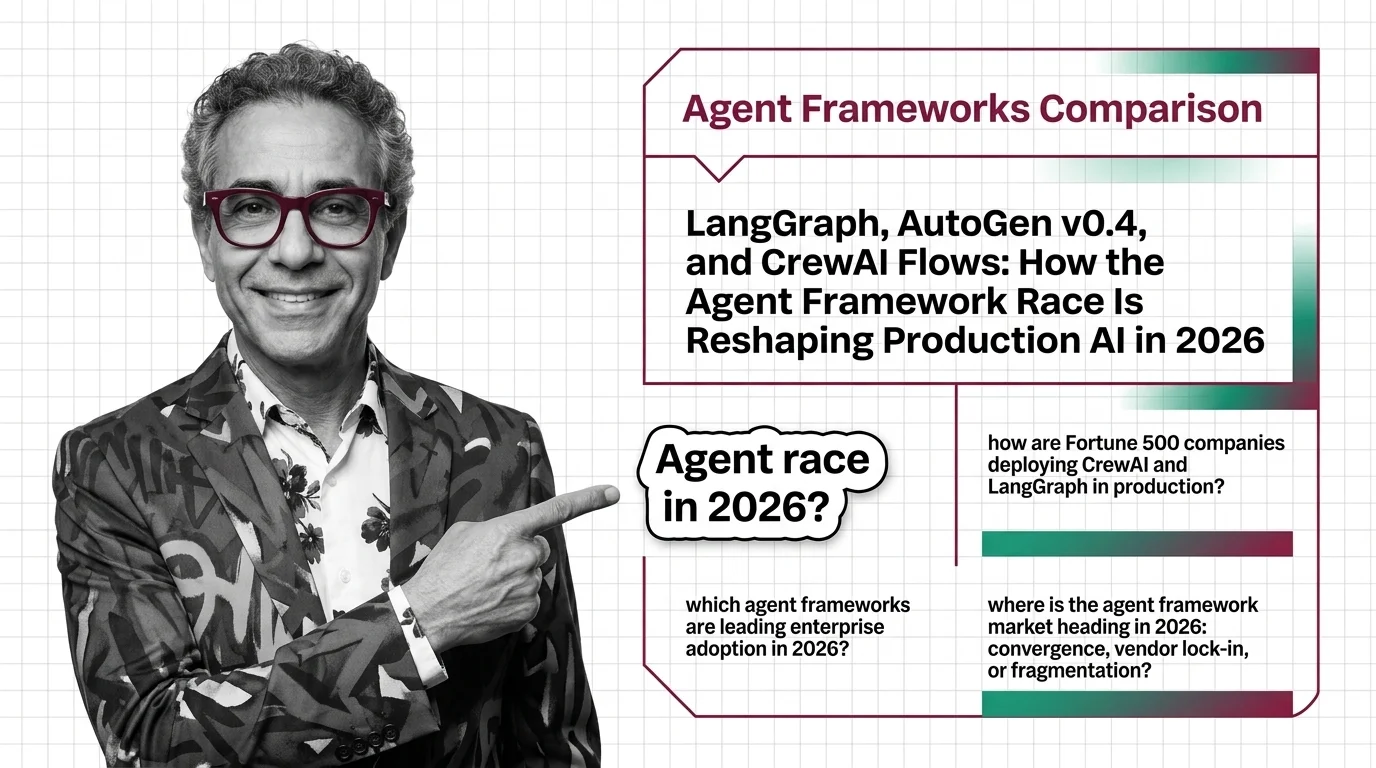
Q: Which agent frameworks are leading enterprise adoption in 2026? A: LangGraph 1.0, the Microsoft Agent Framework 1.0, and CrewAI Flows. LangGraph leads on regulated-enterprise reference customers; Microsoft leads on the Azure-native install base; CrewAI leads on raw production execution volume and Fortune 500 reach.
Q: How are Fortune 500 companies deploying CrewAI and LangGraph in production? A: LangGraph powers durable, audited workflows at firms including JP Morgan, BlackRock, and Klarna (LangChain Blog). CrewAI’s vendor survey reports adoption at 60% of U.S. Fortune 500 companies across 150+ countries (CrewAI Blog), with a strong tilt toward role-based, rapidly deployed flows.
Q: Where is the agent framework market heading in 2026: convergence, vendor lock-in, or fragmentation? A: Convergence on architecture, lock-in on implementation. Every serious framework converges on graph orchestration with checkpointing — but proprietary memory, tool, and observability layers raise switching costs. Pick for the next three years, not the next sprint.
The Bottom Line
The agent framework race is no longer about which library demos best. It is about which vendor your compliance team will sign off on, which SDK your platform org can standardize on, and which execution layer survives an incident. Pick on governance posture, plan for migration friction, and watch the cloud providers next.
AI-assisted content, human-reviewed. Images AI-generated. Editorial Standards · Our Editors