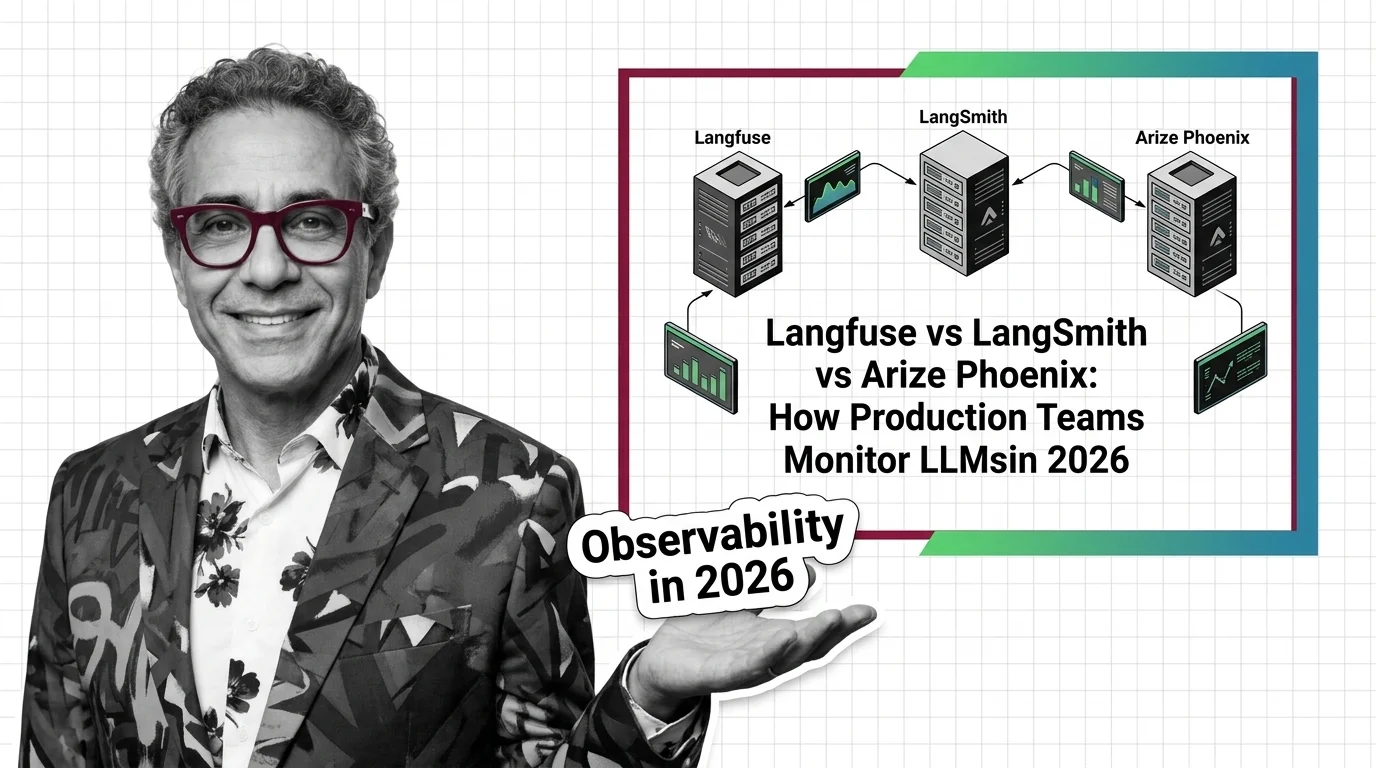
Langfuse vs LangSmith vs Arize Phoenix: How Production Teams Monitor LLMs in 2026
TL;DR
- The shift: LLM observability is consolidating around OpenTelemetry as the shared protocol and managed platforms as the delivery model — the fragmented tooling era is ending.
- Why it matters: Teams that don’t standardize on OTel now will spend the next eighteen months migrating off proprietary tracing formats — at production cost.
- What’s next: Observability moves from a debugging tool to a cost control layer. The teams that instrument everything catch the token waste before it compounds.
Three major acquisitions in six months. A shared protocol that all three dominant platforms adopted simultaneously. The LLM Observability market didn’t just grow — it restructured.
This isn’t a product launch story. It’s a market maturation event. And if your team is still duct-taping together custom logging scripts for your LLM pipelines, the window to get ahead of this is narrowing.
The Consolidation Signal You Should Not Ignore
Thesis: The LLM observability market is compressing from a dozen point solutions into three dominant platforms, all converging on OpenTelemetry as the protocol layer — and enterprise procurement is following.
ClickHouse acquired Langfuse on January 16, 2026, alongside a $400M Series D at a $15B valuation (ClickHouse Blog). That same month, Langfuse reported over 20k GitHub stars and 26M+ SDK installs per month. Two months later, ServiceNow acquired Traceloop — the team behind OpenLLMetry — in a deal worth roughly $60–80M (Calcalist Tech). OpenLLMetry had already been adopted by IBM and Microsoft.
The pattern: the infrastructure layer underneath LLM stacks is being absorbed by enterprise software vendors with distribution.
Both LangSmith and Langfuse added OTLP endpoints in March 2026 (DigitalApplied). Arize Phoenix has been driving OpenTelemetry adoption from day one — the platform now accounts for over 22M monthly OTel instrumentation downloads (Arize Phoenix). The platforms didn’t converge on OTel because someone mandated it. They converged because teams demanded interoperability, and Distributed Tracing infrastructure already had a lingua franca.
You’re not choosing between observability philosophies anymore. You’re choosing between distribution tiers.
The Three Platforms and What They Actually Do Differently
Each of the leading platforms has a differentiated identity. The overlap is real but the edges matter.
Langfuse is the open-source cost efficiency play. The MIT-licensed core covers tracing, evals, prompt logging, and playground. Self-hosting is free. Cloud pricing starts at $29/month for the Core plan and scales to $199/month for Pro (with SOC2/ISO27001), then $2,499/month for Enterprise with dedicated support (Langfuse Docs). At 1M traces per month, Langfuse Cloud comes in around $919 — compared to roughly $2,514 for LangSmith Plus at equivalent volume (MorphLLM). The ClickHouse acquisition adds analytical muscle: Langfuse gains ClickHouse’s columnar storage and query speed as its backend, which matters the moment your trace volume stops fitting in a spreadsheet. The platform also shipped a native MCP server with write capabilities, letting agents fetch and update prompts programmatically (Langfuse Changelog).
LangSmith is the ecosystem integration play. If your stack already runs on LangChain or LangGraph, LangSmith is the path of least friction. The Plus plan runs $39/seat/month with a 10k trace base. Enterprise supports BYOC or self-hosted on AWS, GCP, or Azure Kubernetes (LangChain Pricing). The March 2026 rebrand of Agent Builder to LangSmith Fleet signals the platform’s direction: not just observability, but agent deployment. LangSmith is positioning as the operating layer for LangChain-native agentic workflows, not just a debugger.
Arize Phoenix is the evaluation depth play. Built-in evaluators cover Hallucination, faithfulness, context relevance, and toxicity out of the box (Arize Docs). Framework support spans OpenAI Agents SDK, Claude Agent SDK, LangGraph, LlamaIndex, DSPy, CrewAI, Vercel AI SDK, and Mastra. The license is ELv2 — self-hostable, but not fully permissive for commercial use. Don’t call it “fully open source” without reading the license. Phoenix owns the RAG evaluation niche more thoroughly than either competitor.
Who Is Actually Winning
The market split is already visible.
Startups and cost-sensitive teams are gravitating toward Langfuse. The MIT core removes the licensing anxiety. The pricing math at scale is significantly more favorable. The ClickHouse backend means they’re not outgrowing the platform. Teams that need to track token spend across thousands of daily traces — and need to act on that data quickly — are landing here.
LangChain shops and agent-first teams stay in LangSmith. The integration surface is too good to walk away from when your entire workflow runs on LangGraph. The Fleet rebrand is a tell: LangChain is building LangSmith as the control plane for agentic systems, not just a passive observer. That’s a different value proposition than tracing alone.
ML-serious teams running RAG pick Arize Phoenix. When you need to catch hallucinations before they reach users — not after — the built-in evaluation coverage matters more than pricing. Arize’s evaluator library is the deepest of the three, and the OTel-first architecture means your traces don’t get locked inside a proprietary schema.
Enterprises with existing Datadog contracts may not choose any of these. Datadog LLM Observability ships with native OTel GenAI semantic conventions and plugs directly into existing observability budgets. The choice gets made above the engineering team.
Who Is Getting Left Behind
Teams running homegrown Prompt Logging solutions built before OTel GenAI conventions existed. The technical debt is real and it’s compounding. Every week that passes without standardized tracing is another week of blind spots in your cost model and another sprint required to migrate off custom schemas.
Traceloop’s standalone SaaS is discontinued following the ServiceNow acquisition. Teams that built on Traceloop as a service need a migration path. OpenLLMetry the open-source library remains active — that’s the part ServiceNow kept. But the managed layer is gone.
And anyone who skipped observability entirely because LLMs “worked in testing.” Testing conditions don’t reflect production load, model behavior drift, or the cost of malformed prompts at scale. The teams that find out after launch pay in incident response time, not engineering hours.
What Happens Next
Base case (most likely): OTel GenAI semantic conventions become the non-negotiable baseline for any LLM tracing library within twelve months. Platforms that don’t ship OTLP endpoints lose enterprise consideration. Managed platforms consolidate further — expect one or two additional acquisitions before the end of 2026. Signal to watch: When Datadog, New Relic, and Grafana all ship LLM-native dashboards using OTel GenAI conventions as the primary schema. Timeline: Q4 2026–Q1 2027.
Bull case: OTel GenAI conventions ship a stable 1.0 spec, enterprise procurement standardizes on a single tracing format, and the managed platforms compete entirely on evaluation quality and cost — not on proprietary schemas. Teams get genuine portability. Signal: The OpenTelemetry GenAI SIG publishes a 1.0 semantic convention spec with multi-vendor sign-off. Timeline: First half of 2027.
Bear case: Enterprise vendors ship incompatible “OTel-compatible” implementations that fragment the standard in practice. Teams end up with the worst of both worlds: standardized naming, proprietary semantics. Signal: Vendor-specific OTel extensions become load-bearing in major platform features, making cross-platform migration non-trivial despite technical compliance. Timeline: If it happens, the divergence will be visible by mid-2027.
Frequently Asked Questions
Q: How do companies use LLM observability to catch hallucinations before they reach users? A: Platforms like Arize Phoenix run automated hallucination evaluators on every trace — comparing model output against retrieved context and reference answers in real time. Teams gate on faithfulness scores before responses surface to users, flagging low-confidence outputs for human review or model fallback.
Q: How did startups use observability data to cut LLM token costs in production in 2026? A: By tracing token usage per prompt template and per user cohort, teams identified that a small number of malformed or over-specified prompts consumed a disproportionate share of total tokens. Fixing the top offending templates — visible only after per-trace cost attribution — reduced monthly inference spend significantly without changing model selection.
Q: Why is enterprise LLM observability consolidating around managed platforms and OpenTelemetry in 2026? A: Three M&A events in six months (ClickHouse/Langfuse, ServiceNow/Traceloop, Braintrust Series B) signal infrastructure-grade demand. OTel GenAI semantic conventions give enterprises a vendor-neutral schema, reducing lock-in risk. Managed platforms reduce operational overhead compared to self-hosted tracing stacks. The combination of standard protocol plus managed delivery matches how enterprise infrastructure buying decisions get made.
The Bottom Line
The LLM observability category crossed from optional tooling to required infrastructure. The protocol standardized. The acquisition activity confirmed the demand. Teams that aren’t tracing production LLM calls — with per-trace cost attribution and eval coverage — are flying blind at a moment when token costs and model behavior drift are the two variables that will determine AI unit economics.
You’re either instrumenting before the next production incident or debugging it afterward.
AI-assisted content, human-reviewed. Images AI-generated. Editorial Standards · Our Editors