Langfuse to ClickHouse, Promptfoo to OpenAI: How the 2026 Prompt Management Market Consolidated
TL;DR
- The shift: The independent prompt management tooling category has been absorbed — by a data infrastructure giant and by the dominant model provider, in the same quarter.
- Why it matters: Teams that depended on standalone tools now answer to different roadmaps, and Humanloop — the third pillar of this stack — already shut down without warning.
- What’s next: Programmatic optimization frameworks are eroding manual versioning from below. The next thing absorbed will be the human-authored prompt iteration cycle itself.
Fifty-two days. Two acquisitions. Zero independent category.
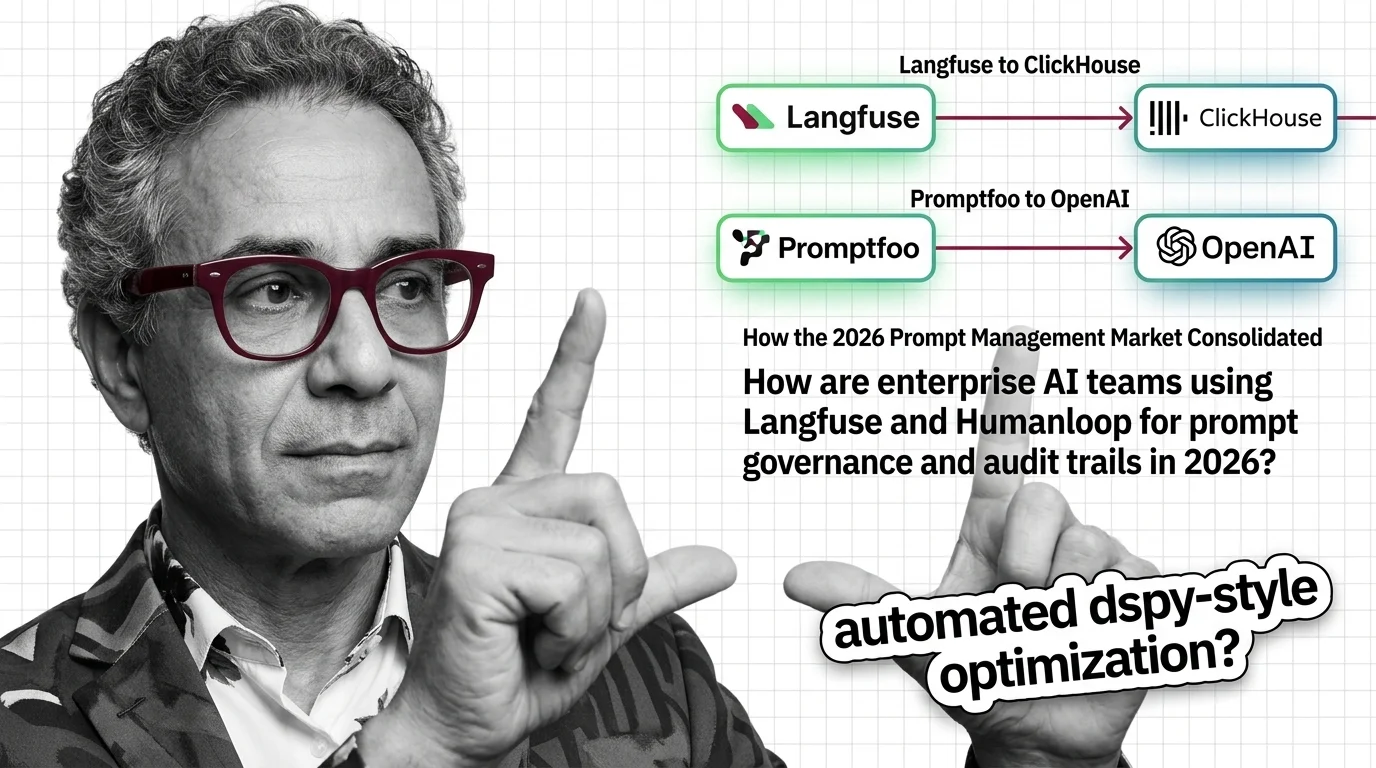
January 16, 2026: ClickHouse acquires Langfuse on the same day it closes a $400 million Series D that triples its valuation to $15 billion (ClickHouse Blog). March 9, 2026: OpenAI announced the acquisition of Promptfoo. Two of the most-deployed open-source Prompt Versioning And Management tools. Both still open source. Both moving inside platforms.
This is not a product update. This is a market restructuring.
The Tooling Layer Has Been Absorbed
Thesis: Prompt management stopped being a standalone product category the moment AI infrastructure companies realized they needed to own the feedback loop — not just sit next to it.
Think about what these acquisitions actually communicate. ClickHouse bought the most-deployed LLMOps observability layer in the enterprise market. OpenAI bought the CLI that red-teams prompts at production scale. Both buyers have the same strategic interest: own the signal between enterprise workloads and AI systems.
The Prompt Registry and Prompt Testing And Evaluation layers were always going to consolidate into infrastructure. The only question was whether the absorbers would be data platforms, model providers, or both.
Both.
That’s not coincidence. That’s a structural signal confirming the direction of the entire space.
Two Deals, One Direction
The usage numbers behind these moves explain why both tools were acquisition targets.
Langfuse, at the time of acquisition: 20,000+ GitHub stars, 23.1 million SDK installs per month, 6 million Docker pulls. Enterprise reach: 19 of the Fortune 50 and 63 of the Fortune 500, with clients including Intuit, Twilio, 7-Eleven, and Merck (ClickHouse Blog). MIT license preserved. Cloud endpoints unchanged (Langfuse Blog).
Promptfoo: 350,000+ developers, 130,000 monthly active users, Fortune 500 penetration above 25% (Promptfoo Blog). Remains open source. Integrating into OpenAI’s Frontier platform.
The third data point is the loudest.
Humanloop — the third pillar of the enterprise prompt management stack — shut down entirely on September 8, 2025. Its team was acqui-hired by Anthropic, but the IP and assets were not acquired (TechCrunch). No migration path. No successor product. Teams that built governance workflows on it rebuilt from scratch.
Three tools entered 2025 as the independent stack. One is gone. Two are inside major platforms.
The independent category didn’t evolve — it was absorbed.
Who Moves Up
Teams already on Langfuse or Promptfoo are in the better position, not the worse one.
ClickHouse’s balance sheet means Langfuse gets faster query performance, deeper storage integrations, and a roadmap budget that a YC-batch startup never had. The MIT license commitment removes the lock-in risk. If the roadmap drifts toward ClickHouse-only use cases, you can fork.
OpenAI’s announced acquisition of Promptfoo addresses a real gap. Agent-level Prompt Injection testing at production scale was an unsolved problem. Bringing that capability inside the model provider closes the red-teaming loop natively. For teams deploying on OpenAI infrastructure, that integration arrives without an extra vendor contract.
Data infrastructure companies that did not move have lost positioning. The window for a standalone Tool Use in Prompts telemetry layer to capture enterprise trust has closed.
The enterprise market now buys observability from the same vendor running the database. That’s not a gap a new entrant closes easily.
Who Gets Left Behind
Teams that built on Humanloop are in the worst position in this space. The platform is gone. Audit trails referencing it are documenting a product that no longer exists.
That is the bear case made real — fast, without warning, at production scale.
The second-tier risk sits with organizations still running manual Structured Output Prompting workflows without tool support. Spreadsheets. Git comments. Ad hoc tagging. These teams missed the window to build governance infrastructure before the category consolidated. They now have to adopt embedded tooling inside platforms they may not already use.
Manual versioning is not a workflow. It is a liability waiting to surface in a compliance audit.
You’re either running governed prompt pipelines with traceable versions, or you’re one production incident away from an accountability gap you cannot close retroactively.
What Happens Next
Base case (most likely): Langfuse and Promptfoo continue as open-source projects but gradually shift roadmap priority toward their acquirers’ platform needs. Teams on ClickHouse or OpenAI infrastructure get tighter integrations sooner. Teams on other stacks see slower feature velocity on neutral use cases.
Signal to watch: The first Langfuse capability that requires a ClickHouse instance to unlock. The first Promptfoo benchmark where OpenAI model results are surfaced more prominently than alternatives.
Timeline: Directional signal visible within two quarters.
Bull case: Both acquirers honor open-source neutrality commitments, attract new contributors under better infrastructure, and the tools improve across the entire market. ClickHouse Langfuse becomes the default observability layer regardless of underlying model provider.
Signal: Active community pull requests merged for non-ClickHouse, non-OpenAI integrations. Third-party adapter velocity maintained.
Timeline: Clear by end of 2026.
Bear case: Roadmap drift narrows applicability. Independent teams fork. Community fragments. New entrants fill the gap — but enterprise trust cycles restart from zero.
Signal: Langfuse deprecates a non-ClickHouse integration path. Promptfoo Prompt Optimization benchmarks favor OpenAI models without explicit disclosure.
Timeline: 12–18 months.
Frequently Asked Questions
Q: How are enterprise AI teams using Langfuse for prompt governance and audit trails in 2026 — and what replaced Humanloop?
A: Enterprise teams use Langfuse to trace prompt versions, score outputs, and build audit trails against compliance requirements. Humanloop shut down in September 2025 after Anthropic acqui-hired its team. Teams that relied on it migrated to Langfuse, Braintrust, or Weights & Biases for equivalent governance workflows. There is no official migration path from Humanloop itself.
Q: Where is prompt management headed in 2026 — from manual versioning toward automated DSPy-style optimization?
A: Manual versioning is losing ground to programmatic frameworks. DSPy’s MIPROv2 optimizer delivers meaningful quality improvements on structured tasks compared to hand-written prompts (CallSphere Blog). The direction is toward automated instruction optimization, not human-authored version increments — and the tooling consolidation accelerates that shift by reducing the friction to instrument workloads properly.
The Bottom Line
Two acquisitions in one quarter closed the era of independent prompt management tooling. Langfuse and Promptfoo are now inside platforms. Humanloop is already a cautionary case study.
The structural shift is done. What remains is adoption — and the gap between teams that built governance infrastructure and teams that didn’t is now wide enough to matter.
AI-assisted content, human-reviewed. Images AI-generated. Editorial Standards · Our Editors