Interpretable but Not Innocent: The Ethics of Sparse Retrieval
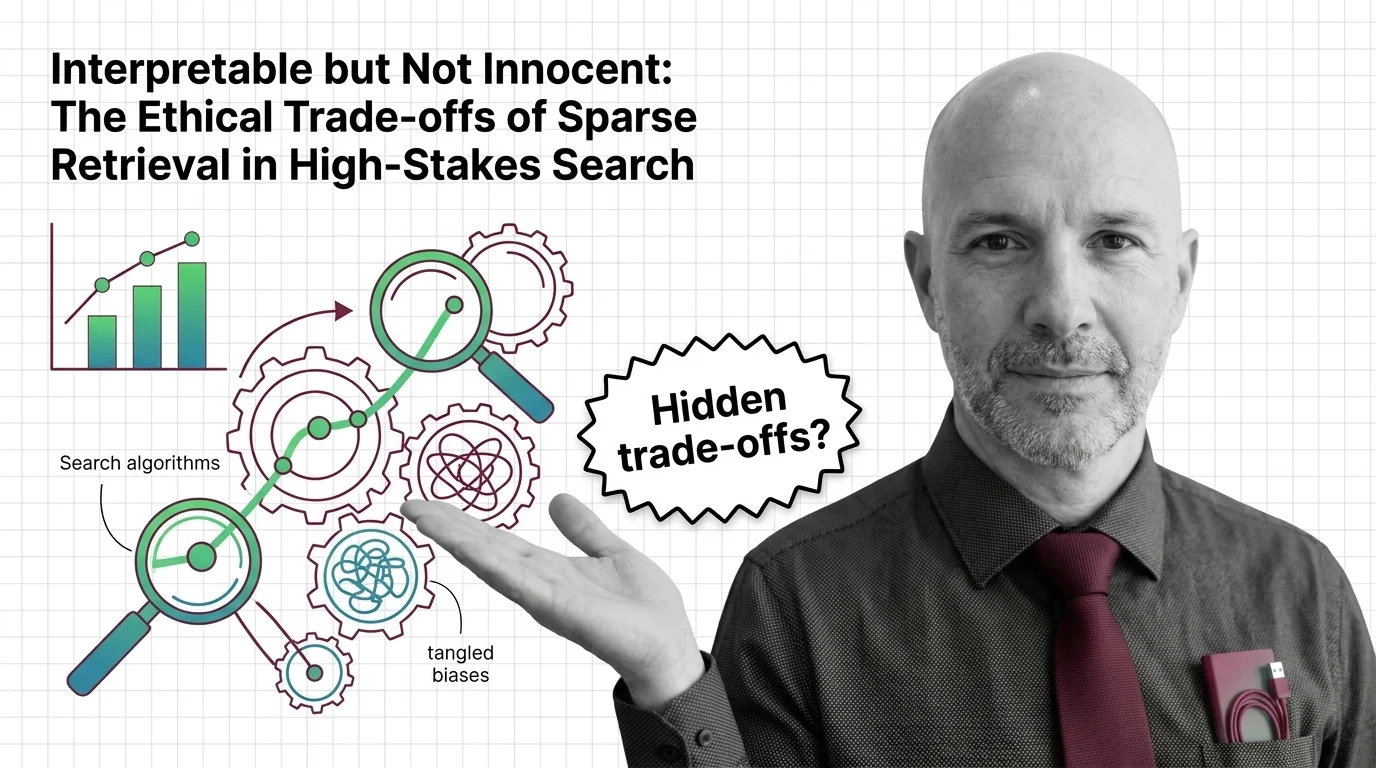
The Hard Truth
Sparse retrieval is sold as the auditable alternative to dense embeddings. You can see every term match, every IDF weight, every reason a document scored. But what if the trail of breadcrumbs leads nowhere except back to the index itself? What if “interpretable” is the most expensive lie a high-stakes search system can tell you?
A hospital information system rolls out a RAG layer for clinicians searching internal protocols. The retrieval is Sparse Retrieval, deliberately, because the team wanted something they could explain to compliance. A nurse types “prescription drugs.” The corpus indexes “medications.” Nothing matches, and the model generates an answer from whatever else surfaces. The system is auditable. The miss is auditable. The patient never finds out.
The Question We Skip When We Choose Lexical Search
The case for sparse retrieval has hardened into something close to a moral position in 2026. Dense embeddings are a black box, the argument goes; TF-IDF and BM25 are a glass one. You can read the match. You can defend it. You can point to the Term Frequency and the inverse document frequency that produced the score and tell a regulator, with a straight face, exactly why this document outranked that one. After years of complaints about the inscrutability of neural retrieval, this seems like the obvious ethical choice for medicine, law, hiring, and credit.
But there is a different question hiding beneath the comforting one. We ask whether the system is interpretable. We rarely ask what its interpretability is for, and who is in the room to use it.
What Makes the Sparse Case Reasonable
The serious version of this argument is not silly, and pretending otherwise would caricature thoughtful work. SPLADE expansions are genuinely inspectable: the model’s tied weight matrices keep the activated tokens human-readable, so an engineer can see which expanded terms a query produced and which the document matched, per Pinecone’s SPLADE explainer. ELSER V2, the GA learned-sparse model in Elasticsearch 8.19 according to Elastic Docs, is an English-only production system that deliberately surfaces the tokens it activates. The BEIR Benchmark family has documented for years that BM25 remains a strong zero-shot baseline across heterogeneous datasets — the original 2021 paper found no single approach won across all 15+ datasets, per the NeurIPS Datasets & Benchmarks publication. On MS MARCO-style passage retrieval, sparse models still hold their own; one 2025 analysis on arXiv: Scaling Sparse and Dense reports that sparse-CL still beats dense-CL by ~4.3% on BEIR. That is a single result, but a real one.
There is also a fairness argument worth stating honestly. The 2024 study Writing Style Matters found BM25 has one of the lowest unfairness scores across writing styles, comparable to LLM2Vec-Llama-2-7b — meaning it does not penalize speakers whose registers diverge from a training corpus the way many neural rerankers do. In one specific dimension, BM25 protects voices the dense models flatten.
The defense, summed up, is that sparse retrieval is mature, fast, transparent, and fair where it counts.
What “Interpretable” Quietly Hides
The trouble with this defense is not that any single claim is wrong. The trouble is in the word “interpretable” itself, which collects two very different ideas under one banner. Reading the score and contesting the score are not the same act. A Pyserini RAG Evaluation pipeline running BM25 on Java 21 and Python 3.12, per the Pyserini GitHub, will tell you with full mathematical clarity why a document was ranked. It will not tell you why “prescription drugs” and “medications” were treated as different concepts in your index. That decision was made years ago, by whoever curated the corpus, and IDF inherits it without comment.
This is the mechanism almost nobody names. Inverse document frequency rewards rarity within the index. Whichever vocabulary dominates becomes statistically privileged; whichever vocabulary sits at the margins gets boosted, but only when it appears literally. Wikipedia’s vocabulary mismatch entry documents that on average about 80% of the time, different people — even experts in the same field — name the same thing differently. The classic example is the health search “prescription drugs” failing to retrieve documents indexed under “medications.” That is not a quirk. That is the model doing exactly what it was designed to do.
SPLADE expansions soften this through learned synonymy, but the softening does not happen for free. The λ regularizer trades effectiveness for sparsity, and the transformer inference adds roughly 100-300 ms of latency over BM25, again per Pinecone’s SPLADE explainer. More importantly, the BERT masked-language-modeling head that produces the expansions is itself an opaque neural model. The expansions are inspectable; the training that produced them is not. Opacity has not vanished. It has moved up a layer, where it is harder to see and easier to forget about.
A Different History Tells a Different Story
There is a useful parallel in the history of indexing. Library catalogers spent a century arguing about whether to file medical conditions under Latin clinical terms or vernacular ones, because they understood that the choice of heading was a decision about who could find the document. The Library of Congress revised “Illegal aliens” to “Noncitizens” after years of public debate. The choice was contested — visibly, slowly, and by people whose names you could look up.
Sparse retrieval has none of that contestation. The IDF weight on “prescription drugs” versus “medications” was set the day the index was built, and it will stay set until somebody notices that a clinical query is missing patient education materials and rebuilds the corpus. The interpretability of the score does not generate the institutional habit of inspecting it. The 2026 JMIR Medical Informatics viewpoint Ethical Imperatives for Retrieval-Augmented Generation in Medicine warns that if a RAG retrieval pool underrepresents minority populations the recommendations become less equitable, and calls for regular audits of retrieval data sources. The mechanism for harm is documented. The institutional mechanism for catching it, in most production stacks, is not.
The fairness picture is also messier than the writing-style result alone suggests. The 2025 study Language Bias in IR found that BM25 shows larger language biases than DPR, and that low-resource languages such as Maltese and Irish get lower retrieval rates and worse language fairness than high-resource ones. ELSER, again per Elastic Docs, is English-only — so using it for non-English high-stakes search is itself a known fairness risk. BM25 is fairer along one axis, less fair along another, and which axis matters depends on whose query you are trying to answer.
The Position This Argument Reaches
Thesis: Sparse retrieval does not eliminate the ethical problems of dense retrieval; it relocates them into a layer that is technically inspectable but institutionally unattended.
This is the conclusion most teams resist, because it is more uncomfortable than the binary it replaces. If sparse and dense both encode worldviews, and sparse merely makes the encoding more legible, then the ethical advantage of choosing BM25 or SPLADE collapses unless somebody is actually reading the encoding and acting on what they read. Interpretability without inspection is decoration. It is the audit log nobody opens, the explanation nobody requests, the score nobody contests until a court does.
There is also a procurement dimension that lawyers will recognize before engineers do. BM25 has a real advantage with out-of-vocabulary tokens — internal product codes, proprietary error strings, novel proper nouns — where a dense model has no learned representation. That advantage matters. It is also exactly the kind of technical strength teams use to justify skipping the harder fairness audit, because the system “obviously works” on the cases anyone tests.
Questions Before You Pick Sparse for High-Stakes Search
There are no clean prescriptions here, only better questions. When was your retrieval corpus last audited for vocabulary skew across the populations your system serves? When a query in a non-dominant register fails to retrieve a relevant document, does anyone hear about it? If your team chose sparse retrieval because it is “more interpretable,” what specifically have you interpreted in the last six months, and what changed as a result?
The questions matter because the affordances of sparse retrieval are real but conditional. Inspectability becomes accountability only inside an institution that has the mandate, the budget, and the cultural permission to act on what the inspection finds. Most production teams do not have that institution. They have a Jira ticket and a quarterly roadmap that does not mention vocabulary fairness.
Where This Argument Is Weakest
This essay leans on the claim that interpretability without inspection is empty, and that claim is most vulnerable to a real shift in tooling. If lightweight bias-audit dashboards become standard, if regulators require evidence that sparse indices have been examined for vocabulary skew, and if the SPLADE community publishes reproducible probes that catch IDF-induced harm before deployment, the moral distinction sharpens rather than collapses. A future where every sparse stack ships with an active fairness inspection layer would prove this essay too pessimistic. That future does not exist yet. It could.
The Question That Remains
Sparse retrieval gives you the receipts, but the receipts are written in a language only the auditors of some imagined future will read. If nobody reads them now, the score is interpretable to nobody who matters. So the question is not whether to choose sparse or dense for high-stakes search. The question is which choice obliges you to actually look at what your system is doing — and whether anyone in your organization has the standing to act on what the looking reveals.
Ethically, Alan.
AI-assisted content, human-reviewed. Images AI-generated. Editorial Standards · Our Editors