Inside the 2026 C2PA-SynthID Alignment: OpenAI, Digimarc, and the Race for Provenance Standards
TL;DR
- The shift: AI content provenance consolidated into a two-layer standard — signed manifests plus invisible watermarking.
- Why it matters: A manifest alone doesn’t survive a platform stripping metadata. A watermark alone can’t prove the original creator. Together, they cover each other’s blind spot.
- What’s next: EU labeling rules are already mandatory — every platform now chooses: stack both layers, or carry compliance exposure.
Upload an image to almost any social platform and its metadata is gone in seconds — stripped by default, not maliciously. For years that made a signed manifest a one-way ticket, useful until the first re-share. In May 2026, the AI Watermarking And Content Provenance fight tipped: OpenAI, Google, Nvidia, Kakao, and ElevenLabs all made the same bet in the same week. Stop trusting one signal. Start stacking two.
Two Signals Beat One: Provenance Just Became a Stack, Not a Standard
Thesis: AI Content Provenance is consolidating around a dual-layer model — signed manifests plus invisible watermarking — because metadata gets stripped by default and neither layer survives alone.
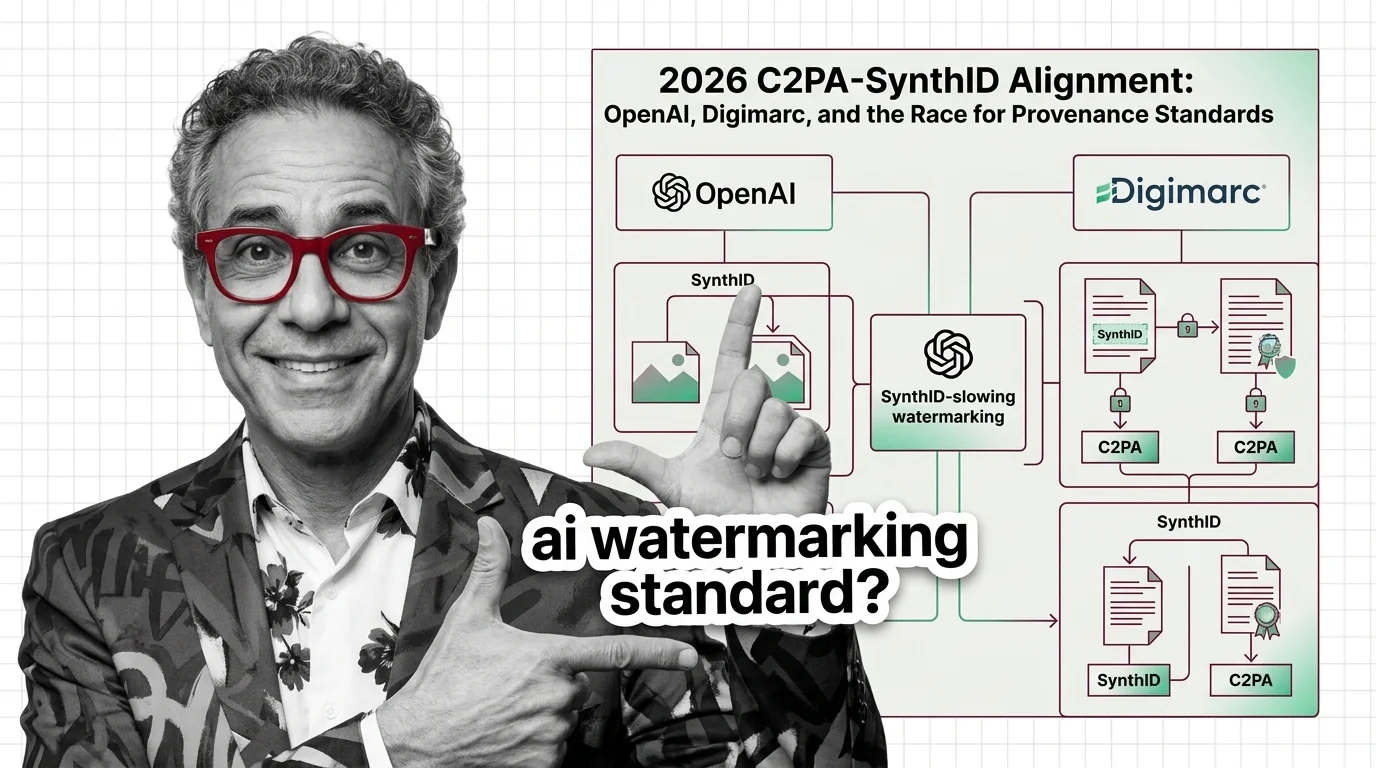
On May 19, 2026, OpenAI began embedding Google DeepMind’s SynthID watermark across its Generative Media APIs — ChatGPT, the API, Codex — onto the Content Credentials manifest it already attaches. Nvidia, Kakao, and ElevenLabs adopted the same watermark the same week, all announced at Google I/O 2026.
That’s not a feature update. That’s five companies agreeing the single-layer era is over.
Google went further — wiring verification natively into Search and Chrome, the two largest distribution surfaces on the internet.
Three Independent Moves, One Pattern
Group the evidence by what it proves, not when it happened.
Labs and recovery infrastructure are converging on the same architecture. OpenAI confirmed the full pairing — signed manifest plus a watermark built on Steganography — on May 19; Nvidia, Kakao, and ElevenLabs adopted the watermark layer the same week. Digimarc went further, launching provenance infrastructure for autonomous AI workflows that links the watermark back to the manifest so recovery survives even after metadata is stripped, then extending that layer into LangChain, ServiceNow, Salesforce, and Microsoft’s agent platforms.
Durability testing and the deadline are forcing the issue, not the technology. Truepic and Steg.AI run signed, watermarked content through compression to see what survives; where both layers fail, platforms fall back on Perceptual Hashing to flag re-uploaded copies. EU AI Act Article 50 transparency obligations became mandatory on August 2, 2026, and the EU’s Code of Practice mandates the same combination directly. The deadline forced convergence, not the technology.
Security & compatibility notes:
- Nikon Z6 III certificate revocation: A signing-key flaw, disclosed last September, let attackers get AI images camera-signed as authentic; Nikon revoked every certificate and the feature remains unrestored.
- C2PA Interim Trust List frozen: Since January 2026, new certificates require the official Conformance Program; older certificates still verify.
- The analog loophole: Re-photographing a screen strips both layers, and open-source models with neither implemented remain the largest adoption gap.
Platforms Stacking Both Layers Get Ahead of the Deadline
OpenAI already clears the bar the EU just made mandatory — manifest and watermark, live since May. Nvidia, Kakao, and ElevenLabs moved on the watermark half; whether each pairs in a full manifest too is the detail to track as August bites. Google wins differently — wiring verification natively into Search and Chrome, detection as a default, not an opt-in.
Digimarc wins differently again, pivoting from Digital Watermarking vendor to recovery-layer infrastructure for agents — the gap nobody else had filled. LangChain, ServiceNow, Salesforce, and Microsoft all adopted its tools within a month.
C2PA wins the way a standard wins when it doesn’t get replaced. SynthID didn’t compete with the manifest format — it complemented it, and the steering committee watched the industry’s biggest watermark provider choose alignment over rivalry.
You’re either running both layers before your next release, or explaining to a regulator why you only built one.
Single-Layer Bets and the Open-Source Gap
Hardware vendors who treated signing as a checkbox are exposed. Nikon’s flaw showed what happens when a manifest can be forged at the source — trust in the signed layer depends on every signer isolating their keys.
Open-source models carry the largest gap in adoption — most ship with neither layer implemented, and nothing forces them to add one.
Single-layer bets are what the EU’s Code of Practice was written to flush out. Signed-only loses the moment someone screenshots the output. Watermark-only can’t prove who made the original.
Half a provenance stack is functionally no provenance stack.
What Happens Next
Base case (most likely): Dual-layer signing and watermarking becomes default for major platforms through 2026; open-source projects lag without enforcement pressure. Signal to watch: More platforms following the OpenAI/SynthID pattern after Google I/O 2026. Timeline: Through 2026.
Bull case: The EU’s interoperability requirement unifies detection across vendors; checking provenance becomes a one-click browser feature. Signal: Broader native SynthID and C2PA detection in Search and Chrome. Timeline: By February 2027.
Bear case: The analog loophole and open-source gap stay wide enough that bad actors route around both layers, and enforcement lags years behind. Signal: More vulnerabilities surfacing in implementations, the way Nikon’s did. Timeline: Ongoing into 2027.
Frequently Asked Questions
Q: Why did OpenAI join the C2PA steering committee and adopt SynthID watermarking in 2026? A: It didn’t join in 2026 — OpenAI joined the C2PA steering committee back in May 2024. The real 2026 news: on May 19, OpenAI began layering Google DeepMind's SynthID watermark onto images from ChatGPT, its API, and Codex.
Q: What did Digimarc’s May 2026 watermark-based provenance recovery launch change for publishers? A: It gave publishers a way to recover provenance after a manifest gets stripped — the default outcome on most platforms. Digimarc’s watermark links back to the original manifest, so tampering or stripped metadata stays detectable.
Q: Will AI content provenance labeling become mandatory under the EU AI Act by 2027? A: It already is, and earlier than that. Article 50 transparency obligations became legally mandatory on August 2, 2026. The 2027 date only covers a narrower interoperability requirement for Code of Practice signatories.
Q: Is C2PA or SynthID becoming the dominant AI content provenance standard in 2026? A: Neither, by design. OpenAI, Google, and the EU’s Code of Practice converge on the same dual-layer model — a signed manifest paired with an invisible watermark. The winning standard is the combination, not either layer alone.
The Bottom Line
Provenance stopped being a single bet the moment platforms proved they’d strip metadata by default. The labs that stacked both layers before the EU’s August deadline aren’t scrambling now — everyone else is. Watch whether the open-source gap closes before regulators stop treating it as an exception.
Stay ahead, Dan.
AI-assisted content, human-reviewed. Images AI-generated. Editorial Standards · Our Editors