Inflated Scores, Misplaced Trust: The Ethical Cost of Benchmark Contamination in AI Procurement
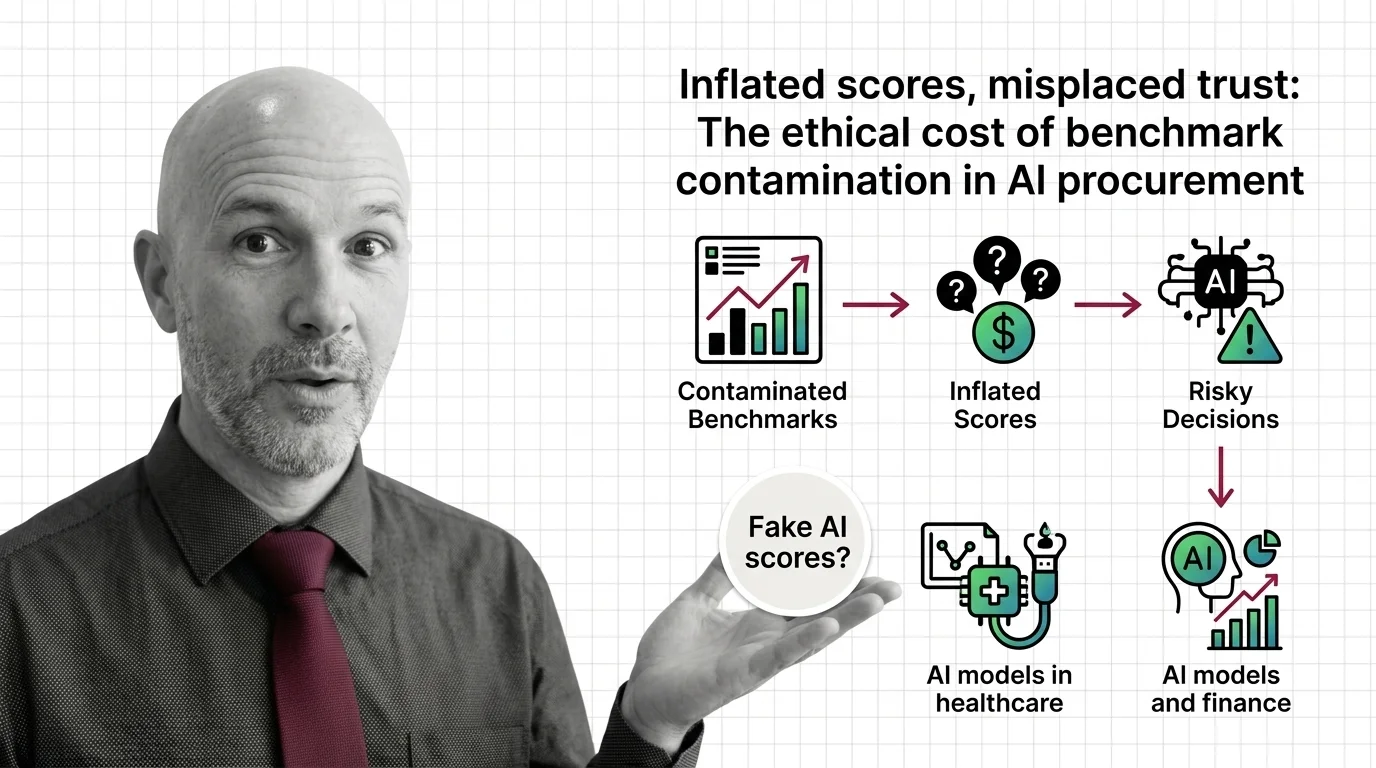
Table of Contents
The Hard Truth
What if the numbers we trust most — the benchmark scores that determine which AI systems reach hospitals and banks — are the numbers most likely to be wrong? And what if nobody in the procurement chain is responsible for checking?
A procurement officer compares two AI vendors. One scores 88% on a widely recognized benchmark; the other, 73%. The choice seems obvious. But the first model’s score reflects memorized test answers, not genuine capability. The distance between the number on the slide and the system’s actual performance is not a rounding error — it is a structural failure in how we evaluate, compare, and ultimately trust the machines we are building into critical infrastructure.
The Number Everyone Trusts, Nobody Verifies
Benchmarks were supposed to solve one of AI’s hardest problems: comparison. How do you tell whether one model is better than another without a standardized test? The answer, for more than a decade, has been to run both models through the same set of problems and compare the scores. The MMLU Benchmark, used across the industry for language understanding, became the shared currency of model comparison. SWE-bench became the standard for coding ability. Procurement teams, hospital administrators, and compliance officers learned to read these numbers as evidence of capability.
The problem is that the numbers have been contaminated.
When top models are tested on a contamination-free version of MMLU, their scores drop by 14-16 points (Microsoft Research). GPT-4o, scored on this clean set, lands at 73.4% in a 5-shot setting — a significant fall from the figures on marketing slides. SWE-bench Verified, once the gold standard for evaluating coding ability, has been retired entirely after an OpenAI audit confirmed that all frontier models showed training data contamination (OpenAI). The benchmark that was supposed to prove capability was, in part, measuring memory.
What are the ethical risks when inflated benchmark scores drive AI procurement decisions? The answer begins with a simpler question: who is checking the numbers before they reach the decision-maker?
The Reasonable Case for Trust
It would be intellectually dishonest to dismiss benchmarks outright. Model Evaluation requires some form of standardized measurement. Without it, every vendor claim becomes anecdotal. Metrics like Precision, Recall, and F1 Score give procurement teams a shared vocabulary for comparing models, and a Confusion Matrix provides a concrete way to examine where a system fails. The infrastructure of evaluation exists because the alternative — trusting marketing copy — is worse.
Researchers have already built contamination-free successors. MMLU-CF strips away the compromised questions. SWE-bench Pro introduces 1,865 multi-language tasks designed to resist data leakage. LiveCodeBench uses problems published after training cutoff dates. The field is trying to self-correct.
But self-correction requires transparency, and here the evidence is uncomfortable. Only 9 of 30 analyzed models reported their train-test overlap, according to a European Commission study (Eriksson et al.). The majority of model developers either did not check for contamination or chose not to disclose their findings. A system built on trust functions well only when that trust is earned — and the disclosure rate suggests it is not being earned.
The Assumption That Breaks Everything
The hidden assumption inside benchmark-driven procurement is that a score reflects generalized capability — that a model scoring 88% on a test will perform at roughly 88% on your real-world problem. Benchmark Contamination breaks this assumption at its root. A contaminated score does not tell you what the model can do. It tells you what the model has seen before.
The International AI Safety Report 2026 names this an emerging “evaluation gap”: existing evaluations are outdated, affected by data contamination, and provide limited insight into real-world AI performance (AI Safety Report 2026). The gap is not between good models and bad models. It is between the number on the page and the performance you will actually receive.
Consider the SWE-bench case. Claude Opus 4.5 scored 80.9% on SWE-bench Verified but 45.9% on SWE-bench Pro (Morph LLM) — though this gap reflects both contamination and increased task difficulty, so it should not be read as a clean contamination measurement. Even granting that complexity contributes, the magnitude of the drop raises a question procurement officers cannot afford to dismiss: are we buying performance, or familiarity with the test?
When Hospitals Buy on Hollow Numbers
The ethical weight of this question becomes unbearable when the procurement decision involves human health. Microsoft Research found that medical AI models “guess correctly even when key inputs like images are removed” and “fabricate convincing yet flawed reasoning” — benchmarks were rewarding test-taking shortcuts rather than clinical understanding (TechPolicy Press). A separate analysis of roughly 1,000 FDA-cleared AI medical devices found that most recalled devices had lacked clinical testing (TechPolicy Press).
Who bears responsibility when contaminated benchmark scores mislead healthcare and finance AI decisions? The vendor submits the score. The benchmark maintainer designs the test. The procurement officer approves the purchase. The regulator clears the device. Each participant performs their role. Yet nobody in this chain is tasked with verifying that the score means what it claims.
No public legal case, as of April 2026, has held a vendor liable for procurement outcomes influenced by contaminated benchmark claims. The accountability gap is not a technicality — it is a structural feature of how AI evaluation currently operates. The EU AI Act’s high-risk requirements, taking effect August 2, 2026, will demand tested, representative, and error-free datasets for high-risk AI systems, but whether this framework will address the contamination problem specifically remains to be seen.
The Accountability No One Claims
Thesis: Benchmark contamination in AI procurement is not a measurement error — it is an accountability vacuum in which vendors, evaluators, and buyers each assume that someone else verified the numbers.
This framing matters because it shifts the problem from “better benchmarks” to “better institutions.” NIST’s draft guidance on automated benchmark evaluations — AI 800-2, with a companion statistical framework in AI 800-3 — represents an early attempt to formalize what responsible evaluation looks like (NIST). The three-stage process it proposes — define what you are measuring, implement the evaluation, analyze and report the results — sounds like common sense. The fact that it needs to be codified tells you how far current practice has drifted.
An Ablation Study can reveal which components of a model contribute to its performance. What we lack is the institutional equivalent: a way to trace which components of a procurement decision were contaminated and where the verification failed. The problem is not that we need better tests. It is that we lack the institutional architecture to ensure the tests mean what they claim.
Questions We Owe the Next Decision
This is not a problem that resolves through better technology alone. The contamination-free benchmarks already exist. The question is whether institutions will adopt them — and whether procurement processes will evolve to treat benchmark provenance as a first-order concern rather than a footnote.
What verification does a hospital owe its patients before selecting an AI diagnostic tool on the basis of a benchmark score? What due diligence does a bank owe its customers before adopting a risk model whose evaluation may have been compromised? And what happens to the people harmed in the gap between the number that was promised and the performance that was delivered?
Where This Argument Is Weakest
If contamination-free benchmarks — MMLU-CF, SWE-bench Pro, LiveCodeBench — become the default, and if reporting standards like NIST AI 800-2 gain broad adoption, the accountability vacuum may close on its own. The strongest counterargument to this essay is that the field is already self-correcting, and the ethical alarm is premature. If the next generation of evaluations proves resistant to contamination and procurement teams learn to demand clean scores, this problem becomes a historical footnote rather than a systemic crisis.
That counterargument deserves honest consideration. Healthcare-specific contamination impact remains largely theoretical — no published study, as of this writing, quantifies patient harm from benchmark-inflated AI procurement. The risk is that confusing the existence of solutions with their adoption provides false comfort — and adoption, in procurement, is measured in years, not papers.
The Question That Remains
We built an entire procurement infrastructure on the assumption that benchmark scores reflect real capability. That assumption has been empirically undermined. The question is no longer whether the numbers were wrong — it is who will be held responsible when the gap between score and performance causes harm that could have been prevented.
Disclaimer
This article is for educational purposes only and does not constitute professional advice. Consult qualified professionals for decisions in your specific situation.
AI-assisted content, human-reviewed. Images AI-generated. Editorial Standards · Our Editors