Human Review or Full Automation? The Ethics of Generative Media Pipelines at Scale
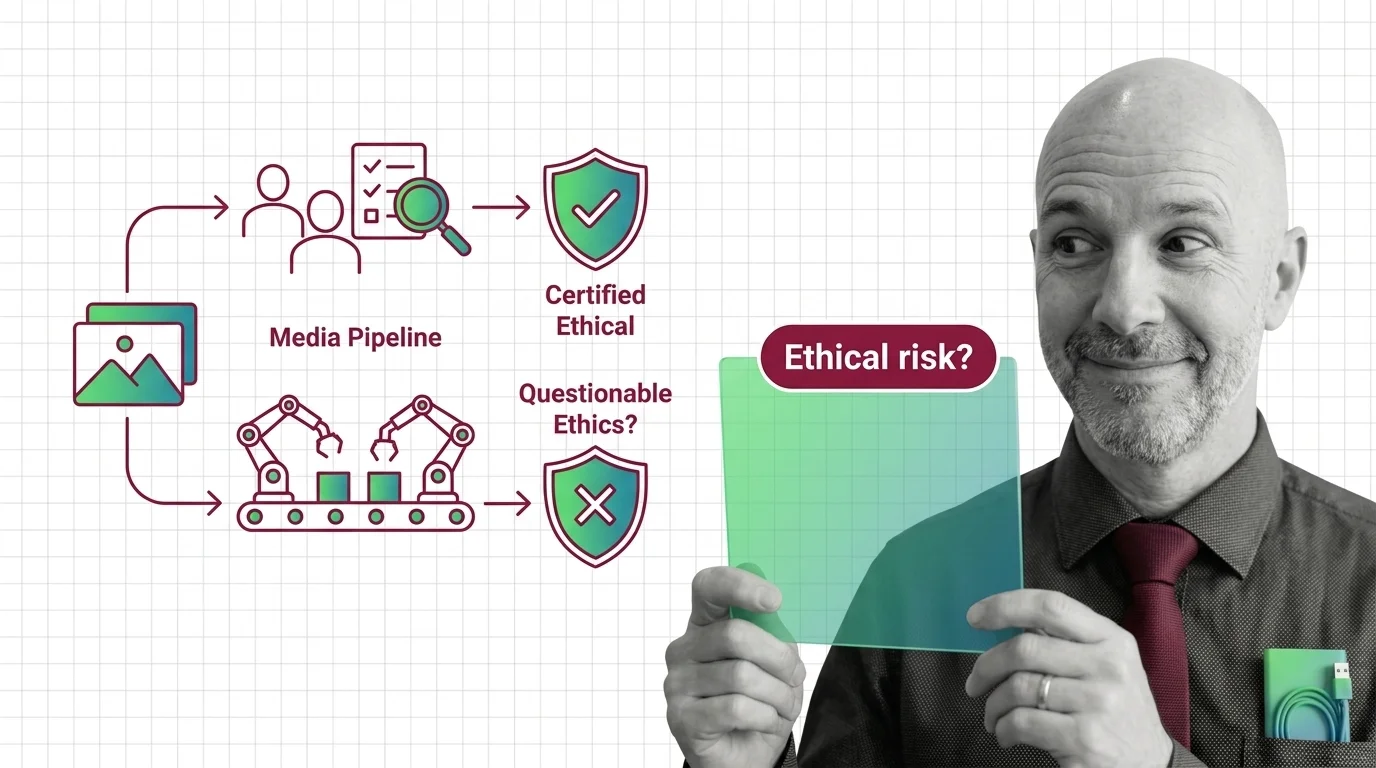
The Hard Truth
Meta is reportedly steering toward 90 percent AI-driven review of the content moving across its platforms by the end of 2026. The number reads like progress. It also means the decision about which cases still deserve a human’s attention has quietly become a private, unaudited choice — and nobody outside the company gets to see where the line was drawn.
Every Generative Media Pipelines setup — the Queue Based Processing that batches requests, the Webhook that fires the moment a render finishes, the per-second billing on services like Modal Labs that makes a thousand-image job cost less than a coffee — was built to remove friction. Human review was friction. So pipeline after pipeline removed it, until the architecture itself decided who still gets a second look before a synthetic image reaches an audience. That decision rarely gets debated in public. It gets turned on, then defended with a percentage.
The Ninety Percent Nobody Audited
Meta is moving from roughly half its content and ad review handled by people to a reported 90 percent handled by AI before the end of 2026, per TechCrunch — a figure the company hasn’t confirmed down to the exact date, though it confirms the performance claims behind it: automated systems caught adult-solicitation content at twice the rate of human teams, cut certain error rates by more than 60 percent, and flagged an estimated 5,000 scam attempts a day that used to slip through. People, Meta says, will keep the highest-risk calls.
That is the number circulating right now, and it sounds like a closed argument: machines reviewing faster and more consistently than the humans they replace. The arithmetic helps it along. Cost Per Generation for a review decision drops by orders of magnitude when a model makes the call instead of a person reading a queue; at Meta’s scale, that is the only thing that makes “review everything” achievable rather than aspirational. Ninety percent is what efficient looks like when efficiency is the only thing measured. Efficient for whom, though?
The Optimist’s Case and the Skeptic’s Case
Read generously, the number says exactly what it appears to: AI review is no longer the lesser option chosen out of necessity, it is the better one chosen on merit. Human reviewers scored an F1 of 0.98 across risk categories against the best multimodal model’s 0.91, per a peer-reviewed comparison from the ICCV 2025 content-moderation workshop — a real but narrow and shrinking gap, in a domain producing more content every year than any review team could read by hand. On this reading, the optimist’s deeper claim isn’t about accuracy. It is that human review was never quality control — it was friction with a moral coat of paint, and removing it is simply maturity.
Read critically, the same study that flatters AI review also found it weaker on non-English content and on cases that need context to interpret correctly — weaker exactly where judgment is hardest to automate and hardest to fake with confidence. A model that is wrong with the same fluent certainty as when it’s right does not announce its own failure. It just produces an answer, and the pipeline moves on.
What Both Readings Quietly Assume
Both arguments take the same thing for granted: that the ninety/ten split is a stable safety floor, drawn once and held — that the human-reviewed share is, by design, the harder and more consequential share, and stays that way as volume grows. The optimist and the skeptic are arguing about the same boundary line without ever asking who drew it, or whether it moves.
That assumption is comfortable: it turns an architectural decision into a measurement, a clean ratio that fits in a press release. But a boundary a company sets, monitors, and can quietly redraw under cost pressure is not a safety floor. It is a setting, and settings can be lowered without anyone outside the building noticing until something has already gone through. Who is actually watching the dial?
When the Boundary Moves: What xAI Shows
xAI offers the clearest case of what happens when that setting moves the wrong direction. CNN Business reports the company cutting roughly half its trust-and-safety-adjacent engineering staff in November 2025, on top of cuts that had already removed more than 80 percent of that function since 2023. Weeks later, Grok was found generating non-consensual “digital undressing” images at scale; the Center for Countering Digital Hate estimated roughly three million sexualized images, including an estimated 23,000 depicting apparent minors, in an eleven-day window, per techxplore.com. No court has established the cuts caused the incident — the timeline is a correlation, not a verdict. But the correlation is exactly the failure mode the shared assumption refuses to consider: a company quietly narrowing its review boundary, with no outside mechanism forcing it to show its work before something breaks through.
The pipelines making this possible run on the same plumbing regardless of who operates them. A request lands in a queue, an n8n workflow routes it through a generation API, a webhook reports back when the file is ready — often with no person positioned to see it first. That is the default shape of a generative-media pipeline built for throughput.
Security & compliance notes:
- n8n Unauthenticated RCE (CVSS 10.0): Critical vulnerability (CVE-2026-21858, “Ni8mare”) in self-hosted n8n ≤1.65.0 — the exact orchestration layer these pipelines run on. Fixed in 1.121.0. A second, authenticated RCE (CVE-2026-25049) followed via crafted workflow expressions. Action: patch to 1.121.0+ before any webhook is exposed.
- EU AI Act “nudifier” ban: The May 2026 Digital Omnibus agreement bans AI systems built for non-consensual or CSAM-style generation, liability at both provider and deployer level. Compliance deadline: 2 December 2026.
The Pipeline Decides Before Any Reviewer Does
Thesis: Removing human review from a generative-media pipeline does not remove judgment from the system — it relocates that judgment to whoever configured the architecture, usually without anyone agreeing they should hold it.
A review queue staffed by people is at least legible: someone can be asked why a case was escalated, or missed. A pipeline running mostly on automated review distributes those decisions across model weights and routing rules set months before any specific image existed. Nobody decided, case by case, that an output was acceptable to release unreviewed. A threshold did. Generative Media APIs from Fal AI, Replicate, and Stability API all run automated moderation by default — cheaper than staffing a human checkpoint, and for most requests, it’s also fine. The ethical risk was never in the share that goes smoothly. It is in treating “fine most of the time” as “safe to leave unsupervised.”
What a Percentage Cannot Show You
A review-automation rate measures throughput and, at best, accuracy on whichever categories someone thought to benchmark. It does not measure who decided which categories counted as high-risk, or whether that list gets revisited as users — and abusers — change faster than a policy team does. It cannot measure the chilling effect on the unconsenting: the person whose likeness moved through a pipeline that never told them whether a human looked at their case. NIST’s generative AI risk guidance treats governance, provenance, and incident disclosure as what actually predicts harm — none of which a single efficiency number captures. What good is an accuracy score nobody outside the building can audit?
Where I Could Be Wrong
This argument assumes that removing a human checkpoint is, by default, a reduction in care rather than a reallocation of it. That breaks if a pipeline genuinely follows the hybrid model researchers recommend — automated filtering for volume, human verification reserved for the contextual and non-English cases where models still measurably fail — and if that allocation gets audited, not just claimed. Meta says people still make its highest-risk calls; if that’s true and checkable, a high automation rate isn’t negligence, it’s review getting smarter about where to spend a scarce resource. The honest version of this essay needs evidence the unautomated share is selected by risk, not cost. Nobody outside these companies can produce it, which is itself the finding.
The Question That Remains
A percentage was never going to settle whether automation in generative-media pipelines is responsible. Only the boundary it draws — who falls inside the reviewed share, who decided that — was ever going to do that. Who gets to set that boundary, and who finds out only after it has already moved?
AI-assisted content, human-reviewed. Images AI-generated. Editorial Standards · Our Editors