How to Read the Chatbot Arena Leaderboard and Compute Your Own LLM ELO Scores in 2026
TL;DR
- The Arena leaderboard uses Bradley-Terry ratings with confidence intervals, not classic ELO — overlapping CIs mean top-10 models often tie statistically
- Filter by task category before comparing models; treat any pre-2025 scores as incomparable to current ones due to the mid-2025 Style Control shift
- arena-rank (
pip install arena-rank) runs the same BT methodology on your own pairwise preference data — pin the version after install
You picked the top-ranked model from Arena, deployed it on structured data tasks, and watched it return prose when you needed JSON. The model ranked sixth outperformed it by a visible margin. That’s not a ranking problem. It’s a reading problem.
Before You Start
You’ll need:
- Python 3.10+ and pip for running arena-rank
- Familiarity with ELO Rating for LLMs and Human Evaluation for AI
- A task-specific set of pairwise preferences, or access to the public Arena dataset
This guide teaches you: how the Bradley-Terry model turns pairwise votes into a rating, what confidence intervals tell you that raw ranks don’t, and how to replicate the Arena methodology on your own evaluation data.
The Number at the Top Is Not the Answer
You opened arena.ai, found the top row, and copied the model name. That’s the first mistake.
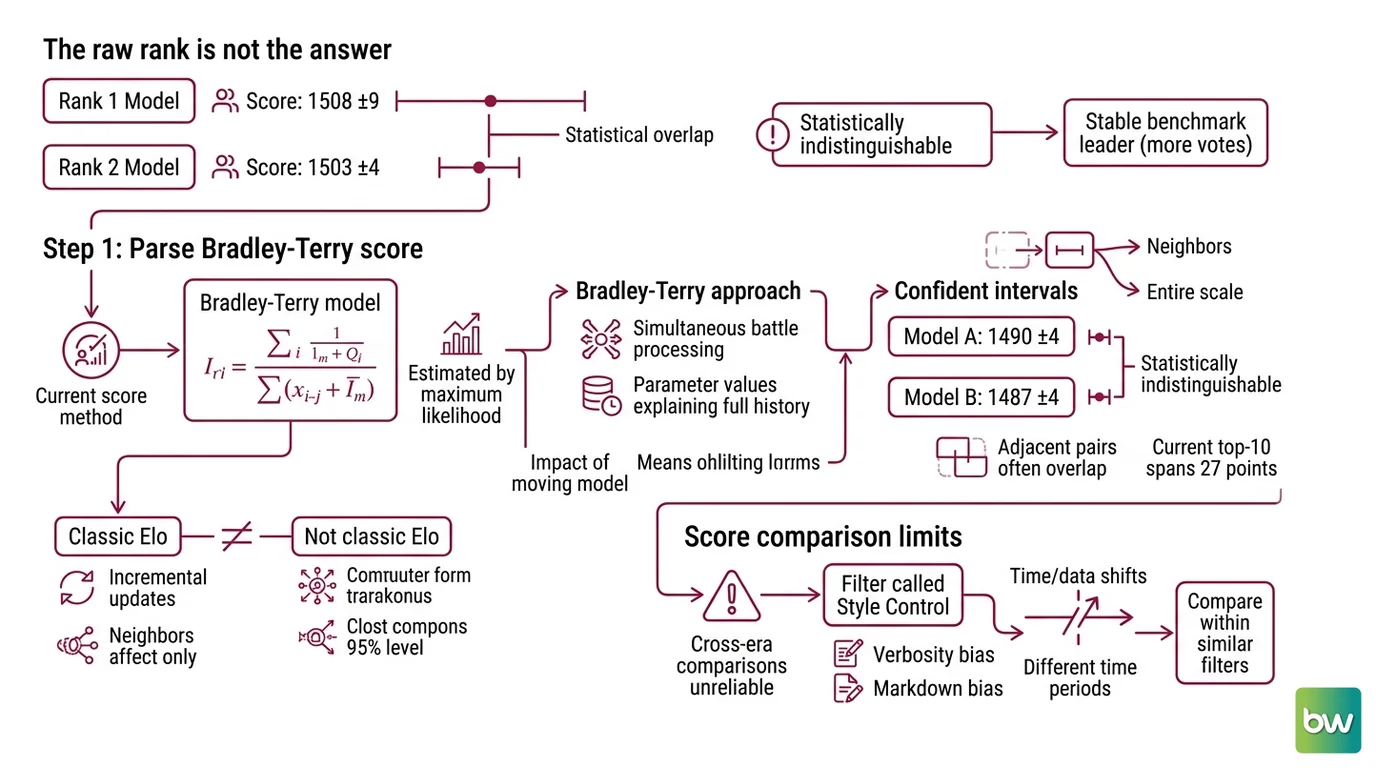
As of June 25, 2026, the Arena leaderboard (Arena Leaderboard) shows 368 models evaluated across 7,060,640 human votes. The top-ranked entry is claude-fable-5 at a score of 1508 — but it has accumulated only 4,366 votes, producing a confidence interval of ±9 points. The next entry, claude-opus-4-6-thinking, sits at 1503 ±4. That’s a 5-point gap with overlapping confidence intervals. These two models are statistically indistinguishable on the current data.
For practical model selection, treat claude-opus-4-6-thinking as the stable benchmark leader until claude-fable-5 accumulates enough votes to shrink that CI. Raw rank without confidence interval is not a comparison.
Step 1: Parse the Bradley-Terry Score — Not ELO
The platform is called Arena (the old lmarena.ai domain redirects since January 28, 2026). The scores are not classic ELO Rating ratings, even though the term persists in team discussions and older documentation.
Arena uses the Bradley Terry Model estimated by maximum likelihood (Chatbot Arena paper). The formula: P(A beats B) = 1 / (1 + e^(ξ_B − ξ_A)), where ξ_A and ξ_B are the model strength parameters. The key difference from classic ELO: rather than updating incrementally after each battle, BT processes all battle outcomes simultaneously and finds the parameter values that best explain the full history. Moving a model up the leaderboard doesn’t just affect its neighbors — it can shift the entire scale.
Arena reports confidence intervals using closed-form sandwich robust standard errors at the 95% level (Arena Blog). A model at 1490 ±4 and another at 1487 ±4 are statistically indistinguishable. The current top-10 spans about 27 points total — meaning many adjacent pairs overlap when you factor in CI.
Cross-era score comparisons are unreliable. A filter called Style Control, introduced mid-2025, shifted some scores 20-40 points (Leaderboard Changelog). Any comparison crossing that boundary is suspect. “Model X scored 1360 in early 2025” and “Model Y scores 1380 today” are not describing the same measurement. Treat them as separate experiments, not as a ranking evolution.
Step 2: Set Up Your Evaluation Context Before You Filter
Reading the leaderboard without specifying your context gives you a population-level ranking. Useful for orientation. Not useful for model selection.
The Arena has enough vote volume to support task-specific filtering. Before you compare models, specify:
- Task domain — coding, creative writing, math, multilingual, instruction following?
- Prompt complexity tier — Chatbot Arena launched Arena Expert evaluation in November 2025, covering the top 5.5% of prompts by reasoning depth and specificity. If your use case is complex multi-step reasoning, Expert mode filters toward harder problems than the general vote pool.
- Vote source — since March 2026, 10% of direct chat sessions are converted to pairwise battles and counted toward the leaderboard (Leaderboard Changelog). This shifts the vote distribution toward deployed users vs. dedicated evaluators.
Set these filters. Then look at the ranking.
One more context item: the leaderboard is not neutral. A Cohere Labs, Stanford, and Princeton study found that big-tech labs received disproportionate data access through the Arena platform (Leaderboard Illusion paper). Models trained on Arena data showed Arena-specific score gains without improving on independent benchmarks. Additionally, researchers have demonstrated that a small number of rigged votes can yield multi-rank promotion — Arena runs anomaly detection but it is not absolute. These aren’t reasons to discard the leaderboard. They’re reasons to verify your top candidates on your own data before committing to one.
Step 3: Run Your Own Bradley-Terry Rating with arena-rank
When you need task-specific ratings the leaderboard can’t give you, here is the specification for computing your own.
Your setup:
- Install arena-rank — the official package from the Arena team
- Collect pairwise preference data in the correct format
- Run the BT estimator with confidence intervals
- Interpret the output against the same CI framework you use for the Arena leaderboard
Replace FastChat ELO scripts with arena-rank. Install with pip install arena-rank. The package uses a JAX backend that is 30x faster than the old FastChat NumPy/SciPy code, which is now deprecated (Arena Blog). If you have scripts referencing the old FastChat ELO implementation, replace them before this work.
If you want to test on real data before running your own, the public dataset lmarena-ai/arena-human-preference-140k on Hugging Face lets you reproduce Arena’s methodology and validate your setup before collecting new votes (arena-rank GitHub).
Your Rubric Design determines annotation quality. If you are using human raters, set a Cohen's Kappa target before collecting votes — below 0.6 means annotators are inconsistent, and the BT scores will reflect noise as much as preference signal. If you are using LLM as a Judge, define the comparison criteria explicitly. Don’t assume the judge defaults to quality. For managing annotation tasks at scale, Label Studio supports custom pairwise preference interfaces and can export formats compatible with arena-rank.
Build in tie options. Arena allows “both are good” and “both are bad” alongside standard win/loss (Chatbot Arena paper). Ties are information. A pairwise setup without them forces annotators to pick a winner for genuinely equal outputs — that noise ends up in your ratings.
Compatibility notes:
- FastChat ELO code (lm-sys/FastChat): Deprecated — replaced by arena-rank. Old scripts still exist in the repo but no longer reflect live leaderboard computation. Do not use them.
- arena-rank package: No tagged stable release yet (main branch only). Pin the version in your requirements file immediately after install — don’t rely on PyPI serving the same version across environments.
- Style Control Elo shift: Mid-2025 filter change moved scores 20-40 points. Pre-2025 vs. 2026 scores are not directly comparable.
Step 4: Validate What Your Scores Actually Mean
You have BT scores with confidence intervals. Now the diagnostic phase.
Validation checklist:
- Confidence interval width — if CI is wider than the score differences you care about, you have too few battles per model pair. The ranking is not actionable yet. Collect more data before drawing conclusions.
- CI overlap check — if two models’ confidence intervals overlap, treat them as tied. Don’t present overlapping models as clearly ordered to stakeholders.
- Domain inversion check — if your task-specific ranking inverts significantly from the Arena general leaderboard without explanation, audit your vote data. Either you have genuine domain signal (worth documenting) or you have annotation noise (worth fixing first).
- Annotation agreement — Cohen's Kappa below 0.6 between annotators invalidates the vote data before it invalidates the rating. Fix the rubric before collecting more votes.
- Leakage risk — if the model you are evaluating was fine-tuned on Arena interaction data, its Arena score is inflated. Test independently on SWE Bench or another benchmark to verify whether the leaderboard signal actually generalizes to your task.
A wide CI means more data, not a ranking. The number itself is less important than the uncertainty around it.
Common Pitfalls
| What You Did | Why the Score Failed | The Fix |
|---|---|---|
| Picked model by raw rank | Confidence intervals overlap in the top-10 | Treat models within ±10 points as tied; check CI explicitly |
| Compared pre-2025 to 2026 scores | Style Control shift moved scores 20-40 points mid-2025 | Only compare scores from the same time period and filter settings |
| Skipped task-specific filter | General chat ranking doesn’t predict domain performance | Filter by task category before comparing any models |
| Used FastChat ELO scripts | FastChat ELO code is deprecated — results diverge from current Arena | Replace with arena-rank; same BT methodology, actively maintained |
| Omitted tie options in preference votes | Forced choices on equal outputs add noise to BT scores | Include “both good” and “both bad” tie options in every voting interface |
Pro Tip
The Arena leaderboard and your internal arena answer different questions. The Arena tells you how a model performs when anyone asks anything. Your internal arena tells you how it performs when you ask what you actually need. Use the Arena to narrow to 3-5 candidates with non-overlapping CIs on your task filter — then use arena-rank on your domain data to pick the winner. Neither dataset is complete without the other.
Frequently Asked Questions
Q: How do you use ELO leaderboards to choose the best LLM for your task in 2026?
A: Start with Arena’s task-specific filter — general rankings don’t distinguish between domains. Then look at confidence intervals, not scores alone. The top-10 as of June 2026 spans about 27 points, with most adjacent pairs overlapping. Narrow to 3-5 models with non-overlapping CIs, then test with your actual prompts. One detail most teams miss: if your use case is complex reasoning, filter to Arena Expert mode specifically — it covers a higher-difficulty prompt distribution that general votes underweight.
Q: How do you compute ELO ratings for your own models from pairwise comparisons?
A: Install arena-rank and pin the version in your requirements file immediately — the package has no tagged stable release. Collect pairwise votes with four options (prefer A, prefer B, both good, both bad) — enough battles per model pair that the CI narrows below the score differences you are trying to distinguish. Feed the data to arena-rank’s BT estimator and read the output ξ scores with 95% CIs. Before scaling: run a subset of battles through both human raters and an LLM judge to calibrate whether the judge matches human preferences on your specific task — most teams skip this and regret it.
Q: How to build an LLM evaluation arena with pairwise preference voting?
A: Three components: a prompt set (50+ items representing your task), a voting interface with four options (prefer A, prefer B, both good, both bad), and arena-rank for computation. Before you scale data collection, run a calibration round with 20-30 battles across multiple annotators and compute Cohen’s kappa. If kappa is below 0.6 on that calibration set, your rubric has ambiguous criteria — fix them before scaling. Volume doesn’t fix a broken rubric. It amplifies it.
Your Spec Artifact
By the end of this guide, you should have:
- A leaderboard reading checklist: CI width threshold, task filter, time period boundary (pre-/post-2025)
- A pairwise evaluation setup spec: prompt count, annotation rubric, kappa target, tie options, tool stack
- A validation criteria list: CI width limit, overlap check, domain inversion audit, leakage test
Your Implementation Prompt
Use this as your starting context when prompting Claude Code, Cursor, or Codex to help you build a pairwise LLM evaluation pipeline. Fill in the bracketed values before you hand this off.
Build a pairwise LLM evaluation pipeline using the Bradley-Terry model.

## System Components
1. Prompt collection: [describe your task domain — e.g., "100 structured data extraction tasks from production logs"]
2. Output generation: Model A = [model name and API endpoint], Model B = [model name and API endpoint]
3. Voting interface: [tool — e.g., "Label Studio pairwise preference template with 4 options: prefer A, prefer B, both good, both bad"]
4. Rating computation: arena-rank (pinned to version [x.y.z])

## Constraints
- Each battle must offer four options: prefer A, prefer B, both good, both bad
- Annotation quality gate: Cohen's kappa >= [your target, e.g., 0.70] on calibration set before production data collection begins
- Minimum battles per model pair: [your target, e.g., 75]
- Output: Bradley-Terry xi scores per model with 95% confidence intervals using sandwich robust standard errors

## Build Order
1. Build prompt collection and output generator first — validate that both models respond correctly before any votes are collected
2. Set up the annotation interface, run [N]-battle calibration with [N] annotators, compute kappa — do not proceed if kappa < [your target]
3. Wire arena-rank to ingest the annotation output and compute BT scores with CIs

## Validation
- CI width < [your acceptable uncertainty, e.g., the score gap you care about] — if wider, collect more battles before drawing conclusions
- No adjacent-rank CI overlap in final results — if overlap exists, treat those models as tied
- Cross-check your domain-specific ranking against Arena's [your task category] filter — document and investigate any major inversions
Ship It
You have two instruments now. The Arena leaderboard gives you statistical rigor across millions of votes and a global ranking baseline. arena-rank gives you the same computation on your data, tuned to your task. Use both — the leaderboard narrows the field, your arena validates the pick.
AI-assisted content, human-reviewed. Images AI-generated. Editorial Standards · Our Editors