How to Detect and Prevent Data Leakage with scikit-learn Pipelines and Deepchecks in 2026
TL;DR
- Data leakage is a specification failure, not a modeling bug — information that won’t exist at prediction time sneaks into training and inflates your validation scores.
- A scikit-learn Pipeline makes leak-free preprocessing the default: it fits transformers on each fold’s training data only, so cross-validation tells the truth.
- Deepchecks is your second pair of eyes — automated checks flag index overlap, date leakage, and features that predict the target suspiciously well, before the model ships.
Your model looked flawless in cross-validation. Near-perfect scores, clean folds. You shipped it. In production it fell apart. Nobody touched the algorithm — the damage was done weeks earlier, the moment your preprocessing code fit on the whole dataset before the split.
Before You Start
You’ll need:
- An AI coding tool — Claude Code, Cursor, or Codex — to turn your spec into working code
- A working understanding of Cross Validation and the Train Test Split
- A dataset with a defined target column and a clear answer to one question: what information actually exists at prediction time?
This guide teaches you: how to specify a preprocessing and validation workflow that designs out the most common forms of Data Leakage — built on a Scikit Learn Pipeline — and then prove it with automated checks.
The Spec Gap That Inflates Every Score
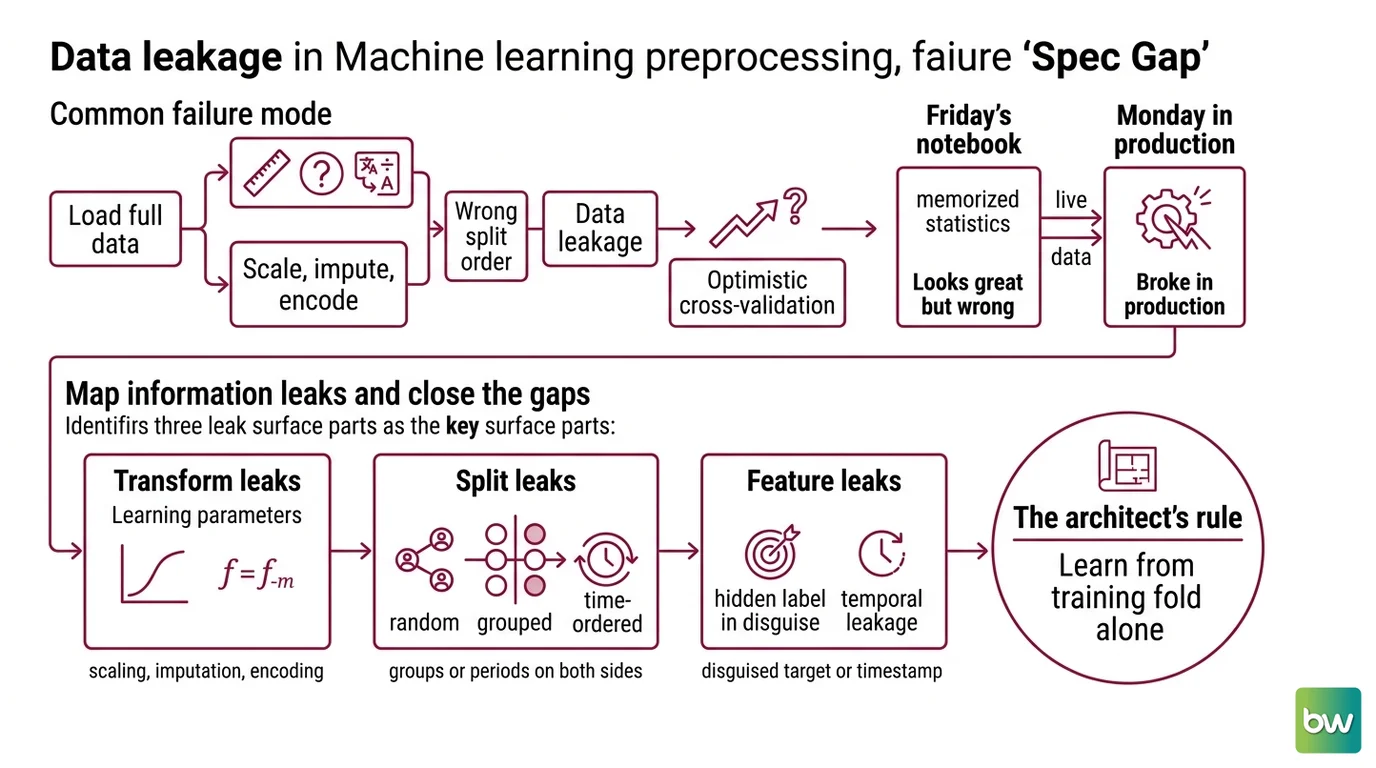
Here is the failure mode I see most. You load the data. You scale it, impute the missing values, encode the categories — all on the full dataframe. Then you split into train and test and run cross-validation. The scores look great.
They look great because they’re wrong. Your scaler already computed its mean and variance from rows that are supposed to be unseen. Your model got a quiet preview of the test set. That’s leakage, and it’s exactly how it produces overly optimistic cross-validation scores (scikit-learn Docs).
The leak isn’t in the model. It’s decided before training ever starts — in the order of your preprocessing steps.
It worked on Friday’s notebook. On Monday it broke in production, because the statistics it had quietly memorized weren’t in the live data.
Step 1: Map Where Information Crosses the Line
Before you specify anything, find every place information can move from where it shouldn’t be — from test into train, from the future into the past. There are three.
Your leak surface has three parts:
- The transforms — scaling, imputation, encoding. Each one learns parameters from data. If it learns them from anything outside the training fold, it leaks.
- The split — random, grouped, or time-ordered. A random split on repeated entities or time-series lets rows from the same group or period sit on both sides of the boundary.
- The features — the columns themselves. A column can encode the answer directly. This is Target Leakage: a feature that is really the target in disguise, often an ID, a post-outcome flag, or a leaked timestamp. When the leak is specifically about time order, it’s Temporal Leakage.
Name all three for your own dataset before you write a line of spec. Each one needs a different fix, and a single pipeline has to close all three.
The Architect’s Rule: If a step learns anything from your data, it must learn it from the training fold alone.
Step 2: Lock the Contract Before You Fit
Now write down what the AI must know before it generates anything. Skip this and the tool reaches for the most common pattern in its training data — which is the leaky one.
Context checklist:
- The target column, and the exact definition of prediction time: what is known when the prediction is made, and what is not
- Every transform that learns parameters lives inside a Pipeline — not run by hand on the dataframe first
- The split strategy: random for independent rows, grouped for repeated entities, time-ordered for anything where order matters
- The column-to-transform mapping: which columns get scaled, which get encoded, which get imputed
- The rule that overrides everything else: never fit on test data
That last one isn’t a style preference. Never call fit on the test data — that is the core rule, stated plainly in the scikit-learn Docs, and every transformer must learn its parameters from training data only.
The Spec Test: If your context doesn’t say “fit the transforms inside the Pipeline,” the AI will scale the full dataset first. It looks correct. It compiles. And it quietly reintroduces the exact leak you set out to prevent.
Step 3: Wire the Pipeline in the Right Order
Order matters here, because each guarantee depends on the one before it.
Build order:
- The split first — choose and lock the split strategy before any transform runs. Every downstream guarantee rests on a clean boundary between train and test.
- The Pipeline second — wrap every learning transform plus the estimator into one Pipeline object. Once they’re inside, fit only ever touches training data. This is the structural fix: the Pipeline makes the leak-free path the default path.
- ColumnTransformer inside the Pipeline — map each transform to its columns so numeric and categorical features get the right treatment in one leak-safe object (scikit-learn Docs).
- Cross-validation around the whole thing — hand the entire Pipeline to the cross-validation routine. That is what makes it run fit_transform on each fold’s training data and only transform on the validation fold (scikit-learn Docs). The boundary is now enforced automatically, fold after fold.
For each component, your context should still specify the basics: what it receives, what it returns, what it must never do (fit on test), and how it handles failure (missing columns, unexpected categories, empty folds).
The payoff is that fit only ever touches the training fold — not because you remembered to be careful, but because the structure takes that mistake off the table.
Step 4: Prove the Leak Is Gone with Deepchecks
A clean pipeline diagram is not proof. You verify in two layers.
The first layer is structural: with preprocessing inside the Pipeline, your cross-validation score should drop to something realistic. If it stays suspiciously high, the leak is still there.
The second layer is an explicit data audit. Deepchecks runs a train_test_validation suite built for exactly this — an independent check on the split your Pipeline produced.
Validation checklist:
- Cross-validation score settles at a believable level — failure looks like: scores stay near-perfect even after you move preprocessing into the Pipeline
- IndexTrainTestLeakage and TrainTestSamplesMix pass — failure looks like: the same rows appear in both train and test
- The date-leakage checks pass on time-series — failure looks like: training rows carry timestamps from the test period
- FeatureLabelCorrelationChange flags nothing — failure looks like: one feature scores an implausibly high Predictive Power Score against the label, the signature of target leakage
These checks are named explicitly so you can point the AI straight at them (Deepchecks Docs). One caution: the target-leakage check has been renamed more than once across versions — it used to be Single Feature Contribution — so verify the exact name against your installed checks gallery before you wire it into a gate.
One caveat on the tool itself: the open-source Deepchecks tabular library is stable and does this job well, but it is effectively in maintenance mode — pin your environment and don’t confuse it with the vendor’s separate paid product. Details in the note below.
Compatibility notes:
- Deepchecks is in maintenance mode: the open-source tabular library has shipped no release since 0.19.1 (December 2024), and the vendor’s active work moved to a separate paid LLM Evaluation product that does not cover tabular train-test contamination (deepchecks PyPI). The leakage checks still run — just don’t expect new ones.
- Mind the Python clash: Deepchecks 0.19.1 officially supports Python 3.6–3.10, while scikit-learn’s current release (1.9.0, June 2026) targets Python 3.11–3.14 (scikit-learn release notes). Pin Python and use a dedicated virtual environment, or expect dependency-resolver friction.
Common Pitfalls
| What You Did | Why AI Failed | The Fix |
|---|---|---|
| Scaled or encoded the full dataset before splitting | The transform learned from test data, so cross-validation scores inflate | Move every learning transform inside a Pipeline; fit per fold |
| Random split on grouped or time-ordered data | Rows from the same entity or period straddle train and test | Use grouped or time-ordered splits; confirm with the Deepchecks date checks |
| Left an ID or post-outcome column in the features | A feature encodes the target, so the model “predicts” by cheating | Drop the leak feature; let FeatureLabelCorrelationChange catch the rest |
| Trusted a clean cross-validation score as proof | A structural leak can still pass a happy-path run | Run the Deepchecks train_test_validation suite as a release gate |
Pro Tip
Treat every transform that calls fit as a privilege scoped to one thing: the training fold. The moment you can’t say which fold a parameter was learned from, you have a leak. Make where did this number come from the standing question in every model review, and most leaks die before they reach a dashboard.
Frequently Asked Questions
Q: How to prevent data leakage using scikit-learn pipelines? A: Wrap every transform that learns parameters — imputers, scalers, encoders — plus your estimator into a single Pipeline, then pass it to cross-validation. Each fold fits on training data only. Watch out: a manual fit_transform before the Pipeline silently reintroduces the leak you just removed.
Q: How to detect data leakage step by step in a machine learning project in 2026? A: Compare cross-validation against a held-out test score; a large gap signals a leak. Then run the Deepchecks train_test_validation suite to localize it. Watch out for grouped data — a near-perfect score on repeated entities is usually leakage masquerading as skill, not a strong model.
Q: How to use Deepchecks to catch train-test contamination? A: Run the train_test_validation suite on your split: IndexTrainTestLeakage and TrainTestSamplesMix flag shared rows, the date checks catch time overlap, and FeatureLabelCorrelationChange flags target leakage via Predictive Power Score. Note it was renamed across versions, so verify the name against your installed checks gallery.
Your Spec Artifact
By the end of this guide, you should have:
- A leak-surface map — the transforms, the split strategy, and the columns that could carry target or temporal information
- A leak-free contract — every learning transform inside a Pipeline, the chosen split strategy, and the never-fit-on-test rule written down
- A validation gate — the cross-validation comparison plus the Deepchecks checks that must pass before the model ships
Your Implementation Prompt
Paste this into your AI coding tool (Claude Code, Cursor, or Codex), pointed at your project. Fill every bracket first — they map one-to-one to the contract from Step 2. The tool generates the code; the spec keeps it leak-free.
You are building a leak-free preprocessing and validation workflow with scikit-learn and Deepchecks.

Context:
- Target column: [target column name]
- Definition of "prediction time": [what information exists when a prediction is made, and what does not]
- Numeric columns: [list]
- Categorical columns: [list]
- Known leak risks: [ID columns, post-outcome fields, timestamps, repeated entities]
- Split strategy: [random | grouped by GROUP_COLUMN | time-ordered by DATE_COLUMN]

Build, in this order:
1. Choose and lock the split strategy above before any transform runs.
2. Put every transform that learns parameters (imputation, scaling, encoding) inside a scikit-learn Pipeline, mapped per column with ColumnTransformer. Never fit any transform on test data.
3. Wrap the full Pipeline (transforms + estimator) and evaluate it with cross-validation, so fit happens per fold on training data only.
4. Validate with the Deepchecks train_test_validation suite: IndexTrainTestLeakage, TrainTestSamplesMix, the date-leakage checks, and FeatureLabelCorrelationChange for target leakage. Verify each check name against the installed Deepchecks version.

Constraints:
- Do not fit_transform on the full dataset before splitting.
- Do not leave [ID or post-outcome columns] in the feature matrix.
- Pin Python and dependencies in a virtual environment: [Python version compatible with both libraries].

Output: the pipeline specification and the list of validation checks that must pass before deployment — not just code.
Ship It
You now see preprocessing as a contract scoped to the training fold, not a step you run once on a dataframe. Decompose the leak surface, specify the boundary, let the Pipeline enforce it, and let Deepchecks prove it. Do that and the gap between your validation score and production reality closes — on this model and the next one.
AI-assisted content, human-reviewed. Images AI-generated. Editorial Standards · Our Editors