How to Choose and Integrate a Generative Media API for Production Apps in 2026
TL;DR
- Billing models differ structurally, not just in price — fal.ai charges flat per-generation rates, Replicate splits between hardware-per-second and per-output, Stability runs a prepaid credit ledger. Match the model to your traffic shape before you compare sticker prices.
- Webhook delivery is at-least-once, never exactly-once. fal.ai retries a failed delivery up to 10 times over a 2-hour window — build idempotency on the request identifier or you’ll process duplicates.
- A single-provider integration is one outage away from total downtime. Specify the fallback chain before you ship, not after the first 5xx storm.
Demo day: a Fal AI job finishes, the Webhook fires, the gallery updates, everyone claps. Three weeks later your support queue fills with duplicate renders charged to the same customer, and the on-call engineer is staring at a handler that never expected the same request to arrive twice. The model didn’t misbehave. The integration assumed delivery happens exactly once. It doesn’t.
Before You Start
You’ll need:
- An AI coding tool — Claude Code, Cursor, or Codex — to scaffold the integration
- A working understanding of Generative Media APIs: async queues, billing-per-render, provider-specific failure modes
- A clear picture of which generation type you’re shipping — image, video, or audio — since that narrows which providers are in scope
This guide teaches you: How to decompose a generative media integration into provider-agnostic layers, so adding a provider is a config change, not a rewrite.
The Webhook That Fired Twice
Most generative media integrations start the same way: pick a provider, copy the quickstart, ship the happy path. The quickstart never mentions that delivery is at-least-once, never exactly-once — or that a 500 from the model host isn’t the same failure as a 429 from the gateway. Building the fallback chain after the first outage is like buying a fire extinguisher after the kitchen’s already on fire.
It worked on Friday. On Monday, a fal.ai job timed out mid-delivery, the webhook retried, and the handler — which assumed each request arrives exactly once — generated the same render twice and billed the customer for both.
Step 1: Map the Three Layers of a Media Generation Request
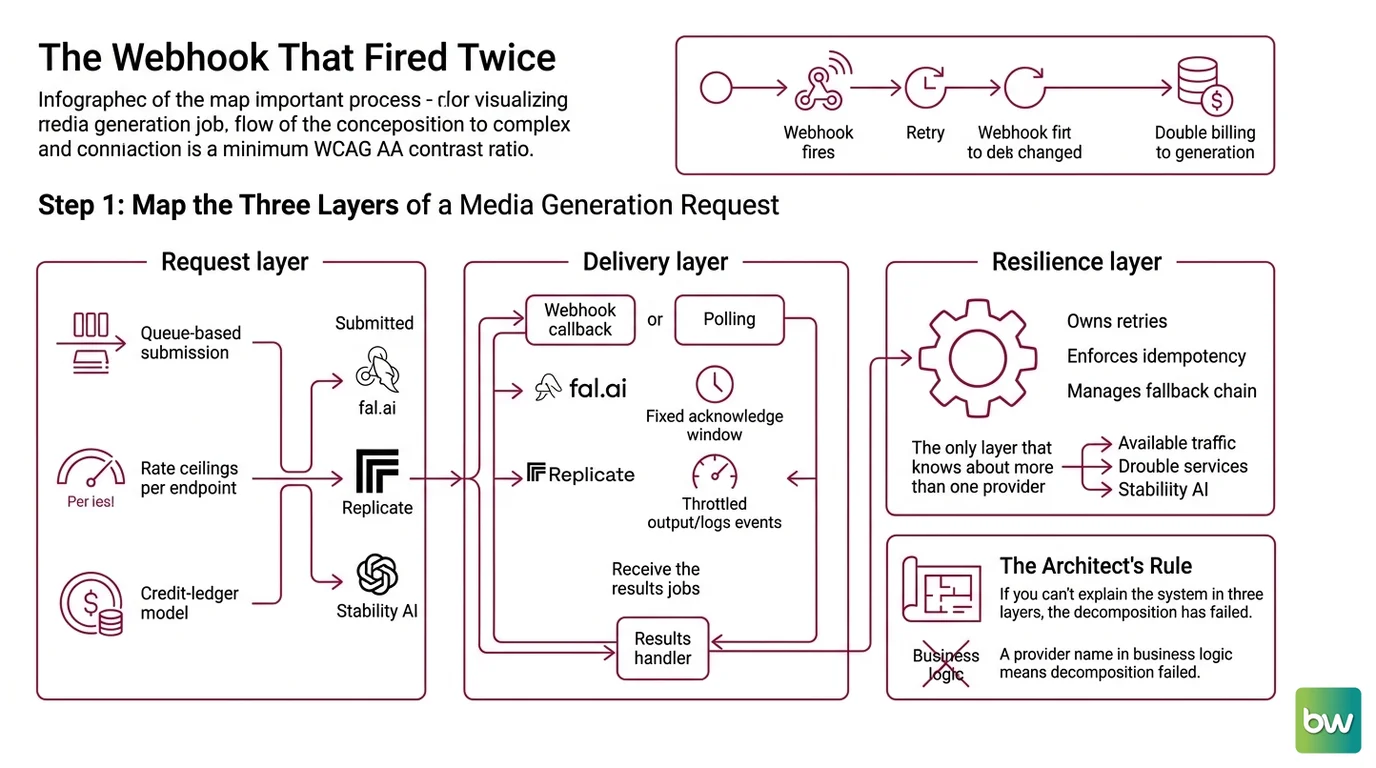
Every generative media integration has three layers, whether your code admits it or not: a request layer, a delivery layer, and a resilience layer that decides what happens when either breaks. Treat them as one blob and the AI tool you’re directing tangles provider quirks into your business logic — then breaks every time you add a second provider.
Your system has these parts:
- Request layer — submits the job. fal.ai uses queue-based submission with no published queue-size limit; Replicate exposes a predictions API with separate rate ceilings per endpoint; the Stability API runs on a credit-ledger model that debits a fixed amount before a call even queues.
- Delivery layer — receives the result via webhook or polling. Timing differs: fal.ai’s webhook gives your handler a fixed acknowledge window before a delivery is marked failed; Replicate throttles
output/logsevents to once per 500ms but always sendsstartandcompleteduntouched. - Resilience layer — owns retries, idempotency, and fallback. This is the only layer allowed to know about more than one provider. A provider name in your business logic means the decomposition failed.
The Architect’s Rule: If you can’t explain the system in three layers, the AI can’t build it either.
Step 2: Lock Down Each Provider’s Contract
Each provider needs a filled-in contract before any code gets written — not “check the pricing page later.” Skip this and the AI you’re directing guesses at billing, rate limits, and failure handling, wrong in the direction of “looks correct in the demo.”
Context checklist:
- Billing unit specified per provider — fal.ai charges flat per-generation (FLUX Schnell ~$0.025/image, FLUX Pro ~$0.05), with GPU-time billing outside that path. Replicate mixes hardware-per-second (A100 80GB at $0.0014/sec) and flat per-output (FLUX Dev $0.025/image), per Replicate’s pricing page. Stability runs a prepaid credit ledger — 1 credit equals $0.01, Stable Image Core costs 3 credits, Ultra costs 8.
- fal.ai never bills for a failed generation — HTTP 500+ responses and queue wait aren’t charged, per fal Docs. Replicate and Stability don’t document the same guarantee; build your cost ceiling on worst-case billing for those two.
- Rate Limiting ceiling specified per endpoint — Replicate publishes exact numbers: 600/min to create a prediction, 3,000/min for other endpoints, 1/sec on throttled accounts with no payment method on file. fal.ai’s ceiling isn’t published; it varies by account tier in your dashboard. Don’t hardcode a guess.
- Webhook guarantee specified — fal.ai’s failed deliveries retry up to 10 times over 2 hours, per fal Docs. Your handler needs to survive that many repeat calls.
- Idempotency key chosen — fal.ai exposes a
request_idfor this. Pick the equivalent field per provider and dedupe before anything else touches the payload.
Pricing note: Prices shown are indicative. Always check the provider’s current pricing before including cost constraints in your specifications.
The Spec Test: If your context doesn’t specify that fal.ai never charges for HTTP 500+ responses, the AI will write a cost-tracking layer that bills the customer for retries that generated nothing.
Security & compatibility notes:
- Stability Stable Video / SD 1.6 retirement: Discontinued July 24, 2025; pricing changed August 1, 2025. Migrate to Stable Image Core, Ultra, or SD 3.5.
- fal.ai parameter rename: Snake_case params (
image_url,guidance_scale) are deprecated for camelCase (imageUrl,guidanceScale). Old names still work but are slated for removal.- Replicate ownership change: Acquired by Cloudflare (announced Nov 17, 2025, deal closing late 2025/early 2026); brand and API unchanged, per Cloudflare. Worth a line in vendor-risk reviews.
Step 3: Wire the Resilience Layer Before the Happy Path
The resilience layer is the piece every other layer depends on — and the piece most teams build last, after the demo shipped without it. Within it, idempotency has to exist before anything else does.
Build order:
- Idempotency check first — every consumer needs to trust it’s seeing a result exactly once, even though the provider only promises at-least-once delivery. Dedupe on the provider’s own identifier (fal.ai calls it
request_id). - Request and delivery layer second — it depends on the idempotency check existing as a gate.
- The Multi Provider Abstraction last — routing only makes sense once one provider’s path is solid. Build it over the first, then add the second.
For each component, your context must specify:
- What it receives (inputs)
- What it returns (outputs)
- What it must NOT do (constraints)
- How to handle failure (error cases)
Wrap each provider client in a Circuit Breaker so one outage doesn’t back up your own queue while it keeps retrying a host that’s already down. Replicate’s own webhook deliveries already retry on Exponential Backoff, final attempt landing roughly a minute after completion, per Replicate Docs — mirror that shape client-side instead of hammering a struggling endpoint at a fixed interval.
Step 4: Prove the Fallback Survives a Real Outage
Validation here isn’t “did a render come back.” It’s “did the system behave correctly when a provider didn’t.” Most teams test the first case and ship.
Validation checklist:
- Idempotency holds — failure looks like: the same request processed twice, duplicate output or billing.
- Webhook timing respected — failure looks like: your handler acknowledges slower than the delivery window, so a successful delivery gets retried as failed.
- Backoff actually backs off — failure looks like: a 429 burst triggers immediate retries, tripping the same limit again within seconds.
- Fallback actually fires — failure looks like: a primary 5xx surfaces as a user-facing error instead of routing to the secondary. An untested fallback is not a fallback.
- Cost ceiling holds under retry — failure looks like: a retry storm against a provider that bills partial work pushes spend past estimate.
Common Pitfalls
| What You Did | Why AI Failed | The Fix |
|---|---|---|
| Wired one provider directly into the app | No fallback path when that provider has an outage or rate-limit spike | Build the multi-provider abstraction before you need it |
| Treated webhook delivery as exactly-once | A retried delivery produced duplicate output or billing | Dedupe on the provider’s request identifier first |
| Assumed every provider bills the same way | Cost model mixed per-second, per-output, and credit units | Specify the exact billing unit per provider up front |
| Hardcoded a guessed rate-limit ceiling | fal.ai’s limits vary by account tier, unpublished | Read the limit from your dashboard, don’t assume |
Pro Tip
Every provider’s documentation describes two products: what success costs, and what failure costs. The pricing page only answers half the question. The webhook and rate-limit docs answer the other half — the number that decides whether your fallback architecture was worth building.
Frequently Asked Questions
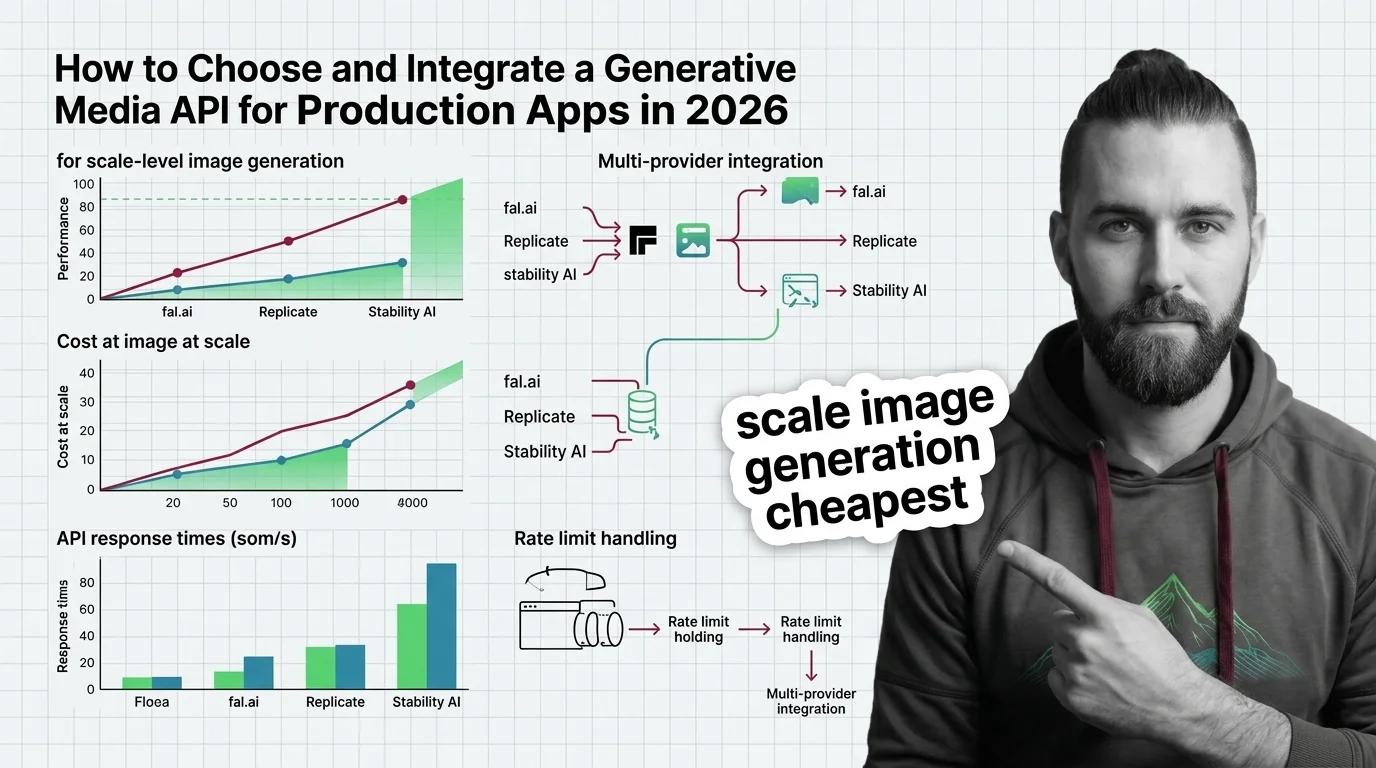
Q: Which generative media API is cheapest for image generation at scale in 2026? A: fal.ai’s FLUX Schnell and Replicate’s FLUX Dev both run about $0.025/image; Stability’s Stable Image Core costs roughly $0.03. The detail that matters at scale: fal.ai never charges for HTTP 500+ responses or queue wait, so cost per success drops once retries enter the picture.
Q: How to choose between fal.ai, Replicate, and Stability API for a video generation app? A: Narrow the field to fal.ai and Replicate — Stability discontinued its Stable Video API in mid-2025, so it’s off the table for new video work. fal.ai favors low-latency, queue-based jobs; Replicate’s broader marketplace gives more model choices under mixed hardware-second and per-output billing. Match the pick to latency control versus model breadth.
Q: How to handle rate limits and timeouts when calling generative media APIs in production? A: Replicate publishes exact ceilings — 600/min to create a prediction, 3,000/min for other endpoints, 429 past that. fal.ai’s ceilings aren’t published; check your dashboard instead of hardcoding a number. Treat a 429 as a backoff signal, never a retry-immediately signal.
Q: How to build a multi-provider abstraction layer that falls back between generative media APIs? A: Define one internal interface — submit, receive, normalize-result — implemented once per provider, with no provider branching in business code. Route failures (timeouts, 5xx, exhausted limits) to a secondary provider through that interface, deduping on your own key since each provider’s identifier format differs.
Your Spec Artifact
By the end of this guide, you should have:
- A three-layer pipeline map — request, delivery, resilience — with provider quirks isolated to the first two layers
- A filled-in provider contract checklist — billing unit, rate-limit ceiling, webhook guarantees, idempotency key
- A validation checklist proving the fallback chain fires under a real provider failure, not just the happy path
Your Implementation Prompt
Drop this into Claude Code, Cursor, or Codex once you’ve filled in your provider list. It mirrors the decomposition above — fill in the brackets before you run it.
You are scaffolding a multi-provider generative media integration. Build it in this order.

## Step 1 — Layers
Request layer providers: [fal.ai | Replicate | Stability API | other], submission style: [queue | sync | poll]
Delivery layer: [webhook | polling], delivery guarantee: [timeout window, retry count]
Resilience layer: owns idempotency, retry, fallback — no provider-specific logic outside it

## Step 2 — Contract per provider
Billing unit: [per-generation | per-second hardware | credit ledger], cost ceiling: [USD or credits]
Rate limits: [published ceiling per endpoint, or "unpublished — read from dashboard"]
Webhook guarantees: [delivery timeout, retry count/window, ordering guarantee or none]
Idempotency key: [provider's request identifier field name]
Failure classification: [billable vs free codes; which trigger fallback vs retry]

## Step 3 — Build order
1. Idempotency check — dedupe gate every result passes through first.
2. Request + delivery layer per provider — built against that gate's interface.
3. Multi-provider fallback layer — routes failures (timeout, 5xx, exhausted limit) to a secondary provider through one shared interface.
Specify per component: inputs, outputs, forbidden actions, failure handling (retry, fail over, fail fast).

## Step 4 — Validation
Fail loud on: idempotency (no duplicate output/billing), webhook timing (ack inside the delivery window), backoff (429 triggers growing delay, not instant retry), fallback trigger (primary 5xx routes to secondary), cost ceiling (retry storm stays under budget).

Output: working integration + validation harness, no provider-specific logic outside the resilience layer.
Ship It
You now have a decomposition, not a tutorial. The provider is a swappable detail behind layer three, not a hardcoded assumption in layer one. Your resilience layer was specified before the first outage, not patched together during it — the difference between a fallback chain and a single point of failure with extra steps.
AI-assisted content, human-reviewed. Images AI-generated. Editorial Standards · Our Editors