How to Build a Tree of Thoughts Pipeline with LangChain and the ToT Library in 2026
TL;DR
- Tree of Thoughts is a search algorithm built on top of LLM reasoning — spec the four components first, then pick your library
- Both major libraries (langchain-experimental and princeton-nlp/tree-of-thought-llm) are archived or unmaintained as of 2026; LangGraph + LATS is the current path
- ToT only earns its massive compute overhead when your problem has evaluable intermediate states — skip it if you can’t score partial solutions
You found a 2023 tutorial. langchain-experimental.experimental.tot, it says — install the package, run the example. The repo was archived in May 2026. The Princeton library is your next stop: v0.1.0, last commit January 2025, OpenAI-only. Two paths. Both dead or dying. This guide maps what’s actually working.
Before You Start
You’ll need:
- An AI coding tool: Claude Code, Cursor, or Codex
- Working knowledge of LangChain or LangGraph — you’ll write graph nodes, not install a black-box ToT library
- Familiarity with Tree of Thoughts search mechanics: thought generation, state evaluation, search control
- Clear understanding of Backtracking logic for pruning dead branches
This guide teaches you: How to decompose a ToT pipeline into four specifiable components so your AI coding tool builds the correct architecture instead of hallucinating one.
The Two Repos That Everyone Googles and Neither Works
On the Game of 24 benchmark, GPT-4 with a single chain-of-thought prompt solved roughly 4% of problems. With Tree of Thoughts, the same model hit approximately 74% (arXiv 2305.10601). That result made ToT famous. It also spawned a generation of tutorials pointing at two libraries — both of which are now a liability.
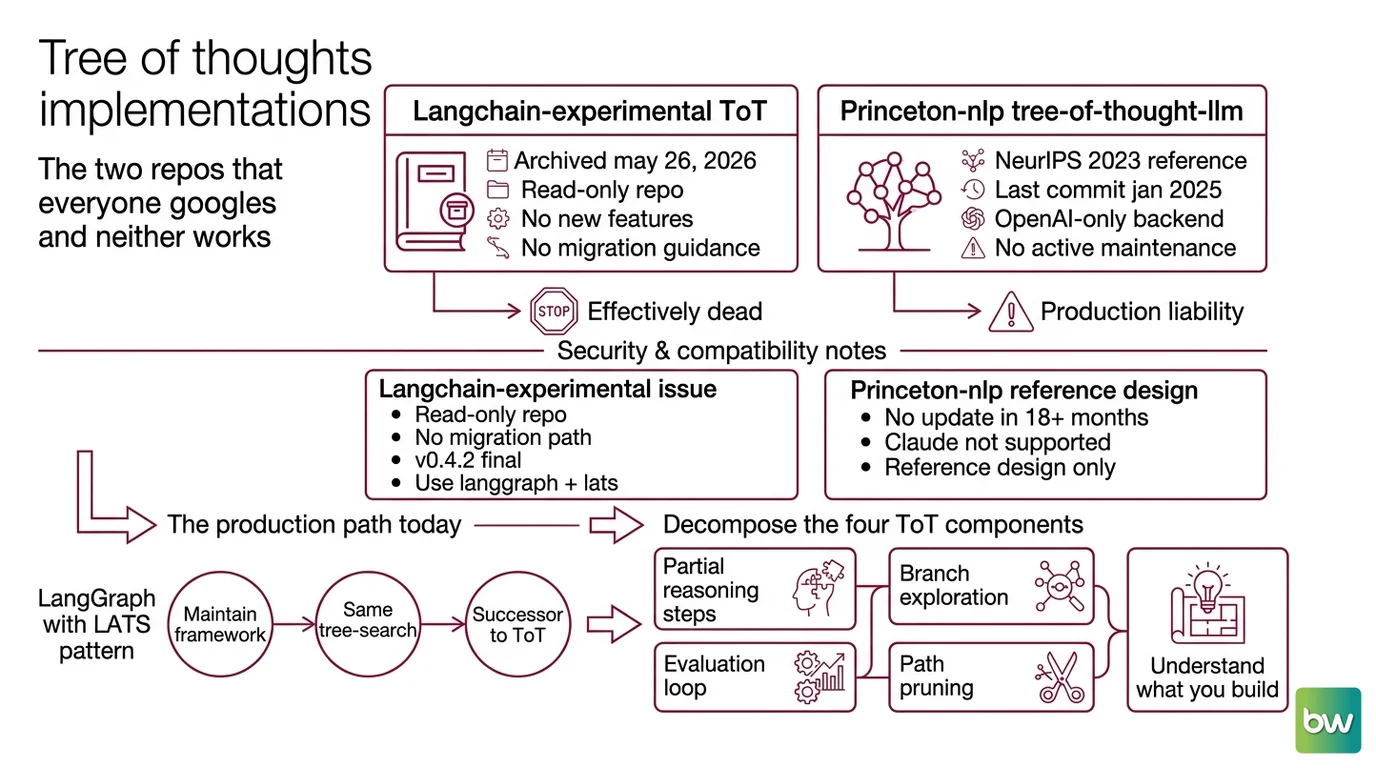
langchain-experimental contained the ToT module most tutorials reference. The package was archived on May 26, 2026 — read-only, no new features, no migration guidance for the ToT component specifically (LangChain GitHub issue #87). Both major implementation paths are now effectively dead.
princeton-nlp/tree-of-thought-llm is the original NeurIPS 2023 reference implementation. Version v0.1.0, shipped July 2023. Last meaningful commit: January 2025, adding GPT-4o support. No Claude backend. No active maintenance signal (Princeton GitHub).
Security & compatibility notes:
- langchain-experimental ToT module: Archived May 26, 2026 (v0.4.2 final). Read-only repository — no migration path exists for the ToT component. Fix: Use LangGraph + LATS or a custom evaluator loop.
- princeton-nlp/tree-of-thought-llm (v0.1.0): Last commit January 2025, 18+ months without update. OpenAI-only backend — Claude is not officially supported. Treat as a reference design, not a production dependency.
The production path today is LangGraph with the LATS (Language Agent Tree Search) pattern — the successor to raw ToT, presented at ICML 2024 (arXiv 2310.04406). Same tree-search mechanics, maintained framework underneath.
That means you need to understand what you’re building before you reach for a library. Here’s the decomposition.
Step 1: Decompose the Four ToT Components
Tree of Thoughts is a search algorithm. It explores a tree of partial reasoning steps, evaluates each branch, and prunes dead paths. Four distinct components drive this. Get them confused and your implementation will compound errors instead of finding solutions.
Your ToT system has these parts:
- Thought generator — produces N candidate next steps from the current state. One LLM call per node. Controls branching width. No scoring happens here.
- State evaluator — scores or classifies each candidate thought against your criterion. Binary pass/fail or a numeric score. This is the critical component: a vague evaluator degrades the whole search into noise.
- Search controller — decides which nodes to expand next. BFS expands all nodes at one depth before going deeper. DFS commits to one branch before backtracking. Beam search keeps only top-K nodes at each depth.
- Backtrack handler — fires when a branch score falls below threshold. Pops back to the last viable node. Pure logic — no LLM call required.
The Architect’s Rule: If you can’t describe your evaluator’s scoring criterion in one sentence, your AI coding tool can’t implement it. Write the criterion before you write any prompts.
The evaluator is the whole game. A vague scoring rubric collapses the search into randomness — your branching factor and search strategy become irrelevant if the judge at each node can’t distinguish good paths from bad ones.
Think of the evaluator like a CI test suite running at every commit, not just at the end of a sprint. The suite doesn’t write the code — it tells you which branch is safe to build on next. Same principle here. Different runtime.
Step 2: Lock Down the Search Contract
Before your coding tool generates a single node, these six constraints need to be in your context file. Miss any one and you’ll hit a failure mode that looks like model error but is actually empty specification.
Context checklist:
- Search strategy: BFS, DFS, or beam — pick one and state why it fits your task
- Branching factor: how many thoughts to generate per node — keep it small, because each branch multiplies your inference calls
- Evaluation criterion: the exact question your evaluator asks about each thought (“Is this arithmetic step mathematically valid?” / “Does this plan violate the stated constraints?”)
- Depth limit: maximum tree depth before forced termination
- Compute budget: total LLM calls allowed — ToT runs approximately 100× more inference than a single chain-of-thought call (arXiv 2305.10601); set a hard ceiling before you start
- Output contract: what the final answer looks like — the winning leaf node, or the complete path from root to leaf
Write the evaluation criterion first.
The Spec Test: If your context file doesn’t specify the evaluation criterion, your coding tool will hallucinate one. The hallucinated version will be vague (“Is this a good step?”) and your search tree will expand randomly. Name the criterion before anything else.
Step 3: Wire the Components with LangGraph
LangGraph models your ToT as a directed graph with conditional edges. Build in this order — each component depends on the interface defined before it.
Build order:
State schema first — define the data structure that flows between nodes:
current_best,frontier,depth,calls_used,best_path. If you’re using Pydantic AI, define this as a Pydantic BaseModel — type validation at every node transition catches format mismatches before they cascade into wrong search results.Thought generator node — takes the current best thought, returns N candidate next thoughts. Input: one thought string. Output: list of N strings. No scoring logic here.
Evaluator node — scores each candidate thought against your criterion. This is explicit Prompt Chaining: the generator’s output is the evaluator’s input. Input: list of N thoughts. Output: list of (thought, score) pairs. Spec the format contract between these two nodes explicitly — mismatched types between generator and evaluator is the most common source of silent failure in ToT implementations.
Search controller edge — a conditional edge function that reads scored thoughts and decides the next expansion target. This is Python logic, not an LLM call. Write it as an explicit function with your pruning rule stated in code.
Termination condition — checked after every expansion. Fires when depth limit is reached, budget is exhausted, or a thought scores above your success threshold.
This architecture is structurally different from ReAct Prompting, which interleaves reasoning and action in a single sequential loop. ToT generates and evaluates candidates in parallel before committing to a branch. The spec for each is different — don’t conflate them when briefing your coding tool.
Step 4: Validate the Reasoning Tree Output
Running the tree and checking the final answer is not enough. These four checks catch the failure modes that functional testing misses entirely.
Validation checklist:
- Branch pruning fires — failure looks like: pruned branches reappear in later expansions. Confirm your search controller excludes low-scored nodes from the frontier, not just marks them with a low-score flag.
- Depth counter increments correctly — failure looks like: infinite expansion at depth 1. Confirm the counter updates after each expansion cycle, not after each individual node evaluation.
- Termination triggers on budget — failure looks like: the tree runs past your call limit. Confirm the termination condition fires when
calls_used >= budget, not only when the success threshold is cleared. - Final answer traces the correct path — failure looks like: the output doesn’t match the highest-scored leaf. Confirm your output extractor follows
best_pathfrom root to leaf, not just the highest single-node score in isolation.
Common Pitfalls
| What You Did | Why AI Failed | The Fix |
|---|---|---|
| Used langchain-experimental ToT module | Package archived May 2026, read-only, no maintenance path | Switch to LangGraph + LATS pattern |
| Used Princeton library with Claude | Claude not in documented backends — OpenAI-only | Use OpenAI backend or implement your own evaluator loop |
| No evaluation criterion in context | AI hallucinated a vague scoring rubric | Write the exact evaluator question before any prompting |
| No branching factor specified | AI generated 15+ thoughts per node, blew context budget | Set max_branches as explicit constraint in Step 2 |
| Applied ToT to open-ended creative writing | No verifiable intermediate states — evaluator had nothing to check | Use chain-of-thought for non-verifiable generation tasks |
Pro Tip
The hardest part of ToT isn’t the search architecture — it’s writing an evaluator that can actually tell good partial states from bad ones. Before you build anything, test your evaluation criterion on a set of hand-crafted examples: some clearly correct, some clearly wrong, a few borderline cases. Apply your criterion by hand and check whether it reliably distinguishes them. If you can’t do it by hand, your LLM evaluator can’t do it at inference time either. The tree is only as good as the judge at each node. Get the judge right first.
Frequently Asked Questions
Q: How do I implement Tree of Thoughts using the LangChain experimental ToT module?
A: You can’t — not for new projects. langchain-experimental was archived on May 26, 2026, making the ToT module read-only and unsupported (langchain-experimental GitHub). The replacement is LangGraph with the LATS pattern. If you’re maintaining an existing system built on langchain-experimental, pin to v0.4.2 and plan migration before upstream LangChain API changes break the archived package silently.
Q: How do I use the Princeton tree-of-thought-llm library with GPT-4o or Claude in 2026?
A: The Princeton library (pip install tree-of-thoughts-llm) works with its OpenAI backend — use GPT-5.5, the current OpenAI model, not GPT-4o, which is no longer the flagship (scriptbyai.com timeline). Claude is not officially documented as a supported backend (Princeton GitHub). For Claude, implement your own evaluator loop using the four-component spec from this guide and call the Claude API directly.
Q: When should I use Tree of Thoughts instead of chain-of-thought or Self Consistency prompting?
A: Use ToT when your problem has verifiable intermediate states — math proofs, logic puzzles, constrained planning. Self Consistency is cheaper and sufficient when you need the most frequent answer across parallel runs. Plain prompt-chaining works for tasks with a fixed, linear decomposition. ToT earns its compute cost only when the tree structure helps you avoid whole families of wrong answers early in the reasoning process.
Q: What reasoning tasks benefit most from explicit Tree of Thoughts scaffolding in 2026?
A: Tasks with hard constraints and verifiable partial steps — formal proofs, code debugging with testable feedback, constraint satisfaction, multi-step planning where a wrong early branch wastes significant downstream compute. The original paper used Game of 24, constrained creative writing, and mini crosswords as benchmarks (Princeton GitHub). Open-ended generation is the wrong fit — without a checkable criterion at each node, the tree adds inference overhead without improving quality.
Your Spec Artifact
By the end of this guide, you should have:
- Component map: four labeled components (thought generator, evaluator, search controller, backtrack handler) with explicit input/output types and responsibilities
- Search contract: branching factor, depth limit, compute budget, termination conditions, and your evaluation criterion written in one precise sentence
- Validation checklist: four failure modes with specific symptoms to check after your coding tool generates the implementation
Your Implementation Prompt
Paste this into Claude Code, Cursor, or Codex. Fill in every bracketed value using your Step 2 checklist before running. The prompt mirrors the four-component spec from Steps 1–4 — your coding tool needs all of it.
Build a Tree of Thoughts pipeline using LangGraph with the following spec:

PROBLEM: [one sentence describing the decision or reasoning task]
TASK TYPE: [constrained planning / symbolic reasoning / formal proof / other verifiable task with intermediate states]

COMPONENT SPEC:
- Thought generator: given current_state, generate [your branching factor] candidate next thoughts as a list of strings. One LLM call. No scoring.
- State evaluator: given a single candidate thought plus full context, return a score on [your scoring scale] and a one-sentence justification. Evaluation criterion: [your exact evaluator question — one sentence].
- Search strategy: [BFS / DFS / beam with K=[your K]]. Only expand nodes with score above [your pruning threshold].
- Termination: stop when depth > [your max depth] OR total LLM calls > [your call budget] OR any thought scores above [your success threshold].

STATE SCHEMA (Pydantic BaseModel): {current_best: str, frontier: list[tuple[str, float]], depth: int, calls_used: int, best_path: list[str]}

OUTPUT CONTRACT: Return best_path as a list of thoughts from root to the highest-scoring leaf, plus the leaf's final score.

VALIDATION REQUIREMENT: After generating, confirm that (1) pruned branches are absent from frontier after each expansion cycle, (2) depth counter increments once per cycle not once per node, (3) termination fires when calls_used >= budget.
Ship It
You now have a spec-first framework for Tree of Thoughts: four components, a search contract, and a validation checklist. The libraries changed. The architecture didn’t. The same decomposition — thought generator, evaluator, search controller, termination condition — applies to LATS, Monte Carlo search, and any beam-search variant you build next. What transfers is the habit of specifying the evaluator before anything else.
AI-assisted content, human-reviewed. Images AI-generated. Editorial Standards · Our Editors